Induction Heating Machine
ProductOverview
Induction heating is a non-contact, highly efficient, and fast method for heating conductive materials using electromagnetic energy. The RF Power Supply generates alternating current at RF frequencies (typically 20–500 kHz), which flows through a custom-shaped Induction Coil Assembly positioned near or around the workpiece. The changing magnetic field induces eddy currents in the conductive part, which dissipate as Joule heat. This self-heating approach achieves rapid temperature rise with no hot furnace or heating elements, only the workpiece gets hot.
Induction heating is the dominant technology for surface hardening (steel gears, shafts, tools), hardening and tempering, annealing, brazing, and soldering. It is also used for forming and bending metals, forging preheating, and pipe welds. The process is fast (seconds to minutes), precise, and energy-efficient compared to furnace heating.
Power supply and inverter
The RF Power Supply converts three-phase mains power into high-frequency AC. The circuit chain is: 3-phase Input Transformer steps down to a rectifier-friendly voltage, the Rectifier Stage diodes convert to DC (~600 VDC), and the IGBT Inverter generates RF by rapidly switching the DC voltage at the desired frequency (20–500 kHz). The Output Filter L-C network attenuates harmonics and tunes the coil impedance for maximum power transfer.
A Soft Start Module module limits inrush current when power is applied, protecting the mains supply and extending transformer life.
Induction coil
The Induction Coil Assembly is a custom-wound hollow Coil Conductor made of 4–10 mm copper tubing, wound around a ceramic Coil Former shaped to match the workpiece. For a cylindrical workpiece (like a gear), the coil is a solenoid surrounding the part. For flat stock or edges, the coil is planar. The copper tube is water-cooled throughout the heating cycle (the RF current generates significant heat in the coil itself).
The coil Coil Connection bussing carries RF current, typically 100–500 A, at voltages of a few hundred volts. A Coil Shield of copper mesh surrounds the active coil region, containing eddy currents and preventing stray RF fields from reaching nearby equipment and personnel.
Frequency and matching
Induction heating operates at a frequency chosen based on skin depth and coil efficiency. Lower frequency (20–50 kHz) heats deeper and is used for large, thick parts; higher frequency (100–500 kHz) provides shallow, localized heating for small parts and surfaces. The Frequency Tuning Network network (a variable capacitor or automatic matching circuit) adjusts the coil-and-load impedance so the inverter can deliver maximum power with minimal reactive current.
Cooling system
The Cooling System is critical: both the induction coil and the RF power supply generate heat. A Coolant Pump circulates deionized water (to prevent electrical conductivity issues) through the hollow Coil Conductor and through the power supply's IGBT heatsinks and transformer. A Chiller or Heat Exchanger maintains coolant at 20–30 °C. A Flow Switch interlock stops RF output if water flow drops below a safe level, preventing coil burnout.
Workpiece heating
The induced current flowing through the conductive workpiece generates Joule heat (I²R loss). The heating rate depends on:
- Part resistivity (lower resistance = more current = more heat)
- Part mass (larger mass takes longer to heat)
- Frequency (higher frequency = shallower heating depth, more surface-concentrated)
- Power output and coil coupling (how tightly the coil wraps the part)
Typical heating rates are 10–100 °C/second. A steel gear shaft can be hardened (heated to 800 °C) in 10–20 seconds; large aluminum billets might require 2–5 minutes.
Hardening and quenching
The most common application is hardness: steel is rapidly heated to the hardening temperature (700–900 °C depending on steel grade) and immediately quenched with water or oil spray. The shallow, localized heating from induction means only the surface becomes hardened while the core remains tough, creating a wear-resistant shell, ideal for gears, bearings, and tool-steel surfaces.
Control and monitoring
The Control & Monitoring manages power output and process timing. A Temperature Sensor (infrared pyrometer or embedded thermocouple) measures the workpiece temperature and feeds back to the PLC Controller. The Power Regulator adjusts the IGBT gate-drive signal to modulate RF power (typically 0–100% via PWM or phase control), holding the part at the target temperature.
The Operator Panel allows the operator to enter a heating profile: temperature setpoint, heating time, power ramp rate, and hold dwell. The PLC executes the profile and logs the process data for quality records.
Safety and EMC
Induction heating systems generate strong electromagnetic fields and RF radiation. The Electrical Cabinet & Enclosure encloses the RF power supply in a Faraday cage RF Shielding to prevent electromagnetic interference with nearby equipment and to protect personnel from RF exposure (a hazard above ~0.2 mW/cm²). Safety Interlock cut RF output if cabinet or coil covers are opened. An E-Stop Button button allows immediate shutdown.
Advantages
Induction heating is far more efficient than furnace heating: 70–90% of input power goes into the workpiece (vs. 40–60% for a resistance furnace where much heat escapes to surroundings). It is precise and controllable, with heating rates that allow rapid, reproducible processes. It is also clean, no combustion, no oxidation (if done in air), no contamination.
Downsides are high capital cost for custom coil design and the need for conductive materials; non-conductors (ceramics, glass) cannot be inductively heated.
Induction Heating Machine parts and their functions
6 top-level parts · 29 parts in total · full bill of materials below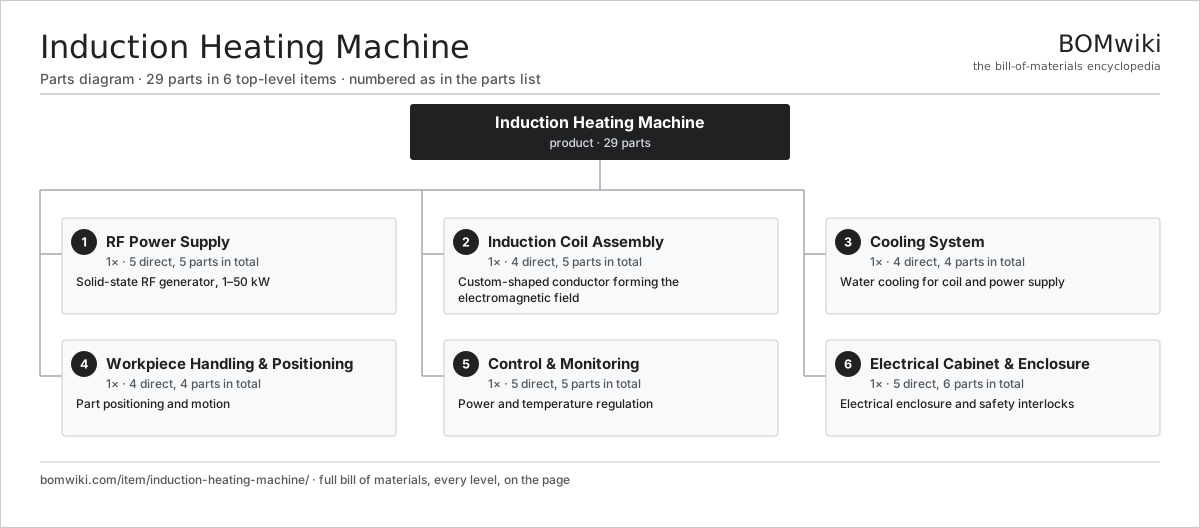
| # | Part | Qty | What it does |
|---|---|---|---|
| 1 | RF Power Supply 5 parts | 1× | Solid-state RF generator, 1–50 kW |
| 2 | Induction Coil Assembly 4 parts | 1× | Custom-shaped conductor forming the electromagnetic field |
| 3 | Cooling System 4 parts | 1× | Water cooling for coil and power supply |
| 4 | Workpiece Handling & Positioning 4 parts | 1× | Part positioning and motion |
| 5 | Control & Monitoring 5 parts | 1× | Power and temperature regulation |
| 6 | Electrical Cabinet & Enclosure 5 parts | 1× | Electrical enclosure and safety interlocks |
3D model
No 3D model yet. Have a CAD file of this? Add a 3D model. STL renders right on this page; STEP, FreeCAD, and OpenSCAD sources are welcome too (openly licensed, like all 3D models on BOMwiki).
Build & assembly graph
expand / collapse · shared sub-assemblies converge · links to related products · est. labourTap an assembly to expand/collapse · tap a part to open it · use “Open page” for any node · drag to pan, scroll to zoom.
Bill of materials for Induction Heating Machine
6 top-level lines · 33 rows shown · 29 parts total · indented to 3 levels| # | Item / sub-assembly | Part no. | Qty/assy | Ext. qty | Parts | Type |
|---|---|---|---|---|---|---|
| 1 | RF Power Supply 5 parts | induction-heating-machine-rf-power-supply | 1× | 1 | 5 | assembly |
| 1.1 | Input Transformer | induction-heating-machine-input-transformer | 1× | 1 | · | part |
| 1.2 | Rectifier Stage | induction-heating-machine-rectifier-stage | 1× | 1 | · | part |
| 1.3 | IGBT Inverter | induction-heating-machine-igbt-inverter | 1× | 1 | · | part |
| 1.4 | Output Filter | induction-heating-machine-output-filter | 1× | 1 | · | part |
| 1.5 | Soft Start Module | induction-heating-machine-soft-start | 1× | 1 | · | part |
| 2 | Induction Coil Assembly 4 parts | induction-heating-machine-induction-coil | 1× | 1 | 5 | assembly |
| 2.1 | Coil Conductor | induction-heating-machine-coil-conductor | 1× | 1 | · | part |
| 2.2 | Coil Former | induction-heating-machine-coil-former | 1× | 1 | · | part |
| 2.3 | Coil Connection | induction-heating-machine-coil-connection | 2× | 2 | · | part |
| 2.4 | Coil Shield | induction-heating-machine-coil-shield | 1× | 1 | · | part |
| 3 | Cooling System 4 parts | induction-heating-machine-cooling-system | 1× | 1 | 4 | assembly |
| 3.1 | Coolant Pump | induction-heating-machine-coolant-pump | 1× | 1 | · | part |
| 3.2 | Chiller or Heat Exchanger | induction-heating-machine-chiller-or-heat-exchanger | 1× | 1 | · | part |
| 3.3 | Coolant Lines | induction-heating-machine-coolant-lines | 1× | 1 | · | part |
| 3.4 | Flow Switch | induction-heating-machine-flow-switch | 1× | 1 | · | part |
| 4 | Workpiece Handling & Positioning 4 parts | induction-heating-machine-workpiece-handling | 1× | 1 | 4 | assembly |
| 4.1 | Workpiece Fixture | induction-heating-machine-workpiece-fixture | 1× | 1 | · | part |
| 4.2 | Positioning Motor | induction-heating-machine-positioning-motor | 1× | 1 | · | part |
| 4.3 | Conveyor or Carousel | induction-heating-machine-conveyor-or-carousel | 1× | 1 | · | part |
| 4.4 | Height Sensor | induction-heating-machine-height-sensor | 1× | 1 | · | part |
| 5 | Control & Monitoring 5 parts | induction-heating-machine-control-system | 1× | 1 | 5 | assembly |
| 5.1 | Temperature Sensor | induction-heating-machine-temperature-sensor | 1× | 1 | · | part |
| 5.2 | PLC Controller | induction-heating-machine-plc | 1× | 1 | · | part |
| 5.3 | Power Regulator | induction-heating-machine-power-regulator | 1× | 1 | · | part |
| 5.4 | Operator Panel | induction-heating-machine-operator-panel | 1× | 1 | · | part |
| 5.5 | Frequency Tuning Network | induction-heating-machine-frequency-tuning | 1× | 1 | · | part |
| 6 | Electrical Cabinet & Enclosure 5 parts | induction-heating-machine-cabinet | 1× | 1 | 6 | assembly |
| 6.1 | Main Breaker | induction-heating-machine-main-breaker | 1× | 1 | · | part |
| 6.2 | Safety Interlock | induction-heating-machine-safety-interlocks | 2× | 2 | · | part |
| 6.3 | E-Stop Button | induction-heating-machine-emergency-stop | 1× | 1 | · | part |
| 6.4 | Cabinet Fan | induction-heating-machine-cooling-fan | 1× | 1 | · | part |
| 6.5 | RF Shielding | induction-heating-machine-rf-shielding | 1× | 1 | · | part |
Something wrong in this list? Report a problem with this BOM.
Sourcing: possible vendors
Browse the supplier directory → Prices, MOQ, and lead times are algorithmic estimates, not quotes, and not claims about these companies. Company mappings are curated by keyword; est. price band $10k–$1M. How estimates work| Vendor | HQ | Specialty | MOQ | Lead time |
|---|---|---|---|---|
|
🇩🇪DMG MORI
dmgmori.com ↗
|
Bielefeld, DE | Machine tools | 5 units | 12–20 wks |
|
🇯🇵Mazak
mazak.com ↗
|
Oguchi, JP | Machine tools | 5 units | 12–20 wks |
| haascnc.com ↗ | Oxnard, US | CNC machine tools | 5 units | 12–20 wks |
|
🇯🇵Okuma
okuma.com ↗
|
Niwa, JP | Machine tools | 5 units | 12–20 wks |
|
🇩🇪Trumpf
trumpf.com ↗
|
Ditzingen, DE | Laser & sheet-metal machines | 5 units | 12–20 wks |
967-word article