Infant Scale
ProductOverview
An infant scale is a precision weighing device used in hospitals, pediatric clinics, and maternity wards to measure the weight of newborns and young children (typically 0–25 kg, from birth to ~5 years of age). Accurate weight measurement is critical for pediatric assessment: rapid weight loss in the first days of life indicates feeding problems; steady gain tracks normal growth and development; and acute weight change can signal infection or metabolic disease. The infant scale differs from a standard bathroom scale by virtue of its precision (±10 g at full scale), stability on moving patients, and tray design optimized for newborns and infants who cannot stand unassisted.
The scale comprises a Weighing Tray Assembly (load-bearing platform), a Strain Gauge Load Cell (strain gauge sensor), Signal Conditioning & Weighing Electronics (signal conditioning and weight calculation), and a Digital Display Module (digital readout). The entire assembly stands on a Base & Support Frame supported by leveling feet and isolation pads to minimize vibration error from floor movement.
Weighing mechanism
The Weighing Tray Assembly is a molded plastic or stainless steel pan, typically 60 × 35 cm, with rounded corners to prevent injury and a slightly raised edge to contain an infant. The tray has drain holes for easy cleaning and a post that transfers the entire weight directly to the Strain Gauge Load Cell mounted underneath via an Vibration Isolation Mount (elastomer dampers that reduce vibration noise).
The Strain Gauge Load Cell is a single-point design (meaning one sensor supports the entire load, not a four-point system like large platform scales). The body is stainless steel, shaped to be highly linear and to minimize bending stress concentration. A Strain Gauge Wheatstone Bridge of four bonded foil gauges (in a full-bridge configuration) converts mechanical deflection into an electrical signal. When 1 kg of weight is placed on the tray, the load cell deforms microscopically (~0.1 mm), changing resistance in the strain gauges proportionally. The output is a small voltage (typically 2 mV/V, meaning 2 millivolts of output for each volt of bridge excitation).
Temperature compensation is critical: as ambient temperature rises, the strain gauge resistance changes slightly, which would shift the zero point and affect linearity. A Temperature Compensation Module uses an NTC thermistor to measure cell temperature and adjust the amplifier gain in real time, maintaining accuracy across 10–40°C operating range.
Signal conditioning and processing
The Precision Instrumentation Amplifier is a low-noise op-amp configured as a bridge amplifier, boosting the 2 mV/V signal to 0–10 V range. Typical gain is 500 V/V (54 dB), with CMRR (common-mode rejection ratio) >80 dB to reject electrical noise. An ADC (Analog-to-Digital Converter) (24-bit sigma-delta ADC, 10 Hz sample rate, <1 LSB noise) digitizes this voltage.
The Weighing Processor (microcontroller) runs the weighing algorithm: it reads ADC counts, applies calibration coefficients (zero and span calibration), performs digital filtering (moving average over several samples to smooth fluctuations from infant movement), and updates the display. The Calibration Coefficient Storage stores these coefficients in non-volatile flash, so calibration persists across power cycles.
Most scales require calibration at zero (empty tray) and at span (e.g., 5 kg standard weight) every 6–12 months or per facility protocol, to maintain Class III metrology accuracy (±10 g).
Display and controls
The Digital Display Module shows the current weight in large 7-segment or LCD digits (typically 5–6 characters) on a LCD Display Panel powered by a Display Controller IC. Control buttons include Function Buttons for tare (zero), unit select (kg/lb/oz), and power. A LCD Backlight LED illuminates the display in low-light areas (nurseries often keep lights dim).
The tare function subtracts the weight of the tray, any diaper, or a blanket wrapped around the infant, allowing measurement of the infant's net weight alone. This is essential because standard practice is to weigh newborns wrapped in a blanket after delivery (for medical records), then again at subsequent clinic visits (typically in a diaper only, to compare apples-to-apples). The scale's memory can store the infant's ID and previous measurements in some models, allowing longitudinal growth tracking.
Power and portability
The Power Supply & Battery System can operate on rechargeable Lithium-Ion Battery Module (7.4 V 2000 mAh Li-ion, providing 40 hours of runtime at typical use), or on AC mains (100–240 V) via an included power adapter. The Li-Ion Charger Circuit automatically charges the battery if AC power is connected, with a Charge Status Indicator LED indicating charging (red) or full (green).
Battery operation allows the scale to be wheeled on a portable cart to patient bedsides, delivery rooms, or home visits. The Voltage Regulator Board maintains stable power to the load cell and electronics even as battery voltage drops from 7.4 V to 6 V, ensuring consistent accuracy throughout the charge cycle.
Mechanical stability and calibration
The Base & Support Frame is welded steel tube (50 × 50 × 2 mm), painted powder-coat to resist corrosion and staining from hospital fluids. Four Floor Contact Foot Pad (rubber or elastomer) provide vibration isolation, damping vibrations from floor traffic. Leveling Foot Adjuster at each foot allow ±5° leveling, critical because load cells are sensitive to orientation; a mis-leveled scale can have 1–2% zero drift.
The Calibration & Verification Weight Set set (1 kg, 2 kg, 5 kg, 10 kg Class F certified weights) allows periodic verification and recalibration. A technician places each weight on the tray and confirms the scale reads the correct value; if drift is detected, the tare and span calibration are reset using the scale's menu (or a technician laptop connected via USB).
Clinical workflow
A newborn arrives in the delivery room. The midwife or nurse unwraps the infant, places it gently on the scale's tray, and reads the weight when the display stabilizes (typically 2–5 seconds, depending on infant squirming). The weight is recorded on the infant's chart. If a standard hospital blanket was around the infant, the nurse first places the wrapped infant on the scale, notes that weight, then tares (zeros) the scale with the blanket still on the tray, places the naked infant back, and reads the net weight.
At subsequent clinic visits (well-baby checks, pediatric appointments), the infant is weighed at each visit. The scale tracks growth percentile and flags any concerns (failure to gain, excessive weight loss, failure to thrive). A Data Output & Communication Interface feature (USB or Bluetooth) on premium models allows the weight to be transmitted directly to the electronic health record, reducing transcription errors and enabling automatic growth chart generation.
For premature or low-birth-weight infants in neonatal intensive care units (NICUs), daily weights are routine; the infant is weighed in an incubator (a special scale under the incubator) or transferred to the infant scale for trending. Weight gain (or loss) of 10–30 g per day is typical, and the precision of the infant scale allows close monitoring of enteral feeding tolerance and fluid balance.
Infant Scale parts and their functions
8 top-level parts · 66 parts in total · full bill of materials below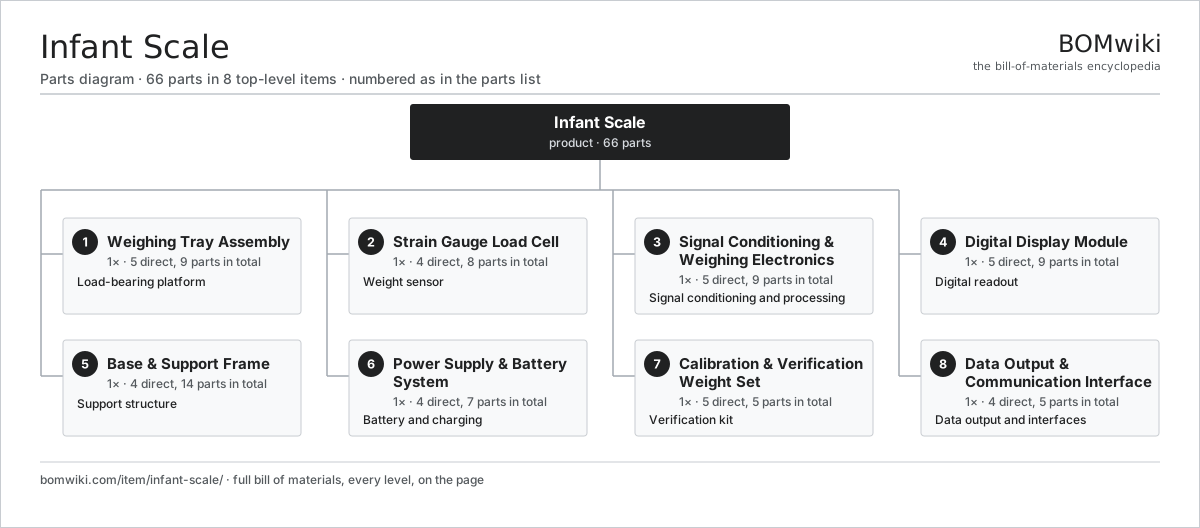
| # | Part | Qty | What it does |
|---|---|---|---|
| 1 | Weighing Tray Assembly 5 parts | 1× | Load-bearing platform |
| 2 | Strain Gauge Load Cell 4 parts | 1× | Weight sensor |
| 3 | Signal Conditioning & Weighing Electronics 5 parts | 1× | Signal conditioning and processing |
| 4 | Digital Display Module 5 parts | 1× | Digital readout |
| 5 | Base & Support Frame 4 parts | 1× | Support structure |
| 6 | Power Supply & Battery System 4 parts | 1× | Battery and charging |
| 7 | Calibration & Verification Weight Set 5 parts | 1× | Verification kit |
| 8 | Data Output & Communication Interface 4 parts | 1× | Data output and interfaces |
3D model
No 3D model yet. Have a CAD file of this? Add a 3D model. STL renders right on this page; STEP, FreeCAD, and OpenSCAD sources are welcome too (openly licensed, like all 3D models on BOMwiki).
Build & assembly graph
expand / collapse · shared sub-assemblies converge · links to related products · est. labourTap an assembly to expand/collapse · tap a part to open it · use “Open page” for any node · drag to pan, scroll to zoom.
Bill of materials for Infant Scale
8 top-level lines · 74 rows shown · 66 parts total · indented to 3 levels| # | Item / sub-assembly | Part no. | Qty/assy | Ext. qty | Parts | Type |
|---|---|---|---|---|---|---|
| 1 | Weighing Tray Assembly 5 parts | infant-scale-weighing-tray | 1× | 1 | 9 | assembly |
| 1.1 | Tray Pan (Weighing Surface) | infant-scale-tray-pan | 1× | 1 | · | part |
| 1.2 | Safety Harness Attachment Point 2 parts | infant-scale-safety-harness-mount | 1× | 1 | 3 | assembly |
| 1.2.1 | Safety Harness Strap | infant-scale-harness-strap | 1× | 1 | · | part |
| 1.2.2 | Strap Attachment Loop | infant-scale-strap-loop | 2× | 2 | · | part |
| 1.3 | Edge Guard / Bumper | infant-scale-tray-edge-guard | 1× | 1 | · | part |
| 1.4 | Drain Hole Pattern | infant-scale-tray-drain-holes | 1× | 1 | · | part |
| 1.5 | Tray Support Post 2 parts | infant-scale-tray-support-post | 1× | 1 | 3 | assembly |
| 1.5.1 | Support Tube | infant-scale-post-tube | 1× | 1 | · | part |
| 1.5.2 | Vibration Isolation Mount 1 parts + deeper › | infant-scale-post-isolation-mount | 1× | 1 | 2 | assembly |
| 2 | Strain Gauge Load Cell 4 parts | infant-scale-load-cell | 1× | 1 | 8 | assembly |
| 2.1 | Load Cell Body | infant-scale-load-cell-body | 1× | 1 | · | part |
| 2.2 | Strain Gauge Wheatstone Bridge 2 parts | infant-scale-strain-gauge-bridge | 1× | 1 | 5 | assembly |
| 2.2.1 | Strain Gauge Element | infant-scale-strain-gauge-element | 4× | 4 | · | part |
| 2.2.2 | Gauge Bonding Adhesive | infant-scale-gauge-adhesive | 1× | 1 | · | part |
| 2.3 | Shunt Calibration Resistor | infant-scale-shunt-calibration-resistor | 1× | 1 | · | part |
| 2.4 | Summing / Weighing Plate | infant-scale-summing-plate | 1× | 1 | · | part |
| 3 | Signal Conditioning & Weighing Electronics 5 parts | infant-scale-scale-electronics | 1× | 1 | 9 | assembly |
| 3.1 | Precision Instrumentation Amplifier 2 parts | infant-scale-instrumentation-amp | 1× | 1 | 2 | assembly |
| 3.1.1 | InAmp IC Chip | infant-scale-inamp-ic | 1× | 1 | · | part |
| 3.1.2 | Gain Setting Resistors 1 parts + deeper › | infant-scale-inamp-components | 1× | 1 | 1 | assembly |
| 3.2 | ADC (Analog-to-Digital Converter) 2 parts | infant-scale-adc-module | 1× | 1 | 2 | assembly |
| 3.2.1 | ADC Chip | infant-scale-adc-ic | 1× | 1 | · | part |
| 3.2.2 | Anti-Aliasing Filter 1 parts + deeper › | infant-scale-adc-filter-network | 1× | 1 | 1 | assembly |
| 3.3 | Weighing Processor 2 parts | infant-scale-microprocessor | 1× | 1 | 2 | assembly |
| 3.3.1 | Microcontroller | mcu | 1× | 1 | · | part |
| 3.3.2 | EEPROM Memory | infant-scale-eeprom | 1× | 1 | · | part |
| 3.4 | Calibration Coefficient Storage 1 parts | infant-scale-calibration-memory | 1× | 1 | 1 | assembly |
| 3.4.1 | Flash Memory Chip | infant-scale-flash-memory | 1× | 1 | · | part |
| 3.5 | Temperature Compensation Module 2 parts | infant-scale-temperature-compensator | 1× | 1 | 2 | assembly |
| 3.5.1 | NTC Thermistor (Temperature Sensor) | infant-scale-thermistor | 1× | 1 | · | part |
| 3.5.2 | Temperature Compensation Amplifier 1 parts + deeper › | infant-scale-compensation-circuit | 1× | 1 | 1 | assembly |
| 4 | Digital Display Module 5 parts | infant-scale-display-unit | 1× | 1 | 9 | assembly |
| 4.1 | LCD Display Panel | infant-scale-lcd-panel | 1× | 1 | · | part |
| 4.2 | Display Controller IC | infant-scale-display-driver | 1× | 1 | · | part |
| 4.3 | Function Buttons 1 parts | infant-scale-control-buttons | 1× | 1 | 4 | assembly |
| 4.3.1 | Tactile Momentary Switch | infant-scale-tactile-switch | 4× | 4 | · | part |
| 4.4 | LCD Backlight 1 parts | infant-scale-backlight | 1× | 1 | 1 | assembly |
| 4.4.1 | LED Backlight Array | infant-scale-led-backlight-array | 1× | 1 | · | part |
| 4.5 | Display Housing 2 parts | infant-scale-display-enclosure | 1× | 1 | 2 | assembly |
| 4.5.1 | Display PCB Board | infant-scale-display-pcb | 1× | 1 | · | part |
| 4.5.2 | Main PCB Connector | infant-scale-display-connector | 1× | 1 | · | part |
| 5 | Base & Support Frame 4 parts | infant-scale-base-frame | 1× | 1 | 14 | assembly |
| 5.1 | Pedestal Support Column | infant-scale-pedestal-post | 1× | 1 | · | part |
| 5.2 | Base Mounting Plate | infant-scale-base-plate | 1× | 1 | · | part |
| 5.3 | Floor Contact Foot Pad | infant-scale-feet-pads | 4× | 4 | · | part |
| 5.4 | Leveling Foot Adjuster 2 parts | infant-scale-leveling-adjusters | 4× | 4 | 2 | assembly |
| 5.4.1 | Leveling Screw | infant-scale-adjuster-screw | 1× | 4 | · | part |
| 5.4.2 | Lock Nut | infant-scale-adjuster-lock-nut | 1× | 4 | · | part |
| 6 | Power Supply & Battery System 4 parts | infant-scale-power-system | 1× | 1 | 7 | assembly |
| 6.1 | Lithium-Ion Battery Module 2 parts | infant-scale-liion-battery-pack | 1× | 1 | 3 | assembly |
| 6.1.1 | Li-ion Cell, 18650 | li-cell-18650 | 2× | 2 | · | part |
| 6.1.2 | Battery Cell Holder | infant-scale-battery-holder | 1× | 1 | · | part |
| 6.2 | Li-Ion Charger Circuit 2 parts | infant-scale-charging-circuit | 1× | 1 | 2 | assembly |
| 6.2.1 | Charger IC | infant-scale-charger-ic | 1× | 1 | · | part |
| 6.2.2 | Charge Status Indicator LED | infant-scale-charge-status-led | 1× | 1 | · | part |
| 6.3 | Power Inlet Connector | infant-scale-power-inlet | 1× | 1 | · | part |
| 6.4 | Voltage Regulator Board 1 parts | infant-scale-regulator-board | 1× | 1 | 1 | assembly |
| 6.4.1 | Power Supply | power-supply | 1× | 1 | · | part |
| 7 | Calibration & Verification Weight Set 5 parts | infant-scale-calibration-weights | 1× | 1 | 5 | assembly |
| 7.1 | 1 kg Calibration Weight | infant-scale-weight-1kg | 1× | 1 | · | part |
| 7.2 | 2 kg Calibration Weight | infant-scale-weight-2kg | 1× | 1 | · | part |
| 7.3 | 5 kg Calibration Weight | infant-scale-weight-5kg | 1× | 1 | · | part |
| 7.4 | 10 kg Calibration Weight | infant-scale-weight-10kg | 1× | 1 | · | part |
| 7.5 | Weight Storage Bag | infant-scale-weight-storage-bag | 1× | 1 | · | part |
| 8 | Data Output & Communication Interface 4 parts | infant-scale-connectivity | 1× | 1 | 5 | assembly |
| 8.1 | USB Communication Module 2 parts | infant-scale-usb-module | 1× | 1 | 2 | assembly |
| 8.1.1 | USB Controller IC | infant-scale-usb-controller | 1× | 1 | · | part |
| 8.1.2 | Connector | connector | 1× | 1 | · | part |
| 8.2 | Bluetooth Low Energy Module 1 parts | infant-scale-bluetooth-module | 1× | 1 | 1 | assembly |
| 8.2.1 | BLE SoC (System-on-Chip) | infant-scale-ble-chip | 1× | 1 | · | part |
| 8.3 | RS-232 Serial Port (Legacy) 1 parts | infant-scale-rs232-serial | 1× | 1 | 1 | assembly |
| 8.3.1 | UART Level Shifter IC | infant-scale-uart-ic | 1× | 1 | · | part |
| 8.4 | Main Data Connector | infant-scale-data-output-connector | 1× | 1 | · | part |
Something wrong in this list? Report a problem with this BOM.
Related products
same domain, ranked by shared parts Surgical Headlight
37 parts · shares 3 with this page
Bladder Scanner
483 parts · shares 2 with this page
Surgical Headlight
37 parts · shares 3 with this page
Bladder Scanner
483 parts · shares 2 with this page
 Fetal Doppler
41 parts · shares 2 with this page
Vein Finder (Near-IR Vein Locator)
65 parts · shares 2 with this page
Heart-Lung Machine
298 parts · shares 2 with this page
Fetal Doppler
41 parts · shares 2 with this page
Vein Finder (Near-IR Vein Locator)
65 parts · shares 2 with this page
Heart-Lung Machine
298 parts · shares 2 with this page
Sourcing: possible vendors
Browse the supplier directory → Prices, MOQ, and lead times are algorithmic estimates, not quotes, and not claims about these companies. Company mappings are curated by keyword; est. price band $500–$3M. How estimates work| Vendor | HQ | Specialty | MOQ | Lead time |
|---|---|---|---|---|
| gehealthcare.com ↗ | Chicago, US | Medical imaging & devices | 100 units | 12–20 wks |
| siemens-healthineers.com ↗ | Erlangen, DE | Medical systems | 100 units | 12–20 wks |
|
🇳🇱Philips
philips.com ↗
|
Amsterdam, NL | Health technology | 100 units | 12–20 wks |
| medtronic.com ↗ | Minneapolis, US | Medical devices | 100 units | 12–20 wks |
|
🇨🇳Mindray
mindray.com ↗
|
Shenzhen, CN | Medical devices | 100 units | 12–20 wks |
1,200-word article