Infrared Thermometer
ProductOverview
An infrared thermometer measures how hot something is without touching it. Every object above absolute zero radiates infrared energy, and the warmer it is the more it radiates; this instrument collects that radiation through a lens, turns it into a small electrical signal, and reports the surface temperature in well under a second. The gun shape lets a user point, pull a trigger, and read a number, which is why these are used for checking cooking surfaces, electrical panels, HVAC ducts, and machinery from a safe distance.
Radiation from the target passes through the IR Optics, which focus it onto a heat-sensing detector. The faint signal is amplified and converted to a temperature by the Signal Board, then shown on the Display. So the user knows exactly what is being measured, the Laser Aiming Module paints a visible dot at the center of the spot. The whole instrument is powered by an Li-ion Cell, 18650 cell, started by the Trigger Switch, and packaged in a molded Housing.
How it works
The IR Optics act like a camera lens for heat. An infrared-transmitting lens gathers radiation from a circular patch of the target and concentrates it onto a thermopile, a cluster of tiny thermocouples in series whose hot junctions sit on a blackened membrane. As that membrane warms relative to a built-in cold-junction reference, the thermopile puts out a voltage of just a few microvolts per degree. A field stop sets the distance-to-spot ratio, fixing how large the measured patch is at any range.
That microvolt signal would be lost in noise without conditioning, so the Signal Board amplifies it with a low-offset preamplifier and digitizes it. The microcontroller then applies two corrections: it adds back the ambient temperature read at the cold junction, and it divides out the target's emissivity, the fraction of a perfect blackbody's radiation that a real surface emits, to recover the true temperature. The result drives the Display.
Because the spot is invisible, the Laser Aiming Module collimates a visible diode into a dot that marks the patch being read. Pulling the Trigger Switch wakes the board, fires the laser, and holds the last reading when released.
Infrared Thermometer parts and their functions
8 top-level parts · 26 parts in total · full bill of materials below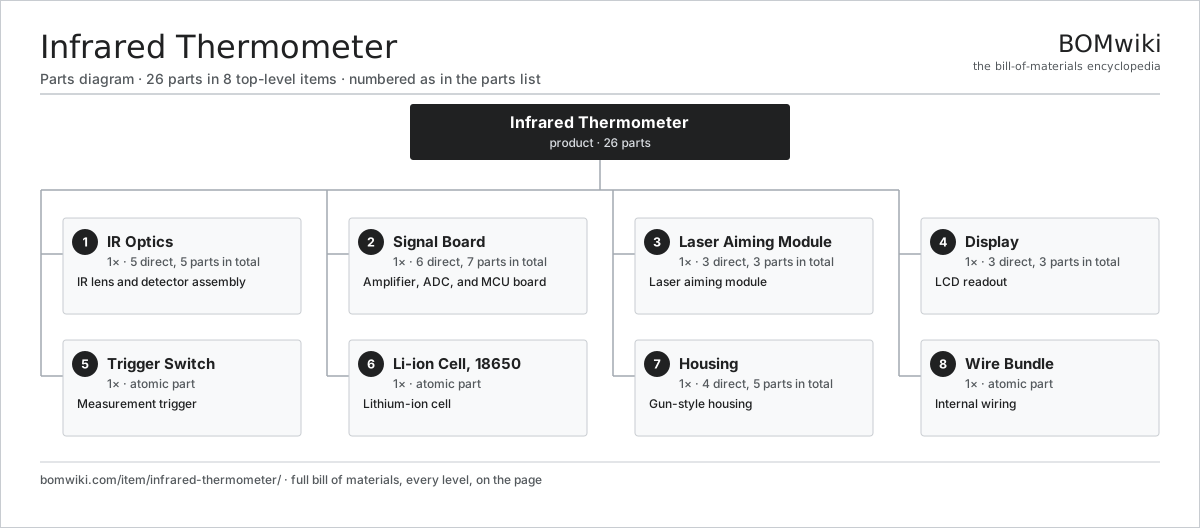
| # | Part | Qty | What it does |
|---|---|---|---|
| 1 | IR Optics 5 parts | 1× | IR lens and detector assembly |
| 2 | Signal Board 6 parts | 1× | Amplifier, ADC, and MCU board |
| 3 | Laser Aiming Module 3 parts | 1× | Laser aiming module |
| 4 | Display 3 parts | 1× | LCD readout |
| 5 | Trigger Switch | 1× | Measurement trigger |
| 6 | Li-ion Cell, 18650 | 1× | Lithium-ion cell |
| 7 | Housing 4 parts | 1× | Gun-style housing |
| 8 | Wire Bundle | 1× | Internal wiring |
3D model
No 3D model yet. Have a CAD file of this? Add a 3D model. STL renders right on this page; STEP, FreeCAD, and OpenSCAD sources are welcome too (openly licensed, like all 3D models on BOMwiki).
Build & assembly graph
expand / collapse · shared sub-assemblies converge · links to related products · est. labourTap an assembly to expand/collapse · tap a part to open it · use “Open page” for any node · drag to pan, scroll to zoom.
Bill of materials for Infrared Thermometer
8 top-level lines · 29 rows shown · 26 parts total · indented to 3 levels| # | Item / sub-assembly | Part no. | Qty/assy | Ext. qty | Parts | Type |
|---|---|---|---|---|---|---|
| 1 | IR Optics 5 parts | infrared-thermometer-optics | 1× | 1 | 5 | assembly |
| 1.1 | Lens Assembly | camera-lens | 1× | 1 | · | part |
| 1.2 | Thermopile Detector | infrared-thermometer-thermopile | 1× | 1 | · | part |
| 1.3 | IR Window | infrared-thermometer-ir-window | 1× | 1 | · | part |
| 1.4 | Field Stop | infrared-thermometer-aperture | 1× | 1 | · | part |
| 1.5 | Fastener Set | fastener-set | 1× | 1 | · | part |
| 2 | Signal Board 6 parts | infrared-thermometer-signal-board | 1× | 1 | 7 | assembly |
| 2.1 | Bare PCB | pcb-bare | 1× | 1 | · | part |
| 2.2 | Microcontroller | mcu | 1× | 1 | · | part |
| 2.3 | ADC | infrared-thermometer-adc | 1× | 1 | · | part |
| 2.4 | Preamplifier | infrared-thermometer-amplifier | 1× | 1 | · | part |
| 2.5 | SMD Passive (R/C/L) | smd-passives | 1× | 1 | · | part |
| 2.6 | Connector | connector | 2× | 2 | · | part |
| 3 | Laser Aiming Module 3 parts | infrared-thermometer-laser | 1× | 1 | 3 | assembly |
| 3.1 | Laser Diode | infrared-thermometer-laser-diode | 1× | 1 | · | part |
| 3.2 | Collimator Lens | infrared-thermometer-collimator | 1× | 1 | · | part |
| 3.3 | Laser Driver | infrared-thermometer-laser-driver | 1× | 1 | · | part |
| 4 | Display 3 parts | infrared-thermometer-display | 1× | 1 | 3 | assembly |
| 4.1 | LCD Panel | lcd-panel | 1× | 1 | · | part |
| 4.2 | Backlight | infrared-thermometer-backlight | 1× | 1 | · | part |
| 4.3 | Connector | connector | 1× | 1 | · | part |
| 5 | Trigger Switch | infrared-thermometer-trigger | 1× | 1 | · | part |
| 6 | Li-ion Cell, 18650 | li-cell-18650 | 1× | 1 | · | part |
| 7 | Housing 4 parts | infrared-thermometer-housing | 1× | 1 | 5 | assembly |
| 7.1 | Housing Shell | infrared-thermometer-shell | 2× | 2 | · | part |
| 7.2 | Grip Overmold | infrared-thermometer-grip | 1× | 1 | · | part |
| 7.3 | Battery Door | infrared-thermometer-battery-door | 1× | 1 | · | part |
| 7.4 | Fastener Set | fastener-set | 1× | 1 | · | part |
| 8 | Wire Bundle | wire-bundle | 1× | 1 | · | part |
Something wrong in this list? Report a problem with this BOM.
Related products
same domain, ranked by shared parts Computerized GoTo Telescope
320 parts · shares 6 with this page
Computerized GoTo Telescope
320 parts · shares 6 with this page
 Laser Rangefinder
220 parts · shares 5 with this page
Laser Rangefinder
220 parts · shares 5 with this page
 Traffic Speed Camera
268 parts · shares 5 with this page
Traffic Speed Camera
268 parts · shares 5 with this page
 Colorimeter
277 parts · shares 4 with this page
Colorimeter
277 parts · shares 4 with this page
 Gloss Meter
242 parts · shares 4 with this page
Gloss Meter
242 parts · shares 4 with this page
 Rotary Laser Level
236 parts · shares 4 with this page
Rotary Laser Level
236 parts · shares 4 with this page
Sourcing: possible vendors
Browse the supplier directory → Prices, MOQ, and lead times are algorithmic estimates, not quotes, and not claims about these companies. Company mappings are curated by keyword; est. price band $100–$8k. How estimates work| Vendor | HQ | Specialty | MOQ | Lead time |
|---|---|---|---|---|
|
🇯🇵Canon
canon.com ↗
|
Tokyo, JP | Imaging & optics | 500 units | 10–16 wks |
|
🇯🇵Nikon
nikon.com ↗
|
Tokyo, JP | Imaging & optics | 500 units | 10–16 wks |
|
🇩🇪ZEISS
zeiss.com ↗
|
Oberkochen, DE | Optics & optoelectronics | 500 units | 10–16 wks |
| leica-camera.com ↗ | Wetzlar, DE | Cameras & optics | 500 units | 10–16 wks |
| flir.com ↗ | Wilsonville, US | Thermal imaging | 500 units | 10–16 wks |
385-word article