Infrared Tube Heater
ProductOverview
An infrared tube heater is a radiant heating system designed for high-ceiling industrial and semi-outdoor spaces, warehouses, airplane hangars, outdoor pavilions, amphitheaters, where heating only the occupied zone (instead of warming all the air to the ceiling) saves enormous energy. The unit is a long perforated steel tube suspended from the ceiling, inside which a gas flame burns; the hot tube walls emit infrared radiation downward toward people and surfaces. A polished aluminum Reflector Assembly above the tube focuses the radiation downward, focusing the heating into a zone 3–10 m below. Heat input ranges from 25 kBtu/h (7 kW) for a small pavilion to 200 kBtu/h (60 kW) for a large warehouse.
The system is remarkably simple: no moving parts except the small Exhaust Venting Fan, no water loops, no ductwork. The Radiant Burner Tube contains a venturi where gas and air mix and burn; a Spark Igniter & Transformer spark starts the flame, and a Control Board monitors flame via a Flame-Proving Electrode. The Exhaust Venting Fan pulls hot combustion products out of the tube and vents them to the roof, while infrared radiation escapes through the tube perforations downward into the space.
The radiant heating concept
The Radiant Burner Tube is a thin-walled steel tube, 25–50 mm OD, with tiny perforations (1–2 mm) drilled along its length. Inside runs a venturi tube where gas and air mix and ignite. As the flame burns, it heats the tube wall to 600–800 °C. This hot metal radiates heat as infrared (long-wave) radiation that travels in straight lines and heats any opaque surface it strikes, a person, the floor, equipment, without heating the air in between. By contrast, a convective heater (like a unit heater) heats all the air to the ceiling, wasting energy on an unoccupied zone.
The Reflector Assembly is a cylindrical or parabolic aluminum dish positioned above and behind the tube. Its polished surface reflects at least 95% of the upward-radiating infrared back downward, focusing the heating below the tube and preventing heat loss to the roof structure. This focus increases the effective delivered heat by 40–60% compared to a tube without a reflector.
Combustion and gas control
The Gas Manifold & Pilot contains a manual Inlet Cock, a Gas Regulator that steps down supply pressure to 3–7 kPa, and a Main Solenoid Valve that opens or closes on demand. For reliability, most designs maintain a small Pilot Orifice pilot flame at all times; when heat is called for, the Control Board energizes the main solenoid to allow main-burner gas flow. Some modern designs use intermittent spark ignition without a standing pilot, igniting the main flame only when needed.
Ignition and flame safety
The Main Burner Nozzle is a precision orifice positioned at the mouth of the venturi, surrounded by the Ignition Electrode. When the control board energizes the igniter, a High-Voltage Transformer steps 120 V AC up to 10–15 kV, creating a spark across the electrode gap. The spark ignites the gas-air mixture in the venturi. A Flame-Proving Electrode senses the presence of the pilot or main flame; loss of flame signal causes the control board to de-energize the Main Solenoid Valve, shutting off gas supply. A purge cycle runs the Exhaust Venting Fan for 2–3 minutes after shutdown to clear combustible vapor.
Venting and air supply
The Exhaust Venting Fan is a small electric blower that pulls hot combustion gases out of the Radiant Burner Tube and forces them through Flue Ductwork ductwork to a Flue Cap & Damper on the roof or wall. This forced-draft design (as opposed to natural draft) allows the heater to be mounted anywhere and ensures consistent venting regardless of outdoor wind. The combustion air for the burner is drawn from the space or outdoors via the venturi itself, atmospheric heaters draw air from the space, while sealed-combustion heaters (less common) draw outside air directly to the venturi and exhaust separately.
Suspension and safety
The entire heater, tube plus reflector, weighs 20–100 kg depending on size. It is suspended from the ceiling structure by Suspension Cable or Rod, typically stainless aircraft cable, running from a Suspension Point bracket on the tube to Ceiling Attachment structural fasteners. A Safety Cable backup cable loops around a permanent structural member as a secondary catch if the primary suspension fails. The heater can be adjusted up or down by tightening or loosening the suspension cables to focus the heat to the right zone.
Control and operation
The thermostat is simple: a Room Thermostat dial mounted on a wall senses room temperature. When room temperature drops below the setpoint, the thermostat sends 24 V to the Control Board, which energizes the Main Solenoid Valve and the Exhaust Venting Fan. Gas flows, the spark ignites it, and the Flame-Proving Electrode confirms flame. The infrared heater now radiates downward. As the room warms back to setpoint, the thermostat cuts off the 24 V signal, the control board closes the Main Solenoid Valve, and the Exhaust Venting Fan runs for a final purge before stopping. Many modern systems add a modulating valve instead of a simple on-off solenoid, allowing proportional heat output.
Energy advantage
In a warehouse with 8 m ceiling and outdoor temperature of -10 °C, a convective unit heater heating the whole air mass to 15 °C requires 3–4 times more fuel than an infrared system heating occupied zones (say, 1.5 m height) to the same sensation of comfort. Over a season, the infrared system can reduce heating fuel by 40–60%, a payback period often under 2 years.
Infrared Tube Heater parts and their functions
8 top-level parts · 125 parts in total · full bill of materials below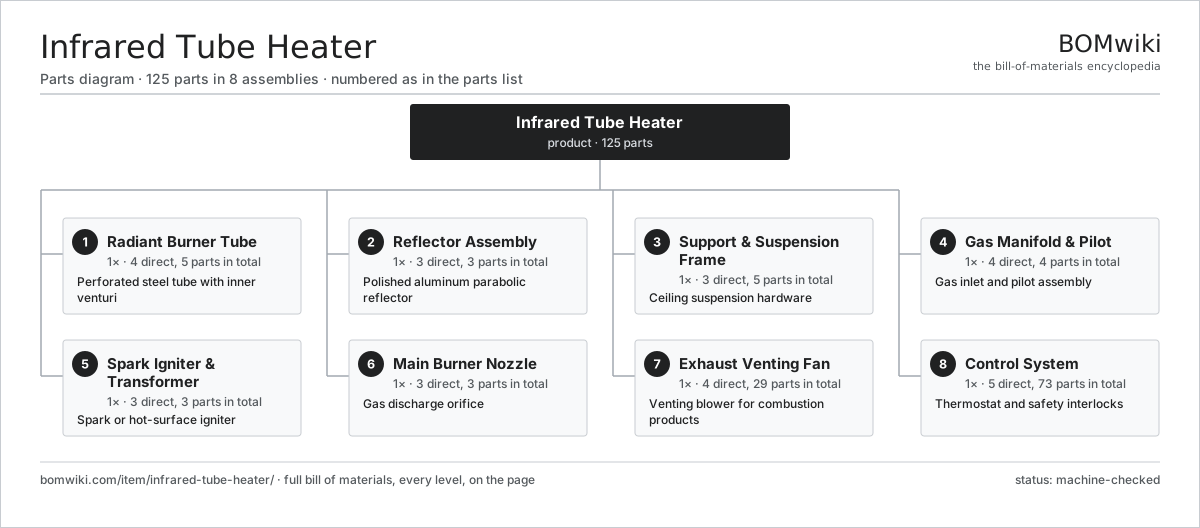
| # | Part | Qty | What it does |
|---|---|---|---|
| 1 | Radiant Burner Tube 4 parts | 1× | Perforated steel tube with inner venturi |
| 2 | Reflector Assembly 3 parts | 1× | Polished aluminum parabolic reflector |
| 3 | Support & Suspension Frame 3 parts | 1× | Ceiling suspension hardware |
| 4 | Gas Manifold & Pilot 4 parts | 1× | Gas inlet and pilot assembly |
| 5 | Spark Igniter & Transformer 3 parts | 1× | Spark or hot-surface igniter |
| 6 | Main Burner Nozzle 3 parts | 1× | Gas discharge orifice |
| 7 | Exhaust Venting Fan 4 parts | 1× | Venting blower for combustion products |
| 8 | Control System 5 parts | 1× | Thermostat and safety interlocks |
3D model
No 3D model yet. Have a CAD file of this? Add a 3D model — STL renders right on this page; STEP, FreeCAD, and OpenSCAD sources are welcome too (openly licensed, like all 3D models on BOMwiki).
Build & assembly graph
expand / collapse · shared sub-assemblies converge · links to related products · est. labourTap an assembly to expand/collapse · tap a part to open it · use “Open page” for any node · drag to pan, scroll to zoom.
Bill of materials for Infrared Tube Heater
8 top-level lines · 47 rows shown · 125 parts total · indented to 3 levels| # | Item / sub-assembly | Part no. | Qty/assy | Ext. qty | Parts | Type |
|---|---|---|---|---|---|---|
| 1 | Radiant Burner Tube 4 parts | infrared-tube-heater-burner-tube | 1× | 1 | 5 | assembly |
| 1.1 | Perforated Tube Body | infrared-tube-heater-tube-body | 1× | 1 | · | part |
| 1.2 | Venturi Mixing Tube | infrared-tube-heater-venturi-inner | 1× | 1 | · | part |
| 1.3 | Tube End Cap | infrared-tube-heater-tube-end-cap | 2× | 2 | · | part |
| 1.4 | Suspension Point | infrared-tube-heater-tube-hanger | 1× | 1 | · | part |
| 2 | Reflector Assembly 3 parts | infrared-tube-heater-reflector | 1× | 1 | 3 | assembly |
| 2.1 | Reflector Panel | infrared-tube-heater-reflector-panel | 1× | 1 | · | part |
| 2.2 | Reflector Support | infrared-tube-heater-reflector-support | 1× | 1 | · | part |
| 2.3 | Clearance Spacers | infrared-tube-heater-tube-clearance | 1× | 1 | · | part |
| 3 | Support & Suspension Frame 3 parts | infrared-tube-heater-support-frame | 1× | 1 | 5 | assembly |
| 3.1 | Suspension Cable or Rod | infrared-tube-heater-cable-or-rod | 2× | 2 | · | part |
| 3.2 | Ceiling Attachment | infrared-tube-heater-ceiling-anchor | 2× | 2 | · | part |
| 3.3 | Safety Cable | infrared-tube-heater-safety-cable | 1× | 1 | · | part |
| 4 | Gas Manifold & Pilot 4 parts | infrared-tube-heater-gas-manifold | 1× | 1 | 4 | assembly |
| 4.1 | Inlet Cock | infrared-tube-heater-inlet-cock | 1× | 1 | · | part |
| 4.2 | Gas Regulator | infrared-tube-heater-regulator | 1× | 1 | · | part |
| 4.3 | Pilot Orifice | infrared-tube-heater-pilot-orifice | 1× | 1 | · | part |
| 4.4 | Main Solenoid Valve | infrared-tube-heater-main-solenoid | 1× | 1 | · | part |
| 5 | Spark Igniter & Transformer 3 parts | infrared-tube-heater-igniter | 1× | 1 | 3 | assembly |
| 5.1 | High-Voltage Transformer | infrared-tube-heater-transformer | 1× | 1 | · | part |
| 5.2 | HV Electrode Cable | infrared-tube-heater-electrode-cable | 1× | 1 | · | part |
| 5.3 | Spark Gap Adjustment | infrared-tube-heater-spark-gap | 1× | 1 | · | part |
| 6 | Main Burner Nozzle 3 parts | infrared-tube-heater-burner-nozzle | 1× | 1 | 3 | assembly |
| 6.1 | Orifice Plate | infrared-tube-heater-nozzle-insert | 1× | 1 | · | part |
| 6.2 | Ignition Electrode | infrared-tube-heater-ignition-electrode | 1× | 1 | · | part |
| 6.3 | Nozzle Holder | infrared-tube-heater-nozzle-holder | 1× | 1 | · | part |
| 7 | Exhaust Venting Fan 4 parts | infrared-tube-heater-exhaust-fan | 1× | 1 | 29 | assembly |
| 7.1 | Exhaust Blower | infrared-tube-heater-exhaust-blower | 1× | 1 | · | part |
| 7.2 | Exhaust Fan Motor 5 parts | infrared-tube-heater-exhaust-motor | 1× | 1 | 26 | assembly |
| 7.2.1 | Stator Assembly 3 parts + deeper › | stator-assembly | 1× | 1 | 3 | assembly |
| 7.2.2 | Rotor Assembly 4 parts + deeper › | rotor-assembly | 1× | 1 | 19 | assembly |
| 7.2.3 | Copper Winding | copper-winding | 1× | 1 | · | part |
| 7.2.4 | Motor Housing | motor-housing | 1× | 1 | · | part |
| 7.2.5 | Ball Bearing | ball-bearing | 2× | 2 | · | part |
| 7.3 | Flue Ductwork | infrared-tube-heater-flue-duct | 1× | 1 | · | part |
| 7.4 | Flue Cap & Damper | infrared-tube-heater-flue-cap | 1× | 1 | · | part |
| 8 | Control System 5 parts | infrared-tube-heater-controls | 1× | 1 | 73 | assembly |
| 8.1 | Control Board 5 parts | infrared-tube-heater-control-board | 1× | 1 | 65 | assembly |
| 8.1.1 | Bare PCB | pcb-bare | 1× | 1 | · | part |
| 8.1.2 | Microcontroller | mcu | 1× | 1 | · | part |
| 8.1.3 | SMD Passive (R/C/L) | smd-passives | 60× | 60 | · | part |
| 8.1.4 | Relay | relay | 1× | 1 | · | part |
| 8.1.5 | Connector | connector | 2× | 2 | · | part |
| 8.2 | Room Thermostat | infrared-tube-heater-thermostat | 1× | 1 | · | part |
| 8.3 | Flame-Proving Electrode | infrared-tube-heater-flame-electrode | 1× | 1 | · | part |
| 8.4 | Relay | relay | 2× | 2 | · | part |
| 8.5 | Connector | connector | 4× | 4 | · | part |
Related products
same domain, ranked by shared parts Air Curtain
115 parts · shares 15 with this page
Air Curtain
115 parts · shares 15 with this page
 Air Handling Unit
631 parts · shares 15 with this page
Air Handling Unit
631 parts · shares 15 with this page
 Ceiling Cassette AC
395 parts · shares 15 with this page
Ceiling Cassette AC
395 parts · shares 15 with this page
 Centrifugal Chiller
340 parts · shares 15 with this page
Centrifugal Chiller
340 parts · shares 15 with this page
 Cleanroom Air Shower
166 parts · shares 15 with this page
Cleanroom Air Shower
166 parts · shares 15 with this page
 Dehumidifier
217 parts · shares 15 with this page
Dehumidifier
217 parts · shares 15 with this page
Sourcing: possible vendors
Prices, MOQ, and lead times are algorithmic estimates, not quotes, and not claims about these companies. Company mappings are curated by keyword; est. price band $100–$20k. How estimates work| Vendor | HQ | Specialty | MOQ | Lead time |
|---|---|---|---|---|
|
🇺🇸Carrier
carrier.com ↗
|
Palm Beach Gardens, US | HVAC | 500 units | 8–14 wks |
| tranetechnologies.com ↗ | Davidson, US | HVAC | 500 units | 8–14 wks |
|
🇯🇵Daikin
daikin.com ↗
|
Osaka, JP | HVAC | 500 units | 8–14 wks |
|
🇺🇸Lennox
lennox.com ↗
|
Richardson, US | HVAC | 500 units | 8–14 wks |
| johnsoncontrols.com ↗ | Milwaukee, US | Building systems | 500 units | 8–14 wks |
1,028-word article