Inline Duct Fan
ProductOverview
An inline duct fan is a fan built into a short length of tube so it can be inserted anywhere in a run of round ductwork, in a ceiling void, a loft, or a riser, rather than at a wall or roof termination. The format dominates residential and light-commercial extract ventilation (bathrooms, kitchens, offices), duct boosting, and applications like grow-room and server-closet ventilation where airflow against several hundred pascals of duct resistance is needed from a compact, quiet package. Units are made in the standard European duct diameters from 100 to 315 mm, moving from about 100 to 2,500 m³/h.
The product combines an Mixed-Flow Impeller and EC Motor cartridge inside a tubular Fan Housing, with a Speed Controller, an external Terminal Box, and Mounting Hardware hardware.
Mixed-flow aerodynamics
The defining component is the mixed-flow Impeller Wheel: a one-piece glass-filled polymer impeller whose conical hub and backward-swept blades accelerate air partly axially (along the duct) and partly radially (outward). The air leaves the blade row at an angle, is turned and de-swirled by fixed Outlet Guide Vanes, and exits along the duct axis. This hybrid geometry develops two to three times the pressure of a pure axial fan in the same tube diameter, without the bulky scroll housing a centrifugal fan needs, which is exactly the trade an in-duct package requires. An Inlet Contraction Ring contracts the incoming flow smoothly into the blades, and small Balance Clip weights added at the factory bring the rotor within balance grade G6.3, the main determinant of transmitted vibration. The wheel locks onto the Motor Shaft through its Impeller Hub.
EC motor
Nearly all current inline fans use an electronically commutated motor: a permanent-magnet rotor carrying Neodymium Magnet poles, a wound Stator Assembly, and Integrated Drive Electronics built into the motor itself. The onboard inverter rectifies 230 V mains and switches the windings through six Power MOSFET devices, with Hall Sensor feedback for commutation. The result is better than 70% motor efficiency where the shaded-pole AC motors of older fans managed about 25%, plus an intrinsic capability the AC motor never had: smooth, stepless speed control from an external 0–10 V or PWM signal, with constant-torque behaviour that holds airflow as filters load up. The rotor spins in two sealed-for-life Ball Bearing units rated beyond 40,000 hours, which in continuous extract service is the real service life of the product.
Housing and installation
The Casing Shell is molded ABS on smaller sizes and rolled galvanized steel on larger ones. Each end carries a Duct Spigot sized to EN 1506 nominal diameters with a rubber lip seal, so the fan push-fits between duct sections and clamps with standard duct clips. The motor hangs in the center of the airway on a Motor Support Spider spider; better designs split the casing in half so the whole motor-impeller cartridge can be swapped without disturbing the duct. Installation is orientation-free: a Mounting Bracket saddle clamps the casing to wall, ceiling, or threaded rod through rubber Anti-Vibration Mount bobbins, and a short Flexible Duct Connector sleeve at each spigot breaks the rigid acoustic path so motor and flow noise do not telegraph down the sheet-metal duct. Field wiring lands in the IP44 Terminal Box through compression Cable Gland entries onto the Terminal Block.
Control
Control ranges from trivial to closed-loop. The simplest installations switch the fan from the room light and rely on the built-in Run-On Timer, adjustable from about 2 to 30 minutes, to keep extracting moisture after the bathroom empties. A Speed Potentiometer on the controller or motor sets maximum speed at commissioning. More capable versions pair the Controller Board with a humidity sensor or a duct Pressure Sensor: in constant-pressure mode the fan serves several intermittently used extract points, speeding up automatically as valves open. Because the EC motor accepts a standard 0–10 V command, the same fan drops into building-management systems without any added drive hardware.
Ratings
Aerodynamic performance is measured to ISO 5801 and published as a pressure-flow curve; sound data distinguishes duct-radiated from casing-radiated levels, typically 25–45 dB(A) at 3 m for the casing path. Within the EU, the ErP regulation 327/2011 sets minimum fan efficiency grades that effectively eliminated AC shaded-pole designs from the market, and household-installation safety falls under IEC 60335-2-80.
Inline Duct Fan parts and their functions
7 top-level parts · 203 parts in total · full bill of materials below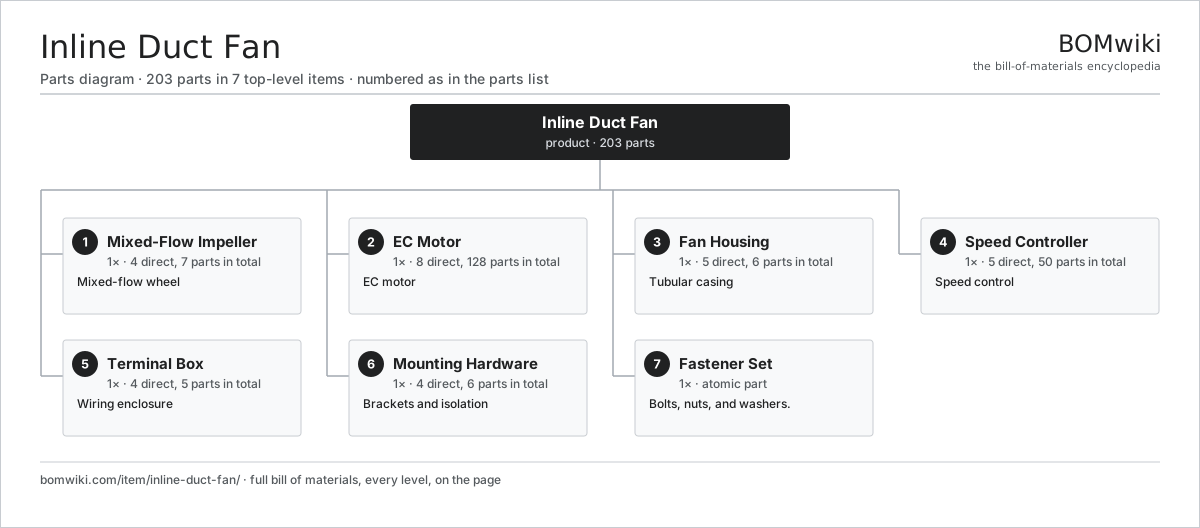
| # | Part | Qty | What it does |
|---|---|---|---|
| 1 | Mixed-Flow Impeller 4 parts | 1× | Mixed-flow wheel |
| 2 | EC Motor 8 parts | 1× | EC motor |
| 3 | Fan Housing 5 parts | 1× | Tubular casing |
| 4 | Speed Controller 5 parts | 1× | Speed control |
| 5 | Terminal Box 4 parts | 1× | Wiring enclosure |
| 6 | Mounting Hardware 4 parts | 1× | Brackets and isolation |
| 7 | Fastener Set | 1× | Bolts, nuts, and washers. |
3D model
No 3D model yet. Have a CAD file of this? Add a 3D model. STL renders right on this page; STEP, FreeCAD, and OpenSCAD sources are welcome too (openly licensed, like all 3D models on BOMwiki).
Build & assembly graph
expand / collapse · shared sub-assemblies converge · links to related products · est. labourTap an assembly to expand/collapse · tap a part to open it · use “Open page” for any node · drag to pan, scroll to zoom.
Bill of materials for Inline Duct Fan
7 top-level lines · 54 rows shown · 203 parts total · indented to 3 levels| # | Item / sub-assembly | Part no. | Qty/assy | Ext. qty | Parts | Type |
|---|---|---|---|---|---|---|
| 1 | Mixed-Flow Impeller 4 parts | inline-duct-fan-impeller | 1× | 1 | 7 | assembly |
| 1.1 | Impeller Wheel | inline-duct-fan-wheel | 1× | 1 | · | part |
| 1.2 | Impeller Hub | inline-duct-fan-hub | 1× | 1 | · | part |
| 1.3 | Balance Clip | inline-duct-fan-balance-clip | 4× | 4 | · | part |
| 1.4 | Outlet Guide Vanes | inline-duct-fan-guide-vanes | 1× | 1 | · | part |
| 2 | EC Motor 8 parts | inline-duct-fan-motor | 1× | 1 | 128 | assembly |
| 2.1 | Stator Assembly 3 parts | stator-assembly | 1× | 1 | 3 | assembly |
| 2.1.1 | Stator Core (laminations) | stator-core | 1× | 1 | · | part |
| 2.1.2 | Copper Winding | copper-winding | 1× | 1 | · | part |
| 2.1.3 | Slot Insulation | stator-insulation | 1× | 1 | · | part |
| 2.2 | Rotor Assembly 4 parts | rotor-assembly | 1× | 1 | 19 | assembly |
| 2.2.1 | Rotor Shaft | rotor-shaft | 1× | 1 | · | part |
| 2.2.2 | Rotor Core | rotor-core | 1× | 1 | · | part |
| 2.2.3 | Neodymium Magnet | neodymium-magnet | 16× | 16 | · | part |
| 2.2.4 | Ball Bearing | ball-bearing | 1× | 1 | · | part |
| 2.3 | Neodymium Magnet | neodymium-magnet | 8× | 8 | · | part |
| 2.4 | Motor Shaft | inline-duct-fan-motor-shaft | 1× | 1 | · | part |
| 2.5 | Ball Bearing | ball-bearing | 2× | 2 | · | part |
| 2.6 | Motor Housing | motor-housing | 1× | 1 | · | part |
| 2.7 | Hall Sensor | hall-sensor | 3× | 3 | · | part |
| 2.8 | Integrated Drive Electronics 5 parts | inline-duct-fan-drive-electronics | 1× | 1 | 91 | assembly |
| 2.8.1 | Bare PCB | pcb-bare | 1× | 1 | · | part |
| 2.8.2 | Microcontroller | mcu | 1× | 1 | · | part |
| 2.8.3 | Power MOSFET | mosfet | 6× | 6 | · | part |
| 2.8.4 | SMD Passive (R/C/L) | smd-passives | 80× | 80 | · | part |
| 2.8.5 | Connector | connector | 3× | 3 | · | part |
| 3 | Fan Housing 5 parts | inline-duct-fan-housing | 1× | 1 | 6 | assembly |
| 3.1 | Casing Shell | inline-duct-fan-casing-shell | 1× | 1 | · | part |
| 3.2 | Duct Spigot | inline-duct-fan-duct-spigot | 2× | 2 | · | part |
| 3.3 | Motor Support Spider | inline-duct-fan-motor-strut | 1× | 1 | · | part |
| 3.4 | Inlet Contraction Ring | inline-duct-fan-inlet-ring | 1× | 1 | · | part |
| 3.5 | O-Ring Set | oring-set | 1× | 1 | · | part |
| 4 | Speed Controller 5 parts | inline-duct-fan-controller | 1× | 1 | 50 | assembly |
| 4.1 | Controller Board 5 parts | inline-duct-fan-controller-pcb | 1× | 1 | 45 | assembly |
| 4.1.1 | Bare PCB | pcb-bare | 1× | 1 | · | part |
| 4.1.2 | Microcontroller | mcu | 1× | 1 | · | part |
| 4.1.3 | SMD Passive (R/C/L) | smd-passives | 40× | 40 | · | part |
| 4.1.4 | Relay | relay | 1× | 1 | · | part |
| 4.1.5 | Connector | connector | 2× | 2 | · | part |
| 4.2 | Speed Potentiometer | inline-duct-fan-potentiometer | 1× | 1 | · | part |
| 4.3 | Run-On Timer | inline-duct-fan-run-on-timer | 1× | 1 | · | part |
| 4.4 | Pressure Sensor | pressure-sensor | 1× | 1 | · | part |
| 4.5 | Connector | connector | 2× | 2 | · | part |
| 5 | Terminal Box 4 parts | inline-duct-fan-terminal-box | 1× | 1 | 5 | assembly |
| 5.1 | Terminal Block | inline-duct-fan-terminal-block | 1× | 1 | · | part |
| 5.2 | Cable Gland | inline-duct-fan-cable-gland | 2× | 2 | · | part |
| 5.3 | Terminal Box Lid | inline-duct-fan-tb-lid | 1× | 1 | · | part |
| 5.4 | Wire Bundle | wire-bundle | 1× | 1 | · | part |
| 6 | Mounting Hardware 4 parts | inline-duct-fan-mounting | 1× | 1 | 6 | assembly |
| 6.1 | Mounting Bracket | inline-duct-fan-mounting-bracket | 1× | 1 | · | part |
| 6.2 | Anti-Vibration Mount | inline-duct-fan-vibration-mount | 2× | 2 | · | part |
| 6.3 | Flexible Duct Connector | inline-duct-fan-flex-connector | 2× | 2 | · | part |
| 6.4 | Fastener Set | fastener-set | 1× | 1 | · | part |
| 7 | Fastener Set | fastener-set | 1× | 1 | · | part |
Something wrong in this list? Report a problem with this BOM.
Related products
same domain, ranked by shared parts VRF Outdoor Unit
801 parts · shares 20 with this page
VRF Outdoor Unit
801 parts · shares 20 with this page
 Air Handling Unit
631 parts · shares 19 with this page
Air Handling Unit
631 parts · shares 19 with this page
 Centrifugal Chiller
340 parts · shares 19 with this page
Centrifugal Chiller
340 parts · shares 19 with this page
 Gas Furnace
308 parts · shares 19 with this page
Gas Furnace
308 parts · shares 19 with this page
 Heat Pump
117 parts · shares 18 with this page
Heat Pump
117 parts · shares 18 with this page
 Air Purifier
331 parts · shares 17 with this page
Air Purifier
331 parts · shares 17 with this page
Sourcing: possible vendors
Browse the supplier directory → Prices, MOQ, and lead times are algorithmic estimates, not quotes, and not claims about these companies. Company mappings are curated by keyword; est. price band $100–$20k. How estimates work| Vendor | HQ | Specialty | MOQ | Lead time |
|---|---|---|---|---|
|
🇺🇸Carrier
carrier.com ↗
|
Palm Beach Gardens, US | HVAC | 500 units | 8–14 wks |
| tranetechnologies.com ↗ | Davidson, US | HVAC | 500 units | 8–14 wks |
|
🇯🇵Daikin
daikin.com ↗
|
Osaka, JP | HVAC | 500 units | 8–14 wks |
|
🇺🇸Lennox
lennox.com ↗
|
Richardson, US | HVAC | 500 units | 8–14 wks |
| johnsoncontrols.com ↗ | Milwaukee, US | Building systems | 500 units | 8–14 wks |
812-word article