Interferential Therapy Unit
ProductOverview
Interferential therapy (IFT) applies medium-frequency alternating current (4 kHz carrier frequency) through four surface electrodes arranged in a square or cross pattern. The key innovation is the Dual Oscillator Module dual oscillator system: two 4 kHz signals slightly out of frequency produce a beat frequency (their difference) when mixed by the Beat-Frequency (Modulation) Generator heterodyne circuit; this beat frequency ranges 1–200 Hz and is swept or held constant during treatment. The physiological benefit derives from the 4 kHz carrier (tissue penetrates 4–8 cm due to medium frequency, deeper than TENS at 50–100 Hz) combined with the low-frequency beat envelope (1–200 Hz), which modulates neural excitability. Physiotherapists and sports medicine physicians use IFT for pain, muscle stimulation, edema reduction, and tissue healing acceleration.
Carrier frequency and tissue penetration
The Fixed Crystal Oscillator and Variable Frequency Oscillator generate 4 kHz carrier waves. Frequency determines penetration: lower frequencies (50–100 Hz, used in TENS) penetrate 1–3 cm (superficial), while 4 kHz medium frequency penetrates 4–8 cm (deeper muscle and joint structures). The reason is Ohm's law applied to tissue: impedance decreases with increasing frequency up to ~1 kHz, then increases; at 4 kHz, impedance is moderate, allowing current to reach deep structures while maintaining reasonable electrode current requirements (<100 mA). The Electrode Pads Set four electrodes are positioned in a square pattern (e.g., 10 cm × 10 cm spacing), creating an interference pattern where the two carrier frequencies overlap in the tissue at the center of the square, producing maximum beat-frequency modulation at the pain site.
Beat frequency and modulation envelope
The Balanced Mixer balanced mixer heterodynes the two 4 kHz signals: if oscillator 1 is 4.000 kHz and oscillator 2 is 4.050 kHz, the mixer output contains sum (8.05 kHz, filtered out) and difference (50 Hz, extracted by the Low-Pass Filter low-pass filter). This 50 Hz beat frequency amplitude-modulates the 4 kHz carrier, creating a signal resembling 4 kHz sine wave with 50 Hz rising-and-falling envelope. The Frequency Adjustment Knob or Control Module software allows adjusting the modulation frequency (beat frequency) from 1–200 Hz: low frequencies (10–50 Hz) promote pain relief, mid frequencies (80–150 Hz) promote muscle relaxation, and very-low frequencies (<5 Hz) promote edema reduction and increased local blood perfusion.
Clinical application: acute muscle injury
A patient with acute hamstring strain (muscle tear with swelling) receives interferential therapy. The Electrode Pads Set are positioned in a square around the posterior thigh: two electrodes medial and lateral at mid-thigh, two electrodes above and below the injury site. Parameters: carrier 4 kHz, modulation frequency 10 Hz (low frequency for anti-inflammatory effect), amplitude 50 mA, duration 20 minutes. The 10 Hz beat frequency (rising/falling 10 times per second) stimulates the dorsal column neurons and activates gate-control mechanisms for pain suppression. The deeper penetration (4 kHz vs. TENS 50 Hz) reaches the hamstring muscle belly (4–5 cm depth) directly. After treatment, pain decreases 40–50%, swelling is subjectively reduced, and the patient tolerates early range-of-motion exercises. Treatment is repeated daily for 3–5 days in the acute phase.
Frequency sweep and adaptive stimulation
The Modulation DAC digital-to-analog converter allows automatic frequency sweep, where the modulation frequency gradually increases from 10 Hz to 150 Hz over 20 minutes. The advantage is that fixed-frequency stimulation risks accommodation (neurons adapt and stop responding after ~20 minutes), while sweeping frequencies prevents accommodation and maintains therapeutic effect throughout the session. Clinically, sweep protocols show superior pain reduction and muscle relaxation compared to fixed-frequency IFT.
Edema reduction and lymphatic stimulation
Post-operative swelling (edema) impairs range of motion and delays recovery. Low-frequency IFT (5–10 Hz modulation) stimulates lymphatic vessel contraction and promotes fluid reabsorption; combined with compression wrap and elevation, IFT accelerates edema resolution. Measurements using fluid-displacement volumetry or circumference tape show 15–25% edema reduction after 5–7 IFT sessions in acute post-operative phase.
Muscle strengthening and re-education
Muscle re-education (re-activation of atrophied or inhibited muscles) benefits from IFT-induced muscle contractions. Mid-range frequencies (80–150 Hz) promote visible muscle contraction (similar to functional electrical stimulation, FES); patients contract muscles volitionally while IFT provides augmenting involuntary contraction, producing higher recruitment and stronger motor-unit activation. Patients recovering from quadriceps inhibition post-ACL injury perform seated knee extensions while receiving IFT (80 Hz modulation, 50 mA); the combined voluntary + IFT-induced contraction produces better strength recovery than voluntary exercise alone.
Safety and adverse effects
The Current Monitor per-channel current limiting prevents excessive current (>100 mA) that would cause muscle fatigue or discomfort. The Beat-Frequency (Modulation) Generator ensures the beat frequency remains <200 Hz, avoiding extremely low frequencies that could theoretically interfere with cardiac rhythm (contraindication for any electrotherapy over the thorax or cardiac region). Adverse effects are minimal: localized erythema (skin redness) may occur at electrode sites from prolonged contact, but resolves within hours. Paresthesias (tingling) may transiently increase as current increases, but typically diminish with accommodation.
Comparison with TENS
Transcutaneous electrical nerve stimulation (TENS) at 50–100 Hz penetrates only 1–3 cm, limiting effectiveness for deep structures (hip joint, deep abdominal pain). Interferential therapy at 4 kHz penetrates 4–8 cm, reaching deeper tissues. Additionally, IFT modulation (1–200 Hz beat frequency) provides adaptive stimulation, while TENS typically runs at fixed frequency. Clinical trials show IFT modestly superior to TENS for chronic pain conditions, though differences are often small (~10–15% additional pain reduction). IFT units are larger and more complex than TENS; for acute superficial pain (e.g., post-operative surface pain), TENS may be adequate.
Typical clinical session
A patient with chronic knee osteoarthritis (pain 6/10 at rest, 8/10 with walking) presents for interferential therapy. Electrodes are positioned: two above the knee (medial and lateral suprapatellar region), two below (medial and lateral infrapatellar region). Treatment parameters: 4 kHz carrier, modulation sweep 30→150 Hz over 20 minutes, amplitude 60 mA. During the first 2 minutes, pain remains unchanged; by minute 5–7, pain decreases to 4/10 as accommodation to the beat frequency establishes. The patient undergoes IFT 2–3 times per week for 4 weeks; cumulative pain reduction is 50%, walking distance increases 200%, and the patient reduces analgesic medication from 6 to 3 tablets per day. Long-term (3-month) pain improvement is maintained, suggesting both acute symptom relief (during and shortly after treatment) and chronic anti-inflammatory adaptation.
Interferential Therapy Unit parts and their functions
6 top-level parts · 79 parts in total · full bill of materials below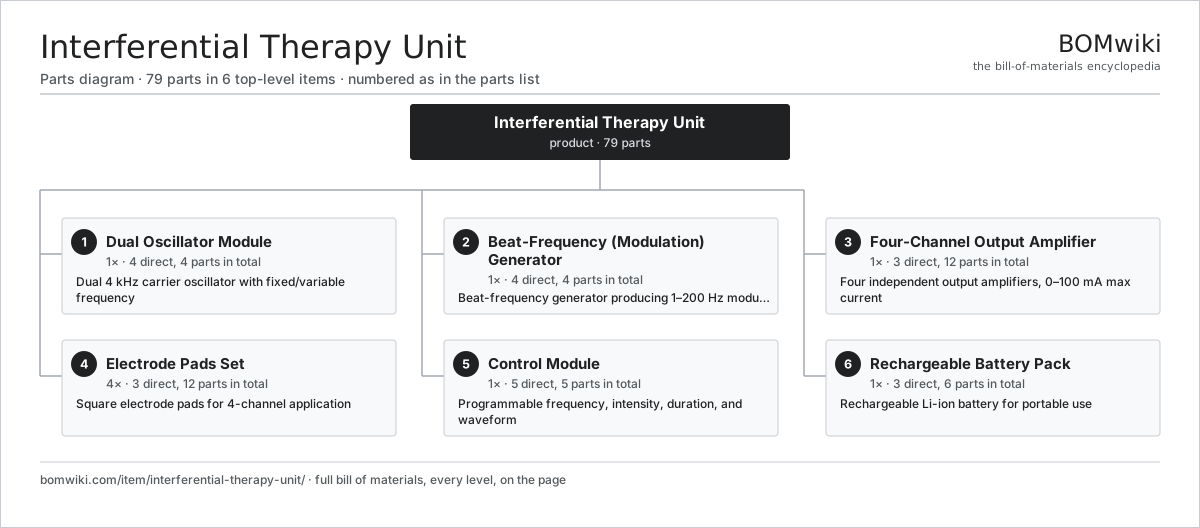
| # | Part | Qty | What it does |
|---|---|---|---|
| 1 | Dual Oscillator Module 4 parts | 1× | Dual 4 kHz carrier oscillator with fixed/variable frequency |
| 2 | Beat-Frequency (Modulation) Generator 4 parts | 1× | Beat-frequency generator producing 1–200 Hz modulation |
| 3 | Four-Channel Output Amplifier 3 parts | 1× | Four independent output amplifiers, 0–100 mA max current |
| 4 | Electrode Pads Set 3 parts | 4× | Square electrode pads for 4-channel application |
| 5 | Control Module 5 parts | 1× | Programmable frequency, intensity, duration, and waveform |
| 6 | Rechargeable Battery Pack 3 parts | 1× | Rechargeable Li-ion battery for portable use |
3D model
No 3D model yet. Have a CAD file of this? Add a 3D model. STL renders right on this page; STEP, FreeCAD, and OpenSCAD sources are welcome too (openly licensed, like all 3D models on BOMwiki).
Build & assembly graph
expand / collapse · shared sub-assemblies converge · links to related products · est. labourTap an assembly to expand/collapse · tap a part to open it · use “Open page” for any node · drag to pan, scroll to zoom.
Bill of materials for Interferential Therapy Unit
6 top-level lines · 28 rows shown · 79 parts total · indented to 3 levels| # | Item / sub-assembly | Part no. | Qty/assy | Ext. qty | Parts | Type |
|---|---|---|---|---|---|---|
| 1 | Dual Oscillator Module 4 parts | interferential-therapy-unit-oscillator | 1× | 1 | 4 | assembly |
| 1.1 | Fixed Crystal Oscillator | interferential-therapy-unit-osc1-crystal | 1× | 1 | · | part |
| 1.2 | Variable Frequency Oscillator | interferential-therapy-unit-osc2-vfo | 1× | 1 | · | part |
| 1.3 | Varactor Tuning Diode | interferential-therapy-unit-osc2-varactor | 1× | 1 | · | part |
| 1.4 | Oscillator Buffer | interferential-therapy-unit-buffer-amplifier | 1× | 1 | · | part |
| 2 | Beat-Frequency (Modulation) Generator 4 parts | interferential-therapy-unit-modulation-circuit | 1× | 1 | 4 | assembly |
| 2.1 | Balanced Mixer | interferential-therapy-unit-mixer-diode | 1× | 1 | · | part |
| 2.2 | Low-Pass Filter | interferential-therapy-unit-lpf-filter | 1× | 1 | · | part |
| 2.3 | Modulation Amplifier | interferential-therapy-unit-modulation-amp | 1× | 1 | · | part |
| 2.4 | Modulation DAC | interferential-therapy-unit-dac-modulation | 1× | 1 | · | part |
| 3 | Four-Channel Output Amplifier 3 parts | interferential-therapy-unit-amplifier-stage | 1× | 1 | 12 | assembly |
| 3.1 | Output Channel Amplifier | interferential-therapy-unit-output-amp | 4× | 4 | · | part |
| 3.2 | Current Monitor | interferential-therapy-unit-current-monitor | 4× | 4 | · | part |
| 3.3 | Electrode Current Driver | interferential-therapy-unit-electrode-driver | 4× | 4 | · | part |
| 4 | Electrode Pads Set 3 parts | interferential-therapy-unit-electrode-pads | 4× | 4 | 12 | assembly |
| 4.1 | Electrode Pad | interferential-therapy-unit-pad-conductor | 4× | 16 | · | part |
| 4.2 | Adhesive Backing | interferential-therapy-unit-pad-adhesive | 4× | 16 | · | part |
| 4.3 | Pad Lead Connector | interferential-therapy-unit-lead-connector | 4× | 16 | · | part |
| 5 | Control Module 5 parts | interferential-therapy-unit-controller | 1× | 1 | 5 | assembly |
| 5.1 | Microcontroller | interferential-therapy-unit-mcu | 1× | 1 | · | part |
| 5.2 | LCD Display | interferential-therapy-unit-display | 1× | 1 | · | part |
| 5.3 | Control Keypad | interferential-therapy-unit-keypad | 1× | 1 | · | part |
| 5.4 | Session Timer | interferential-therapy-unit-timer | 1× | 1 | · | part |
| 5.5 | Frequency Adjustment Knob | interferential-therapy-unit-frequency-dial | 1× | 1 | · | part |
| 6 | Rechargeable Battery Pack 3 parts | interferential-therapy-unit-battery-pack | 1× | 1 | 6 | assembly |
| 6.1 | Li-ion Cell, 18650 | li-cell-18650 | 4× | 4 | · | part |
| 6.2 | Battery Management System | interferential-therapy-unit-bms | 1× | 1 | · | part |
| 6.3 | USB Charging Module | interferential-therapy-unit-usb-charging | 1× | 1 | · | part |
Something wrong in this list? Report a problem with this BOM.
Related products
same domain, ranked by shared parts Blood Pressure Monitor
173 parts · shares 1 with this page
Blood Pressure Monitor
173 parts · shares 1 with this page
 Defibrillator
677 parts · shares 1 with this page
Defibrillator
677 parts · shares 1 with this page
 Fetal Doppler
41 parts · shares 1 with this page
Fetal Doppler
41 parts · shares 1 with this page
 Holter ECG Monitor
55 parts · shares 1 with this page
Infant Scale
66 parts · shares 1 with this page
Holter ECG Monitor
55 parts · shares 1 with this page
Infant Scale
66 parts · shares 1 with this page
Sourcing: possible vendors
Browse the supplier directory → Prices, MOQ, and lead times are algorithmic estimates, not quotes, and not claims about these companies. Company mappings are curated by keyword; est. price band $500–$3M. How estimates work| Vendor | HQ | Specialty | MOQ | Lead time |
|---|---|---|---|---|
| gehealthcare.com ↗ | Chicago, US | Medical imaging & devices | 100 units | 12–20 wks |
| siemens-healthineers.com ↗ | Erlangen, DE | Medical systems | 100 units | 12–20 wks |
|
🇳🇱Philips
philips.com ↗
|
Amsterdam, NL | Health technology | 100 units | 12–20 wks |
| medtronic.com ↗ | Minneapolis, US | Medical devices | 100 units | 12–20 wks |
|
🇨🇳Mindray
mindray.com ↗
|
Shenzhen, CN | Medical devices | 100 units | 12–20 wks |
1,117-word article