Leak Monitoring System
ProductOverview
Leak Monitoring Systems (LMS) detect fuel breaches in double-wall Underground Storage Tank annular spaces. EPA regulations (40 CFR Part 280) require all USTs installed after 1998 to include secondary containment and continuous interstitial monitoring. A breach in the primary tank wall, micro-cracks from corrosion, mechanical damage, or manufacturing defect, is invisible until fuel pools in the annulus and environmental contamination spreads. The LMS detects this breach within seconds, triggering alarms that automatically shut down dispensers and alert operators.
A typical LMS comprises two Annular Space Capacitive Probe capacitive electrode sensors (one in the annular space, one in the sump), a wall-mounted Monitoring Console Unit controller, and an alarm relay output driving external sirens and pump shutoff solenoids.
Capacitive Sensing Principle
The Annular Space Capacitive Probe uses capacitive sensing. Two Probe Electrode electrodes (graphite or stainless steel) are spaced 1–3 inches apart, mounted on the external tank wall and inserted into the annular space through a port fitting.
The Microcontroller Board microcontroller applies a low-frequency voltage (typically 1 kHz) across the electrodes and measures the resulting capacitance. Air (the normal state) has a dielectric constant of 1.0; diesel fuel has ε ≈ 2.0. When fuel breaches the primary tank wall and fills the annular space, the measured capacitance rises sharply, triggering the alarm circuit.
Capacitive sensing is preferred over resistive (conductivity) sensing because:
- Moisture rejection: A wet annular space (condensation from temperature swings) is not alarmed, only fuel-saturated conditions trigger. Diesel's dielectric signature is distinct from water.
- Speed: Capacitive response is immediate (< 1 second); resistive drift-based sensors are slower and prone to false alarms.
- Reliability: No electrochemical reactions; no electrode corrosion affecting measurements.
Redundancy and Sump Monitoring
The Secondary or Sump Probe provides redundancy (dual annular-space sensors) or sump monitoring. A sump probe is positioned at the lowest point of the tank-excavation pit, where gravity naturally collects any leaked fuel. The sump acts as a secondary catch basin; if the annular-space probe fails, the sump probe still detects fuel accumulation.
A third safety layer is the Sump Fuel Float Switch, a simple mechanical float switch. As fuel pools in the sump, the Float Ball rises, activating a Floating Magnet that closes a Reed Switch reed contact. This mechanical backup requires zero power and provides foolproof leak detection if both capacitive probes fail.
Console Design and Alarm Logic
The Monitoring Console Unit is a wall-mounted NEMA 4 enclosure, typically located in the station office or pump-house. The Regulated Power Supply provides regulated 24 VDC from 120 VAC mains. The Microcontroller Board continuously monitors both probes and the float switch.
Alarm thresholds are programmable:
- Low alarm (yellow LED): Capacitance rising, possible early fuel accumulation; alerts technician to inspect the tank.
- Leak alarm (red LED): Capacitance exceeds 75% threshold; triggers Alarm Relay Output Module output, closing a dry-contact relay that energizes external audible alarms and sends a discrete signal to the Site Controller Module.
The site controller receives the leak alarm, immediately de-energizes the Pump Unit motor contactor (via relay cutoff to the pump solenoid), shutting down all dispensers. Transactions are halted; no further fuel is dispensed until technicians confirm the tank is safe.
Cabling and Installation
The Probe-to-Console Shielded Cable connects probes to console over shielded twisted-pair cable. Typical installations run 200–500 feet of cable, from the tank site (in the equipment vault or at the manway location) to the office console. Long cable runs introduce noise susceptibility; the drain shield and twisted-pair construction minimize crosstalk.
Probe installations vary by tank configuration:
- Annular-space probe: A port fitting on the tank's external surface allows probe insertion into the annulus. Drilling a hole in the secondary wall, fitting a stainless steel NPT connector, and threading the probe through ensures proper spacing between electrodes and the primary tank wall.
- Sump probe: Positioned at the lowest point of the tank-excavation pit, or in the containment basin below the tank, where gravity drains any leaked fuel.
- Float switch: Installed in a separate sump or drip pan, either above or below ground.
Electrically, probe connectors are Cable Shield Braid shielded, with shield bonded to console ground at both ends to prevent ground loops and RF interference.
False Alarm Mitigation
Moisture (rain, condensation, ground water seepage) can degrade sensor accuracy. The 1–3 inch electrode spacing acts as a filter: tiny moisture droplets suspended between electrodes produce minimal capacitance change. Only bulk liquid fuel, which fills the entire annular space, produces a significant, unmistakable signal.
Some advanced LMS units implement firmware hysteresis and timing delays: a single spike above alarm threshold is ignored; sustained elevation for >5 seconds triggers alarm. This rejects electrical transients and condensation artifacts while capturing true leaks.
Integration with Fuel Management System
The Alarm Relay Output Module output is a dry-contact SPDT relay, rated 120 VAC 5 A. This relay can drive:
- Pump shutoff solenoid: A normally-energized solenoid on the pump motor contactor de-energizes on alarm, stopping all fuel flow.
- Audible alarm siren: 110 dB horn or bell, visible and audible from the street, alerting customers and passersby.
- Site Controller Module: A discrete input to the FMS registers the leak alarm, triggering a page to the station manager and logging the event for regulatory reporting.
- Strobing beacon: A red flashing light on top of the LED Fuel Price Sign or pump-island canopy signaling equipment shutdown.
Most jurisdictions require simultaneous activation of two or more alarm methods (audible + visual + system log) to prevent nuisance shutdown from a single-point failure.
Regulatory Compliance
EPA 40 CFR Part 280.43 requires continuous monitoring of interstitial space with response time < 12 hours (detection and alarm activation). An LMS satisfies this requirement with <10 second detection. Annual certification by a licensed tank tester verifies:
- Probe sensitivity and calibration (test with known fuel concentration)
- Relay response time (trigger relay with fuel contact, measure LED/alarm activation latency)
- Cabling integrity (megohm resistance test, insulation breakdown voltage)
Maintenance logs must document:
- Monthly visual inspection of console (LEDs operational, no physical damage)
- Quarterly probe cleaning (if sump-mounted, remove sediment/water)
- Annual certified pressure testing and probe sensitivity verification
- Any false alarms or maintenance performed
Historical Context
Before LMS became mandatory, tank leaks were detected by monthly stick-measuring or annual tightness tests. Small leaks (<0.1 GPH) could persist for years before discovery, by which time, contamination had already reached groundwater. Computerized LMS systems reduced the liability window from months to seconds, transforming the economics of tank life and insurance.
Modern LMS systems are often bundled with the Console Display Unit, sharing the same console display and back-office connectivity for unified inventory and leak monitoring.
Leak Monitoring System parts and their functions
6 top-level parts · 29 parts in total · full bill of materials below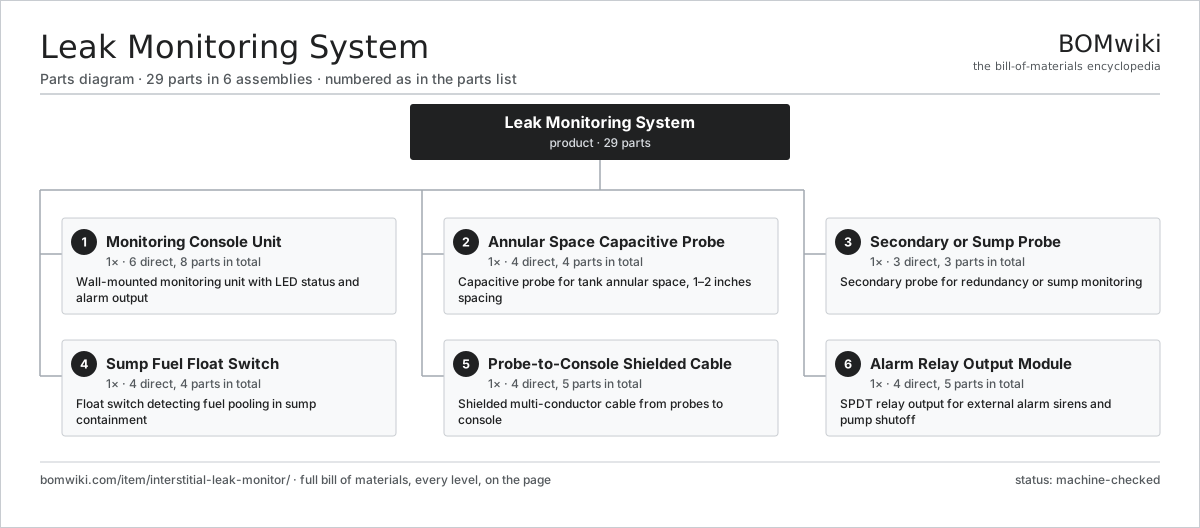
| # | Part | Qty | What it does |
|---|---|---|---|
| 1 | Monitoring Console Unit 6 parts | 1× | Wall-mounted monitoring unit with LED status and alarm output |
| 2 | Annular Space Capacitive Probe 4 parts | 1× | Capacitive probe for tank annular space, 1–2 inches spacing |
| 3 | Secondary or Sump Probe 3 parts | 1× | Secondary probe for redundancy or sump monitoring |
| 4 | Sump Fuel Float Switch 4 parts | 1× | Float switch detecting fuel pooling in sump containment |
| 5 | Probe-to-Console Shielded Cable 4 parts | 1× | Shielded multi-conductor cable from probes to console |
| 6 | Alarm Relay Output Module 4 parts | 1× | SPDT relay output for external alarm sirens and pump shutoff |
3D model
No 3D model yet. Have a CAD file of this? Add a 3D model — STL renders right on this page; STEP, FreeCAD, and OpenSCAD sources are welcome too (openly licensed, like all 3D models on BOMwiki).
Build & assembly graph
expand / collapse · shared sub-assemblies converge · links to related products · est. labourTap an assembly to expand/collapse · tap a part to open it · use “Open page” for any node · drag to pan, scroll to zoom.
Bill of materials for Leak Monitoring System
6 top-level lines · 31 rows shown · 29 parts total · indented to 3 levels| # | Item / sub-assembly | Part no. | Qty/assy | Ext. qty | Parts | Type |
|---|---|---|---|---|---|---|
| 1 | Monitoring Console Unit 6 parts | interstitial-leak-monitor-console | 1× | 1 | 8 | assembly |
| 1.1 | Microcontroller Board | interstitial-leak-monitor-cpu-board | 1× | 1 | · | part |
| 1.2 | Regulated Power Supply | interstitial-leak-monitor-power-supply | 1× | 1 | · | part |
| 1.3 | Console Enclosure | interstitial-leak-monitor-enclosure | 1× | 1 | · | part |
| 1.4 | Status LED Indicator | interstitial-leak-monitor-led-indicators | 3× | 3 | · | part |
| 1.5 | Relay | relay | 1× | 1 | · | part |
| 1.6 | SMD Passive (R/C/L) | smd-passives | 1× | 1 | · | part |
| 2 | Annular Space Capacitive Probe 4 parts | interstitial-leak-monitor-probe-1 | 1× | 1 | 4 | assembly |
| 2.1 | Probe Electrode | interstitial-leak-monitor-probe-electrode | 1× | 1 | · | part |
| 2.2 | Probe Housing | interstitial-leak-monitor-probe-housing | 1× | 1 | · | part |
| 2.3 | Probe Connector | interstitial-leak-monitor-probe-connector | 1× | 1 | · | part |
| 2.4 | Connector | connector | 1× | 1 | · | part |
| 3 | Secondary or Sump Probe 3 parts | interstitial-leak-monitor-probe-2 | 1× | 1 | 3 | assembly |
| 3.1 | Probe Electrode | interstitial-leak-monitor-probe-electrode | 1× | 1 | · | part |
| 3.2 | Probe Housing | interstitial-leak-monitor-probe-housing | 1× | 1 | · | part |
| 3.3 | Probe Connector | interstitial-leak-monitor-probe-connector | 1× | 1 | · | part |
| 4 | Sump Fuel Float Switch 4 parts | interstitial-leak-monitor-sump-float | 1× | 1 | 4 | assembly |
| 4.1 | Float Ball | interstitial-leak-monitor-float-ball | 1× | 1 | · | part |
| 4.2 | Floating Magnet | interstitial-leak-monitor-float-magnet | 1× | 1 | · | part |
| 4.3 | Reed Switch | interstitial-leak-monitor-float-switch | 1× | 1 | · | part |
| 4.4 | Connector | connector | 1× | 1 | · | part |
| 5 | Probe-to-Console Shielded Cable 4 parts | interstitial-leak-monitor-cabling | 1× | 1 | 5 | assembly |
| 5.1 | Cable Twisted Pair | interstitial-leak-monitor-cable-conductors | 1× | 1 | · | part |
| 5.2 | Cable Shield Braid | interstitial-leak-monitor-cable-shield | 1× | 1 | · | part |
| 5.3 | Cable Outer Jacket | interstitial-leak-monitor-cable-jacket | 1× | 1 | · | part |
| 5.4 | Connector | connector | 2× | 2 | · | part |
| 6 | Alarm Relay Output Module 4 parts | interstitial-leak-monitor-alarm-relay | 1× | 1 | 5 | assembly |
| 6.1 | Relay | relay | 1× | 1 | · | part |
| 6.2 | Relay Driver IC | interstitial-leak-monitor-relay-driver | 1× | 1 | · | part |
| 6.3 | SMD Passive (R/C/L) | smd-passives | 1× | 1 | · | part |
| 6.4 | Connector | connector | 2× | 2 | · | part |
Sourcing: possible vendors
Prices, MOQ, and lead times are algorithmic estimates, not quotes, and not claims about these companies. Company mappings are curated by keyword; est. price band $5k–$50M. How estimates work| Vendor | HQ | Specialty | MOQ | Lead time |
|---|---|---|---|---|
| gevernova.com ↗ | Cambridge, US | Power generation | made to order | 20–40 wks |
| siemens-energy.com ↗ | Munich, DE | Power & grid | made to order | 20–40 wks |
| hitachienergy.com ↗ | Zurich, CH | Grid & transformers | made to order | 20–40 wks |
|
🇨🇭ABB
abb.com ↗
|
Zurich, CH | Electrification & automation | made to order | 20–40 wks |
| se.com ↗ | Rueil-Malmaison, FR | Electrical & automation | made to order | 20–40 wks |
1,162-word article