Ion Thruster
ProductOverview
An ion thruster abandons the central trick of chemical rockets, using the propellant's own chemical energy, and instead accelerates propellant electrostatically with externally supplied electric power. A chemical engine tops out near 4.5 km/s exhaust velocity because that is all the energy the bonds contain. An ion thruster routinely exhausts xenon at 30–40 km/s, so each kilogram of propellant buys roughly ten times the momentum. The price is thrust: at 2.3 kW this engine produces about 100 mN, the weight of a sheet of paper. It earns its keep by running for years, geostationary stationkeeping, orbit raising, and deep-space cruises where total impulse matters and hurry does not.
The machine has three plasma elements, the Discharge Chamber, the Ion Optics Assembly, and two hollow cathodes, plus a Power Processing Unit and a Xenon Feed System that supply them.
Making the plasma
Xenon enters through the Main Flow Distributor at a few milligrams per second. The Discharge Hollow Cathode emits electrons: inside it, a porous tungsten BaO Emitter Insert impregnated with barium oxide thermionically emits at about 1,100 °C, pre-heated for ignition by the Cathode Heater and started against the Keeper Electrode electrode. These electrons fall toward the Anode Shell anode through a 25 V discharge, and on the way they ionize xenon atoms by impact.
A 25 V electron crossing a 30 cm chamber once would mostly miss. The Ring-Cusp Magnet Ring sets solve this: samarium-cobalt rings create a ring-cusp magnetic field that reflects electrons back into the volume again and again until they have spent their energy on ionization. This is why modern thrusters convert over 90% of the xenon flow into ions while spending only ~150 W of discharge power per ampere of beam.
Accelerating the beam
The plasma sits at +1,100 V because the whole discharge chamber floats on the Beam Supply, isolated from the grounded feed system by the ceramic High-Voltage Isolator. Ions drifting to the chamber exit meet the Screen Grid, whose ~15,000 apertures focus them into beamlets, and then the Accelerator Grid 0.6 mm downstream at −250 V. Across that gap each ion gains the full 1,100 eV, leaving at about 40 km/s. The negative accel bias also walls off beam electrons that would otherwise stream backward into the chamber.
The thruster ejects positive charge, so the spacecraft would charge negative within microseconds and pull the beam back. The Neutralizer Cathode, a second hollow cathode beside the beam, injects an exactly matching electron current, keeping beam and vehicle neutral.
Lifetime is set by an erosion process: slow charge-exchange collisions in the gap create low-energy ions that fall into the accel grid and sputter it, gradually enlarging its holes. The Accel Grid Supply current is the standard health telemetry for this wear. Flight units have demonstrated more than 30,000 hours before grid geometry degrades.
Power and propellant management
The Power Processing Unit converts a 100 V class spacecraft bus into six floating outputs at about 94% efficiency, dumping its ~400 W of losses through the PPU Chassis baseplate. Its hardest job is the arc recycle: the grids occasionally flash over, and the beam supply must collapse its output in microseconds, pause, and ramp back without help from the ground, hundreds of times over a mission, harmlessly.
The Xenon Feed System spans seven orders of magnitude in pressure: 150 bar in the Xenon Tank, ~2.5 bar after the High-Pressure Regulator, and millibar in the chamber. Three branches, main, cathode, neutralizer, are split by Calibrated Flow Restrictor elements and trimmed by Proportional Flow Valve valves; thrust setpoint is essentially a coordinated change of beam current and main flow.
Because the engine burns for thousands of hours, the thrust vector must pass through the spacecraft's centre of mass as tanks drain; the two-axis Thruster Gimbal makes those corrections a few degrees at a time, fed through the High-Voltage Cable service loops of the High-Voltage Harness.
Ion Thruster parts and their functions
8 top-level parts · 880 parts in total · full bill of materials below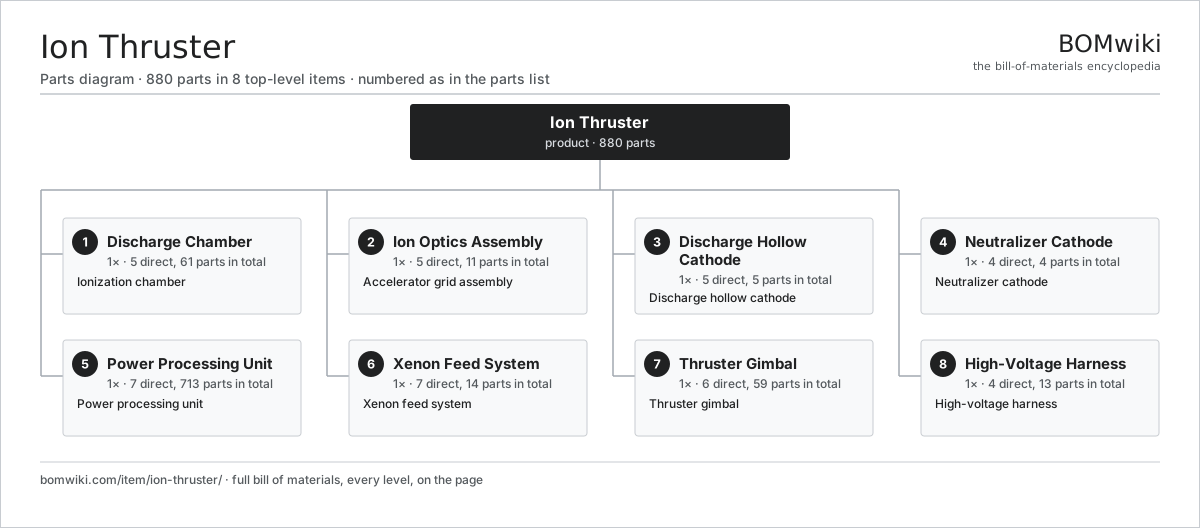
| # | Part | Qty | What it does |
|---|---|---|---|
| 1 | Discharge Chamber 5 parts | 1× | Ionization chamber |
| 2 | Ion Optics Assembly 5 parts | 1× | Accelerator grid assembly |
| 3 | Discharge Hollow Cathode 5 parts | 1× | Discharge hollow cathode |
| 4 | Neutralizer Cathode 4 parts | 1× | Neutralizer cathode |
| 5 | Power Processing Unit 7 parts | 1× | Power processing unit |
| 6 | Xenon Feed System 7 parts | 1× | Xenon feed system |
| 7 | Thruster Gimbal 6 parts | 1× | Thruster gimbal |
| 8 | High-Voltage Harness 4 parts | 1× | High-voltage harness |
Diagrams & photos

3D model
No 3D model yet. Have a CAD file of this? Add a 3D model. STL renders right on this page; STEP, FreeCAD, and OpenSCAD sources are welcome too (openly licensed, like all 3D models on BOMwiki).
Build & assembly graph
expand / collapse · shared sub-assemblies converge · links to related products · est. labourTap an assembly to expand/collapse · tap a part to open it · use “Open page” for any node · drag to pan, scroll to zoom.
Bill of materials for Ion Thruster
8 top-level lines · 70 rows shown · 880 parts total · indented to 3 levels| # | Item / sub-assembly | Part no. | Qty/assy | Ext. qty | Parts | Type |
|---|---|---|---|---|---|---|
| 1 | Discharge Chamber 5 parts | ion-thruster-discharge-chamber | 1× | 1 | 61 | assembly |
| 1.1 | Anode Shell | ion-thruster-chamber-shell | 1× | 1 | · | part |
| 1.2 | Ring-Cusp Magnet Ring 2 parts | ion-thruster-cusp-magnet-ring | 3× | 3 | 19 | assembly |
| 1.2.1 | Neodymium Magnet | neodymium-magnet | 18× | 54 | · | part |
| 1.2.2 | Magnet Retainer Ring | ion-thruster-magnet-retainer | 1× | 3 | · | part |
| 1.3 | Main Flow Distributor | ion-thruster-propellant-manifold | 1× | 1 | · | part |
| 1.4 | High-Voltage Isolator | ion-thruster-chamber-isolator | 1× | 1 | · | part |
| 1.5 | Rear Plenum Plate | ion-thruster-backplate | 1× | 1 | · | part |
| 2 | Ion Optics Assembly 5 parts | ion-thruster-ion-optics | 1× | 1 | 11 | assembly |
| 2.1 | Screen Grid | ion-thruster-screen-grid | 1× | 1 | · | part |
| 2.2 | Accelerator Grid | ion-thruster-accel-grid | 1× | 1 | · | part |
| 2.3 | Grid Mount Ring | ion-thruster-grid-mount-ring | 2× | 2 | · | part |
| 2.4 | Grid Standoff Insulator | ion-thruster-grid-insulator | 6× | 6 | · | part |
| 2.5 | Fastener Set | fastener-set | 1× | 1 | · | part |
| 3 | Discharge Hollow Cathode 5 parts | ion-thruster-discharge-cathode | 1× | 1 | 5 | assembly |
| 3.1 | BaO Emitter Insert | ion-thruster-cathode-insert | 1× | 1 | · | part |
| 3.2 | Cathode Tube | ion-thruster-cathode-tube | 1× | 1 | · | part |
| 3.3 | Cathode Heater | ion-thruster-cathode-heater | 1× | 1 | · | part |
| 3.4 | Keeper Electrode | ion-thruster-keeper | 1× | 1 | · | part |
| 3.5 | Cathode Orifice Plate | ion-thruster-cathode-orifice | 1× | 1 | · | part |
| 4 | Neutralizer Cathode 4 parts | ion-thruster-neutralizer | 1× | 1 | 4 | assembly |
| 4.1 | BaO Emitter Insert | ion-thruster-cathode-insert | 1× | 1 | · | part |
| 4.2 | Cathode Tube | ion-thruster-cathode-tube | 1× | 1 | · | part |
| 4.3 | Cathode Heater | ion-thruster-cathode-heater | 1× | 1 | · | part |
| 4.4 | Keeper Electrode | ion-thruster-keeper | 1× | 1 | · | part |
| 5 | Power Processing Unit 7 parts | ion-thruster-ppu | 1× | 1 | 713 | assembly |
| 5.1 | Beam Supply 5 parts | ion-thruster-beam-supply | 1× | 1 | 313 | assembly |
| 5.1.1 | Bare PCB | pcb-bare | 2× | 2 | · | part |
| 5.1.2 | Power MOSFET | mosfet | 8× | 8 | · | part |
| 5.1.3 | IGBT Power Module | igbt-module | 2× | 2 | · | part |
| 5.1.4 | HV Transformer | ion-thruster-hv-transformer | 1× | 1 | · | part |
| 5.1.5 | SMD Passive (R/C/L) | smd-passives | 300× | 300 | · | part |
| 5.2 | Discharge Supply 4 parts | ion-thruster-discharge-supply | 1× | 1 | 209 | assembly |
| 5.2.1 | Bare PCB | pcb-bare | 1× | 1 | · | part |
| 5.2.2 | Power MOSFET | mosfet | 6× | 6 | · | part |
| 5.2.3 | SMD Passive (R/C/L) | smd-passives | 200× | 200 | · | part |
| 5.2.4 | Connector | connector | 2× | 2 | · | part |
| 5.3 | Accel Grid Supply | ion-thruster-accel-supply | 1× | 1 | · | part |
| 5.4 | Heater/Keeper Supply | ion-thruster-heater-keeper-supply | 2× | 2 | · | part |
| 5.5 | PPU Controller 4 parts | ion-thruster-ppu-controller | 1× | 1 | 186 | assembly |
| 5.5.1 | Bare PCB | pcb-bare | 1× | 1 | · | part |
| 5.5.2 | Microcontroller | mcu | 1× | 1 | · | part |
| 5.5.3 | SMD Passive (R/C/L) | smd-passives | 180× | 180 | · | part |
| 5.5.4 | Connector | connector | 4× | 4 | · | part |
| 5.6 | PPU Chassis | ion-thruster-ppu-chassis | 1× | 1 | · | part |
| 5.7 | Bus Input Filter | ion-thruster-input-filter | 1× | 1 | · | part |
| 6 | Xenon Feed System 7 parts | ion-thruster-xenon-feed | 1× | 1 | 14 | assembly |
| 6.1 | Xenon Tank | ion-thruster-xenon-tank | 1× | 1 | · | part |
| 6.2 | High-Pressure Regulator | ion-thruster-hp-regulator | 1× | 1 | · | part |
| 6.3 | Proportional Flow Valve | ion-thruster-flow-controller | 3× | 3 | · | part |
| 6.4 | Calibrated Flow Restrictor | ion-thruster-flow-restrictor | 3× | 3 | · | part |
| 6.5 | Latch Valve | ion-thruster-latch-valve | 2× | 2 | · | part |
| 6.6 | Pressure Sensor | pressure-sensor | 3× | 3 | · | part |
| 6.7 | Fill & Drain Valve | ion-thruster-fill-valve | 1× | 1 | · | part |
| 7 | Thruster Gimbal 6 parts | ion-thruster-gimbal | 1× | 1 | 59 | assembly |
| 7.1 | Gimbal Frame | ion-thruster-gimbal-frame | 1× | 1 | · | part |
| 7.2 | Servo Motor 4 parts | servo-motor | 2× | 2 | 24 | assembly |
| 7.2.1 | Stator Assembly 3 parts + deeper › | stator-assembly | 1× | 2 | 3 | assembly |
| 7.2.2 | Rotor Assembly 4 parts + deeper › | rotor-assembly | 1× | 2 | 19 | assembly |
| 7.2.3 | Encoder | encoder | 1× | 2 | · | part |
| 7.2.4 | Motor Housing | motor-housing | 1× | 2 | · | part |
| 7.3 | Helical Gear Pair | gear-pair | 2× | 2 | · | part |
| 7.4 | Encoder | encoder | 2× | 2 | · | part |
| 7.5 | Ball Bearing | ball-bearing | 4× | 4 | · | part |
| 7.6 | Gimbal Launch Lock | ion-thruster-launch-lock | 2× | 2 | · | part |
| 8 | High-Voltage Harness 4 parts | ion-thruster-harness | 1× | 1 | 13 | assembly |
| 8.1 | High-Voltage Cable | ion-thruster-hv-cable | 4× | 4 | · | part |
| 8.2 | HV Feedthrough Connector | ion-thruster-hv-connector | 4× | 4 | · | part |
| 8.3 | Wire Bundle | wire-bundle | 1× | 1 | · | part |
| 8.4 | Connector | connector | 4× | 4 | · | part |
Something wrong in this list? Report a problem with this BOM.
Related products
same domain, ranked by shared parts Communications Satellite
725 parts · shares 9 with this page
Communications Satellite
725 parts · shares 9 with this page
 Crewed Space Capsule
7,222 parts · shares 14 with this page
Crewed Space Capsule
7,222 parts · shares 14 with this page
 GPS Navigation Satellite
2,640 parts · shares 14 with this page
GPS Navigation Satellite
2,640 parts · shares 14 with this page
 Rocket Upper Stage
1,459 parts · shares 14 with this page
Rocket Upper Stage
1,459 parts · shares 14 with this page
 Weather Satellite
1,765 parts · shares 14 with this page
Weather Satellite
1,765 parts · shares 14 with this page
 Planetary Rover
1,805 parts · shares 13 with this page
Planetary Rover
1,805 parts · shares 13 with this page
Sourcing: possible vendors
Browse the supplier directory → Prices, MOQ, and lead times are algorithmic estimates, not quotes, and not claims about these companies. Company mappings are curated by keyword; est. price band $50k–$500M. How estimates work| Vendor | HQ | Specialty | MOQ | Lead time |
|---|---|---|---|---|
|
🇺🇸SpaceX
spacex.com ↗
|
Hawthorne, US | Launch & spacecraft | made to order | 52–104 wks |
| northropgrumman.com ↗ | Falls Church, US | Space & defense | made to order | 52–104 wks |
|
🇫🇷Airbus
airbus.com ↗
|
Toulouse, FR | Aerospace OEM | made to order | 52–104 wks |
| rocketlabusa.com ↗ | Long Beach, US | Launch & spacecraft | made to order | 52–104 wks |
| thalesaleniaspace.com ↗ | Cannes, FR | Satellites | made to order | 52–104 wks |
707-word article