Jewelry Laser Welder
ProductOverview
A jewelry laser welder is a precision micro-welding system using a pulsed Nd:YAG laser to join metal components without solder or chemical flux. A laser pulse lasting milliseconds heats a tiny spot (50–200 μm diameter) to 2000–3000 K, melting the metal locally and forming a bond. Argon gas shields the melt from oxidation. The result is a weld seam invisible to the naked eye, strong enough to pass pressure tests, and with no heat distortion of surrounding metal, critical for delicate jewelry where traditional torch soldering would anneal hardened metal or burn enamel and stone settings.
Laser welding is used for ring sizing, repairing broken clasps, joining white-gold bezels to yellow-gold bands, mending platinum settings, and fusing sheet metal seams in pendant fabrication. It is also essential for dental crown repair, hearing aid assembly, and delicate watch escapement work, anywhere precision, minimal heat, and high-strength welds are required.
How it works
The operator loads a jewelry component onto the XYZ precision stage inside the work chamber. The component is positioned under the stereo microscope, which provides 20–40× magnification. A crosshair or dot in the microscope eyepiece marks the exact point where the laser will fire.
Using the foot pedal, the operator positions the part precisely by moving the micrometer-controlled stage screws. The LED ring light illuminates the part, casting no shadows. Once positioned, the operator depresses the foot pedal; this simultaneously (1) triggers the argon purge solenoid to flood the chamber with inert gas, and (2) discharges the capacitor bank through the xenon flash tubes, triggering the Nd:YAG laser.
The laser emits a pulse of 1064 nm infrared light lasting 0.5–5 milliseconds. This light travels through the optics assembly, dichroic beamsplitter, turning mirrors, and focusing lens, and is focused to a spot 50–200 μm diameter on the metal. The focused intensity is 10⁷–10⁸ W/cm², sufficient to melt most metals.
The laser pulse is absorbed by the metal (gold, silver, platinum, titanium all have good 1064 nm absorptivity), raising the spot temperature to 2000–3000 K. A molten pool forms, typically 0.3–1.0 mm diameter. The argon gas flowing from the solenoid shields the melt from atmospheric oxygen, preventing oxidation and maintaining weld strength. The pulse ends, the laser cools, and the mold freezes in 1–5 milliseconds, forming a solid weld seam.
The operator can fire multiple pulses in sequence, stepping the component laterally to create a continuous seam, or fire single pulses to build up filler metal if both pieces are held edge-to-edge. Typical small jewelry welds (ring sizing or clasp repair) require 1–3 pulses; larger seams may require 5–20 pulses spaced 0.5–2 mm apart.
Laser Physics and Nd:YAG Technology
The Nd:YAG laser is a solid-state laser: a crystal rod of YAG (yttrium aluminum garnet) doped with neodymium ions is optically pumped by bright light from xenon flash tubes. The neodymium ions absorb green/yellow light from the xenon flash (producing excited state ⁴F₃/₂), then decay back to the ground state, emitting 1064 nm infrared photons in a coherent laser cavity bounded by two mirrors.
The output is not continuous; instead, each capacitor discharge (typically 1–5 times per second) triggers one xenon flash, which pumps one laser pulse. The pulse shape is roughly square-wave: rising in 0.5–1 ms to peak power (50–200 W), then falling back to zero in 1–5 ms. Pulse energy varies from 0.1 to 1 joule depending on capacitor voltage and flash-tube efficiency.
The 1064 nm wavelength is near-infrared, invisible to the eye but readily absorbed by most metals. Copper and gold are excellent absorbers (~0.5–0.7 absorptivity); platinum is very reflective at 1064 nm (~0.7 reflectivity) but can still be welded by using extended pulse widths or slightly defocused beams to allow energy buildup. Aluminum and titanium are also strong absorbers.
Optics and Beam Delivery
The optics system guides the 1064 nm beam coaxially with the microscope, so what the operator sees under magnification is exactly where the laser will hit. This is achieved using a dichroic beamsplitter, an optical coating that is highly reflective to 1064 nm but transmits visible light (the microscope illumination and the part itself are visible through this mirror).
The 1064 nm beam bounces off the dichroic and is redirected by gold-coated mirrors to a focusing lens (usually zinc selenide, which is transparent to infrared). The lens focuses the beam to a small spot; the focal length is typically 50–100 mm, and the numerical aperture is chosen to yield a 50–200 μm spot diameter at the workpiece. Smaller spot = higher intensity and precision, but shallower depth of field (harder to keep in focus).
A mechanical solenoid shutter blocks the beam path when the laser is not firing, preventing accidental exposure or degradation of optics from stray 1064 nm light.
Cooling and Power Management
The laser rod and flash tubes generate significant waste heat, roughly 80–90% of input electrical energy is lost as heat. A water chiller circulates coolant through a jacket surrounding the laser assembly, maintaining temperatures below 40°C to prevent crystal damage and maintain lasing efficiency. Thermoelectric chillers are compact (no refrigerant needed) but less efficient; larger production systems use refrigerant-based chillers.
The high-voltage power supply charges a capacitor bank to 300–500V. When the operator presses the foot pedal, a solid-state relay discharges the capacitor through the xenon flash tubes in a very short pulse (1–2 milliseconds), delivering peak current of 100–1000 amps. Pulse energy = ½CV², so a 100 μF capacitor at 400V stores 8 joules; after losses in the lamp, perhaps 1–2 joules reaches the laser crystal as green/yellow light.
Safety
The 1064 nm laser light is invisible; human eyes cannot detect the beam visually but can be severely damaged if pointed into the eye (retinal burns, vision loss). All commercial systems include a safety interlock switch that disables the high-voltage supply if the chamber door is opened, preventing accidental exposure. Operators always wear protective eyewear (laser safety goggles) blocking 1064 nm during alignment or troubleshooting.
The xenon flash tubes operate at 300–500V DC, capable of delivering lethal current; the power supply enclosure is interlocked and capacitor banks are bled down when the unit is powered off.
Applications and Workflow
Ring sizing: a jeweler cuts a ring open with a jewelry saw, files the edges flat, positions the gap under the laser, and fires 2–4 pulses to weld the seam. The heat shrinks the total circumference by a small amount, reducing ring size. Alternatively, solder can be avoided entirely.
Clasp repair: broken jump rings and clasp hooks are positioned with the break edges touching, and 1–2 pulses fuse the joint. The weld is strong enough to pass tensile testing.
Stone setting repair: if a stone bezel is cracked or the setting damaged, the laser can be used to join broken bezels or weld a replacement bezel cup without burning the stone itself (the beam is focused below the bezel, heating the metal while the stone remains cooler).
White-to-yellow gold joining: custom jewelry often mixes metal colors (white-gold settings on yellow-gold bands). Laser welding joins these without the color shift that traditional soldering can cause (solder is often a lighter alloy that visibly changes the color at the joint).
Production throughput: a skilled operator can position and weld a simple join in 30–60 seconds, making 20–40 welds per hour feasible. Batch production of 50–100 identical items is common in dental labs and fine jewelry shops.
Maintenance and Troubleshooting
The xenon flash tubes degrade over time (output drops after 10,000–100,000 pulses); they are replaced every 1–2 years or when output power falls below 80% of rated value. The laser rod can last 10,000–50,000 hours depending on pump power; darkening of the crystal indicates end-of-life.
Cooling system maintenance: coolant should be changed annually; mineral buildup or algae growth reduces cooling efficiency and can clog narrow passages. The coolant filter should be inspected quarterly.
Alignment: if the laser spot no longer coincides with the crosshair, mirrors have shifted. Professional realignment typically requires disassembly and optical-bench work; most shops send units to manufacturers for this (cost: USD 200–500).
Jewelry Laser Welder parts and their functions
7 top-level parts · 41 parts in total · full bill of materials below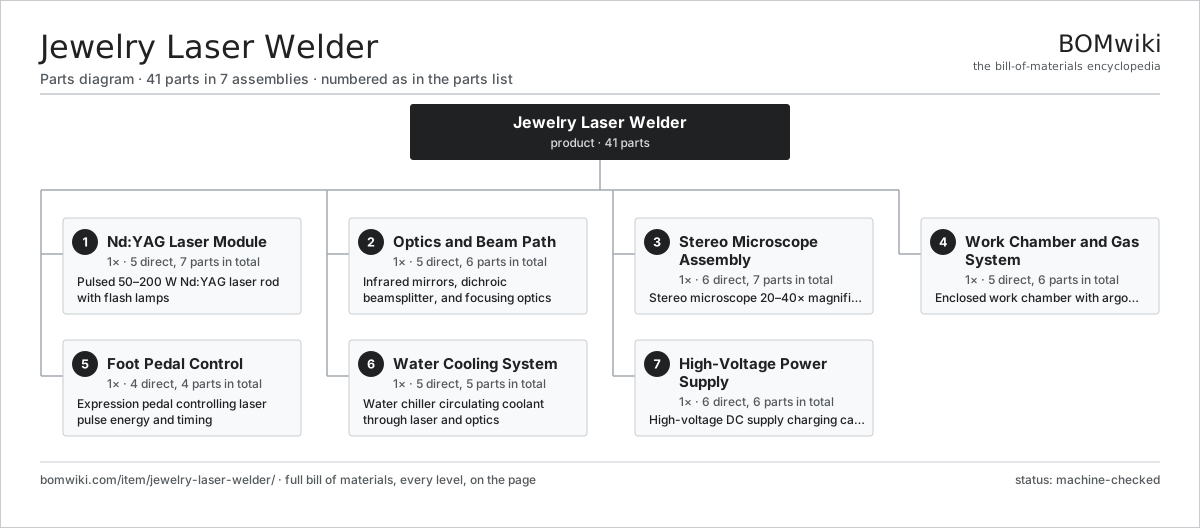
| # | Part | Qty | What it does |
|---|---|---|---|
| 1 | Nd:YAG Laser Module 5 parts | 1× | Pulsed 50–200 W Nd:YAG laser rod with flash lamps |
| 2 | Optics and Beam Path 5 parts | 1× | Infrared mirrors, dichroic beamsplitter, and focusing optics |
| 3 | Stereo Microscope Assembly 6 parts | 1× | Stereo microscope 20–40× magnification with coaxial illumination |
| 4 | Work Chamber and Gas System 5 parts | 1× | Enclosed work chamber with argon purge system |
| 5 | Foot Pedal Control 4 parts | 1× | Expression pedal controlling laser pulse energy and timing |
| 6 | Water Cooling System 5 parts | 1× | Water chiller circulating coolant through laser and optics |
| 7 | High-Voltage Power Supply 6 parts | 1× | High-voltage DC supply charging capacitor bank for laser |
3D model
No 3D model yet. Have a CAD file of this? Add a 3D model — STL renders right on this page; STEP, FreeCAD, and OpenSCAD sources are welcome too (openly licensed, like all 3D models on BOMwiki).
Build & assembly graph
expand / collapse · shared sub-assemblies converge · links to related products · est. labourTap an assembly to expand/collapse · tap a part to open it · use “Open page” for any node · drag to pan, scroll to zoom.
Bill of materials for Jewelry Laser Welder
7 top-level lines · 43 rows shown · 41 parts total · indented to 3 levels| # | Item / sub-assembly | Part no. | Qty/assy | Ext. qty | Parts | Type |
|---|---|---|---|---|---|---|
| 1 | Nd:YAG Laser Module 5 parts | jewelry-laser-welder-laser-head | 1× | 1 | 7 | assembly |
| 1.1 | Nd:YAG Laser Rod | jewelry-laser-welder-laser-rod | 1× | 1 | · | part |
| 1.2 | Xenon Flash Tube | jewelry-laser-welder-flash-lamp | 2× | 2 | · | part |
| 1.3 | Cavity Mirror | jewelry-laser-welder-resonator-mirror | 2× | 2 | · | part |
| 1.4 | Laser Rod Chamber | jewelry-laser-welder-rod-chamber | 1× | 1 | · | part |
| 1.5 | Coolant Jacket | jewelry-laser-welder-coolant-jacket | 1× | 1 | · | part |
| 2 | Optics and Beam Path 5 parts | jewelry-laser-welder-optics-assembly | 1× | 1 | 6 | assembly |
| 2.1 | Dichroic Beamsplitter | jewelry-laser-welder-dichroic-mirror | 1× | 1 | · | part |
| 2.2 | Turning Mirror | jewelry-laser-welder-turning-mirror | 2× | 2 | · | part |
| 2.3 | Focusing Lens | jewelry-laser-welder-focus-lens | 1× | 1 | · | part |
| 2.4 | Beam Shutter | jewelry-laser-welder-shutter | 1× | 1 | · | part |
| 2.5 | Optics Bench | jewelry-laser-welder-optics-mount | 1× | 1 | · | part |
| 3 | Stereo Microscope Assembly 6 parts | jewelry-laser-welder-microscope | 1× | 1 | 7 | assembly |
| 3.1 | Microscope Body | jewelry-laser-welder-microscope-body | 1× | 1 | · | part |
| 3.2 | Objective Lens | jewelry-laser-welder-objective-lens | 1× | 1 | · | part |
| 3.3 | Eyepieces | jewelry-laser-welder-eyepieces | 2× | 2 | · | part |
| 3.4 | Precision XYZ Stage | jewelry-laser-welder-focuser-stage | 1× | 1 | · | part |
| 3.5 | LED Ring Illuminator | jewelry-laser-welder-illuminator | 1× | 1 | · | part |
| 3.6 | Crosshair Reticle | jewelry-laser-welder-crosshair-reticle | 1× | 1 | · | part |
| 4 | Work Chamber and Gas System 5 parts | jewelry-laser-welder-welding-chamber | 1× | 1 | 6 | assembly |
| 4.1 | Chamber Enclosure | jewelry-laser-welder-chamber-body | 1× | 1 | · | part |
| 4.2 | Chamber Optical Window | jewelry-laser-welder-chamber-window | 2× | 2 | · | part |
| 4.3 | Argon Pressure Regulator | jewelry-laser-welder-argon-regulator | 1× | 1 | · | part |
| 4.4 | Purge Solenoid | jewelry-laser-welder-chamber-purge-valve | 1× | 1 | · | part |
| 4.5 | Exhaust Port | jewelry-laser-welder-exhaust-port | 1× | 1 | · | part |
| 5 | Foot Pedal Control 4 parts | jewelry-laser-welder-foot-pedal | 1× | 1 | 4 | assembly |
| 5.1 | Pedal Housing | jewelry-laser-welder-pedal-body | 1× | 1 | · | part |
| 5.2 | Expression Pot | jewelry-laser-welder-potentiometer | 1× | 1 | · | part |
| 5.3 | Pedal Momentary Switch | jewelry-laser-welder-pedal-switch | 1× | 1 | · | part |
| 5.4 | Pedal Cable | jewelry-laser-welder-pedal-cable | 1× | 1 | · | part |
| 6 | Water Cooling System 5 parts | jewelry-laser-welder-cooling-system | 1× | 1 | 5 | assembly |
| 6.1 | Thermoelectric Chiller | jewelry-laser-welder-chiller-unit | 1× | 1 | · | part |
| 6.2 | Coolant Pump | jewelry-laser-welder-coolant-pump | 1× | 1 | · | part |
| 6.3 | Coolant Tank | jewelry-laser-welder-coolant-reservoir | 1× | 1 | · | part |
| 6.4 | Coolant Hose | jewelry-laser-welder-coolant-line | 1× | 1 | · | part |
| 6.5 | Coolant Filter | jewelry-laser-welder-coolant-filter | 1× | 1 | · | part |
| 7 | High-Voltage Power Supply 6 parts | jewelry-laser-welder-power-supply | 1× | 1 | 6 | assembly |
| 7.1 | Step-up Transformer | jewelry-laser-welder-transformer | 1× | 1 | · | part |
| 7.2 | Silicon Rectifier Stack | jewelry-laser-welder-rectifier | 1× | 1 | · | part |
| 7.3 | High-Voltage Capacitor Bank | jewelry-laser-welder-high-voltage-cap | 1× | 1 | · | part |
| 7.4 | High-Voltage Relay | jewelry-laser-welder-supply-relay | 1× | 1 | · | part |
| 7.5 | Supply Filter | jewelry-laser-welder-supply-filter | 1× | 1 | · | part |
| 7.6 | Safety Interlock Switch | jewelry-laser-welder-safety-interlock | 1× | 1 | · | part |
Sourcing: possible vendors
Prices, MOQ, and lead times are algorithmic estimates, not quotes, and not claims about these companies. Company mappings are curated by keyword; est. price band $10k–$1M. How estimates work| Vendor | HQ | Specialty | MOQ | Lead time |
|---|---|---|---|---|
|
🇩🇪DMG MORI
dmgmori.com ↗
|
Bielefeld, DE | Machine tools | 5 units | 12–20 wks |
|
🇯🇵Mazak
mazak.com ↗
|
Oguchi, JP | Machine tools | 5 units | 12–20 wks |
| haascnc.com ↗ | Oxnard, US | CNC machine tools | 5 units | 12–20 wks |
|
🇯🇵Okuma
okuma.com ↗
|
Niwa, JP | Machine tools | 5 units | 12–20 wks |
|
🇩🇪Trumpf
trumpf.com ↗
|
Ditzingen, DE | Laser & sheet-metal machines | 5 units | 12–20 wks |
1,559-word article