JTAG Debug Probe
ProductOverview
A JTAG debug probe is a compact hardware adapter connecting a development workstation to embedded systems via the Joint Test Action Group (JTAG) interface standard. JTAG is ubiquitous in embedded systems, implemented in virtually every modern microcontroller, FPGA, and ASIC. The debug probe translates between USB (or Ethernet) commands from the host development environment (GDB, IAR Embedded Workbench, Keil uVision) and JTAG serial protocol, enabling in-circuit debugging, memory read/write, and flash programming without removing the device from its circuit board.
JTAG debug probes range from simple passive adapters (converting USB to raw TTL signals, relying on the host to implement timing) to sophisticated standalone systems with embedded protocol processors. Modern probes include TAP state machine hardware allowing microsecond-precision timing independent of host OS jitter. This is critical for devices with strict JTAG clock timing requirements or high-speed processors.
How it Works
The host interface is enumerated by the development PC as a USB CDC (Communications Device Class) or vendor-specific device. When the IDE initiates a debug session, it sends commands to the probe: "read memory at 0x20000000," "step until breakpoint," "write 0xDEADBEEF to register R0." The MCU firmware parses these commands and translates them into JTAG protocol sequences.
JTAG is a serial protocol with four signal lines: TCK (test clock), TMS (test mode select), TDI (test data in), TDO (test data out). The TAP controller drives these signals at precise timing intervals. The TMS signal steers the target device's internal state machine through a defined sequence: shifting instruction bits into the device, then data bits into a scan chain that reads/writes memories or registers.
A typical debug operation: reading a 32-bit memory word at address 0x20000000 on an ARM Cortex-M processor involves six JTAG commands:
- Issue DPACC (debug port access) instruction to the device.
- Shift in address 0x20000000 on TDI.
- Clock the device's internal circuitry to perform the memory access.
- Shift out the resulting 32-bit data value on TDO.
- Repeat as needed for multiple words.
The voltage translators protect the host (running at 3.3V logic) from target signals that might be 5V, 1.8V, or even higher. If the target accidentally drives a JTAG signal beyond safe limits (e.g., due to a short circuit), the series resistors limit fault current, preventing latch-up of the probe's I/O pins.
Scan Chain Architecture
The target device contains one or more scan chains, shift registers connected in series. When the TAP controller issues a scan shift operation, all cells in the chain shift simultaneously at the TCK rate. The leftmost cell (connected to TDI) receives the new bit value; the rightmost cell (connected to TDO) outputs the bit that was in that position. After N clock cycles (where N is the chain length), the probe has shifted out N bits representing device internal state (register values, memory contents, etc.).
Multiple devices can be chained in series, with TDO of one device connected to TDI of the next. The TAP controller then shifts N1 + N2 + ... + Nn bits (where Ni is chain i length) to read/write all devices simultaneously. This is why high-complexity systems with many FPGAs or SoCs benefit from JTAG debugging: a single probe can debug all components without additional wiring.
Development Environment Integration
GDB (GNU Debugger), IAR Embedded Workbench, and Segger J-Link (a popular standalone JTAG probe) all standardize on the same command-line interface. When a developer hits a breakpoint or sets a watchpoint, the IDE sends high-level debug commands to the probe. The probe firmware converts these to JTAG sequences and reports results back. This abstraction means a developer never writes JTAG code directly, the toolchain handles it.
Sophisticated probes (like Segger J-Link Pro) cache breakpoint conditions inside the probe itself, reducing USB round-trip latency. When the target hits a breakpoint, the probe logs the event and freezes the processor without notifying the host immediately. The developer can then inspect memory and registers while the target remains paused.
In-System Flash Programming
JTAG is the primary mechanism for programming FPGAs and microcontrollers in production boards. The TAP controller sequences the target's flash programmer state machine, transferring firmware images at 10–50 MB/s (depending on target speed and USB bandwidth). This is faster than serial bootloaders and enables field firmware updates in deployed systems.
ARM-based microcontrollers often support JTAG-based flash programming via the ROM bootloader, allowing a developer to reprogram device flash without knowing device-specific flash controller details. The TAP handles all timing and error-checking.
Optional Features
High-end probes incorporate optional buffering FPGAs capturing high-speed waveforms during debug sessions. For example, when debugging a processor that initializes memory at 100 MHz, the FPGA can capture address/data/control signals at full speed and transfer the recorded waveform to the host for offline analysis.
Some probes include optional target power supplies, providing 3.3V or regulated voltage to the target device under test. This simplifies single-board debugging by eliminating the need for a separate power supply or allowing the probe to measure target current consumption in real-time.
Voltage Translation and Signal Integrity
Modern embedded systems use mixed-voltage interfaces: 3.3V processors with 5V legacy sensors, or 1.8V I/O on high-speed chips. The bidirectional level shifters (typically TXB0104 or similar) translate on a per-signal basis. The FPGA configures each level shifter's supply voltage to match the target. If the target is 5V, the shifter's high-side supply is set to 5V; if 1.8V, it switches to 1.8V.
JTAG signals are relatively low-frequency (1–100 MHz) and short waveform (tens of nanoseconds per bit), so signal integrity is less critical than in high-speed buses. However, shielded probe cables with ferrite cores minimize EMI from switching power supplies and high-frequency switching devices in the target.
Standardization and Compatibility
The ARM JTAG standard defines a 20-pin keyed connector used by virtually all ARM processors (Cortex-M, Cortex-A). Other vendors (Microchip, TI) often follow this standard for ease of interoperability. Non-standard connectors exist (Segger, Altera proprietary), requiring custom cable adapters.
IEEE 1149.1 specifies the TAP protocol, ensuring that any standards-compliant probe can debug any standards-compliant device. However, manufacturers often implement device-specific debug extensions (vendor-specific JTAG instructions) that only their toolchains understand, limiting interoperability between vendor probes and devices.
Limitations and Alternatives
JTAG assumes the target device is alive (clocks running, power stable). Dead devices or those in low-power sleep modes may not respond to JTAG commands. Some devices support "JTAG wake-on-event" sequences to recover from sleep, but this is not universal.
For high-speed, non-intrusive debugging, some processors support real-time trace interfaces (Arm ETM, Embedded Trace Macrocell), which stream live instruction execution data to the probe at gigabit rates. JTAG alone cannot capture this; a high-bandwidth port (typically 4–8 parallel lines at 100+ MHz) is required. Modern probes often support both JTAG and parallel trace, making them suitable for advanced profiling work.
JTAG Debug Probe parts and their functions
7 top-level parts · 37 parts in total · full bill of materials below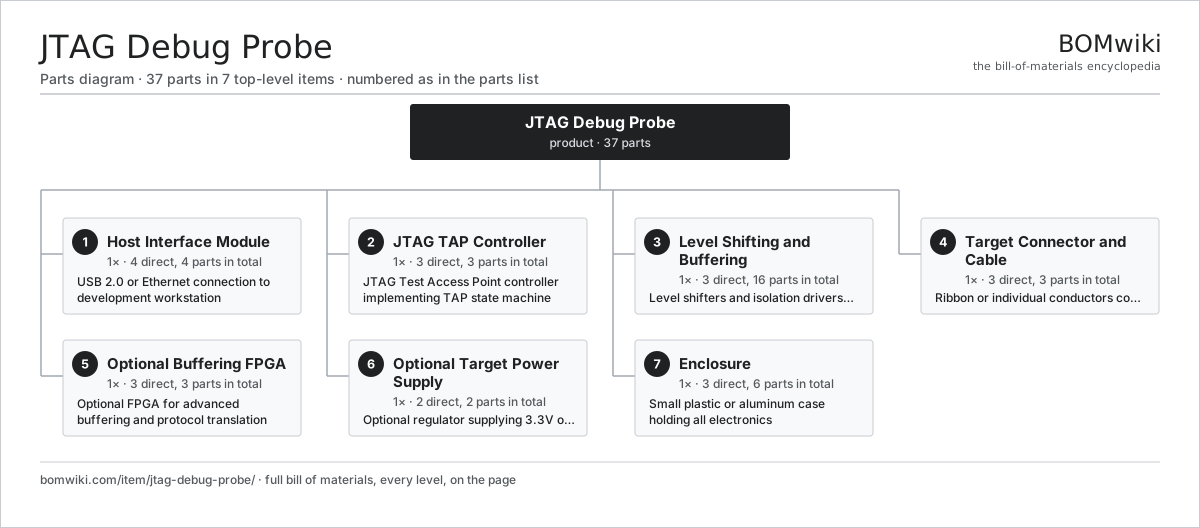
| # | Part | Qty | What it does |
|---|---|---|---|
| 1 | Host Interface Module 4 parts | 1× | USB 2.0 or Ethernet connection to development workstation |
| 2 | JTAG TAP Controller 3 parts | 1× | JTAG Test Access Point controller implementing TAP state machine |
| 3 | Level Shifting and Buffering 3 parts | 1× | Level shifters and isolation drivers for target signal protection |
| 4 | Target Connector and Cable 3 parts | 1× | Ribbon or individual conductors connecting to target device |
| 5 | Optional Buffering FPGA 3 parts | 1× | Optional FPGA for advanced buffering and protocol translation |
| 6 | Optional Target Power Supply 2 parts | 1× | Optional regulator supplying 3.3V or 5V to target device |
| 7 | Enclosure 3 parts | 1× | Small plastic or aluminum case holding all electronics |
3D model
No 3D model yet. Have a CAD file of this? Add a 3D model. STL renders right on this page; STEP, FreeCAD, and OpenSCAD sources are welcome too (openly licensed, like all 3D models on BOMwiki).
Build & assembly graph
expand / collapse · shared sub-assemblies converge · links to related products · est. labourTap an assembly to expand/collapse · tap a part to open it · use “Open page” for any node · drag to pan, scroll to zoom.
Bill of materials for JTAG Debug Probe
7 top-level lines · 28 rows shown · 37 parts total · indented to 3 levels| # | Item / sub-assembly | Part no. | Qty/assy | Ext. qty | Parts | Type |
|---|---|---|---|---|---|---|
| 1 | Host Interface Module 4 parts | jtag-debug-probe-host-interface | 1× | 1 | 4 | assembly |
| 1.1 | USB Physical Layer | jtag-debug-probe-usb-phy | 1× | 1 | · | part |
| 1.2 | Host MCU | jtag-debug-probe-mcu-host | 1× | 1 | · | part |
| 1.3 | Ethernet PHY | jtag-debug-probe-ethernet-phy | 1× | 1 | · | part |
| 1.4 | USB Connector | jtag-debug-probe-usb-connector | 1× | 1 | · | part |
| 2 | JTAG TAP Controller 3 parts | jtag-debug-probe-jtag-tap | 1× | 1 | 3 | assembly |
| 2.1 | TAP Controller IC | jtag-debug-probe-fpga-tap | 1× | 1 | · | part |
| 2.2 | Instruction Register | jtag-debug-probe-ir-register | 1× | 1 | · | part |
| 2.3 | Data Register Chain | jtag-debug-probe-dr-register | 1× | 1 | · | part |
| 3 | Level Shifting and Buffering 3 parts | jtag-debug-probe-signal-buffers | 1× | 1 | 16 | assembly |
| 3.1 | Bidirectional Level Converter | jtag-debug-probe-level-shifter | 8× | 8 | · | part |
| 3.2 | Series Protection Resistor | jtag-debug-probe-protection-resistor | 4× | 4 | · | part |
| 3.3 | Pull-up/Pull-down Resistor | jtag-debug-probe-termination-resistor | 4× | 4 | · | part |
| 4 | Target Connector and Cable 3 parts | jtag-debug-probe-connector-cable | 1× | 1 | 3 | assembly |
| 4.1 | Target Connector Header | jtag-debug-probe-connector-header | 1× | 1 | · | part |
| 4.2 | Ribbon Cable Assembly | jtag-debug-probe-cable-assembly | 1× | 1 | · | part |
| 4.3 | Target Adapter PCB | jtag-debug-probe-target-adapter | 1× | 1 | · | part |
| 5 | Optional Buffering FPGA 3 parts | jtag-debug-probe-fpga | 1× | 1 | 3 | assembly |
| 5.1 | FPGA Logic Fabric | jtag-debug-probe-fpga-fabric | 1× | 1 | · | part |
| 5.2 | Waveform Capture SRAM | jtag-debug-probe-memory-buffer | 1× | 1 | · | part |
| 5.3 | Clock PLL/DLL | jtag-debug-probe-clock-manager | 1× | 1 | · | part |
| 6 | Optional Target Power Supply 2 parts | jtag-debug-probe-power-module | 1× | 1 | 2 | assembly |
| 6.1 | Buck Regulator | jtag-debug-probe-buck-converter | 1× | 1 | · | part |
| 6.2 | Current Sense Circuit | jtag-debug-probe-current-monitor | 1× | 1 | · | part |
| 7 | Enclosure 3 parts | jtag-debug-probe-enclosure | 1× | 1 | 6 | assembly |
| 7.1 | Enclosure Shell | jtag-debug-probe-case-shell | 1× | 1 | · | part |
| 7.2 | Internal Heatspreader | jtag-debug-probe-internal-heatsink | 1× | 1 | · | part |
| 7.3 | Silicone Isolation Feet | jtag-debug-probe-feet-rubber | 4× | 4 | · | part |
Something wrong in this list? Report a problem with this BOM.
Sourcing: possible vendors
Browse the supplier directory → Prices, MOQ, and lead times are algorithmic estimates, not quotes, and not claims about these companies. Company mappings are curated by keyword; est. price band $20–$3k. How estimates work| Vendor | HQ | Specialty | MOQ | Lead time |
|---|---|---|---|---|
| dell.com ↗ | Round Rock, US | Computers & infrastructure | 1,000 units | 8–14 wks |
|
🇺🇸HP
hp.com ↗
|
Palo Alto, US | Computers & printers | 1,000 units | 8–14 wks |
|
🇨🇳Lenovo
lenovo.com ↗
|
Beijing, CN | Computers | 1,000 units | 8–14 wks |
|
🇹🇼ASUS
asus.com ↗
|
Taipei, TW | Computers & components | 1,000 units | 8–14 wks |
|
🇨🇳Foxconn
foxconn.com ↗
|
Shenzhen, CN | Electronics contract mfg | 1,000 units | 8–14 wks |
1,243-word article