Kalimba
ProductOverview
The kalimba (also known as a thumb piano or mbira in its traditional African context) is a direct and playable idiophone requiring no external power or tuning reference. Unlike a wind instrument, which demands breath control, or a stringed instrument, which demands finger dexterity and muscle memory, the kalimba uses the thumb or fingers to pluck metal tines mounted on a Bridge above a wooden Resonator Body. Each tine is tuned to a fixed pitch, so any plucking sequence produces in-tune melody.
This accessibility, a complete beginner can make pleasant sounds in minutes, combined with its warm, percussive tone, has made the kalimba popular worldwide. Yet the instrument has deep roots in Southern African musical traditions, where wooden versions with different tine counts and tuning schemes accompany vocals and dance.
Resonator and acoustic design
The Resonator Body is a hollowed wooden chamber, typically rectangular and 20–30 cm long, constructed from hardwoods like walnut, mahogany, or rosewood (soft, lightweight woods are also common). The walls are thick enough to resonate without rattling, and the Sound Hole (typically one or two openings, 2–3 cm diameter) allows air to move in and out, coupling the tine vibrations to the surrounding room air.
Unlike a guitar or violin, which rely on a very specific wood (spruce for the top) with precise thickness and properties, the kalimba's resonator is more forgiving. The goal is simply to provide acoustic amplification: the wooden box stores vibrational energy from the plucked tines and releases it gradually, extending sustain from a fraction of a second (if the tine alone were plucked in air) to 2–4 seconds. The internal volume and the size and position of the sound holes tune the resonant frequency, affecting whether low or high tines dominate the overall tone.
The Bottom Plate may be removable, allowing access to the interior for tuning or repairs, or it may be permanently attached for structural stiffness.
Tine design and tuning
The Tine Set consists of 15–21 metal or bamboo bars, each tuned to a specific pitch. Modern kalimbas use steel tines, typically 2–3 mm thick, chosen for stiffness and tone durability. Traditional African versions use bamboo or other plant material, which has a slightly different resonance and wear pattern.
Each Tine is clamped to the Bridge at one end, leaving the other end free to vibrate. The pitch of a tine is determined almost entirely by its length (longer = lower pitch) and stiffness (stiffer = higher pitch); thickness affects tone colour. A typical 15-tine kalimba spans about 1.5–2 octaves in the major pentatonic scale (C–D–E–G–A–C–D–E–G–A–C–D–E–G–A), arranged alternating left-right for ergonomic playing: the lowest notes (C, G) are at the outer edges, and the highest notes (E, A) are near the centre. This layout allows the thumb to play rapid scalar passages by moving left-right across the bridge.
Bridge and pitch adjustment
The Bridge is a carved hardwood or metal bar, 5–8 cm wide, glued or screwed to the resonator top. It has 15–21 grooves or slots (the Tine Slots), each one holding a single tine. The tines rest lightly in the slots, clamped by a screw or lever mechanism that can be loosened to reposition them.
Tuning is done by sliding a tine along its slot, toward the bridge (raising pitch) or away from it (lowering pitch). The player or a technician loosens the Tuning Clamp for a given tine, nudges it slightly, and re-tightens, then plucks and listens. Pitch adjustment is in the range of a whole tone or more per centimetre of movement. The Tuning Hammer, a rubber or brass hammer, can be used to strike the bridge, loosening all clamps simultaneously, making bulk retuning faster.
Playing and tone
The kalimba is played by striking the tines with the thumbs (or the thumb and fingers) of both hands. The player holds it with the sound hole pointing away, toward the lap or toward the audience. A typical playing technique involves the thumbs striking the left-right alternating tines in rapid sequence, creating scalar runs, or striking specific tines in rhythmic patterns for accompaniment.
The tone is warm and percussive, with a slight metallic ring characteristic of steel tines vibrating against the wooden bridge. This ring is considered pleasing and essential to the instrument's character, distinguishing it from, say, a plucked string or a struck bar. The sustain is typically 2–4 seconds without damping, which is long enough for smooth melodic lines but short enough that the instrument doesn't sustain muddy when multiple notes are played in sequence.
Some kalimbas include a Damping Mechanism, felt or cloth pads positioned behind the tines, movable by a lever. Engaging the damper reduces sustain, making the tone more percussive and staccato; disengaging it allows full sustain for legato playing or slow hymn-like melodies.
Variations and repertoire
The standard 15-tine kalimba is the most common and accessible, fitting neatly in two hands and covering the major pentatonic scale in C. But variations exist: 17–21 tine versions add chromatic notes, allowing playing in more keys and styles. Some African traditional versions use 8–10 tines and are tuned to regional scales; others use far more tines and require two hands plus the feet for full mastery.
The kalimba repertoire ranges from traditional African melodies to pop, jazz, and classical transcriptions. Its bright, accessible sound has made it popular in world music contexts, meditation music, and contemporary composition. A kalimba and a simple drum or percussion kit can sustain an ensemble sound, and many world music groups feature kalimba as a lead melodic voice.
Kalimba parts and their functions
5 top-level parts · 41 parts in total · full bill of materials below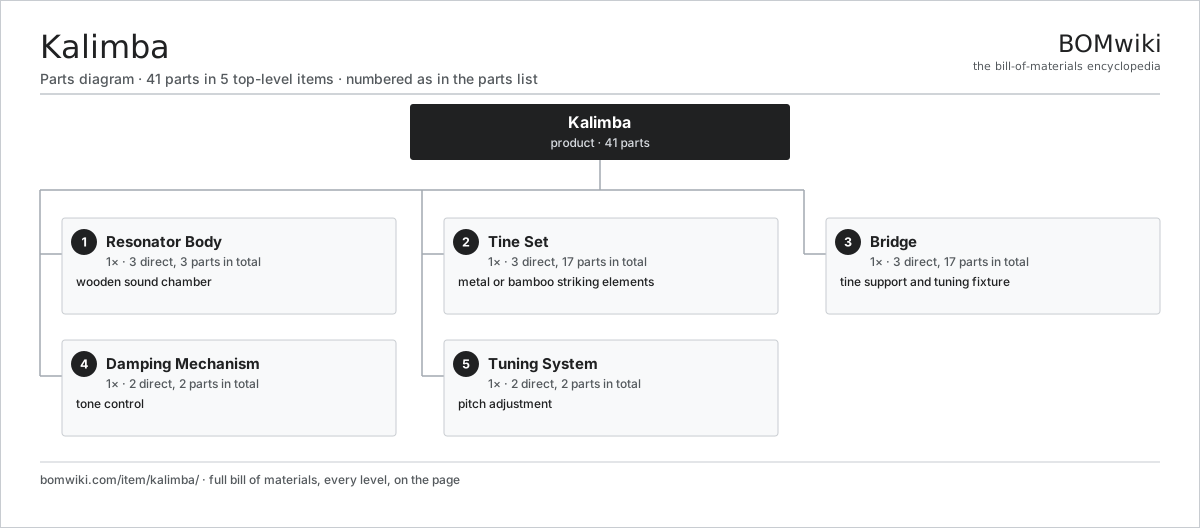
| # | Part | Qty | What it does |
|---|---|---|---|
| 1 | Resonator Body 3 parts | 1× | wooden sound chamber |
| 2 | Tine Set 3 parts | 1× | metal or bamboo striking elements |
| 3 | Bridge 3 parts | 1× | tine support and tuning fixture |
| 4 | Damping Mechanism 2 parts | 1× | tone control |
| 5 | Tuning System 2 parts | 1× | pitch adjustment |
3D model
No 3D model yet. Have a CAD file of this? Add a 3D model. STL renders right on this page; STEP, FreeCAD, and OpenSCAD sources are welcome too (openly licensed, like all 3D models on BOMwiki).
Build & assembly graph
expand / collapse · shared sub-assemblies converge · links to related products · est. labourTap an assembly to expand/collapse · tap a part to open it · use “Open page” for any node · drag to pan, scroll to zoom.
Bill of materials for Kalimba
5 top-level lines · 18 rows shown · 41 parts total · indented to 3 levels| # | Item / sub-assembly | Part no. | Qty/assy | Ext. qty | Parts | Type |
|---|---|---|---|---|---|---|
| 1 | Resonator Body 3 parts | kalimba-resonator-body | 1× | 1 | 3 | assembly |
| 1.1 | Wooden Chamber | kalimba-wooden-chamber | 1× | 1 | · | part |
| 1.2 | Sound Hole | kalimba-sound-hole | 1× | 1 | · | part |
| 1.3 | Bottom Plate | kalimba-bottom-plate | 1× | 1 | · | part |
| 2 | Tine Set 3 parts | kalimba-tine-set | 1× | 1 | 17 | assembly |
| 2.1 | Tine | kalimba-tine | 15× | 15 | · | part |
| 2.2 | Tine Arrangement | kalimba-tine-arrangement | 1× | 1 | · | part |
| 2.3 | Tine Material | kalimba-tine-material | 1× | 1 | · | part |
| 3 | Bridge 3 parts | kalimba-bridge | 1× | 1 | 17 | assembly |
| 3.1 | Bridge Block | kalimba-bridge-block | 1× | 1 | · | part |
| 3.2 | Tine Slots | kalimba-tine-slots | 15× | 15 | · | part |
| 3.3 | Bridge Height | kalimba-bridge-height | 1× | 1 | · | part |
| 4 | Damping Mechanism 2 parts | kalimba-damping-mechanism | 1× | 1 | 2 | assembly |
| 4.1 | Dampener Pads | kalimba-dampener-pads | 1× | 1 | · | part |
| 4.2 | Damper Control | kalimba-damper-control | 1× | 1 | · | part |
| 5 | Tuning System 2 parts | kalimba-tuning-system | 1× | 1 | 2 | assembly |
| 5.1 | Tuning Hammer | kalimba-tuning-hammer | 1× | 1 | · | part |
| 5.2 | Tuning Clamp | kalimba-tuning-clamp | 1× | 1 | · | part |
Something wrong in this list? Report a problem with this BOM.
Sourcing: possible vendors
Browse the supplier directory → Prices, MOQ, and lead times are algorithmic estimates, not quotes, and not claims about these companies. Company mappings are curated by keyword; est. price band $50–$5k. How estimates work| Vendor | HQ | Specialty | MOQ | Lead time |
|---|---|---|---|---|
| yamaha.com ↗ | Hamamatsu, JP | Audio & instruments | 200 units | 8–14 wks |
|
🇺🇸Fender
fender.com ↗
|
Los Angeles, US | Guitars & amps | 200 units | 8–14 wks |
|
🇺🇸Gibson
gibson.com ↗
|
Nashville, US | Guitars | 200 units | 8–14 wks |
|
🇯🇵Roland
roland.com ↗
|
Hamamatsu, JP | Electronic instruments | 200 units | 8–14 wks |
| steinway.com ↗ | New York, US | Pianos | 200 units | 8–14 wks |
968-word article