Keg Washer
ProductOverview
The carousel keg washer automates the tedious and labor-intensive process of cleaning and sanitizing empty kegs returned from customer sites. A typical craft brewery cycles 300–500 kegs monthly through restaurants, bars, and retail accounts. Manual hand-washing this volume requires 40+ hours per week per operator, creates repetitive strain injuries, and often leaves residual beer stone and biofilm harboring off-flavor microbes. The carousel washer reduces this to 4–6 minutes per keg fully automated, maintaining consistent rinse quality and eliminating human error while freeing staff for higher-value packaging and quality control tasks.
This machine bridges the gap between small breweries (which wash a few kegs weekly by hand) and large nationals (which operate dedicated CIP tunnel washers). It fits floor footprint-efficiently in a 2×2 meter corner, connects to standard facility water/drain/power, and runs 900+ kegs weekly at two full-time shifts.
The Keg Fouling Problem
Empty kegs returned from bars contain residual beer (1–5 L depending on tap depth), foam, yeast sediment, and ingrained biofilm. If not cleaned within 24 hours, hop resins and proteins oxidize into stubborn brown staining, alkaloid off-flavors develop from bacterial metabolites, and wild yeasts (Brettanomyces, Lactobacillus) establish themselves in micro-pits along the keg seams. Manual hand-washing with a spray hose and brush struggles to reach the top interior corners and dip tube interior.
The carousel design solves this via internal spray: the coupler head manifold inserts directly into each keg's opening, injecting pressurized wash jets inside the vessel. Two spray nozzles per coupler head create cross-directional spray patterns, saturating the keg interior and dislodging even calcified deposits. The machine's high-pressure caustic cycle (3 bar, 65°C, 2–3 % NaOH) saponifies fatty residues and denatures protein films in 2–3 minutes; subsequent acid neutralization and hot water rinses eliminate caustic residue and any soap film.
Wash Cycle Sequence
A standard 5-minute complete cycle proceeds as:
Step 1: Pre-Rinse (0–1 min) Cold water circulates at 2 bar, flushing loose sediment and beer dregs. The primary pump begins at low speed, relieving pressure through the relief valve to equalize system. Flow is monitored via turbine meters; if flow drops below minimum threshold, the PLC halts and alerts the operator (blocked keg inlet, stuck coupler head).
Step 2: Caustic Wash (1–3 min) The chemical injection pump doses liquid caustic (NaOH) into the main wash stream at ~2–3 % concentration. The 36 kW heater has ramped water to 65°C. The coupler heads thrust into four keg openings simultaneously via pneumatic actuators. Pressurized caustic solution sprays internally for 120 seconds, saponifying fats and denaturating proteins. Pressure gauges confirm delivery.
Step 3: Intermediate Rinse (3–4 min) Hot water (50°C) rinses at 2 bar for 40 seconds, removing caustic residue and loose debris. The secondary pump engages at lower pressure to prevent foam generation.
Step 4: Acid Wash (4–4.5 min) A second chemical injection pulses dilute sulfuric acid (1–2 % H₂SO₄) to neutralize any residual caustic and dissolve mineral scale (calcium carbonate, magnesium hydroxide). Acid is corrosive; the dosing pump injects only the minimum required amount (typically 50–100 mL per wash) to achieve pH 5–6 in the keg.
Step 5: Final Rinse (4.5–5 min) Cold water at 80°C and 2 bar flushes final acid traces and achieves microbe killing via thermal shock. Some operations inject a quaternary ammonium (quat) sanitizer at this stage: 200 ppm for 30 seconds. This leaves a residual biostatic coating preventing re-colonization during storage.
Post-Cycle: Coupler heads retract, the carousel indexes to the next position. Drain solenoid opens, wastewater flows to the accumulator tank or directly to sewer. The cycle repeats every 6 minutes, yielding 240 kegs washed per 24-hour day (two 12-hour shifts).
Chemical Management & Dosing
The dosing system maintains precise caustic and acid concentrations independent of water flow rate. This is critical: too much caustic leaves residue; too little leaves organic buildup. The PLC reads the main flow meter (in pulses per minute) and adjusts the peristaltic pump stroke rate proportionally, maintaining a constant injection ratio (e.g., 1 L caustic per 50 L wash water = 2 %).
The operator loads 20 L chemical tanks with pre-mixed caustic (sodium hydroxide or potassium hydroxide) and acid (phosphoric acid or sulfuric acid). Tank level sensors alert when refill is due. Chemical consumption is logged per cycle to track cost and detect leaks (sudden surges in consumption indicate a failed solenoid or cracked line).
Water & Energy Recovery Considerations
A typical wash cycle consumes 50–80 L of water (pre-rinse, caustics, final rinse combined) and 6–8 kW·h of heating energy per keg. For a 250-keg-per-day facility, this is 12,500–20,000 L water and 1,500–2,000 kW·h monthly, substantial utility costs.
Advanced installations add:
- Wastewater recirculation: The drain system collects wash outflows in an 80 L tank, filters out solids via a strainer basket, and recycles pre-rinse water for the next cycle's cold spray (saving 40 % water)
- Heat recovery: Installing a small plate heat exchanger in the drain line to transfer exiting hot water to fresh incoming supply, pre-warming it 10–15°C and reducing heater runtime by 15–20 %
These additions require additional piping, heat exchanger, and pump investment (~$5K USD) but deliver payback within 18–24 months on water and energy savings.
Keg Types & Special Handling
Standard 50 L Sankey kegs (commercial beer kegs) and 30 L Euro-style Slim-line kegs are supported via adjustable pallet posts. The PLC can store separate wash profiles for each type (heavier soils might require extended caustic soak; aluminum Euro kegs need gentler acid to prevent pitting).
Special kegs requiring alternative programs:
- Wine kegs (20 L, PVC bladder): Caustic-only wash (no acid, which degrades bladder), lower spray pressure (1.5 bar)
- Stainless micro-batch kegs (10 L): Standard cycle but double-rinse for smaller internal volume
- Ball-lock (Cornelius) homebrew kegs: Manual external wash only (machine incompatible); not automated
The HMI allows custom recipe programming: breweries can upload 8–10 different wash profiles for different keg types, seasonal soiling levels, or customer specifications (e.g., "extra sanitize" for a new customer with unknown hygiene baseline).
Operator Workflow & Integration
A single operator runs the machine during morning keg processing:
- Empty dirty kegs arrive on a pallet from beer delivery route
- Operator sets pallet posts to keg height, manually loads four kegs into carousel cradles
- Operator selects wash program on HMI (standard 50 L, or 30 L Euro, or custom)
- Operator presses "Start Cycle", machine runs fully automated for 5 minutes
- Operator unloads clean kegs, loads four new kegs, repeats
- Cleaned kegs roll via pallet jack to QA inspection (visual check for residual stains, random microbial swabs) and then to the filling line
Across an 8-hour shift, one operator can process 240–300 kegs with this semi-manual approach. Fully automated carousel loaders (robotic arms) exist for large nationals but cost $50K+; the semi-manual version stays affordable for mid-size breweries ($8K–12K USD machine cost).
Maintenance & Troubleshooting
Scale buildup in heater: Over 3–6 months, mineral deposits (CaCO₃, MgCO₃) accumulate on the immersion heater element, reducing heat transfer efficiency. Remedy: drain tank, circulate dilute citric acid (1 % by weight) through heating circuit for 1 hour monthly. This keeps heater clean and maintains 8-minute hot-water ramp-up time.
Caustic carryover & film residue: If acid injection fails (clogged metering line, depleted tank), residual caustic leaves a slippery film inside kegs. Remedy: verify pump inlet tube is immersed in chemical tank, check solenoid opening in response to PLC command, inspect metering line for mineral blockage.
Pressure drop mid-cycle: Sudden loss of spray pressure (gauge falls from 3 bar to <1 bar) suggests blocked coupler head nozzles or a ruptured internal spray line. Remedy: manually pull coupler head from test keg, inspect nozzles for mineral debris using a thin wire, backflush with hot water. If pressure remains low, check hose routing for kinks.
Slow drain after cycle: Accumulated sludge in drain pan or blocked sump line prevents wastewater discharge. Remedy: open drain valve, flush with clean water; inspect sump pump intake filter for buildup, clean as needed.
Keg Washer parts and their functions
7 top-level parts · 94 parts in total · full bill of materials below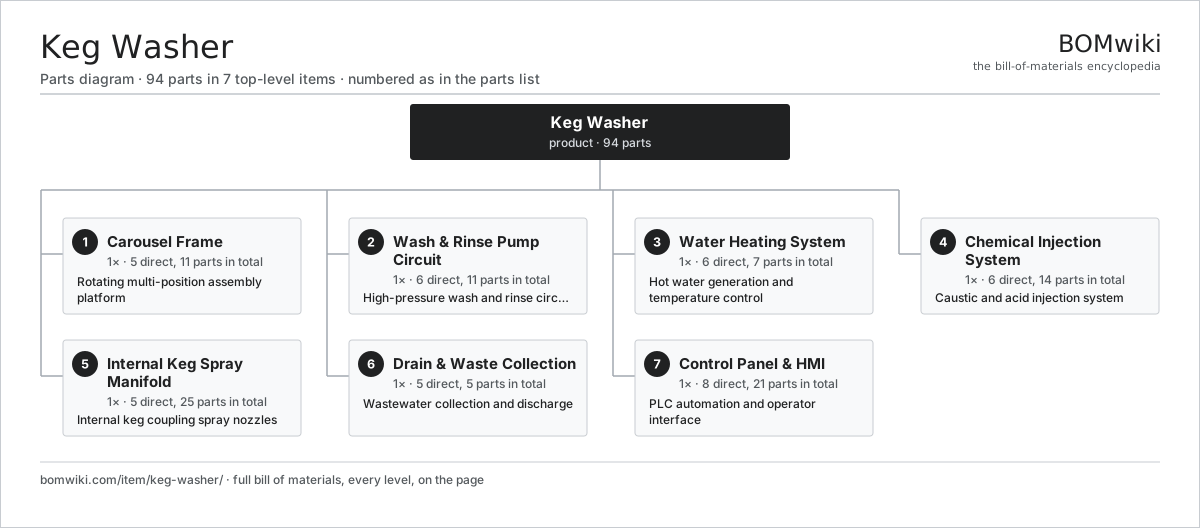
| # | Part | Qty | What it does |
|---|---|---|---|
| 1 | Carousel Frame 5 parts | 1× | Rotating multi-position assembly platform |
| 2 | Wash & Rinse Pump Circuit 6 parts | 1× | High-pressure wash and rinse circulation |
| 3 | Water Heating System 6 parts | 1× | Hot water generation and temperature control |
| 4 | Chemical Injection System 6 parts | 1× | Caustic and acid injection system |
| 5 | Internal Keg Spray Manifold 5 parts | 1× | Internal keg coupling spray nozzles |
| 6 | Drain & Waste Collection 5 parts | 1× | Wastewater collection and discharge |
| 7 | Control Panel & HMI 8 parts | 1× | PLC automation and operator interface |
3D model
No 3D model yet. Have a CAD file of this? Add a 3D model. STL renders right on this page; STEP, FreeCAD, and OpenSCAD sources are welcome too (openly licensed, like all 3D models on BOMwiki).
Build & assembly graph
expand / collapse · shared sub-assemblies converge · links to related products · est. labourTap an assembly to expand/collapse · tap a part to open it · use “Open page” for any node · drag to pan, scroll to zoom.
Bill of materials for Keg Washer
7 top-level lines · 48 rows shown · 94 parts total · indented to 3 levels| # | Item / sub-assembly | Part no. | Qty/assy | Ext. qty | Parts | Type |
|---|---|---|---|---|---|---|
| 1 | Carousel Frame 5 parts | keg-washer-carousel-frame | 1× | 1 | 11 | assembly |
| 1.1 | Carousel Turntable Base | keg-washer-carousel-base | 1× | 1 | · | part |
| 1.2 | Carousel Drive Motor | keg-washer-carousel-motor | 1× | 1 | · | part |
| 1.3 | Position Sensor | keg-washer-position-sensor | 4× | 4 | · | part |
| 1.4 | Keg Pallet Post | keg-washer-pallet-post | 4× | 4 | · | part |
| 1.5 | Overflow & Spill Tray | keg-washer-overflow-tray | 1× | 1 | · | part |
| 2 | Wash & Rinse Pump Circuit 6 parts | keg-washer-pump-system | 1× | 1 | 11 | assembly |
| 2.1 | Centrifugal Wash Pump | keg-washer-centrifugal-pump | 2× | 2 | · | part |
| 2.2 | Pump Check Valve | keg-washer-pump-check-valve | 2× | 2 | · | part |
| 2.3 | Flow Meter | keg-washer-flowmeter | 2× | 2 | · | part |
| 2.4 | Pressure Gauge | keg-washer-pressure-gauge | 2× | 2 | · | part |
| 2.5 | System Pressure Relief | keg-washer-relief-valve | 2× | 2 | · | part |
| 2.6 | Motor Housing | motor-housing | 1× | 1 | · | part |
| 3 | Water Heating System 6 parts | keg-washer-heating-module | 1× | 1 | 7 | assembly |
| 3.1 | Electric Immersion Heater | keg-washer-electric-heater | 1× | 1 | · | part |
| 3.2 | Plate Heat Exchanger | keg-washer-heat-exchanger | 1× | 1 | · | part |
| 3.3 | Thermostatic Mixing Valve | keg-washer-mixing-valve | 1× | 1 | · | part |
| 3.4 | Pressure Sensor | pressure-sensor | 2× | 2 | · | part |
| 3.5 | Heating Element | heating-element | 1× | 1 | · | part |
| 3.6 | Insulated Hot Water Tank | keg-washer-insulated-tank | 1× | 1 | · | part |
| 4 | Chemical Injection System 6 parts | keg-washer-chemical-dosing | 1× | 1 | 14 | assembly |
| 4.1 | Peristaltic Metering Pump | keg-washer-peristaltic-pump | 2× | 2 | · | part |
| 4.2 | Chemical Storage Tank | keg-washer-chemical-tank | 2× | 2 | · | part |
| 4.3 | Chemical Injection Solenoid | keg-washer-solenoid-inject-valve | 2× | 2 | · | part |
| 4.4 | Check Valve (Chemical Line) | keg-washer-check-valve-inject | 2× | 2 | · | part |
| 4.5 | Chemical Flow Meter | keg-washer-flowmeter-chemical | 2× | 2 | · | part |
| 4.6 | Connector | connector | 4× | 4 | · | part |
| 5 | Internal Keg Spray Manifold 5 parts | keg-washer-coupler-head-manifold | 1× | 1 | 25 | assembly |
| 5.1 | Keg Coupler Head | keg-washer-coupler-head | 4× | 4 | · | part |
| 5.2 | Internal Spray Nozzle | keg-washer-spray-nozzle | 8× | 8 | · | part |
| 5.3 | Coupler Arm Assembly | keg-washer-coupler-arm-assembly | 1× | 1 | · | part |
| 5.4 | Quick Disconnect Coupling | keg-washer-quick-disconnect | 4× | 4 | · | part |
| 5.5 | Connector | connector | 8× | 8 | · | part |
| 6 | Drain & Waste Collection 5 parts | keg-washer-drain-system | 1× | 1 | 5 | assembly |
| 6.1 | Drain Pan | keg-washer-drain-pan | 1× | 1 | · | part |
| 6.2 | Waste Drain Valve | keg-washer-drain-valve | 1× | 1 | · | part |
| 6.3 | Sump Discharge Pump | keg-washer-sump-pump | 1× | 1 | · | part |
| 6.4 | Strainer Basket | keg-washer-strainer-basket | 1× | 1 | · | part |
| 6.5 | Waste Accumulator Tank | keg-washer-waste-tank | 1× | 1 | · | part |
| 7 | Control Panel & HMI 8 parts | keg-washer-control-panel | 1× | 1 | 21 | assembly |
| 7.1 | Wash Cycle PLC | keg-washer-plc | 1× | 1 | · | part |
| 7.2 | HMI Touchscreen | keg-washer-hmi-screen | 1× | 1 | · | part |
| 7.3 | I/O Module Pack | keg-washer-io-module | 2× | 2 | · | part |
| 7.4 | Relay | relay | 6× | 6 | · | part |
| 7.5 | Microcontroller | mcu | 1× | 1 | · | part |
| 7.6 | Thermal Fuse | thermal-fuse | 1× | 1 | · | part |
| 7.7 | Connector | connector | 8× | 8 | · | part |
| 7.8 | Bare PCB | pcb-bare | 1× | 1 | · | part |
Something wrong in this list? Report a problem with this BOM.
Related products
same domain, ranked by shared parts Chocolate Enrober
470 parts · shares 7 with this page
Confectionery Depositor
699 parts · shares 7 with this page
Spiral Freezer
179 parts · shares 7 with this page
Chocolate Enrober
470 parts · shares 7 with this page
Confectionery Depositor
699 parts · shares 7 with this page
Spiral Freezer
179 parts · shares 7 with this page
 Chocolate Tempering Machine
141 parts · shares 6 with this page
Chocolate Tempering Machine
141 parts · shares 6 with this page
 Commercial Dishwasher
211 parts · shares 6 with this page
Commercial Dishwasher
211 parts · shares 6 with this page
 Industrial Smokehouse
267 parts · shares 6 with this page
Industrial Smokehouse
267 parts · shares 6 with this page
Sourcing: possible vendors
Browse the supplier directory → Prices, MOQ, and lead times are algorithmic estimates, not quotes, and not claims about these companies. Company mappings are curated by keyword; est. price band $1k–$500k. How estimates work| Vendor | HQ | Specialty | MOQ | Lead time |
|---|---|---|---|---|
| gea.com ↗ | Düsseldorf, DE | Process technology | 20 units | 12–20 wks |
| buhlergroup.com ↗ | Uzwil, CH | Food & materials processing | 20 units | 12–20 wks |
| tetrapak.com ↗ | Pully, CH | Food packaging & processing | 20 units | 12–20 wks |
| jbtc.com ↗ | Chicago, US | Food processing equipment | 20 units | 12–20 wks |
| alfalaval.com ↗ | Lund, SE | Heat transfer & separation | 20 units | 12–20 wks |
1,474-word article