Kei Truck
ProductOverview
A kei truck (軽トラック) is a commercial utility vehicle constrained by Japan's kei vehicle regulations: engine displacement not exceeding 660 cc, overall length under 3.4 m, and width under 1.48 m. Designed for small-scale contractors, farmers, and light commerce, the kei truck prioritizes payload-to-footprint efficiency over power, using a compact cab-over chassis to maximize cargo bed area. The 660 cc three-cylinder engine is naturally aspirated and typically air-cooled, delivering 40–50 hp at 6500 rpm. Most kei trucks offer manual or automatic transmission options, with manual being the standard for cost and durability.
The chassis uses a ladder-frame construction welded from box-section steel, providing torsional rigidity while keeping weight low. Front suspension employs independent double-wishbone geometry with coil springs; the rear uses multi-leaf springs for load compliance under the 500 kg payload rating. Steering is hydraulic-assisted rack-and-pinion, delivering a 6.2 m turning radius essential for navigating narrow Japanese streets and job sites. Braking combines hydraulic front disc and rear drum systems with a proportioning valve to prevent rear lock-up during emergency stops.
The cargo bed is typically available in two configurations: a fixed flat bed or a dump bed with manual or electric hydraulic cylinders. Dump cylinders are double-acting 50 mm bore units with 300 mm stroke, powered by a small displacement piston pump driven from the engine. The dump functionality allows single-operator unloading of gravel, sand, and agricultural materials without manual shoveling.
Electrical systems are minimal: a 36 Ah 12 V lead-acid battery, 50 A alternator, and a 1.2 kW starter motor. The alternator is sized to sustain the basic lighting load and provide modest charging margin at idle. The wiring harness uses simple color-coding and basic relays for headlights, horn, and wipers. The gauge cluster is typically a single-gauge design with speedometer, fuel level, water temperature, and warning lights.
How it works
The kei truck starts with key-operated ignition, energizing the starter solenoid and cranking the 660 cc engine at ~300 rpm. Once running, fuel from the 40 L tank flows through a gravity-fed carburetor to three inlet valves per cylinder. The three pistons fire in sequence, each consuming a short intake stroke before compression and ignition at spark plugs gapped to 0.8 mm. Exhaust gases exit into a muffler and tailpipe after a 120-degree crankshaft offset distributes firing loads evenly.
Power flows through a Transmission to a mechanical differential, which splits engine torque equally between the rear wheels. The driver selects gears via a shift fork mechanism engaging synchronizer rings that equalize shaft speeds before full dog-clutch engagement. Manual gearboxes require deliberate shift timing; automatics use simple centrifugal governors to trigger upshifts at rising engine speed.
The Steering System responds to steering wheel rotation through a collapsible column, moving the pinion gear along a rack that pulls or pushes track rods connected to the front wheels. Hydraulic pressure from a belt-driven piston Power Steering Pump assists the driver, reducing the steering effort required to maneuver at low speeds or during slow, tight turns. The hydraulic fluid also powers the dump bed Hydraulic Dump Cylinder when the operator opens a solenoid proportioning valve.
Braking engages when the driver presses the pedal, pushing the Master Cylinder and driving fluid through the Proportioning Valve. Front Brake Caliper pistons are pushed against the 240 mm rotors by the same fluid pressure, while rear wheel cylinders push brake shoes against the 180 mm drums. The proportioning valve reduces rear pressure below front pressure, keeping the rear wheels on the verge of lock-up but not exceeding it, preventing the common kei truck rear-skid failure mode under emergency braking.
The Suspension System absorbs road shocks through the front coil springs and rear leaf springs. At full compression (e.g., when laden with 500 kg of gravel), the leaf springs deflect ~50 mm, moving the rear axle upward and compressing the shock dampers. Shock absorbers use velocity-sensitive hydraulic orifices that allow quick spring compression under sharp impacts but resist rapid rebound, preventing oscillation.
The electrical system maintains a charge cycle: while the engine runs above 800 rpm, the Alternator generates alternating current, which the internal voltage regulator converts to 14.4 V DC. This charges the 12 V Battery and powers the Gauge Cluster, lights, and Starter Motor solenoid. When the engine is off, the battery sustains the warning lights and horn until depleted.
Design trade-offs
Kei trucks sacrifice on-highway performance for urban maneuverability and payload efficiency. The 660 cc engine produces modest power, limiting freeway cruising speed to ~100 km/h and acceleration from standstill to ~12 seconds to reach 60 km/h. Air-cooling keeps weight and complexity low, but requires exposed cooling fins and hotter operating temperatures (80–90°C cylinder head). The manual transmission is the de facto standard because it costs 40–50% less than an automatic and is simpler to repair in rural areas.
The cab-over design places the engine under the driver's seat, maximizing cargo bed length but creating a cramped driver compartment with minimal legroom and no synchro-matched reverse gear on older manuals (some models require heel-and-toe downshifting). The independent front suspension, while providing good ride quality, is more complex and costly than a solid axle but allows softer springing without binding or excessive body roll in corners.
Dump bed hydraulics are operated entirely by engine power: there is no accumulator or electric pump. If the engine is off, the bed cannot be raised, and if the operator leaves the solenoid valve in the raise position while the engine idles, the small displacement pump will overheat and the pressure relief valve will vent fluid. This design constraint enforces proper operation discipline.
Market and variants
Kei trucks are abundant in Japan, where parking density and road widths make full-size trucks impractical. Common manufacturers include Daihatsu Hijet, Suzuki Carry, Honda Acty, Mitsubishi Minicab, and Toyota Pixis. Exports to Southeast Asia and the Pacific are growing, although stricter emissions regulations in the US and EU have limited import volumes. Many kei trucks are powered by turbocharged 660 cc engines (660 T variants) producing 64–70 hp and enabling higher cruise speeds on expressways; these require reinforced transmissions and engine cooling.
Agricultural variants (nogyo yo) include high-dump models with payload capacities up to 700 kg and extra-long beds. Commercial variants include side-opening reefer boxes for refrigerated delivery, insulated boxes for hot food service, and crane kits mounted on the bed frame for light material handling up to 300 kg.
Kei Truck parts and their functions
8 top-level parts · 86 parts in total · full bill of materials below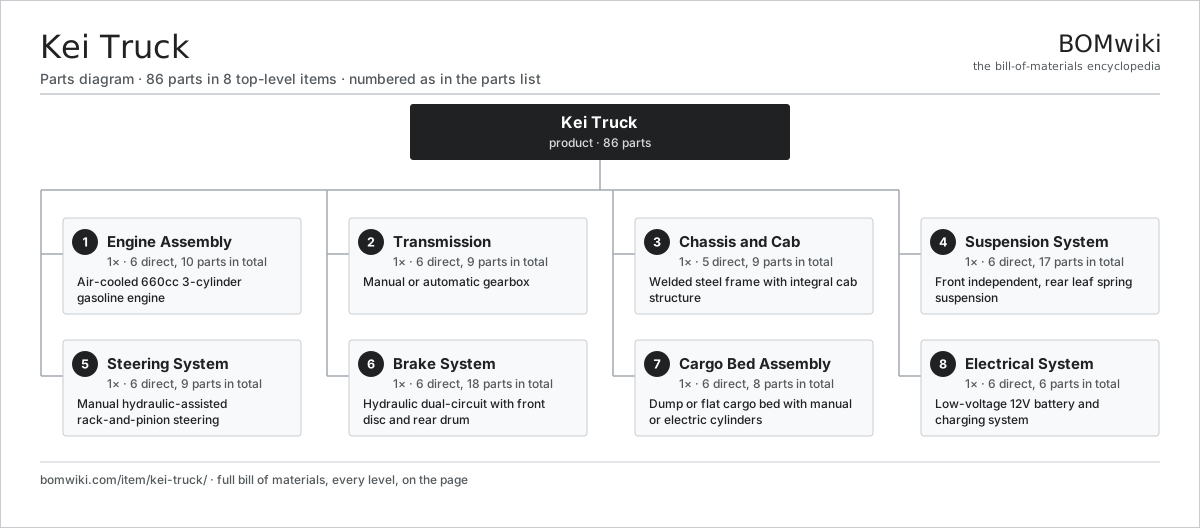
| # | Part | Qty | What it does |
|---|---|---|---|
| 1 | Engine Assembly 6 parts | 1× | Air-cooled 660cc 3-cylinder gasoline engine |
| 2 | Transmission 6 parts | 1× | Manual or automatic gearbox |
| 3 | Chassis and Cab 5 parts | 1× | Welded steel frame with integral cab structure |
| 4 | Suspension System 6 parts | 1× | Front independent, rear leaf spring suspension |
| 5 | Steering System 6 parts | 1× | Manual hydraulic-assisted rack-and-pinion steering |
| 6 | Brake System 6 parts | 1× | Hydraulic dual-circuit with front disc and rear drum |
| 7 | Cargo Bed Assembly 6 parts | 1× | Dump or flat cargo bed with manual or electric cylinders |
| 8 | Electrical System 6 parts | 1× | Low-voltage 12V battery and charging system |
3D model
No 3D model yet. Have a CAD file of this? Add a 3D model. STL renders right on this page; STEP, FreeCAD, and OpenSCAD sources are welcome too (openly licensed, like all 3D models on BOMwiki).
Build & assembly graph
expand / collapse · shared sub-assemblies converge · links to related products · est. labourTap an assembly to expand/collapse · tap a part to open it · use “Open page” for any node · drag to pan, scroll to zoom.
Bill of materials for Kei Truck
8 top-level lines · 62 rows shown · 86 parts total · indented to 3 levels| # | Item / sub-assembly | Part no. | Qty/assy | Ext. qty | Parts | Type |
|---|---|---|---|---|---|---|
| 1 | Engine Assembly 6 parts | kei-truck-engine | 1× | 1 | 10 | assembly |
| 1.1 | Cylinder Block | kei-truck-cylinder-block | 1× | 1 | · | part |
| 1.2 | Cylinder Head | kei-truck-head | 1× | 1 | · | part |
| 1.3 | Crankshaft | kei-truck-crank | 1× | 1 | · | part |
| 1.4 | Piston and Rod Assembly | piston-rod-assy | 3× | 3 | · | part |
| 1.5 | Copper Winding | copper-winding | 1× | 1 | · | part |
| 1.6 | Spark Plugs | spark-plug-set | 3× | 3 | · | part |
| 2 | Transmission 6 parts | kei-truck-transmission | 1× | 1 | 9 | assembly |
| 2.1 | Gearbox Housing | gearbox-housing | 1× | 1 | · | part |
| 2.2 | Input Shaft | input-shaft | 1× | 1 | · | part |
| 2.3 | Helical Gear Pair | gear-pair | 2× | 2 | · | part |
| 2.4 | Synchronizer Rings | synchro-ring-set | 3× | 3 | · | part |
| 2.5 | Shift Forks | shift-fork-set | 1× | 1 | · | part |
| 2.6 | Drive Belt | drive-belt | 1× | 1 | · | part |
| 3 | Chassis and Cab 5 parts | kei-truck-chassis | 1× | 1 | 9 | assembly |
| 3.1 | Main Frame | kei-truck-frame | 1× | 1 | · | part |
| 3.2 | Cab Shell | kei-truck-cab | 1× | 1 | · | part |
| 3.3 | Sheet Metal Panel | sheet-panel | 4× | 4 | · | part |
| 3.4 | Bumper Assembly | bumper-assy | 2× | 2 | · | part |
| 3.5 | Fastener Set | fastener-set | 1× | 1 | · | part |
| 4 | Suspension System 6 parts | kei-truck-suspension | 1× | 1 | 17 | assembly |
| 4.1 | Control Arm Pair | wishbone-pair | 2× | 2 | · | part |
| 4.2 | Coil Spring | coil-spring | 2× | 2 | · | part |
| 4.3 | Leaf Spring Pack | kei-truck-leaf-spring | 2× | 2 | · | part |
| 4.4 | Shock Absorber | shock-damper | 4× | 4 | · | part |
| 4.5 | Ball Bearing | ball-bearing | 6× | 6 | · | part |
| 4.6 | Bushing Mounts | rubber-bushing-set | 1× | 1 | · | part |
| 5 | Steering System 6 parts | kei-truck-steering | 1× | 1 | 9 | assembly |
| 5.1 | Steering Column | steering-column | 1× | 1 | · | part |
| 5.2 | Steering Wheel 3 parts | steering-wheel | 1× | 1 | 4 | assembly |
| 5.2.1 | Wheel Rim Core | wheel-rim-core | 1× | 1 | · | part |
| 5.2.2 | Airbag Module | airbag-module | 1× | 1 | · | part |
| 5.2.3 | Steering Control Switch | control-switches | 2× | 2 | · | part |
| 5.3 | Rack & Pinion | rack-pinion | 1× | 1 | · | part |
| 5.4 | Power Steering Pump | hydraulic-pump | 1× | 1 | · | part |
| 5.5 | Pressure Sensor | pressure-sensor | 1× | 1 | · | part |
| 5.6 | Hydraulic Hose Set | hose-set | 1× | 1 | · | part |
| 6 | Brake System 6 parts | kei-truck-brakes | 1× | 1 | 18 | assembly |
| 6.1 | Master Cylinder | brake-master-cyl | 1× | 1 | · | part |
| 6.2 | Brake Caliper 4 parts | brake-caliper | 2× | 2 | 6 | assembly |
| 6.2.1 | Caliper Body | caliper-body | 1× | 2 | · | part |
| 6.2.2 | Caliper Piston | caliper-piston | 2× | 4 | · | part |
| 6.2.3 | O-Ring Set | oring-set | 2× | 4 | · | part |
| 6.2.4 | Bleed Screw | bleed-screw | 1× | 2 | · | part |
| 6.3 | Rear Brake Drum | brake-drum | 2× | 2 | · | part |
| 6.4 | Proportioning Valve | proportioning-valve | 1× | 1 | · | part |
| 6.5 | Brake Hose Set | kei-truck-brake-hose-set | 1× | 1 | · | part |
| 6.6 | Brake Fluid | brake-fluid | 1× | 1 | · | part |
| 7 | Cargo Bed Assembly 6 parts | kei-truck-bed | 1× | 1 | 8 | assembly |
| 7.1 | Bed Floor Panel | bed-floor | 1× | 1 | · | part |
| 7.2 | Side Rail Set | bed-sides | 2× | 2 | · | part |
| 7.3 | Tailgate Assembly | bed-tailgate | 1× | 1 | · | part |
| 7.4 | Hydraulic Dump Cylinder | dump-cylinder | 2× | 2 | · | part |
| 7.5 | Directional Valve | hydraulic-valve-block | 1× | 1 | · | part |
| 7.6 | Hydraulic Hose Set | hose-set | 1× | 1 | · | part |
| 8 | Electrical System 6 parts | kei-truck-electrical | 1× | 1 | 6 | assembly |
| 8.1 | 12 V Battery | lv-battery | 1× | 1 | · | part |
| 8.2 | Alternator | alternator | 1× | 1 | · | part |
| 8.3 | Starter Motor | starter-motor | 1× | 1 | · | part |
| 8.4 | Main Wiring Harness | wiring-harness | 1× | 1 | · | part |
| 8.5 | Fuse and Relay Block | fuse-relay-block | 1× | 1 | · | part |
| 8.6 | Gauge Cluster | gauge-cluster | 1× | 1 | · | part |
Something wrong in this list? Report a problem with this BOM.
Related products
same domain, ranked by shared parts Coupe Car
1,617 parts · shares 15 with this page
Coupe Car
1,617 parts · shares 15 with this page
 Station Wagon
1,657 parts · shares 15 with this page
Station Wagon
1,657 parts · shares 15 with this page
 Convertible Car
1,727 parts · shares 14 with this page
Convertible Car
1,727 parts · shares 14 with this page
 Crossover SUV
1,653 parts · shares 14 with this page
Crossover SUV
1,653 parts · shares 14 with this page
 Hatchback Car
18,053 parts · shares 14 with this page
Hatchback Car
18,053 parts · shares 14 with this page
 Gasoline Car
1,190 parts · shares 13 with this page
Gasoline Car
1,190 parts · shares 13 with this page
Sourcing: possible vendors
Browse the supplier directory → Prices, MOQ, and lead times are algorithmic estimates, not quotes, and not claims about these companies. Company mappings are curated by keyword; est. price band $8k–$90k. How estimates work| Vendor | HQ | Specialty | MOQ | Lead time |
|---|---|---|---|---|
|
🇯🇵Toyota
global.toyota ↗
|
Toyota City, JP | Automaker | made to order | 16–28 wks |
| volkswagen-group.com ↗ | Wolfsburg, DE | Automaker | made to order | 16–28 wks |
| gm.com ↗ | Detroit, US | Automaker | made to order | 16–28 wks |
| hyundai.com ↗ | Seoul, KR | Automaker | made to order | 16–28 wks |
|
🇨🇳BYD
byd.com ↗
|
Shenzhen, CN | EV & battery manufacturer | made to order | 16–28 wks |
1,114-word article