Kicksled
ProductOverview
The kicksled (also called a kick sledge or spark) is a winter human-powered vehicle consisting of a chair mounted on two flexible steel runners, propelled by the operator standing and kicking against snow or ice. Originating in Scandinavia and widely used in Finland, Canada, and other northern regions, kicksleds are optimized for packed snow, ice, and winter trails. The vehicle requires no motor, chains, pedals, or complex mechanics, just the operator's leg power and balance.
Modern recreational kicksleds weigh 15–20 kg and can reach 40 km/h on steep downhill slopes, while offering sustainable speeds of 10–15 km/h on flat terrain. They are used for winter exercise, sport (kicksled racing is an organized winter sport in Scandinavia), and practical short-distance transport on frozen surfaces.
How it works
Propulsion Method
The operator sits in the integrated seat, feet resting on or near the forward footboards. To propel the sled forward, the operator plants one foot against the snow and pushes hard, transferring body weight from the seated position into a powerful leg extension. The opposite leg remains elevated. The sled accelerates forward in a series of kicks, each pushing the vehicle 1–3 meters depending on snow conditions and force applied. Once moving, the operator can alternate feet in a rhythmic stride, similar to skateboarding or scooter propulsion.
On slopes, the operator can sit back and use drag (by dragging a foot or using a rope) to control speed. On flat ground, the operator may stand on one footboard and perform multiple kicks in succession, using the other footboard for balance and recovery.
Runner Design and Flexibility
The two steel runners are curved blades, approximately 1200 mm long and spaced 600 mm apart. They are made from flexible spring steel (often carbon or alloy steel, heat-treated to 45–50 HRC hardness) that can bend and flex under the weight of the vehicle and operator. The front of each runner is curved upward (similar to a ski tip), allowing smooth riding over uneven terrain. The base of the runners is flat or slightly curved, providing ground contact across the entire blade length.
The tips of the runners wear quickly against abrasive ice; they are often reinforced with a hardened steel shoe (stainless steel or carbide-tipped) to extend blade life. The runners are joined at the front by a rigid brace, maintaining their separation and preventing divergence under load.
Steering Mechanism
Steering is controlled through the handlebar, which is mechanically linked to the runners via tie-rods or rope lines. When the operator pulls the handlebar to the left, a mechanical linkage or direct rope deflects the runners slightly leftward, causing the sled to follow. The deflection is limited (typically 5–10 degrees) to prevent tipping and maintain control. Some designs use direct handlebar-to-runner linkages with pivoting mounts; others rely purely on weight shifting and handlebar tension.
The steering geometry creates understeer (the sled wants to go straight), which is desirable for safety: accidental handlebar movements do not trigger sharp, uncontrolled turns.
Frame and Seating
The frame is typically made from wood (ash, birch, or softwood) or welded steel tubing. Wooden frames are lighter and more traditional; steel frames are more durable and easier to repair. The seat is a fixed bench or bucket, mounted at the balance point of the sled, typically positioned such that the occupant's weight is distributed across both runners for stable handling.
The footboards extend forward from the main frame, allowing the operator to position feet for kicking. Footboards are usually wooden and may have grip tape or textured surfaces to prevent foot slipping during winter propulsion.
Damping and Vibration
The flexible runners act as a natural shock absorber, bending under impact and releasing energy on the rebound. This spring-and-damping behavior is tuned by runner material thickness and curvature; stiffer runners reduce comfort but improve control, while softer runners provide a smoother ride but less precise handling. Some kicksleds include minimal suspension (fabric or rubber dampers between frame and runners) to further smooth the ride.
Racing and Sport
Kicksled racing is an organized winter sport in Finland and Scandinavia, with annual national championships. Racers use specialized lightweight kicksleds (weighing as little as 8–10 kg for racing versions) on frozen lakes and packed snow tracks. Racing courses are typically 100 m, 500 m, and 1 km distances, with sprints emphasizing explosive leg power. Elite racers can sustain speeds of 15–20 km/h in sustained efforts and reach 30+ km/h in downhill sections.
Kicksled racing technique emphasizes explosive quad and glute power, core stability, and efficient weight transfer. Athletes train year-round, with winter specialization on actual snow. The sport has a small but dedicated international following, with athletes from Finland, Sweden, Norway, and Canada competing in world championships.
Condition-Dependent Performance
Kicksled performance is highly dependent on snow and ice conditions. On packed, fast ice (Lake Mendota in Wisconsin, Lake Saimaa in Finland), sleds move effortlessly with minimal effort. On soft, wet snow, momentum is quickly lost and greater kicking effort is required. On gravel or dirt (sleds do exist for non-winter use with polyurethane or rubber wheels replacing blades), the frictional characteristics change dramatically.
Temperature affects runner rigidity: extremely cold steel becomes slightly more brittle, while warmer temperatures reduce the runner's spring constant. Most traditional kicksleds are optimized for temperatures between −10 and −30 °C, the typical range for Scandinavian winter racing.
Historical Context
The kicksled emerged as an affordable personal transport in 19th-century Scandinavia, predating snowmobiles by decades. It remains in use as both a recreational and practical winter vehicle, though modern competition has shifted primarily to sport and recreation rather than utility transport. Some Nordic families maintain kicksleds for winter leisure and short-distance travel in snow-heavy regions.
Kicksled parts and their functions
7 top-level parts · 100 parts in total · full bill of materials below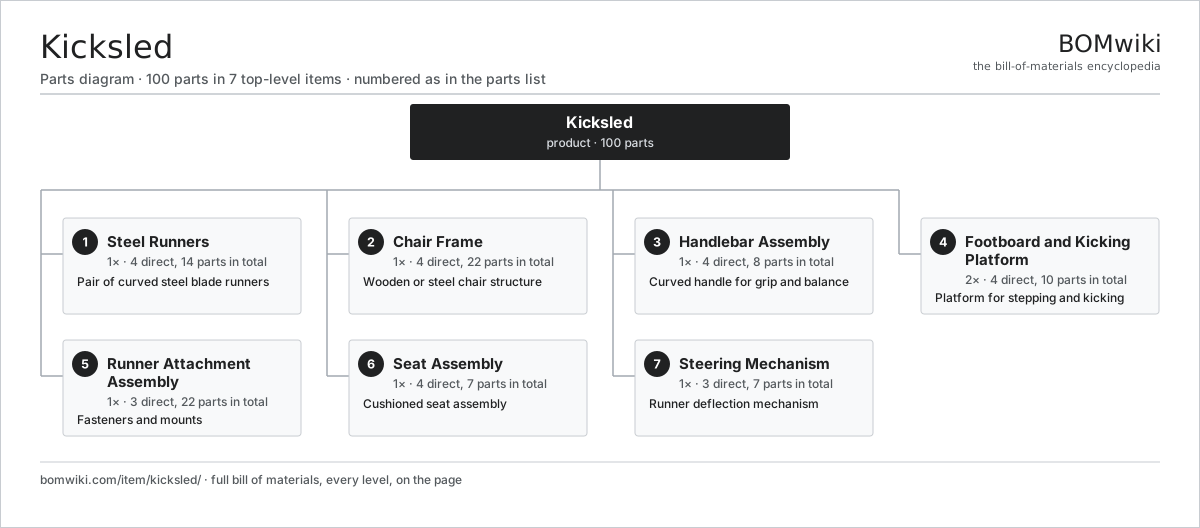
| # | Part | Qty | What it does |
|---|---|---|---|
| 1 | Steel Runners 4 parts | 1× | Pair of curved steel blade runners |
| 2 | Chair Frame 4 parts | 1× | Wooden or steel chair structure |
| 3 | Handlebar Assembly 4 parts | 1× | Curved handle for grip and balance |
| 4 | Footboard and Kicking Platform 4 parts | 2× | Platform for stepping and kicking |
| 5 | Runner Attachment Assembly 3 parts | 1× | Fasteners and mounts |
| 6 | Seat Assembly 4 parts | 1× | Cushioned seat assembly |
| 7 | Steering Mechanism 3 parts | 1× | Runner deflection mechanism |
3D model
No 3D model yet. Have a CAD file of this? Add a 3D model. STL renders right on this page; STEP, FreeCAD, and OpenSCAD sources are welcome too (openly licensed, like all 3D models on BOMwiki).
Build & assembly graph
expand / collapse · shared sub-assemblies converge · links to related products · est. labourTap an assembly to expand/collapse · tap a part to open it · use “Open page” for any node · drag to pan, scroll to zoom.
Bill of materials for Kicksled
7 top-level lines · 33 rows shown · 100 parts total · indented to 3 levels| # | Item / sub-assembly | Part no. | Qty/assy | Ext. qty | Parts | Type |
|---|---|---|---|---|---|---|
| 1 | Steel Runners 4 parts | kicksled-runners | 1× | 1 | 14 | assembly |
| 1.1 | Steel Blade Runner | kicksled-blade | 2× | 2 | · | part |
| 1.2 | Blade Tip Shoe | kicksled-blade-shoe | 2× | 2 | · | part |
| 1.3 | Runner Brace | kicksled-runner-brace | 2× | 2 | · | part |
| 1.4 | Fastener Set | fastener-set | 8× | 8 | · | part |
| 2 | Chair Frame 4 parts | kicksled-frame | 1× | 1 | 22 | assembly |
| 2.1 | Frame Leg | kicksled-frame-leg | 4× | 4 | · | part |
| 2.2 | Frame Crossbar | kicksled-frame-crossbar | 4× | 4 | · | part |
| 2.3 | Seat Rail | kicksled-frame-seat-rail | 2× | 2 | · | part |
| 2.4 | Fastener Set | fastener-set | 12× | 12 | · | part |
| 3 | Handlebar Assembly 4 parts | kicksled-handlebar | 1× | 1 | 8 | assembly |
| 3.1 | Handle Bar | kicksled-bar | 1× | 1 | · | part |
| 3.2 | Handle Grip | kicksled-bar-grip | 2× | 2 | · | part |
| 3.3 | Handlebar Mount | kicksled-bar-mount | 1× | 1 | · | part |
| 3.4 | Fastener Set | fastener-set | 4× | 4 | · | part |
| 4 | Footboard and Kicking Platform 4 parts | kicksled-footboard | 2× | 2 | 10 | assembly |
| 4.1 | Footboard | kicksled-board | 2× | 4 | · | part |
| 4.2 | Board Support | kicksled-board-support | 2× | 4 | · | part |
| 4.3 | Board Surface | kicksled-board-surface | 2× | 4 | · | part |
| 4.4 | Fastener Set | fastener-set | 4× | 8 | · | part |
| 5 | Runner Attachment Assembly 3 parts | kicksled-attachment | 1× | 1 | 22 | assembly |
| 5.1 | Mount Bracket | kicksled-mount-bracket | 4× | 4 | · | part |
| 5.2 | Fastener Set | fastener-set | 16× | 16 | · | part |
| 5.3 | Flex Coupling | kicksled-flex-coupling | 2× | 2 | · | part |
| 6 | Seat Assembly 4 parts | kicksled-seat | 1× | 1 | 7 | assembly |
| 6.1 | Seat Pan | kicksled-seat-pan | 1× | 1 | · | part |
| 6.2 | Seat Padding | kicksled-seat-padding | 1× | 1 | · | part |
| 6.3 | Seat Cover | kicksled-seat-cover | 1× | 1 | · | part |
| 6.4 | Fastener Set | fastener-set | 4× | 4 | · | part |
| 7 | Steering Mechanism 3 parts | kicksled-steering | 1× | 1 | 7 | assembly |
| 7.1 | Tie Rod | kicksled-tie-rod | 2× | 2 | · | part |
| 7.2 | Pivot Pin | kicksled-pivot-pin | 1× | 1 | · | part |
| 7.3 | Fastener Set | fastener-set | 4× | 4 | · | part |
Something wrong in this list? Report a problem with this BOM.
Sourcing: possible vendors
Browse the supplier directory → Prices, MOQ, and lead times are algorithmic estimates, not quotes, and not claims about these companies. Company mappings are curated by keyword; est. price band $300–$15k. How estimates work| Vendor | HQ | Specialty | MOQ | Lead time |
|---|---|---|---|---|
| global.honda ↗ | Tokyo, JP | Motorcycles & power products | made to order | 10–16 wks |
| yamaha-motor.com ↗ | Iwata, JP | Motorcycles & marine | made to order | 10–16 wks |
| heromotocorp.com ↗ | New Delhi, IN | Motorcycle & scooter maker | made to order | 10–16 wks |
| bajajauto.com ↗ | Pune, IN | Two- & three-wheeler maker | made to order | 10–16 wks |
| harley-davidson.com ↗ | Milwaukee, US | Motorcycles | made to order | 10–16 wks |
973-word article