Coin-Operated Kiddie Ride
ProductOverview
A coin-operated kiddie ride is the molded animal, car, or cartoon character found outside supermarkets and inside arcades since the 1950s. A child sits on the Character Body, a coin goes into the Coin System, and for the next minute or two the Motion Drive Mechanism rocks the figure gently fore and aft while the Control Electronics plays a soundtrack and sequences the Lighting System. Everything stands on a heavy Base Platform that cannot tip no matter how a small rider leans.
The machine is deliberately simple. There is one motor, one moving linkage, and a timer. That simplicity is why rides from the 1980s are still earning coins today: a venue operator can service the whole mechanism with hand tools.
The motion mechanism
The movement is a textbook crank-rocker four-bar linkage. The Gearmotor, a fractional-horsepower AC motor with an integral reduction gearbox built from Helical Gear Pair stages inside a Gearbox Housing, turns the Crank Wheel at 30-60 rpm, usually through a final Drive Belt stage that also acts as a slip element if the mechanism is jammed. An offset pin on the crank drives the Connecting Rod, which pushes a pair of Rocker Arm levers pivoting on Pivot Bracket bushings bolted to the base chassis. The geometry converts continuous rotation into a smooth ±10-15 degree pitching oscillation with soft reversals at each end of travel, the crank cannot slam the body against a stop because the sinusoidal motion decelerates naturally. Ball Bearing sets at the crank pin and pivots keep the action quiet enough for a shop doorway.
The character on top is a hand-laid fiberglass Body Shell, typically 4-6 mm thick, bonded to a steel Body Mounting Plate that bolts to the rocker arms. A Seat Assembly insert, a chromed Handlebar, and molded Footrest steps locate the rider; the airbrushed Paint Finish under UV-stable clearcoat is what survives years of weather and small shoes.
Coins, credits, and the timer
The Coin Acceptor is an electronic comparator: a sample coin is clipped into the unit, and sense coils measure the diameter and alloy signature of each inserted coin against it. A match fires the Reject Gate solenoid to route the coin through the Coin Chute into the locked Cash Box and pulses a credit line; everything else falls straight back out the Coin Faceplate return. Operators can re-program the price by changing the sample coin and a DIP-switch multiplier.
The credit pulse arms the Timer & Sound Board. When the child presses the illuminated Start Button (or immediately, on simpler machines), the board closes the motor Relay, starts the stored audio track through the Speaker, and begins the ride countdown, 60 to 120 seconds, set by the operator. Power MOSFET drivers on the same board run the audio amplifier and switch the LED Strip chase patterns and Dome Lamp accents. A Volume Potentiometer lets the operator tame the soundtrack for indoor venues. At time-out the relay opens and the crank coasts to rest; the gear reduction is high enough that the mechanism stops within a cycle.
Stability and safety
The engineering risk in a kiddie ride is not the motion, which is gentle, but tipping and pinch points. The Base Chassis is a welded steel frame loaded with a Ballast Weight so the centre of gravity stays low; total machine mass runs 80-150 kg against a rider of at most 50 kg. The Base Skirt closes off the linkage so fingers cannot reach the crank or rocker arms, and the Step Pad gives a non-slip mount. Leveling Foot adjusters take out floor slope. Electrically, the entire rider-accessible system, lights, sound, controls, runs at low voltage from an isolated Power Supply, with mains confined to the motor circuit inside the base. EN 62115 and ASTM F2374 govern the electrical isolation, entrapment gaps, and stability tests.
Operating economics
A kiddie ride is a vending machine that vends motion. Operators site them on revenue-share with the venue; a good doorway location turns over its purchase price in one to two seasons. Because the Motion Drive Mechanism runs only while a credit is active, duty cycle is low and gearmotors commonly last decades, the wear items are the Drive Belt, the pivot bushings, the Start Button, and the paint.
Coin-Operated Kiddie Ride parts and their functions
9 top-level parts · 91 parts in total · full bill of materials below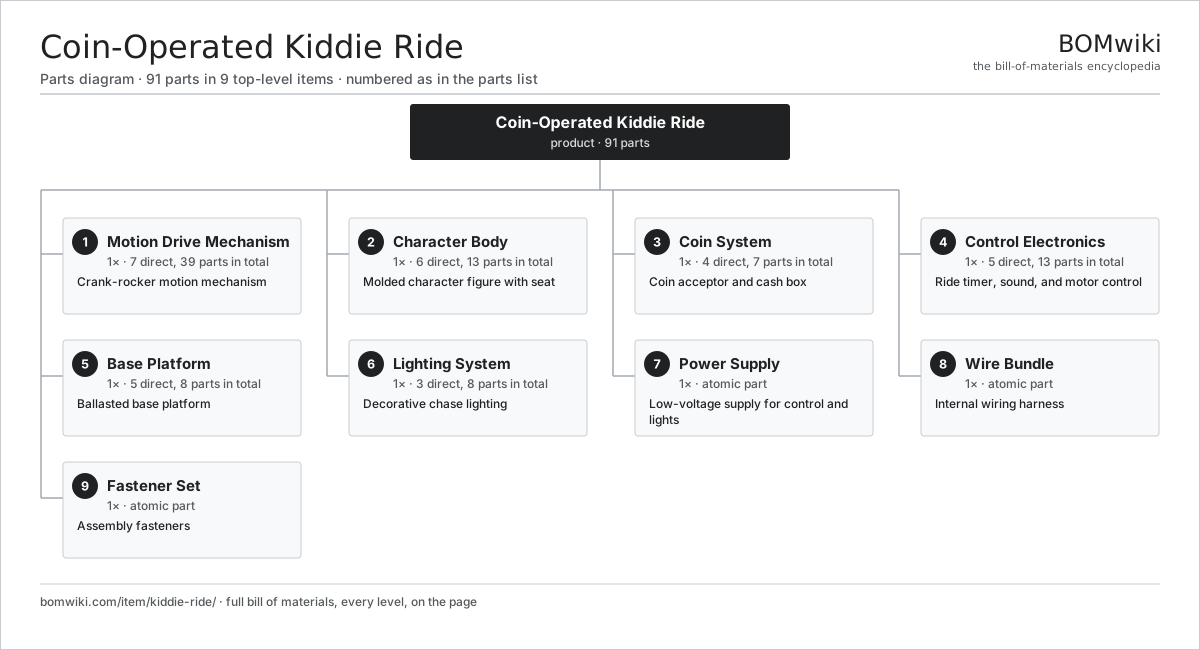
| # | Part | Qty | What it does |
|---|---|---|---|
| 1 | Motion Drive Mechanism 7 parts | 1× | Crank-rocker motion mechanism |
| 2 | Character Body 6 parts | 1× | Molded character figure with seat |
| 3 | Coin System 4 parts | 1× | Coin acceptor and cash box |
| 4 | Control Electronics 5 parts | 1× | Ride timer, sound, and motor control |
| 5 | Base Platform 5 parts | 1× | Ballasted base platform |
| 6 | Lighting System 3 parts | 1× | Decorative chase lighting |
| 7 | Power Supply | 1× | Low-voltage supply for control and lights |
| 8 | Wire Bundle | 1× | Internal wiring harness |
| 9 | Fastener Set | 1× | Assembly fasteners |
3D model
No 3D model yet. Have a CAD file of this? Add a 3D model. STL renders right on this page; STEP, FreeCAD, and OpenSCAD sources are welcome too (openly licensed, like all 3D models on BOMwiki).
Build & assembly graph
expand / collapse · shared sub-assemblies converge · links to related products · est. labourTap an assembly to expand/collapse · tap a part to open it · use “Open page” for any node · drag to pan, scroll to zoom.
Bill of materials for Coin-Operated Kiddie Ride
9 top-level lines · 59 rows shown · 91 parts total · indented to 3 levels| # | Item / sub-assembly | Part no. | Qty/assy | Ext. qty | Parts | Type |
|---|---|---|---|---|---|---|
| 1 | Motion Drive Mechanism 7 parts | kiddie-ride-motion-drive | 1× | 1 | 39 | assembly |
| 1.1 | Gearmotor 6 parts | kiddie-ride-gearmotor | 1× | 1 | 28 | assembly |
| 1.1.1 | Stator Assembly 3 parts + deeper › | stator-assembly | 1× | 1 | 3 | assembly |
| 1.1.2 | Rotor Assembly 4 parts + deeper › | rotor-assembly | 1× | 1 | 19 | assembly |
| 1.1.3 | Motor Housing | motor-housing | 1× | 1 | · | part |
| 1.1.4 | Gearbox Housing | gearbox-housing | 1× | 1 | · | part |
| 1.1.5 | Helical Gear Pair | gear-pair | 2× | 2 | · | part |
| 1.1.6 | Ball Bearing | ball-bearing | 2× | 2 | · | part |
| 1.2 | Crank Wheel | kiddie-ride-crank-wheel | 1× | 1 | · | part |
| 1.3 | Connecting Rod | kiddie-ride-connecting-rod | 1× | 1 | · | part |
| 1.4 | Rocker Arm | kiddie-ride-rocker-arm | 2× | 2 | · | part |
| 1.5 | Pivot Bracket | kiddie-ride-pivot-bracket | 2× | 2 | · | part |
| 1.6 | Drive Belt | drive-belt | 1× | 1 | · | part |
| 1.7 | Ball Bearing | ball-bearing | 4× | 4 | · | part |
| 2 | Character Body 6 parts | kiddie-ride-character-body | 1× | 1 | 13 | assembly |
| 2.1 | Body Shell | kiddie-ride-body-shell | 1× | 1 | · | part |
| 2.2 | Seat Assembly 5 parts | seat-assembly | 1× | 1 | 7 | assembly |
| 2.2.1 | Seat Frame | seat-frame | 1× | 1 | · | part |
| 2.2.2 | Seat Foam | seat-foam | 2× | 2 | · | part |
| 2.2.3 | Seat Cover | seat-cover | 1× | 1 | · | part |
| 2.2.4 | Seat Motor | seat-motor | 2× | 2 | · | part |
| 2.2.5 | Seat Heater Mat | seat-heater | 1× | 1 | · | part |
| 2.3 | Handlebar | kiddie-ride-handlebar | 1× | 1 | · | part |
| 2.4 | Footrest | kiddie-ride-footrest | 2× | 2 | · | part |
| 2.5 | Paint Finish | kiddie-ride-paint-finish | 1× | 1 | · | part |
| 2.6 | Body Mounting Plate | kiddie-ride-mounting-plate | 1× | 1 | · | part |
| 3 | Coin System 4 parts | kiddie-ride-coin-system | 1× | 1 | 7 | assembly |
| 3.1 | Coin Acceptor 4 parts | kiddie-ride-coin-acceptor | 1× | 1 | 4 | assembly |
| 3.1.1 | Bare PCB | pcb-bare | 1× | 1 | · | part |
| 3.1.2 | Microcontroller | mcu | 1× | 1 | · | part |
| 3.1.3 | SMD Passive (R/C/L) | smd-passives | 1× | 1 | · | part |
| 3.1.4 | Reject Gate | kiddie-ride-reject-gate | 1× | 1 | · | part |
| 3.2 | Coin Faceplate | kiddie-ride-coin-faceplate | 1× | 1 | · | part |
| 3.3 | Coin Chute | kiddie-ride-coin-chute | 1× | 1 | · | part |
| 3.4 | Cash Box | kiddie-ride-cash-box | 1× | 1 | · | part |
| 4 | Control Electronics 5 parts | kiddie-ride-control-electronics | 1× | 1 | 13 | assembly |
| 4.1 | Timer & Sound Board 5 parts | kiddie-ride-timer-board | 1× | 1 | 9 | assembly |
| 4.1.1 | Bare PCB | pcb-bare | 1× | 1 | · | part |
| 4.1.2 | Microcontroller | mcu | 1× | 1 | · | part |
| 4.1.3 | SMD Passive (R/C/L) | smd-passives | 1× | 1 | · | part |
| 4.1.4 | Power MOSFET | mosfet | 2× | 2 | · | part |
| 4.1.5 | Connector | connector | 4× | 4 | · | part |
| 4.2 | Relay | relay | 1× | 1 | · | part |
| 4.3 | Speaker | speaker | 1× | 1 | · | part |
| 4.4 | Volume Potentiometer | kiddie-ride-volume-pot | 1× | 1 | · | part |
| 4.5 | Start Button | kiddie-ride-start-button | 1× | 1 | · | part |
| 5 | Base Platform 5 parts | kiddie-ride-base | 1× | 1 | 8 | assembly |
| 5.1 | Base Chassis | kiddie-ride-base-chassis | 1× | 1 | · | part |
| 5.2 | Ballast Weight | kiddie-ride-ballast-weight | 1× | 1 | · | part |
| 5.3 | Base Skirt | kiddie-ride-base-skirt | 1× | 1 | · | part |
| 5.4 | Step Pad | kiddie-ride-step-pad | 1× | 1 | · | part |
| 5.5 | Leveling Foot | kiddie-ride-leveling-foot | 4× | 4 | · | part |
| 6 | Lighting System 3 parts | kiddie-ride-lighting | 1× | 1 | 8 | assembly |
| 6.1 | LED Strip | kiddie-ride-led-strip | 2× | 2 | · | part |
| 6.2 | Dome Lamp | kiddie-ride-dome-lamp | 4× | 4 | · | part |
| 6.3 | Connector | connector | 2× | 2 | · | part |
| 7 | Power Supply | power-supply | 1× | 1 | · | part |
| 8 | Wire Bundle | wire-bundle | 1× | 1 | · | part |
| 9 | Fastener Set | fastener-set | 1× | 1 | · | part |
Something wrong in this list? Report a problem with this BOM.
Related products
same domain, ranked by shared parts Bumper Car
69 parts · shares 19 with this page
Bumper Car
69 parts · shares 19 with this page
 Dark Ride System
1,005 parts · shares 19 with this page
Dark Ride System
1,005 parts · shares 19 with this page
 Roller Coaster
657 parts · shares 13 with this page
Roller Coaster
657 parts · shares 13 with this page
 Carousel (Merry-Go-Round)
755 parts · shares 19 with this page
Carousel (Merry-Go-Round)
755 parts · shares 19 with this page
 Pirate Ship Ride
478 parts · shares 11 with this page
Pirate Ship Ride
478 parts · shares 11 with this page
 Teacup Ride
660 parts · shares 11 with this page
Teacup Ride
660 parts · shares 11 with this page
Sourcing: possible vendors
Browse the supplier directory → Prices, MOQ, and lead times are algorithmic estimates, not quotes, and not claims about these companies. Company mappings are curated by keyword; est. price band $20–$3k. How estimates work| Vendor | HQ | Specialty | MOQ | Lead time |
|---|---|---|---|---|
|
🇩🇰LEGO
lego.com ↗
|
Billund, DK | Construction toys | 2,000 units | 6–10 wks |
|
🇺🇸Mattel
mattel.com ↗
|
El Segundo, US | Toys | 2,000 units | 6–10 wks |
|
🇺🇸Hasbro
hasbro.com ↗
|
Pawtucket, US | Toys & games | 2,000 units | 6–10 wks |
| bandainamco.co.jp ↗ | Tokyo, JP | Toys & amusement | 2,000 units | 6–10 wks |
| spinmaster.com ↗ | Toronto, CA | Toys | 2,000 units | 6–10 wks |
781-word article