Knee Walker
ProductOverview
A knee walker (also called a knee scooter or leg scooter) is a four-wheeled mobility device allowing patients with lower-leg or foot injuries to move independently while maintaining complete non-weight-bearing (NWB) status. Unlike crutches, which require upper-body strength and balance, a knee walker supports the patient's injured leg at the knee and shin, allowing the patient to propel themselves forward by pushing with their uninjured leg or using hands for additional steering.
Knee walkers are prescribed for acute foot/ankle injuries (fractures, sprains, post-operative recovery), Achilles tendon injury, or any condition requiring 4–8 weeks of NWB status. They are superior to crutches for most patients, reducing fall risk, preserving upper-extremity function, and improving psychological acceptance of mobility aids. Patients using knee walkers report higher independence and faster functional recovery than crutch users.
How it works
The patient positions their injured leg on the padded knee platform, resting the shin and knee in the contoured support. The high-density foam padding distributes pressure evenly, reducing skin irritation during extended mobility. The patient grips the handlebars for balance and control, then propels forward by pushing with their uninjured leg against the ground while the four wheels roll freely.
The two swivel front casters allow steering by rotating the handlebars left or right. The two rear wheels include hand-operated brakes (cable-actuated levers on the handlebars) for stopping. The patient can coast downhill (on slight slopes) by rolling the walker while continuing to rest their knee on the platform, or they can actively propel themselves on level ground or uphill by pushing with their good leg.
Advantages over crutches
Reduced fall risk: Crutches require precise balance and upper-arm coordination; knee walkers provide a stable four-point base, reducing falls, critical in elderly patients or those with balance impairments.
Preserved upper-extremity function: Crutches place load on shoulders, armpits, and wrists; prolonged crutch use causes repetitive strain injuries, nerve compression in the axilla, and shoulder pain. Knee walkers eliminate this burden, allowing patients to use hands for eating, dressing, and other ADLs without fatigue.
Higher walking speed and distance: Patients using knee walkers walk 20–30% faster than crutch users and report greater endurance over longer distances.
Improved comfort: The padded platform is more comfortable than axillary crutch pads for extended periods. The optional calf support prevents shin irritation.
Social acceptance: Many patients psychologically accept knee walkers more readily than crutches, reporting higher confidence and reduced stigma during community mobility.
Limitations and patient selection
Knee walkers require minimum functional capacity:
- Ability to bear weight and propel on the uninjured leg.
- Sufficient balance and upper-body strength to stabilize using handlebars.
- Cognitive ability to manage steering and braking.
- Adequate hand strength to operate brake levers.
Patients with bilateral leg injuries, severe balance impairments, or profound upper-extremity weakness benefit more from crutches or full-body mobility aids. Knee walkers are also less stable on steep outdoor terrain or stairs compared to crutches, limiting outdoor mobility in some environments.
Adjustment and fit
The height-adjustable steering column accommodates patient stature from ~1.5 m to 1.9 m via quick-pin adjustment. The knee platform angle is customizable (0–20 degrees) to match the patient's leg length and comfort preference. Proper fit prevents back strain and ensures efficient propulsion, the handlebars should be at wrist height when the patient stands upright on their good leg, and the knee platform should support the shin without excessive pressure on the popliteal fossa (back of knee).
Most knee walkers fit 90% of adult patients with basic adjustment; custom orthotic versions exist for pediatric or unusual anthropometries.
Wheel design and mobility
Pneumatic (air-filled) tires provide superior cushioning and shock absorption, improving comfort on bumpy terrain but requiring occasional air pressure checks. Solid tires (polyurethane) are maintenance-free, ideal for facilities or users unwilling to pump tires, but offer less comfort. Sealed bearing wheels reduce friction and extend lifespan; poor-quality walkers with unsealed bearings develop squeaking and resistance within weeks.
The two swivel front casters allow tight turning radii (~0.8–1.2 m), enabling navigation through doorways, around furniture, and in cramped environments. Some models offer fixed front wheels for increased stability at the cost of maneuverability.
Brake systems and safety
Most knee walkers use hand-lever brakes (similar to bicycle brakes) that cable-operate drum or pad brakes on rear wheels. Squeezing the lever applies friction, slowing and stopping the walker. Some models include parking brakes (foot-pedal locks) that hold the walker stationary during patient transfer or rest, preventing unintended rolling.
The rear and front reflectors improve visibility in low-light conditions, particularly important for elderly patients using walkers outdoors in dawn/dusk hours.
Typical recovery timeline
A patient with an uncomplicated ankle fracture typically uses a knee walker for 4–8 weeks while healing, then transitions to partial weight-bearing (using crutches with a walking boot) for 2–3 weeks, and finally to full weight-bearing (unassisted walking) as pain and swelling resolve. Physical therapy during the NWB phase focuses on maintaining upper-body and core strength while the lower-leg injury heals.
Patients report rapid confidence improvement in the first few days of knee walker use, often preferring it to prescribed crutches, a preference that should be honored when medically appropriate, as improved compliance and faster functional recovery result when patients accept their mobility aid.
Knee Walker parts and their functions
7 top-level parts · 119 parts in total · full bill of materials below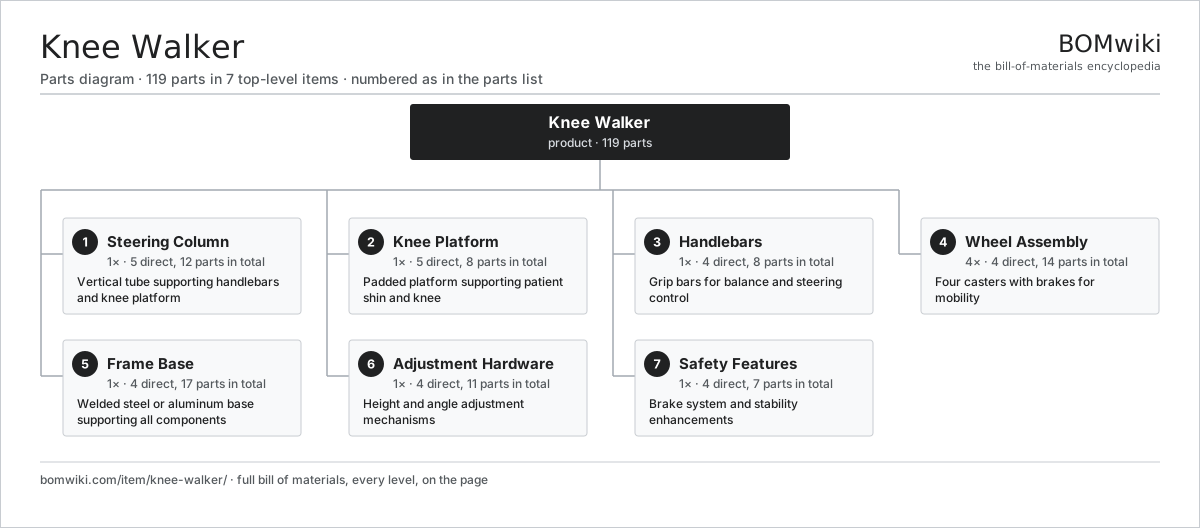
| # | Part | Qty | What it does |
|---|---|---|---|
| 1 | Steering Column 5 parts | 1× | Vertical tube supporting handlebars and knee platform |
| 2 | Knee Platform 5 parts | 1× | Padded platform supporting patient shin and knee |
| 3 | Handlebars 4 parts | 1× | Grip bars for balance and steering control |
| 4 | Wheel Assembly 4 parts | 4× | Four casters with brakes for mobility |
| 5 | Frame Base 4 parts | 1× | Welded steel or aluminum base supporting all components |
| 6 | Adjustment Hardware 4 parts | 1× | Height and angle adjustment mechanisms |
| 7 | Safety Features 4 parts | 1× | Brake system and stability enhancements |
3D model
No 3D model yet. Have a CAD file of this? Add a 3D model. STL renders right on this page; STEP, FreeCAD, and OpenSCAD sources are welcome too (openly licensed, like all 3D models on BOMwiki).
Build & assembly graph
expand / collapse · shared sub-assemblies converge · links to related products · est. labourTap an assembly to expand/collapse · tap a part to open it · use “Open page” for any node · drag to pan, scroll to zoom.
Bill of materials for Knee Walker
7 top-level lines · 37 rows shown · 119 parts total · indented to 3 levels| # | Item / sub-assembly | Part no. | Qty/assy | Ext. qty | Parts | Type |
|---|---|---|---|---|---|---|
| 1 | Steering Column 5 parts | knee-walker-steering-column | 1× | 1 | 12 | assembly |
| 1.1 | Steering Post | knee-walker-steering-post | 1× | 1 | · | part |
| 1.2 | Column Extension | knee-walker-column-extension | 1× | 1 | · | part |
| 1.3 | Handlebar Mount | knee-walker-handlebars-mount | 1× | 1 | · | part |
| 1.4 | Platform Mount | knee-walker-knee-platform-mount | 1× | 1 | · | part |
| 1.5 | Fastener Set | fastener-set | 8× | 8 | · | part |
| 2 | Knee Platform 5 parts | knee-walker-knee-platform | 1× | 1 | 8 | assembly |
| 2.1 | Platform Base | knee-walker-platform-base | 1× | 1 | · | part |
| 2.2 | Platform Padding | knee-walker-platform-padding | 1× | 1 | · | part |
| 2.3 | Calf Rest | knee-walker-calf-rest | 1× | 1 | · | part |
| 2.4 | Angle Adjuster | knee-walker-platform-angle-adjuster | 1× | 1 | · | part |
| 2.5 | Fastener Set | fastener-set | 4× | 4 | · | part |
| 3 | Handlebars 4 parts | knee-walker-handlebars | 1× | 1 | 8 | assembly |
| 3.1 | Handlebar Tube | knee-walker-handlebar-tube | 1× | 1 | · | part |
| 3.2 | Handlebar Grip | knee-walker-handlebar-grip | 2× | 2 | · | part |
| 3.3 | Grip Diameter | knee-walker-grip-diameter | 1× | 1 | · | part |
| 3.4 | Fastener Set | fastener-set | 4× | 4 | · | part |
| 4 | Wheel Assembly 4 parts | knee-walker-wheel-assembly | 4× | 4 | 14 | assembly |
| 4.1 | Front Wheels | knee-walker-front-wheels | 2× | 8 | · | part |
| 4.2 | Rear Wheels | knee-walker-rear-wheels | 2× | 8 | · | part |
| 4.3 | Wheel Brakes | knee-walker-wheel-brake | 2× | 8 | · | part |
| 4.4 | Fastener Set | fastener-set | 8× | 32 | · | part |
| 5 | Frame Base 4 parts | knee-walker-frame-base | 1× | 1 | 17 | assembly |
| 5.1 | Base Platform | knee-walker-base-platform | 1× | 1 | · | part |
| 5.2 | Frame Sides | knee-walker-frame-sides | 2× | 2 | · | part |
| 5.3 | Cross Braces | knee-walker-cross-braces | 2× | 2 | · | part |
| 5.4 | Fastener Set | fastener-set | 12× | 12 | · | part |
| 6 | Adjustment Hardware 4 parts | knee-walker-adjustment-hardware | 1× | 1 | 11 | assembly |
| 6.1 | Height Adjuster | knee-walker-height-adjuster | 1× | 1 | · | part |
| 6.2 | Angle Adjuster | knee-walker-angle-adjuster | 1× | 1 | · | part |
| 6.3 | Width Adjuster | knee-walker-width-adjuster | 1× | 1 | · | part |
| 6.4 | Fastener Set | fastener-set | 8× | 8 | · | part |
| 7 | Safety Features 4 parts | knee-walker-safety-features | 1× | 1 | 7 | assembly |
| 7.1 | Brake Lever | knee-walker-brake-lever | 2× | 2 | · | part |
| 7.2 | Brake Cable | knee-walker-brake-cable | 1× | 1 | · | part |
| 7.3 | Reflectors | knee-walker-reflectors | 3× | 3 | · | part |
| 7.4 | Wheel Lock | knee-walker-wheel-lock | 1× | 1 | · | part |
Something wrong in this list? Report a problem with this BOM.
Sourcing: possible vendors
Browse the supplier directory → Prices, MOQ, and lead times are algorithmic estimates, not quotes, and not claims about these companies. Company mappings are curated by keyword; est. price band $500–$3M. How estimates work| Vendor | HQ | Specialty | MOQ | Lead time |
|---|---|---|---|---|
| gehealthcare.com ↗ | Chicago, US | Medical imaging & devices | 100 units | 12–20 wks |
| siemens-healthineers.com ↗ | Erlangen, DE | Medical systems | 100 units | 12–20 wks |
|
🇳🇱Philips
philips.com ↗
|
Amsterdam, NL | Health technology | 100 units | 12–20 wks |
| medtronic.com ↗ | Minneapolis, US | Medical devices | 100 units | 12–20 wks |
|
🇨🇳Mindray
mindray.com ↗
|
Shenzhen, CN | Medical devices | 100 units | 12–20 wks |
975-word article