Kreisel Tank
ProductOverview
A Kreisel Tank (German for "whirlpool" or "gyrating") is a specialized cylindrical rearing vessel designed to rear planktonic larvae and other sensitive aquatic organisms through controlled circular flow. Unlike conventional rectangular aquariums with distinct corners and dead zones, the kreisel's seamless cylindrical geometry eliminates stagnant regions, ensuring uniform water quality throughout. The distinctive feature is the tangential intake-and-outlet design: water is injected at an angle to impart gentle rotational motion, creating a slow, stable eddy that keeps suspended larvae continuously circulating without exhausting them against sharp tank walls or suction points.
Kreisel tanks originated in European marine hatcheries and are now standard equipment in coral propagation facilities, fish breeding operations, and larval research. They are essential for rearing delicate, non-mobile larvae (fish eggs, copepod nauplii, coral planulae) that cannot compete with aggressive flow regimes and are prone to injury from conventional circulation pumps.
The Laminar Inflow Manifold delivers water slowly from the Return Circulation Pump via tangential ports positioned to spin the water body like a lazy carousel. The Screened Outlet Assembly drains water at approximately mid-height, positioned tangentially to maintain the rotational pattern. The Main Tank Bowl itself, seamless acrylic or fiberglass, provides the hydrodynamic foundation for this gentle, stable circulation pattern.
Fluid Dynamics and Design Rationale
Conventional tank designs prioritize rapid water turnover and mechanical filtration; they accept high-velocity flow jets and sharp velocity gradients. Larval organisms are too fragile for this environment. Larvae are neutrally buoyant, have minimal swimming ability (most are passively drifting planktonic stages), and can be damaged by:
- High shear forces at pump inlets and filter intakes (can damage developing gills and sensory organs)
- Localized turbulence at corners and dead zones (larvae become trapped, exhaust fighting currents, or sink and die in anoxic pockets)
- Uneven food distribution (flow concentration areas starve adjacent larvae)
The kreisel's tangential intake design minimizes these hazards. Water is injected at 2–4 m³/h tangent to the cylindrical wall, imparting a slow, smooth rotational velocity (typically <0.2 m/s surface speed at the wall). This creates a unified rotational field where:
- Larvae drift in the rotational current at near-uniform velocity, experiencing minimal shear
- Food particles (copepod nauplii, rotifer cysts, algal cells) distribute evenly throughout the water column
- Dead zones are eliminated because the seamless cylinder has no corners where flow can separate
The Screened Outlet Assembly is positioned tangentially at mid-height; water exits in the direction of circulation, avoiding the "sink-then-drain" problem of center drains. The Outlet Screen (100–500 µm mesh) prevents larval escapement while maintaining flow rate.
Circulation Mechanics
The Return Circulation Pump is intentionally oversized compared to traditional aquarium circulation (10–50 W vs. typical 100+ W pumps). This low power requirement reflects the kreisel's design efficiency: instead of fighting against dead zones and complex internal baffles, the pump simply sustains a gentle rotational current. Flow rate is 1–5 tank turnovers per hour, much slower than biological filtration systems (which might achieve 10–20 turnovers).
Water from the Drain Tubing flows via gravity into the Sump Bucket, which serves as the pump inlet reservoir. The pump draws from this sump and delivers water back through the Return Tubing to the Laminar Inflow Manifold. The manifold's Intake Diffuser Baffle baffle upstream of the tangential ports eliminates pump discharge turbulence, ensuring smooth injection.
Aeration and Oxygenation
The Aeration Module maintains dissolved oxygen via passive diffusion from an Air Stone Diffuser, not from the circulation system. This separation is intentional: mechanical aeration (bubbling) introduces additional shear forces that can damage delicate larvae. Instead, the Air Flow Control Valve regulates a slow, steady stream of fine bubbles from a simple aquarium air pump. At typical operating conditions (0.5–2 L/min air), diffusion alone provides sufficient O₂ for densely stocked larvae tanks.
The False Floor Assembly (an optional false floor with a gas-diffusion grid) promotes upward aeration flow while keeping larvae suspended, preventing settlement on the tank bottom where anaerobic conditions can develop.
Larval Rearing Workflow
Kreisel tanks are typically used in a batch process. Fertilized eggs or larvae are placed in the tank during an initial fill cycle. Over 2–4 weeks, water quality is maintained by daily partial water changes (25–50% of volume) rather than continuous biological filtration, larvae cannot tolerate the detritus-rich environment of sump-filtered systems. Feeding occurs via pipette or small dispenser, introducing live food (copepod nauplii, rotifers) or microencapsulated dry food at multiple points around the rim so distributions are uniform.
The gentle Laminar Inflow Manifold and Screened Outlet Assembly prevent larval sucking-in or escape. Larvae spend their entire developmental window in the kreisel, emerging as juveniles capable of handling conventional tank environments.
Maintenance and Cleaning
The Outlet Screen clogs with detritus and bio-slime after 1–2 days; daily rinsing (or rotation of a second screen) is essential. The Acrylic Cylinder develops algal films on walls in light-exposed systems; gentle brushing maintains visibility. The Sump Bucket requires daily cleaning to prevent bacterial bloom. The Return Circulation Pump, running continuously at low power, may accumulate minor biofilm in the impeller housing; weekly inspection and flushing are recommended.
Scalability
Small portable kreisel tanks (30 cm diameter, 20-liter volume) are suitable for hobbyist coral or fish propagation. Industrial hatcheries use multiple 200-liter kreisel tanks arranged in series, each stage supporting progressively later developmental stages. The modular Support Frame and Plumbing design allows tanks to be stacked or arranged in rows with shared sump and aeration systems, optimizing hatchery floor space.
Kreisel Tank parts and their functions
6 top-level parts · 19 parts in total · full bill of materials below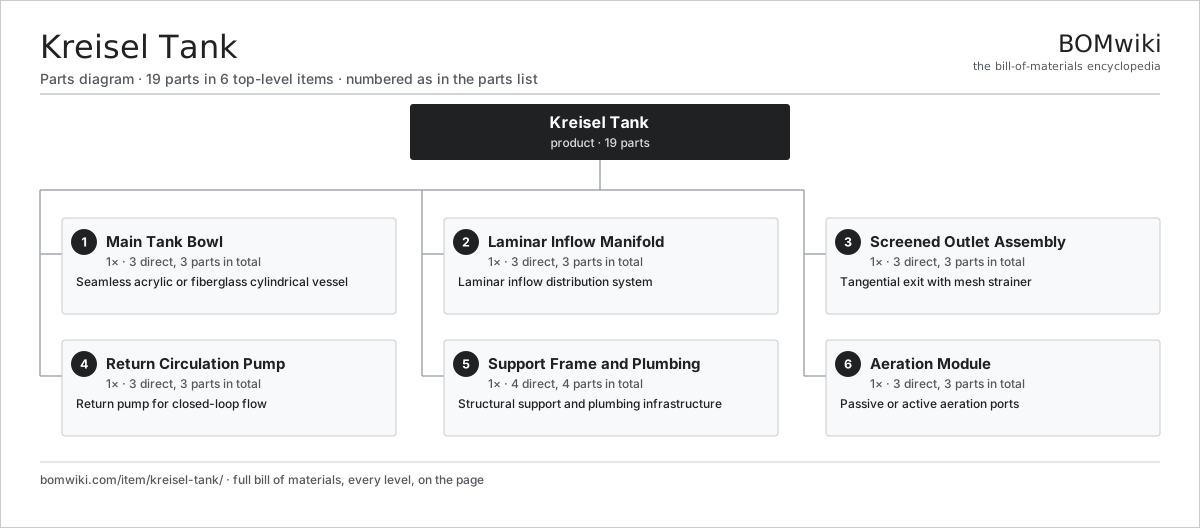
| # | Part | Qty | What it does |
|---|---|---|---|
| 1 | Main Tank Bowl 3 parts | 1× | Seamless acrylic or fiberglass cylindrical vessel |
| 2 | Laminar Inflow Manifold 3 parts | 1× | Laminar inflow distribution system |
| 3 | Screened Outlet Assembly 3 parts | 1× | Tangential exit with mesh strainer |
| 4 | Return Circulation Pump 3 parts | 1× | Return pump for closed-loop flow |
| 5 | Support Frame and Plumbing 4 parts | 1× | Structural support and plumbing infrastructure |
| 6 | Aeration Module 3 parts | 1× | Passive or active aeration ports |
3D model
No 3D model yet. Have a CAD file of this? Add a 3D model. STL renders right on this page; STEP, FreeCAD, and OpenSCAD sources are welcome too (openly licensed, like all 3D models on BOMwiki).
Build & assembly graph
expand / collapse · shared sub-assemblies converge · links to related products · est. labourTap an assembly to expand/collapse · tap a part to open it · use “Open page” for any node · drag to pan, scroll to zoom.
Bill of materials for Kreisel Tank
6 top-level lines · 25 rows shown · 19 parts total · indented to 3 levels| # | Item / sub-assembly | Part no. | Qty/assy | Ext. qty | Parts | Type |
|---|---|---|---|---|---|---|
| 1 | Main Tank Bowl 3 parts | kreisel-tank-bowl | 1× | 1 | 3 | assembly |
| 1.1 | Acrylic Cylinder | kreisel-tank-acrylic-body | 1× | 1 | · | part |
| 1.2 | False Floor Assembly | kreisel-tank-floor-insert | 1× | 1 | · | part |
| 1.3 | Central Drain Valve | kreisel-tank-drain-port | 1× | 1 | · | part |
| 2 | Laminar Inflow Manifold 3 parts | kreisel-tank-intake-manifold | 1× | 1 | 3 | assembly |
| 2.1 | Intake Manifold Ring | kreisel-tank-intake-ring | 1× | 1 | · | part |
| 2.2 | Intake Diffuser Baffle | kreisel-tank-intake-diffuser | 1× | 1 | · | part |
| 2.3 | Intake Fittings | kreisel-tank-intake-fittings | 1× | 1 | · | part |
| 3 | Screened Outlet Assembly 3 parts | kreisel-tank-screened-outlet | 1× | 1 | 3 | assembly |
| 3.1 | Outlet Port | kreisel-tank-outlet-port | 1× | 1 | · | part |
| 3.2 | Outlet Screen | kreisel-tank-outlet-screen | 1× | 1 | · | part |
| 3.3 | Outlet Isolation Valve | kreisel-tank-outlet-valve | 1× | 1 | · | part |
| 4 | Return Circulation Pump 3 parts | kreisel-tank-circulation-pump | 1× | 1 | 3 | assembly |
| 4.1 | Circulation Motor | kreisel-tank-pump-motor | 1× | 1 | · | part |
| 4.2 | Low-Shear Impeller | kreisel-tank-pump-impeller | 1× | 1 | · | part |
| 4.3 | Pump Volute | kreisel-tank-pump-housing | 1× | 1 | · | part |
| 5 | Support Frame and Plumbing 4 parts | kreisel-tank-stand-frame | 1× | 1 | 4 | assembly |
| 5.1 | Frame Structure | kreisel-tank-frame-structure | 1× | 1 | · | part |
| 5.2 | Sump Bucket | kreisel-tank-sump-bucket | 1× | 1 | · | part |
| 5.3 | Return Tubing | kreisel-tank-return-line | 1× | 1 | · | part |
| 5.4 | Drain Tubing | kreisel-tank-drain-line | 1× | 1 | · | part |
| 6 | Aeration Module 3 parts | kreisel-tank-aeration-system | 1× | 1 | 3 | assembly |
| 6.1 | Air Stone Diffuser | kreisel-tank-air-stone | 1× | 1 | · | part |
| 6.2 | Air Supply Tubing | kreisel-tank-air-line | 1× | 1 | · | part |
| 6.3 | Air Flow Control Valve | kreisel-tank-air-control-valve | 1× | 1 | · | part |
Something wrong in this list? Report a problem with this BOM.
Sourcing: possible vendors
Browse the supplier directory → Prices, MOQ, and lead times are algorithmic estimates, not quotes, and not claims about these companies. Company mappings are curated by keyword; est. price band $2k–$500M. How estimates work| Vendor | HQ | Specialty | MOQ | Lead time |
|---|---|---|---|---|
| hd.com ↗ | Ulsan, KR | Shipbuilder | made to order | 52–104 wks |
| fincantieri.com ↗ | Trieste, IT | Shipbuilder | made to order | 52–104 wks |
| damen.com ↗ | Gorinchem, NL | Shipbuilder | made to order | 52–104 wks |
| brunswick.com ↗ | Mettawa, US | Marine & boats | made to order | 52–104 wks |
|
🇨🇳CSSC
cssc.net.cn ↗
|
Shanghai, CN | Shipbuilding conglomerate | made to order | 52–104 wks |
960-word article