L-Bar Sealer
ProductOverview
An L-bar sealer is a workhorse machine in food, beverage and consumer goods packaging. It wraps a continuous thermoplastic film around a product as it passes through, seals the overlap with a heated bar, then carries the sealed pack through a heated shrink tunnel where the film shrinks and contracts, forming a tamper-evident, moisture-proof envelope. The name "L-bar" comes from the shaped heating element that fuses the two overlapping film edges as they cross the seal point. Most L-sealers operate at 15–60 packs per minute and are found in small food producers, bakeries, meat and seafood facilities, and logistic centres sealing mixed goods into individual retail packs.
Film supply and tension
Plastic film (LDPE, LLDPE, PVC or PET/PE coextrusions, typically 50–75 microns thick) arrives on large rolls mounted on the Film Reel. An Film Unwind Motor with encoder feedback provides precise tension control, the film must be taut to wrap cleanly but not so tight that it distorts or wrinkles. A Film Tension Arm (a spring-loaded dancer) maintains constant tension through the film path. The Film Guide (a roller or slot) straightens the film as it advances toward the Sealing Frame.
Film forming around the product
The product arrives on the Infeed Conveyor and enters the sealing frame. The Sealing Frame is ingenious: the film descends over the product and is pulled down tightly around all sides by a Pull-Down Belt (a conveyor belt with forming corners). At each of the four sides of the product are Forming Corner blocks (rounded or angled corner pieces) that guide the film smoothly down. By the time the product exits the frame, the film has wrapped three-quarters around it; a small overlap (typically 20–40 mm) is created at the fifth side. The wrapped product then advances toward the Hot Seal Bar.
Heat sealing
The Hot Seal Bar is the sealing zone. Two film layers (the leading edge and the trailing edge overlap) converge at the sealing plane. A heated metal bar (or pair of bars) at 200–280 °C presses these overlapping layers together for 0.5–2 seconds. The Heater Element (typically a resistive strip or cartridge heater embedded in an aluminum or steel block) is powered and regulated by the Seal Temperature Control, a PID controller monitoring temperature via a thermocouple in the bar. The Seal Bar Pressure Pad (a PTFE-coated pad that slides across the film to prevent sticking) applies even pressure, creating a strong weld line. The sealed pack then advances onto a take-away conveyor leading into the tunnel.
Shrink tunnel
As the sealed pack enters the Shrink Tunnel, it is exposed to 200–250 °C air, generated by a Tunnel Heater (electric resistance heaters or steam coil). A Tunnel Circulation Motor (a blower motor) circulates hot air inside the insulated Tunnel Frame chamber. Dwell time in the tunnel is typically 2–8 seconds depending on pack density and film thickness. The plastic film softens and shrinks around the product, creating a tight, conforming envelope and a tamper-evident appearance. The product emerges from the tunnel slightly warm.
Cooling and quality
As the pack exits the tunnel, a Cooling Air System system (driven by a Cooling Fan) blows cool air (or ambient air in larger systems) to set the shrink and prevent wrinkling. The cooled pack then either drops into a collection bin or continues to the next line station (labeller, checkweigher, case packer). Temperature, dwell time and conveyor speed are all inter-related; the Control System (a Control PLC running sealer logic) coordinates seal bar temperature, film tension, conveyor speed and tunnel air temperature to meet the operating recipe.
Film choice and application
LDPE and LLDPE films are most common for food wrapping because they shrink reliably and create strong seals. Oriented PET/PE laminates provide better puncture resistance and clarity. Colours can include opaque white (good for labelling), clear (showcasing product), or printed rolls with product branding. Shrink ratios (the percentage the film contracts) are typically 30–50% in both machine and transverse directions. Well-designed packs hold heat set with minimal wrinkling; poor film or misadjusted temperature leads to loose, wrinkled packs that look unprofessional and fail moisture tests.
Changeover and flexibility
Running a different product size requires adjusting film tension, seal bar temperature and dwell time, tunnel temperature, and conveyor speed, typically a 15–30 minute recipe change. The HMI Panel stores 20+ recipes, so operators can switch between, for example, a 100 g pack of meat, a 200 g bakery loaf, and a 500 g bulk seafood package in quick succession. Some machines can automatically adjust film width via motorised film guides, though most require manual reel swap.
Speed and economics
Throughput is limited by cool-down time in the tunnel; faster tunnels (longer or hotter) can achieve 40–60 packs per minute for small, thin-film packs. Heavy products or thick films need longer dwell to shrink fully, capping speed at 15–25 packs per minute. Film waste is minimal (~5–8% scrap trim), making the running cost proportional to product weight and film consumption.
L-Bar Sealer parts and their functions
10 top-level parts · 169 parts in total · full bill of materials below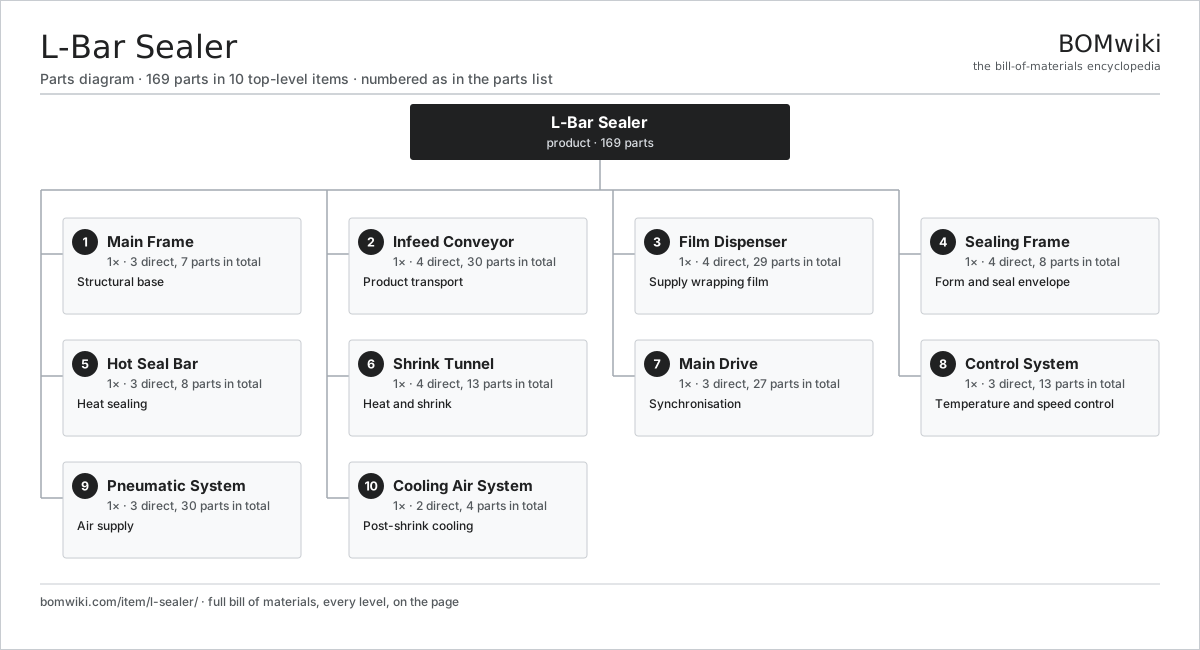
| # | Part | Qty | What it does |
|---|---|---|---|
| 1 | Main Frame 3 parts | 1× | Structural base |
| 2 | Infeed Conveyor 4 parts | 1× | Product transport |
| 3 | Film Dispenser 4 parts | 1× | Supply wrapping film |
| 4 | Sealing Frame 4 parts | 1× | Form and seal envelope |
| 5 | Hot Seal Bar 3 parts | 1× | Heat sealing |
| 6 | Shrink Tunnel 4 parts | 1× | Heat and shrink |
| 7 | Main Drive 3 parts | 1× | Synchronisation |
| 8 | Control System 3 parts | 1× | Temperature and speed control |
| 9 | Pneumatic System 3 parts | 1× | Air supply |
| 10 | Cooling Air System 2 parts | 1× | Post-shrink cooling |
3D model
No 3D model yet. Have a CAD file of this? Add a 3D model. STL renders right on this page; STEP, FreeCAD, and OpenSCAD sources are welcome too (openly licensed, like all 3D models on BOMwiki).
Build & assembly graph
expand / collapse · shared sub-assemblies converge · links to related products · est. labourTap an assembly to expand/collapse · tap a part to open it · use “Open page” for any node · drag to pan, scroll to zoom.
Bill of materials for L-Bar Sealer
10 top-level lines · 80 rows shown · 169 parts total · indented to 3 levels| # | Item / sub-assembly | Part no. | Qty/assy | Ext. qty | Parts | Type |
|---|---|---|---|---|---|---|
| 1 | Main Frame 3 parts | l-sealer-main-frame | 1× | 1 | 7 | assembly |
| 1.1 | Frame Rail | l-sealer-frame-rail | 2× | 2 | · | part |
| 1.2 | Cross Member | l-sealer-cross-member | 4× | 4 | · | part |
| 1.3 | Base Plate | l-sealer-base-plate | 1× | 1 | · | part |
| 2 | Infeed Conveyor 4 parts | l-sealer-infeed-conveyor | 1× | 1 | 30 | assembly |
| 2.1 | Conveyor Belt | l-sealer-conveyor-belt | 1× | 1 | · | part |
| 2.2 | Conveyor Motor 3 parts | l-sealer-conveyor-motor | 1× | 1 | 24 | assembly |
| 2.2.1 | Stator Assembly 3 parts + deeper › | stator-assembly | 1× | 1 | 3 | assembly |
| 2.2.2 | Rotor Assembly 4 parts + deeper › | rotor-assembly | 1× | 1 | 19 | assembly |
| 2.2.3 | Ball Bearing | ball-bearing | 2× | 2 | · | part |
| 2.3 | Ball Bearing | ball-bearing | 4× | 4 | · | part |
| 2.4 | Conveyor Frame | l-sealer-conveyor-frame | 1× | 1 | · | part |
| 3 | Film Dispenser 4 parts | l-sealer-film-dispenser | 1× | 1 | 29 | assembly |
| 3.1 | Film Reel | l-sealer-film-reel | 1× | 1 | · | part |
| 3.2 | Film Unwind Motor 4 parts | l-sealer-film-unwind-motor | 1× | 1 | 25 | assembly |
| 3.2.1 | Stator Assembly 3 parts + deeper › | stator-assembly | 1× | 1 | 3 | assembly |
| 3.2.2 | Rotor Assembly 4 parts + deeper › | rotor-assembly | 1× | 1 | 19 | assembly |
| 3.2.3 | Encoder | encoder | 1× | 1 | · | part |
| 3.2.4 | Ball Bearing | ball-bearing | 2× | 2 | · | part |
| 3.3 | Film Tension Arm | l-sealer-film-tension-arm | 1× | 1 | · | part |
| 3.4 | Film Guide | l-sealer-film-guide | 2× | 2 | · | part |
| 4 | Sealing Frame 4 parts | l-sealer-sealing-frame | 1× | 1 | 8 | assembly |
| 4.1 | Forming Corner | l-sealer-forming-corner | 2× | 2 | · | part |
| 4.2 | Pull-Down Belt | l-sealer-pull-down-belt | 1× | 1 | · | part |
| 4.3 | Product Stop | l-sealer-product-stop | 1× | 1 | · | part |
| 4.4 | Ball Bearing | ball-bearing | 4× | 4 | · | part |
| 5 | Hot Seal Bar 3 parts | l-sealer-hot-seal-bar | 1× | 1 | 8 | assembly |
| 5.1 | Seal Bar Heater 2 parts | l-sealer-seal-bar-heater | 1× | 1 | 3 | assembly |
| 5.1.1 | Heater Element | l-sealer-heater-element | 2× | 2 | · | part |
| 5.1.2 | Pressure Sensor | pressure-sensor | 1× | 1 | · | part |
| 5.2 | Seal Bar Pressure Pad | l-sealer-seal-bar-pressure-pad | 1× | 1 | · | part |
| 5.3 | Seal Temperature Control 4 parts | l-sealer-seal-temperature-control | 1× | 1 | 4 | assembly |
| 5.3.1 | Microcontroller | mcu | 1× | 1 | · | part |
| 5.3.2 | Bare PCB | pcb-bare | 1× | 1 | · | part |
| 5.3.3 | SMD Passive (R/C/L) | smd-passives | 1× | 1 | · | part |
| 5.3.4 | Relay | relay | 1× | 1 | · | part |
| 6 | Shrink Tunnel 4 parts | l-sealer-shrink-tunnel | 1× | 1 | 13 | assembly |
| 6.1 | Tunnel Heater 2 parts | l-sealer-tunnel-heater | 1× | 1 | 6 | assembly |
| 6.1.1 | Heating Element | heating-element | 4× | 4 | · | part |
| 6.1.2 | Temperature Sensor | l-sealer-temperature-sensor | 2× | 2 | · | part |
| 6.2 | Tunnel Circulation Motor 2 parts | l-sealer-tunnel-motor | 1× | 1 | 3 | assembly |
| 6.2.1 | Blower Motor | blower-motor | 1× | 1 | · | part |
| 6.2.2 | Ball Bearing | ball-bearing | 2× | 2 | · | part |
| 6.3 | Tunnel Frame | l-sealer-tunnel-frame | 1× | 1 | · | part |
| 6.4 | Tunnel Temp Control 3 parts | l-sealer-tunnel-temperature-control | 1× | 1 | 3 | assembly |
| 6.4.1 | Microcontroller | mcu | 1× | 1 | · | part |
| 6.4.2 | Bare PCB | pcb-bare | 1× | 1 | · | part |
| 6.4.3 | Relay | relay | 1× | 1 | · | part |
| 7 | Main Drive 3 parts | l-sealer-main-drive | 1× | 1 | 27 | assembly |
| 7.1 | Main Motor 3 parts | l-sealer-main-motor | 1× | 1 | 24 | assembly |
| 7.1.1 | Stator Assembly 3 parts + deeper › | stator-assembly | 1× | 1 | 3 | assembly |
| 7.1.2 | Rotor Assembly 4 parts + deeper › | rotor-assembly | 1× | 1 | 19 | assembly |
| 7.1.3 | Ball Bearing | ball-bearing | 2× | 2 | · | part |
| 7.2 | Main Shaft | l-sealer-main-shaft | 1× | 1 | · | part |
| 7.3 | Drive Belt | drive-belt | 2× | 2 | · | part |
| 8 | Control System 3 parts | l-sealer-control-system | 1× | 1 | 13 | assembly |
| 8.1 | Control PLC 4 parts | l-sealer-control-plc | 1× | 1 | 9 | assembly |
| 8.1.1 | Microcontroller | mcu | 1× | 1 | · | part |
| 8.1.2 | Bare PCB | pcb-bare | 1× | 1 | · | part |
| 8.1.3 | Connector | connector | 6× | 6 | · | part |
| 8.1.4 | SMD Passive (R/C/L) | smd-passives | 1× | 1 | · | part |
| 8.2 | HMI Panel 3 parts | l-sealer-hmi-panel | 1× | 1 | 3 | assembly |
| 8.2.1 | LCD Panel | lcd-panel | 1× | 1 | · | part |
| 8.2.2 | Touch Digitizer | touch-digitizer | 1× | 1 | · | part |
| 8.2.3 | Bare PCB | pcb-bare | 1× | 1 | · | part |
| 8.3 | Safety Relay | l-sealer-safety-relay | 1× | 1 | · | part |
| 9 | Pneumatic System 3 parts | l-sealer-pneumatic-system | 1× | 1 | 30 | assembly |
| 9.1 | Air Compressor 3 parts | l-sealer-air-compressor | 1× | 1 | 24 | assembly |
| 9.1.1 | Stator Assembly 3 parts + deeper › | stator-assembly | 1× | 1 | 3 | assembly |
| 9.1.2 | Rotor Assembly 4 parts + deeper › | rotor-assembly | 1× | 1 | 19 | assembly |
| 9.1.3 | Ball Bearing | ball-bearing | 2× | 2 | · | part |
| 9.2 | Air Tank | l-sealer-air-tank | 1× | 1 | · | part |
| 9.3 | Air Manifold 2 parts | l-sealer-air-manifold | 1× | 1 | 5 | assembly |
| 9.3.1 | Relay | relay | 4× | 4 | · | part |
| 9.3.2 | Fastener Set | fastener-set | 1× | 1 | · | part |
| 10 | Cooling Air System 2 parts | l-sealer-cooling-air | 1× | 1 | 4 | assembly |
| 10.1 | Cooling Fan 2 parts | l-sealer-cooling-fan | 1× | 1 | 3 | assembly |
| 10.1.1 | Blower Motor | blower-motor | 1× | 1 | · | part |
| 10.1.2 | Ball Bearing | ball-bearing | 2× | 2 | · | part |
| 10.2 | Cooling Duct | l-sealer-cooling-duct | 1× | 1 | · | part |
Something wrong in this list? Report a problem with this BOM.
Related products
same domain, ranked by shared parts Gravure Printing Press
2,094 parts · shares 4 with this page
Gravure Printing Press
2,094 parts · shares 4 with this page
 Offset Printing Press
1,931 parts · shares 4 with this page
Offset Printing Press
1,931 parts · shares 4 with this page
 Shrink Wrap Machine
213 parts · shares 4 with this page
Tray Shrink Packer
386 parts · shares 4 with this page
Automatic Screen Printing Machine
640 parts · shares 3 with this page
Digital Label Press
340 parts · shares 3 with this page
Shrink Wrap Machine
213 parts · shares 4 with this page
Tray Shrink Packer
386 parts · shares 4 with this page
Automatic Screen Printing Machine
640 parts · shares 3 with this page
Digital Label Press
340 parts · shares 3 with this page
Sourcing: possible vendors
Browse the supplier directory → Prices, MOQ, and lead times are algorithmic estimates, not quotes, and not claims about these companies. Company mappings are curated by keyword; est. price band $10k–$3M. How estimates work| Vendor | HQ | Specialty | MOQ | Lead time |
|---|---|---|---|---|
| heidelberg.com ↗ | Heidelberg, DE | Printing presses | 10 units | 12–22 wks |
|
🇨🇭Bobst
bobst.com ↗
|
Lausanne, CH | Packaging machinery | 10 units | 12–22 wks |
| koenig-bauer.com ↗ | Würzburg, DE | Printing presses | 10 units | 12–22 wks |
| wuh-group.com ↗ | Lengerich, DE | Flexible packaging machines | 10 units | 12–22 wks |
| markandy.com ↗ | Chesterfield, US | Label presses | 10 units | 12–22 wks |
901-word article