Laboratory Glovebox
ProductOverview
A laboratory glovebox is a sealed chamber with integrated gloves and airtight access port, enabling manipulation of air-sensitive, moisture-sensitive, or toxic materials in a controlled inert atmosphere. Common applications include:
- Handling alkali metals (sodium, potassium) that react violently with air and water.
- Synthesis of reactive organometallic compounds (Grignard reagents, organolithium compounds).
- Manipulation of oxygen-sensitive coordination complexes.
- Preparation of moisture-sensitive materials (anhydrous salts, Zeolites).
- Toxic compound containment (heavy-metal salts, carcinogenic organics).
Unlike a fume hood (which exhausts contaminated air), a glovebox traps hazardous material inside and maintains an inert, moisture-free atmosphere indefinitely by cycling gas through a purification loop.
How it works
Inert Atmosphere: Argon or Nitrogen gas enters the glovebox from a cylinder, regulated first to 0.5 bar gauge by a main pressure regulator, then fine-tuned to 1–5 mbar above ambient by a proportional solenoid valve. This slight positive pressure prevents air ingress through glove-port seals or small leaks. As gas circulates, it continuously passes through a dual-stage purification system: first through molecular sieve cartridges (3Å or 4Å zeolite) removing water vapor, then through an oxygen-scavenging cartridge (hot copper mesh or catalyst bed) reducing O₂ to <10 ppm. The result is a dry, deoxygenated atmosphere (<1 ppm H₂O, <10 ppm O₂) suitable for air-sensitive synthesis.
Glove Port Design: Two molded elastomer gloves (EPDM or nitrile, 0.8 mm wall thickness) are chemically bonded into holes in the front of the chamber. Each glove extends through a 200 mm rubberized cloth cuff secured by double hose clamps. The operator inserts hands, grasping tools and manipulating materials while maintaining an airtight seal. Typical glove lifespan is 40–100 hours of use; nitrile degrades faster than EPDM but tolerates a wider range of solvents.
Antechamber Cycle: To introduce fresh samples or remove waste without opening the main chamber, an airlock antechamber (6 L volume) is used. The operator places a sample in the antechamber, closes the external door, then initiates an automated cycle:
- Evacuate: A solenoid valve opens the vacuum pump inlet, pulling the antechamber to 0.05 bar (30–60 seconds typical), removing air and water vapor.
- Backfill: The vacuum valve closes; a second solenoid opens purified inert gas from the glovebox to backfill the antechamber to 1 mbar above ambient.
- Equilibrate: Once pressure equalized, an internal ball valve separating the antechamber from the main chamber can be manually opened, allowing the sample to be pushed or pulled into the glovebox using the integrated gloves.
The entire cycle takes 4–6 minutes. After sample transfer, the antechamber door can be reopened to air without compromising the main chamber atmosphere.
Gas Circulation: A recirculation pump (often the same vacuum pump used for antechamber cycles, or a separate small diaphragm pump) continuously draws gas from the glovebox, passes it through the purification cartridges, and returns it. Continuous circulation ensures the glovebox atmosphere remains dry and oxygen-free; cartridges become saturated after 200–500 hours and require replacement.
Pressure Monitoring: An analog gauge (0–10 mbar) displays internal pressure. A proportional solenoid valve maintains setpoint by modulating inlet gas flow. If an operator removes a hand briefly or a glove develops a small leak, pressure drops; the solenoid responds by opening wider until pressure stabilizes. Pressure drops below 0 mbar (vacuum relative to room) indicate a significant leak (punctured glove, loose fitting).
Operational Technique
- Donning gloves: Insert hands gently into gloves, fully extending fingers. Grasp any tools or apparatus.
- Transfer samples in: Place sample in antechamber, close external door. Press the "CYCLE" button to evacuate and backfill. Once complete (indicator light turns green), open the internal antechamber gate valve and transfer sample into the main chamber using the gloves.
- Work inside: Perform synthesis, weighing, or assembly. Work slowly to avoid glove puncture; maintain pressure above 0 mbar.
- Transfer waste out: Place waste in antechamber via glove port. Close the gate valve. Open the external antechamber door and retrieve waste (it will be inert-saturated, so minimize air exposure to preserve reactive contents).
- Withdraw hands: Pull hands out of gloves gently. Glove ports remain sealed by the elastomer's internal check mechanism.
Glove Replacement
Gloves degrade from solvent exposure (chloroform, acetone), thermal stress (heating the chamber), and puncture. Replacement requires:
- Dry the old glove interior with a lint-free cloth.
- Cut away the internal cuff clamps with a utility knife.
- Peel out the old elastomer glove.
- Clean the chamber wall hole with acetone (if non-reactive) or ethanol.
- Position the new glove, ensuring the sleeve is fully inserted.
- Slide both hose clamps over the cuff and tighten (snug but not crushed).
- Run the glovebox idle with vacuum/backfill cycles 3–4 times to seat the new glove and verify no leaks.
Limitations
- Glove fatigue: Working inside gloves for >4 hours causes hand fatigue and reduced dexterity. Frequent breaks are essential.
- Temperature: Sustained work above 35 °C can degrade elastomer faster. Some gloveboxes include thermoelectric coolers.
- Optical distortion: Acrylic or polycarbonate walls introduce ~5–10% optical magnification and slight chromatic aberration; optical precision work (weighing, fine measurements) is challenging.
- Size: Gloveboxes are limited to ~100 L for affordability; reactions requiring larger flasks or multiple apparatus may be impractical.
- Cost: A quality glovebox ($8,000–20,000 new) is expensive; recirculating cartridge costs (~$200–500/year) add up.
Alternatives & Comparisons
- Schlenk line: Open-air glassware apparatus using vacuum/inert gas switches; faster for small-scale work but less containment.
- Dry box (analogous to glovebox): Larger industrial gloveboxes (>200 L) with better ergonomics for sustained work; cost $25,000+.
- Fume hood + desiccant cabinet: Separate workspaces; air-sensitive work done inside a small desiccant chamber on the hood bench.
Maintenance
- Cartridge saturation: Molecular sieve and oxygen-trap cartridges should be replaced every 200–500 hours of operation (or annually), depending on gas consumption and humidity. Cost ~$200–300 per cartridge set.
- Glove inspection: Monthly visual check for visible cracks, discoloration, or tears. Replace immediately if puncture suspected.
- Seals and O-rings: Check antechamber door and internal gate valve O-rings for hardening or swelling; replace every 2–3 years.
- Vacuum pump oil: If using oil-lubricated rotary vane pump, check oil level monthly and change annually (~$50 per oil change).
- Gauge calibration: Pressure gauge may drift; compare to a calibrated reference annually.
- Antechamber valve draining: Some designs allow condensation in the antechamber; open drain valve monthly if provided.
Safety & Hazards
- Glove puncture: If a glove tears during work with reactive material, air and moisture rush into the glovebox, potentially causing violent reactions. Always work with one hand near the main chamber exit in case of emergency venting.
- Pressure over-relief: If the pressure regulator fails or solenoid sticks, pressure can build beyond the glovebox's design limit (typically <50 mbar gauge). Over-pressurization can crack acrylic walls. Bypass relief valve prevents this.
- Reactive atmosphere escape: If the glovebox is forcibly opened or vented during work with reactive material (e.g., an alkali metal exposed to the glovebox interior), inert-atmosphere vapors or reactive dust may escape. Always vent glovebox through a fume hood or outdoors.
Laboratory Glovebox parts and their functions
8 top-level parts · 43 parts in total · full bill of materials below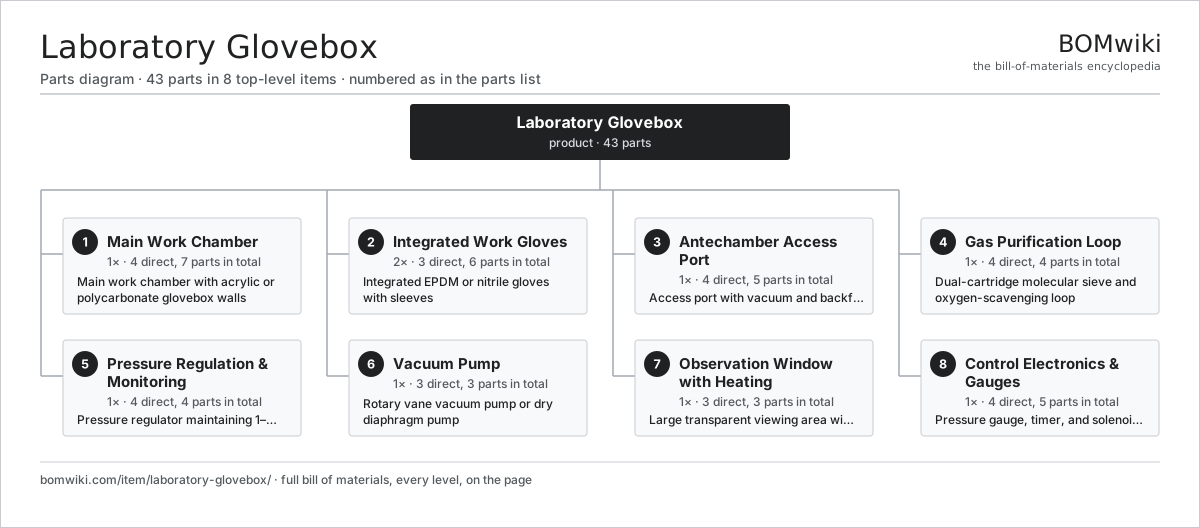
| # | Part | Qty | What it does |
|---|---|---|---|
| 1 | Main Work Chamber 4 parts | 1× | Main work chamber with acrylic or polycarbonate glovebox walls |
| 2 | Integrated Work Gloves 3 parts | 2× | Integrated EPDM or nitrile gloves with sleeves |
| 3 | Antechamber Access Port 4 parts | 1× | Access port with vacuum and backfill cycles |
| 4 | Gas Purification Loop 4 parts | 1× | Dual-cartridge molecular sieve and oxygen-scavenging loop |
| 5 | Pressure Regulation & Monitoring 4 parts | 1× | Pressure regulator maintaining 1–5 mbar positive pressure |
| 6 | Vacuum Pump 3 parts | 1× | Rotary vane vacuum pump or dry diaphragm pump |
| 7 | Observation Window with Heating 3 parts | 1× | Large transparent viewing area with heating element |
| 8 | Control Electronics & Gauges 4 parts | 1× | Pressure gauge, timer, and solenoid control for antechamber cycle |
3D model
No 3D model yet. Have a CAD file of this? Add a 3D model. STL renders right on this page; STEP, FreeCAD, and OpenSCAD sources are welcome too (openly licensed, like all 3D models on BOMwiki).
Build & assembly graph
expand / collapse · shared sub-assemblies converge · links to related products · est. labourTap an assembly to expand/collapse · tap a part to open it · use “Open page” for any node · drag to pan, scroll to zoom.
Bill of materials for Laboratory Glovebox
8 top-level lines · 37 rows shown · 43 parts total · indented to 3 levels| # | Item / sub-assembly | Part no. | Qty/assy | Ext. qty | Parts | Type |
|---|---|---|---|---|---|---|
| 1 | Main Work Chamber 4 parts | laboratory-glovebox-chamber | 1× | 1 | 7 | assembly |
| 1.1 | Acrylic Chamber Walls | laboratory-glovebox-acrylic-walls | 1× | 1 | · | part |
| 1.2 | Structural Frame | laboratory-glovebox-frame | 1× | 1 | · | part |
| 1.3 | Corner Bracket Set | laboratory-glovebox-corner-brackets | 4× | 4 | · | part |
| 1.4 | Internal Shelf | laboratory-glovebox-shelf | 1× | 1 | · | part |
| 2 | Integrated Work Gloves 3 parts | laboratory-glovebox-gloves | 2× | 2 | 6 | assembly |
| 2.1 | Glove Shell | laboratory-glovebox-glove-material | 1× | 2 | · | part |
| 2.2 | Glove Cuff Extension | laboratory-glovebox-glove-sleeves | 1× | 2 | · | part |
| 2.3 | Hose Clamp Set | laboratory-glovebox-glove-clamps | 4× | 8 | · | part |
| 3 | Antechamber Access Port 4 parts | laboratory-glovebox-antechamber | 1× | 1 | 5 | assembly |
| 3.1 | Antechamber Door | laboratory-glovebox-antechamber-door | 1× | 1 | · | part |
| 3.2 | Antechamber-to-Main Interface | laboratory-glovebox-antechamber-wall | 1× | 1 | · | part |
| 3.3 | Antechamber Ball Valve Pair | laboratory-glovebox-antechamber-valve-pair | 2× | 2 | · | part |
| 3.4 | O-Ring Set | oring-set | 1× | 1 | · | part |
| 4 | Gas Purification Loop 4 parts | laboratory-glovebox-gas-purification | 1× | 1 | 4 | assembly |
| 4.1 | Molecular Sieve Cartridge | laboratory-glovebox-molecular-sieve | 1× | 1 | · | part |
| 4.2 | Oxygen Trap Cartridge | laboratory-glovebox-oxygen-trap | 1× | 1 | · | part |
| 4.3 | Bypass Relief Valve | laboratory-glovebox-bypass-valve | 1× | 1 | · | part |
| 4.4 | Cartridge Socket | laboratory-glovebox-cartridge-housing | 1× | 1 | · | part |
| 5 | Pressure Regulation & Monitoring 4 parts | laboratory-glovebox-pressure-control | 1× | 1 | 4 | assembly |
| 5.1 | Main Pressure Regulator | laboratory-glovebox-main-regulator | 1× | 1 | · | part |
| 5.2 | Fine-Control Regulator | laboratory-glovebox-fine-regulator | 1× | 1 | · | part |
| 5.3 | Pressure Gauge | laboratory-glovebox-pressure-gauge | 1× | 1 | · | part |
| 5.4 | Check Valve | laboratory-glovebox-check-valve | 1× | 1 | · | part |
| 6 | Vacuum Pump 3 parts | laboratory-glovebox-pump | 1× | 1 | 3 | assembly |
| 6.1 | Pump Head | laboratory-glovebox-pump-unit | 1× | 1 | · | part |
| 6.2 | Pump Motor | laboratory-glovebox-pump-motor | 1× | 1 | · | part |
| 6.3 | Pump Inlet Filter | laboratory-glovebox-pump-filter | 1× | 1 | · | part |
| 7 | Observation Window with Heating 3 parts | laboratory-glovebox-window | 1× | 1 | 3 | assembly |
| 7.1 | Window Pane | laboratory-glovebox-window-pane | 1× | 1 | · | part |
| 7.2 | Window Frame | laboratory-glovebox-window-frame | 1× | 1 | · | part |
| 7.3 | Heating Foil (Optional) | laboratory-glovebox-heating-foil | 1× | 1 | · | part |
| 8 | Control Electronics & Gauges 4 parts | laboratory-glovebox-electronics | 1× | 1 | 5 | assembly |
| 8.1 | Timer Board | laboratory-glovebox-timer-board | 1× | 1 | · | part |
| 8.2 | Bare PCB | pcb-bare | 1× | 1 | · | part |
| 8.3 | Relay | relay | 2× | 2 | · | part |
| 8.4 | LED Indicator Panel | laboratory-glovebox-led-indicator | 1× | 1 | · | part |
Something wrong in this list? Report a problem with this BOM.
Used in 1 assembly
Related products
same domain, ranked by shared parts Atomic Absorption Spectrometer
648 parts · shares 2 with this page
Autoclave Sterilizer
282 parts · shares 2 with this page
Benchtop Bioreactor
487 parts · shares 2 with this page
Atomic Absorption Spectrometer
648 parts · shares 2 with this page
Autoclave Sterilizer
282 parts · shares 2 with this page
Benchtop Bioreactor
487 parts · shares 2 with this page
 Climate Test Chamber
64 parts · shares 2 with this page
Dissolution Tester
370 parts · shares 2 with this page
Climate Test Chamber
64 parts · shares 2 with this page
Dissolution Tester
370 parts · shares 2 with this page
Sourcing: possible vendors
Browse the supplier directory → Prices, MOQ, and lead times are algorithmic estimates, not quotes, and not claims about these companies. Company mappings are curated by keyword; est. price band $1k–$500k. How estimates work| Vendor | HQ | Specialty | MOQ | Lead time |
|---|---|---|---|---|
| thermofisher.com ↗ | Waltham, US | Lab instruments | 100 units | 10–18 wks |
|
🇺🇸Agilent
agilent.com ↗
|
Santa Clara, US | Analytical instruments | 100 units | 10–18 wks |
|
🇺🇸Bruker
bruker.com ↗
|
Billerica, US | Scientific instruments | 100 units | 10–18 wks |
|
🇯🇵Shimadzu
shimadzu.com ↗
|
Kyoto, JP | Analytical instruments | 100 units | 10–18 wks |
|
🇺🇸Waters
waters.com ↗
|
Milford, US | Chromatography & MS | 100 units | 10–18 wks |
1,195-word article