Large Animal Hoist
ProductOverview
The large animal hoist is a fixed overhead gantry system for safely lifting and positioning anesthetized horses and cattle during transfer to surgical tables or recovery areas. Unlike temporary portable lifting devices, the facility-mounted Large Animal Hoist provides precise, repeatable patient positioning with integrated load monitoring, motorized lateral traverse, and multiple safety interlocks protecting both patient and operating room staff.
The system lifts animals via Patient Sling Assemblies (padded multi-point supports) suspended from a Wire Rope and Terminations driven by a Electric Winch Assembly. The Overhead Gantry and Trolley overhead rail and motorized large-animal-hoist-gantry-trolley allow the operator to position the patient precisely over a surgical table, induction box, or recovery padded stall. The Safety and Load Monitoring load cell continuously measures patient weight, alarming if overage occurs (e.g., sling entanglement or scale calibration drift).
Gantry Structure and Installation
The Overhead Gantry and Trolley is a heavy-duty fixed structure anchored to the surgical facility's roof or overhead structure. The main span consists of two parallel Overhead Beam box beams (200 × 100 mm steel profile, 6–8 m long) running the length of the operating room or recovery area. Four Support Column vertical support columns (150 × 150 mm tubular steel, 3.5 m height) anchor the beams to the building frame via high-strength anchor bolts embedded in reinforced concrete pads.
The lateral spacing between beam columns is typically 5 m, with gantry length extending 6–8 m to cover two to three surgical tables. Installation requires structural engineering certification confirming building capacity (rated 5000 kg suspended load on the overhead beams). Electrical supply (3-phase 110–240 VAC, 30 A circuit) and control wiring are routed through conduit along the support columns.
Motorized Trolley and Longitudinal Motion
A Overhead Trolley wheeled carriage rides on the overhead beam rails, supporting the winch assembly and cable. The trolley features sealed ball-bearing wheels (four per rail, two rails = eight wheels total) enabling smooth, low-friction traverse along the 6–8 m beam span. The trolley capacity is 1000 kg, accommodating the winch assembly (200 kg), spreader bar (150 kg), patient load (600 kg), plus safety margin.
A Trolley Motor (1 kW AC motor, 1400 rpm) drives the trolley via a chain or belt reducer, positioning the patient anywhere along the beam length (lateral motion 0.5–1 m/sec). The trolley operator can pull the trolley manually if power is lost (light friction), enabling emergency patient evacuation. The trolley brakes automatically when power is removed, preventing drift.
Electric Winch and Lift Mechanism
The Electric Winch Assembly assembly mounted on the trolley comprises a Blower Motor (3 kW AC induction, 1400 rpm) driving a Gear Reducer (worm or helical type, 50:1 reduction ratio). At 1400 rpm motor speed, the output is 28 rpm on the Cable Drum (0.6 m diameter). This rotation winds the Wire Rope and Terminations (10 mm steel wire rope) onto the drum at approximately 0.3 m/min lifting speed, fast enough for efficient patient handling but slow enough for safe control.
A Load-Slip Clutch (torque-limiting, 250 Nm setpoint) protects the cable from shock loads: if the sling snags on a door frame or table corner, the clutch slips rather than jerking the patient. The Spring-Applied Brake (spring-applied electromagnetic brake, 300 Nm holding torque, 24 VDC solenoid) engages automatically on power loss, holding the patient at rest indefinitely without power. This redundant safety ensures that a power failure or pendant disconnection immediately stops the patient, preventing drop.
Cable and Load Path
The Wire Rope and Terminations consists of 10 mm diameter high-strength steel wire rope (6×19 independent wire rope core construction, 1500 kg breaking strength). The rope is wound on the Cable Drum in a grooved pattern, spooled for 30 m length (sufficient for 3–4 m lift height plus 10 m coil storage). The rope terminates in Swaged Eye swaged eye fittings (formed by ferrule compression under pressure, rated 1000 kg per eye) connected to a Load-Sensing Pin instrumented clevis pin.
The load pin integrates a strain-gauge load cell (0–1000 kg range, ±1 kg accuracy, 4–20 mA output) feeding real-time patient weight to the Pendant Control System pendant display and to the Load Limiter alarm module. The rope then ascends to the Load-Distribution Spreader Bar, where Anchor Shackle stainless steel shackles connect the rope eyes to the spreader bar attachment points.
Load Distribution and Spreader Bar
The Load-Distribution Spreader Bar is a welded steel frame (200 cm × 100 cm footprint, 0.2 m height) distributing patient weight evenly across all four sling attachment points. The frame features four Attachment D-Ring forged D-rings welded at the corners, each rated 1500 kg individual load capacity (designed for three-to-one safety factor on 1000 kg patient load). The spreader bar top surface is covered with Spreader Padding (50 mm closed-cell foam, slip-resistant covering), preventing sling straps from sliding during tilt.
The spreader bar geometry is sized so that when a horse is properly suspended by all four slings, the load is divided equally at each corner (~250 kg per sling for a 1000 kg patient). This balanced load distribution prevents diagonal swing and reduces the likelihood of sling bunching at one side, which could compress soft tissues and cause post-operative swelling.
Multi-Point Sling System
The Patient Sling Assemblies assembly consists of three main components:
Body Sling: A large Body Sling (heavy canvas 400 oz, 200 cm × 100 cm) with foam-lined chest and flank areas. The patient lies supine or lateral on this wide platform, distributing weight across the barrel and leg.
Limb Slings: Two Forelegs Sling and two Hind Legs Sling nylon loop supports, circumferential bands that wrap around the limbs above the fetlock or hock joint. These suspend the legs without pressure on joint capsules or lateral ligaments, reducing injury risk during long lifts.
Connector Webbing: Heavy nylon Connector Webbing straps terminate in D-rings, connecting all sling components to the spreader bar attachment points.
Before each patient lift, the slings are inspected for tears, pulled seams, or compressed padding. Over 2–3 years of use, foam naturally compresses and loses impact absorption; Sling Padding Kit replacement kits (adhesive-backed 30 mm closed-cell foam) are applied to worn areas, or entire slings are replaced. Slings are machine-washed weekly with quaternary ammonium disinfectant to prevent contamination transfer between patients.
Control Pendant and Load Display
The Pendant Control System pendant is a handheld IP54-rated plastic unit with momentary-contact pushbuttons for lift up, lift down, and emergency stop. A LCD Display backlit LCD screen (16 × 2 alphanumeric) displays current patient weight (from the Load-Sensing Pin) and hoist position (from the drum encoder).
The pendant is connected via a 50 m Control Cable (shielded six-conductor, UV-resistant jacket, XLR 5-pin connector) to the trolley-mounted Control PCB proportional motor control board. The operator can vary lifting speed smoothly from 0.1 m/min (fine positioning) to 0.5 m/min (fast approach). All pendant commands are latching: the operator must release the button to stop motion, preventing accidental hands-free suspended-patient scenarios.
Optional wireless RF pendant module (2.4 GHz industrial ISM band, 100 m range) allows the operator to walk alongside the patient during final positioning without cable management, though the wired pendant remains for backup critical operations.
Safety Interlocks and Load Monitoring
The Safety and Load Monitoring system integrates multiple redundant safety mechanisms:
Load Cell Alarm: The Load Cell (1000 kg capacity, ±0.1% accuracy) feeds to the Load Limiter. If patient weight exceeds 950 kg (5% margin), an audible beeper and flashing light on the pendant alerts the operator that slings may be twisted or the patient not fully seated.
Emergency Stop: A Emergency Stop Relay dual-channel TÜV-certified safety relay module (24 VDC logic) de-energizes all motor and solenoid outputs if the emergency stop button is pressed. This is a latching circuit; the button must be manually reset before operation resumes, preventing accidental restart after emergency descent.
Brake System: The Spring-Applied Brake spring-applied electromagnetic brake (300 Nm holding torque) engages immediately on power loss or emergency stop. Manual override lever permits hand-crank emergency descent if motor power fails completely, providing two minutes of controlled descent at ~1 m/min (sufficient to lower a 1000 kg patient to the floor safely).
Overload Clutch: The Load-Slip Clutch (250 Nm torque limit) prevents shock loads if slings snag during lift. The clutch slips silently; excessive slipping after 10 seconds triggers a "slippage alarm" on the pendant display, prompting the operator to investigate obstruction.
Beacon Light: A Beacon Light (LED amber warning light, 12 VDC, IP67) mounted on the gantry above the patient lift zone flashes during all hoist motion, alerting nearby staff to clear the operating area below.
Clinical Workflow and Positioning
Pre-operative lift checkout confirms pendant function, load cell zero-calibration (empty spreader bar should read 150–180 kg self-weight), and sling inspection. The patient is led or wheeled into the induction stall, placed on the sling assembly, and all limb loops are positioned and tightened. The operator then activates the hoist, lifting the patient at slow speed (0.1 m/min) while observing sling tension and patient position on the pendant display.
Once the patient is airborne (0.5 m above floor), the trolley motor is engaged to traverse the patient toward the surgical table or recovery area. The operator uses the trolley and winch controls simultaneously to position the patient directly over the table center. As the patient descends onto the surgical table pad, the operator watches the load cell: when weight exceeds 80% of the patient baseline (indicating full contact with the table), the operator releases the lift button, stopping descent.
The hoist is then secured (emergency stop pressed) while surgical staff connect restraint straps and positioning accessories on the table. During recovery, the patient is re-slung and hoisted back to the recovery stall or barn.
Maintenance and Service
Weekly: visual inspection of overhead rails for dust or debris (brush clean), observation of trolley wheel movement (should be smooth), load cell zero check (empty spreader = 150–180 kg), and pendant button function test.
Monthly: lubrication of trolley wheel bearings and rail slides (light machine oil), inspection of cable for fraying, kinks, or visible wear, and sling tear inspection.
Quarterly: torque check on anchor bolts (200 Nm specification), load cell recalibration using certified 500 kg and 1000 kg test weights, and motor current draw measurement (should remain constant year-to-year, indicating bearing condition).
Annually: certified rope inspection (visual for core protrusion, compression, or broken wires; minimum 6–10 year service life), brake pad inspection and replacement (wear limit 0.2 mm), and complete electrical safety certification (electrical arc flash assessment, ground resistance test).
The large animal hoist transforms equine and bovine surgery center efficiency and safety: eliminating manual patient lifting prevents handler injury, patient positioning precision improves surgical visualization and reduces anesthesia time, and integrated load monitoring provides early warning of sling or patient stability issues. A properly maintained hoist system offers 15–20 years of reliable service.
Large Animal Hoist parts and their functions
7 top-level parts · 50 parts in total · full bill of materials below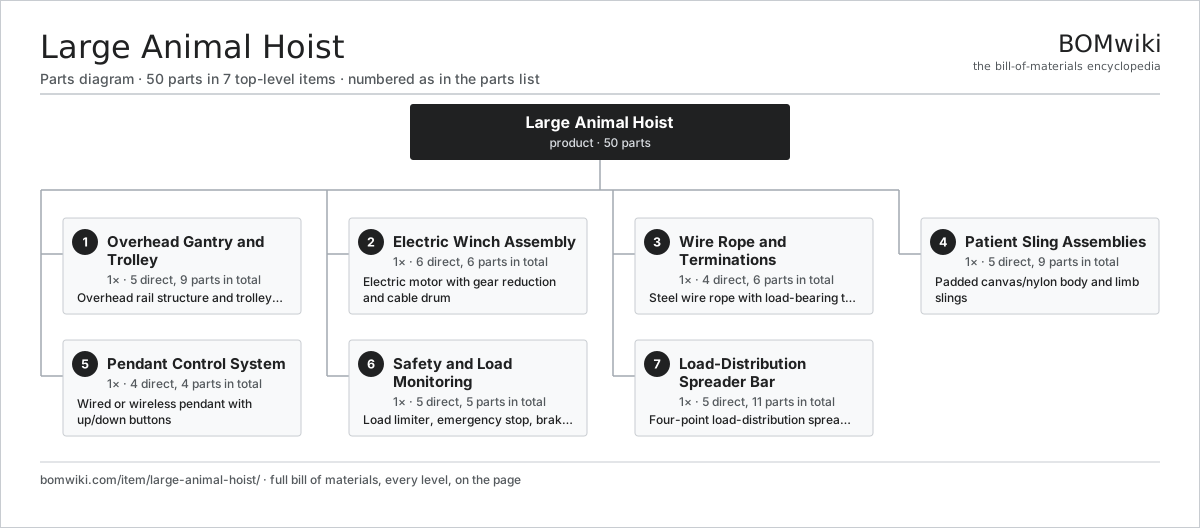
| # | Part | Qty | What it does |
|---|---|---|---|
| 1 | Overhead Gantry and Trolley 5 parts | 1× | Overhead rail structure and trolley system |
| 2 | Electric Winch Assembly 6 parts | 1× | Electric motor with gear reduction and cable drum |
| 3 | Wire Rope and Terminations 4 parts | 1× | Steel wire rope with load-bearing terminations |
| 4 | Patient Sling Assemblies 5 parts | 1× | Padded canvas/nylon body and limb slings |
| 5 | Pendant Control System 4 parts | 1× | Wired or wireless pendant with up/down buttons |
| 6 | Safety and Load Monitoring 5 parts | 1× | Load limiter, emergency stop, brake system |
| 7 | Load-Distribution Spreader Bar 5 parts | 1× | Four-point load-distribution spreader frame |
3D model
No 3D model yet. Have a CAD file of this? Add a 3D model. STL renders right on this page; STEP, FreeCAD, and OpenSCAD sources are welcome too (openly licensed, like all 3D models on BOMwiki).
Build & assembly graph
expand / collapse · shared sub-assemblies converge · links to related products · est. labourTap an assembly to expand/collapse · tap a part to open it · use “Open page” for any node · drag to pan, scroll to zoom.
Bill of materials for Large Animal Hoist
7 top-level lines · 41 rows shown · 50 parts total · indented to 3 levels| # | Item / sub-assembly | Part no. | Qty/assy | Ext. qty | Parts | Type |
|---|---|---|---|---|---|---|
| 1 | Overhead Gantry and Trolley 5 parts | large-animal-hoist-gantry | 1× | 1 | 9 | assembly |
| 1.1 | Overhead Beam | large-animal-hoist-gantry-rail | 2× | 2 | · | part |
| 1.2 | Support Column | large-animal-hoist-gantry-column | 4× | 4 | · | part |
| 1.3 | Overhead Trolley | large-animal-hoist-trolley | 1× | 1 | · | part |
| 1.4 | Trolley Motor | large-animal-hoist-trolley-motor | 1× | 1 | · | part |
| 1.5 | Fastener Set | fastener-set | 1× | 1 | · | part |
| 2 | Electric Winch Assembly 6 parts | large-animal-hoist-winch | 1× | 1 | 6 | assembly |
| 2.1 | Blower Motor | blower-motor | 1× | 1 | · | part |
| 2.2 | Gear Reducer | large-animal-hoist-gear-reducer | 1× | 1 | · | part |
| 2.3 | Load-Slip Clutch | large-animal-hoist-load-slip-clutch | 1× | 1 | · | part |
| 2.4 | Cable Drum | large-animal-hoist-cable-drum | 1× | 1 | · | part |
| 2.5 | Spring-Applied Brake | large-animal-hoist-brake | 1× | 1 | · | part |
| 2.6 | Brake Solenoid | large-animal-hoist-brake-solenoid | 1× | 1 | · | part |
| 3 | Wire Rope and Terminations 4 parts | large-animal-hoist-cable | 1× | 1 | 6 | assembly |
| 3.1 | Wire Rope | large-animal-hoist-cable-rope | 1× | 1 | · | part |
| 3.2 | Swaged Eye | large-animal-hoist-cable-eye | 2× | 2 | · | part |
| 3.3 | Anchor Shackle | large-animal-hoist-cable-shackle | 2× | 2 | · | part |
| 3.4 | Load-Sensing Pin | large-animal-hoist-load-pin | 1× | 1 | · | part |
| 4 | Patient Sling Assemblies 5 parts | large-animal-hoist-slings | 1× | 1 | 9 | assembly |
| 4.1 | Body Sling | large-animal-hoist-sling-body | 1× | 1 | · | part |
| 4.2 | Forelegs Sling | large-animal-hoist-sling-forelegs | 1× | 1 | · | part |
| 4.3 | Hind Legs Sling | large-animal-hoist-sling-hindlegs | 1× | 1 | · | part |
| 4.4 | Connector Webbing | large-animal-hoist-sling-connector | 4× | 4 | · | part |
| 4.5 | Sling Padding Kit | large-animal-hoist-sling-padding | 2× | 2 | · | part |
| 5 | Pendant Control System 4 parts | large-animal-hoist-control | 1× | 1 | 4 | assembly |
| 5.1 | Control Pendant | large-animal-hoist-control-pendant | 1× | 1 | · | part |
| 5.2 | Control Cable | large-animal-hoist-control-cable | 1× | 1 | · | part |
| 5.3 | LCD Display | large-animal-hoist-control-display | 1× | 1 | · | part |
| 5.4 | Control PCB | large-animal-hoist-control-pcb | 1× | 1 | · | part |
| 6 | Safety and Load Monitoring 5 parts | large-animal-hoist-safety | 1× | 1 | 5 | assembly |
| 6.1 | Load Cell | large-animal-hoist-load-cell | 1× | 1 | · | part |
| 6.2 | Load Limiter | large-animal-hoist-load-limiter | 1× | 1 | · | part |
| 6.3 | Emergency Stop Relay | large-animal-hoist-emergency-stop | 1× | 1 | · | part |
| 6.4 | Pressure Switch | large-animal-hoist-pressure-switch | 1× | 1 | · | part |
| 6.5 | Beacon Light | large-animal-hoist-beacon-light | 1× | 1 | · | part |
| 7 | Load-Distribution Spreader Bar 5 parts | large-animal-hoist-spreader-bar | 1× | 1 | 11 | assembly |
| 7.1 | Spreader Bar Frame | large-animal-hoist-spreader-bar-frame | 1× | 1 | · | part |
| 7.2 | Attachment D-Ring | large-animal-hoist-spreader-bar-point | 4× | 4 | · | part |
| 7.3 | Spreader Padding | large-animal-hoist-spreader-bar-padding | 4× | 4 | · | part |
| 7.4 | Load-Sensing Pin | large-animal-hoist-load-pin | 1× | 1 | · | part |
| 7.5 | Fastener Set | fastener-set | 1× | 1 | · | part |
Something wrong in this list? Report a problem with this BOM.
Related products
same domain, ranked by shared parts Dental Oil-Free Compressor
208 parts · shares 1 with this page
Dental Oil-Free Compressor
208 parts · shares 1 with this page
 Dental X-Ray Unit
113 parts · shares 1 with this page
Equine Surgery Table
98 parts · shares 1 with this page
Equine Treadmill
55 parts · shares 1 with this page
Dental X-Ray Unit
113 parts · shares 1 with this page
Equine Surgery Table
98 parts · shares 1 with this page
Equine Treadmill
55 parts · shares 1 with this page
 Large Animal Anesthesia Machine
75 parts · shares 1 with this page
Large Animal Anesthesia Machine
75 parts · shares 1 with this page
Sourcing: possible vendors
Browse the supplier directory → Prices, MOQ, and lead times are algorithmic estimates, not quotes, and not claims about these companies. Company mappings are curated by keyword; est. price band $200–$200k. How estimates work| Vendor | HQ | Specialty | MOQ | Lead time |
|---|---|---|---|---|
| dentsplysirona.com ↗ | Charlotte, US | Dental equipment | 100 units | 10–16 wks |
|
🇺🇸Envista
envistaco.com ↗
|
Brea, US | Dental (KaVo, Nobel) | 100 units | 10–16 wks |
|
🇫🇮Planmeca
planmeca.com ↗
|
Helsinki, FI | Dental units & imaging | 100 units | 10–16 wks |
|
🇺🇸A-dec
a-dec.com ↗
|
Newberg, US | Dental chairs & delivery | 100 units | 10–16 wks |
|
🇺🇸Midmark
midmark.com ↗
|
Versailles, US | Medical & veterinary equipment | 100 units | 10–16 wks |
1,971-word article