Laser Coding Machine
ProductOverview
A laser coding machine prints date codes, lot numbers, barcodes and 2D matrices on products moving down a packaging line, without ink. A focused beam of 10–60 W either vaporizes a thin layer of the surface, etches it, or triggers a color change, drawing each character as a sequence of vector strokes steered by two fast mirrors. Against its main rival, continuous inkjet, the laser trades a higher purchase price for zero consumables, no makeup solvent, no clogged printheads, and a permanent mark that survives steam, abrasion and grey-market label swapping. Typical duty: 200–600 packs per minute of PET bottles, cartons, glass, coated cans and film.
How it works
Marking starts in the Laser Source. In the dominant CO2 variant, the Sealed CO2 Resonator is a sealed slab resonator: a CO2 gas mix between RF electrodes driven at roughly 81 MHz by the RF Driver Board. Pulsing the RF modulates beam power stroke by stroke, which is how the machine writes rather than burns continuously. The beam exits through the Output Coupler and is widened by the Beam Expander, a wider entry beam lets the lens focus to a finer spot, since spot size scales inversely with input diameter. Sealed tubes run more than 20,000 hours before gas depletion; fiber sources at 1064 nm, used where CO2 light reflects (bare metal, some plastics), run effectively for the machine's life.
Steering is the job of the Galvanometer Scan Head. The X Galvanometer and Y Galvanometer are limited-rotation motors, each carrying a gold-coated Scan Mirror of minimal inertia, settling to a new angle in under a millisecond with Encoder feedback closed through the Galvo Driver Board. Two reflections give full two-dimensional addressing, and the F-theta Lens does the focusing trick that makes scanning practical: an ordinary lens focuses a deflected beam onto a sphere, but the f-theta design puts the focal point on a flat plane with spot displacement proportional to mirror angle, so a flat marking field of 60×60 up to 300×300 mm falls naturally out of the geometry. A sacrificial Protection Window keeps splatter off the lens.
The Marking Controller turns "BB 2026-06-10 L42" into mirror motion. The DSP Vector Board streams XY setpoints and power commands at around 100 kHz, while a Compute SoC Module holds message templates, fonts, counters and the Ethernet/IP link to the line's MES. Marking on the fly is the differentiating feature: the Product Trigger Sensor fires a cycle per package and the Line Encoder Interface reads the conveyor encoder, letting the DSP add the belt's displacement to every vector so characters land undistorted on product moving at up to 600 m/min. The code is effectively drawn in the product's reference frame.
What the beam does to the surface
The mark mechanism depends on the substrate. On printed cartons and labels, the beam ablates the ink layer to reveal the contrasting board beneath, the cleanest, fastest mark, needing the least power. On PET and glass it makes a frosted engraving by micro-cracking the surface. On coated beverage cans CO2 removes lacquer; on bare metal a fiber laser anneals or engraves. On many plastics, laser-additive masterbatch darkens under the beam for a high-contrast mark with no material removal. All of these produce particulates and organic vapor, which is why the Fume Extraction Unit unit is not optional: the Extraction Nozzle pulls air across the mark point, a Blower Motor drags it through the HEPA Filter and Activated Carbon Filter, and the Filter Pressure Sensor reports clogging. Uncaptured fume recondenses on the lens and the line.
Safety and integration
The source is a Class 4 laser; the installed machine must be Class 1 to IEC 60825-1. That conversion is mechanical: the Beam Guard Panel shielding and interlocks enclose the beam path, the Safety Shutter drops a physical block when any guard opens, and the Emergency Stop cuts everything. The Beam Umbilical keeps the beam enclosed between the source cabinet and the head, which the Head Clamp holds at the lens's fixed focal distance from the product, focus tolerance is a few millimetres, so the Floor Stand is set per package format. About 500 W of waste heat leaves through the Source Heatsink and Cooling Fan pair; no water cooling is needed at coding powers. Operators interact through the Operator Terminal touchscreen, picking recipes that bundle message, power, speed and focus offsets, with the Stack Light showing line status at a glance.
Laser Coding Machine parts and their functions
7 top-level parts · 48 parts in total · full bill of materials below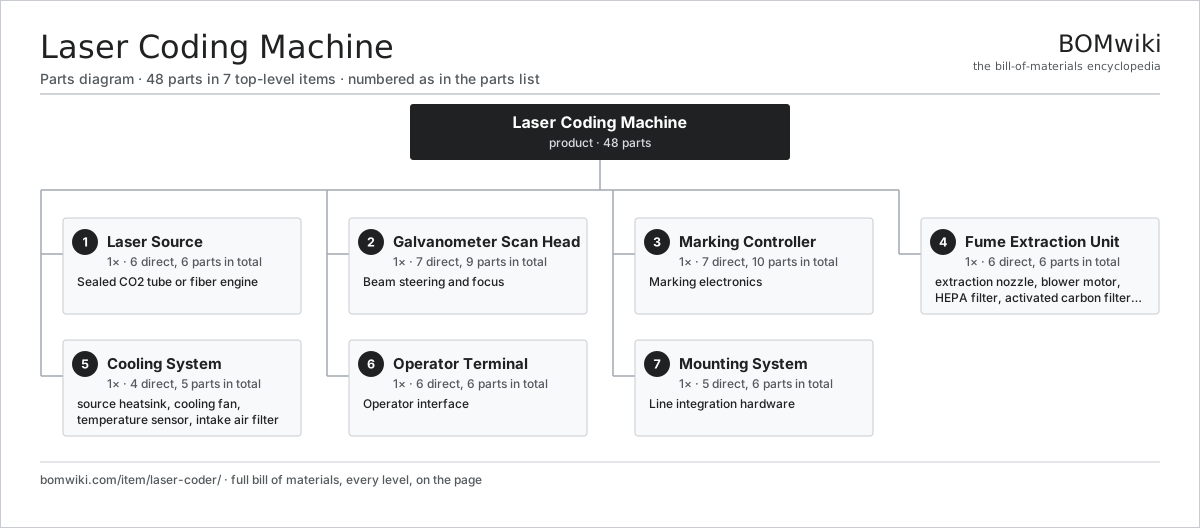
| # | Part | Qty | What it does |
|---|---|---|---|
| 1 | Laser Source 6 parts | 1× | Sealed CO2 tube or fiber engine |
| 2 | Galvanometer Scan Head 7 parts | 1× | Beam steering and focus |
| 3 | Marking Controller 7 parts | 1× | Marking electronics |
| 4 | Fume Extraction Unit 6 parts | 1× | Captures vaporized ink and substrate particles at the mark point. |
| 5 | Cooling System 4 parts | 1× | Air cooling that holds the sealed tube and electronics at working temperature. |
| 6 | Operator Terminal 6 parts | 1× | Operator interface |
| 7 | Mounting System 5 parts | 1× | Line integration hardware |
3D model
No 3D model yet. Have a CAD file of this? Add a 3D model. STL renders right on this page; STEP, FreeCAD, and OpenSCAD sources are welcome too (openly licensed, like all 3D models on BOMwiki).
Build & assembly graph
expand / collapse · shared sub-assemblies converge · links to related products · est. labourTap an assembly to expand/collapse · tap a part to open it · use “Open page” for any node · drag to pan, scroll to zoom.
Bill of materials for Laser Coding Machine
7 top-level lines · 48 rows shown · 48 parts total · indented to 3 levels| # | Item / sub-assembly | Part no. | Qty/assy | Ext. qty | Parts | Type |
|---|---|---|---|---|---|---|
| 1 | Laser Source 6 parts | laser-coder-laser-source | 1× | 1 | 6 | assembly |
| 1.1 | Sealed CO2 Resonator | laser-coder-co2-tube | 1× | 1 | · | part |
| 1.2 | RF Driver Board | laser-coder-rf-driver | 1× | 1 | · | part |
| 1.3 | Output Coupler | laser-coder-output-coupler | 1× | 1 | · | part |
| 1.4 | Beam Expander | laser-coder-beam-expander | 1× | 1 | · | part |
| 1.5 | Safety Shutter | laser-coder-shutter | 1× | 1 | · | part |
| 1.6 | Power Supply | power-supply | 1× | 1 | · | part |
| 2 | Galvanometer Scan Head 7 parts | laser-coder-galvo-head | 1× | 1 | 9 | assembly |
| 2.1 | X Galvanometer | laser-coder-galvo-x | 1× | 1 | · | part |
| 2.2 | Y Galvanometer | laser-coder-galvo-y | 1× | 1 | · | part |
| 2.3 | Scan Mirror | laser-coder-scan-mirror | 2× | 2 | · | part |
| 2.4 | F-theta Lens | laser-coder-ftheta-lens | 1× | 1 | · | part |
| 2.5 | Galvo Driver Board | laser-coder-galvo-driver | 1× | 1 | · | part |
| 2.6 | Protection Window | laser-coder-head-window | 1× | 1 | · | part |
| 2.7 | Encoder | encoder | 2× | 2 | · | part |
| 3 | Marking Controller 7 parts | laser-coder-controller | 1× | 1 | 10 | assembly |
| 3.1 | DSP Vector Board | laser-coder-dsp-board | 1× | 1 | · | part |
| 3.2 | Compute SoC Module | soc-module | 1× | 1 | · | part |
| 3.3 | Bare PCB | pcb-bare | 1× | 1 | · | part |
| 3.4 | Line Encoder Interface | laser-coder-line-encoder-input | 1× | 1 | · | part |
| 3.5 | Product Trigger Sensor | laser-coder-trigger-sensor | 1× | 1 | · | part |
| 3.6 | SMD Passive (R/C/L) | smd-passives | 1× | 1 | · | part |
| 3.7 | Connector | connector | 4× | 4 | · | part |
| 4 | Fume Extraction Unit 6 parts | laser-coder-fume-extraction | 1× | 1 | 6 | assembly |
| 4.1 | Extraction Nozzle | laser-coder-extraction-nozzle | 1× | 1 | · | part |
| 4.2 | Blower Motor | blower-motor | 1× | 1 | · | part |
| 4.3 | HEPA Filter | laser-coder-hepa-filter | 1× | 1 | · | part |
| 4.4 | Activated Carbon Filter | laser-coder-carbon-filter | 1× | 1 | · | part |
| 4.5 | Filter Pressure Sensor | laser-coder-filter-sensor | 1× | 1 | · | part |
| 4.6 | Extraction Hose | laser-coder-extraction-hose | 1× | 1 | · | part |
| 5 | Cooling System 4 parts | laser-coder-cooling | 1× | 1 | 5 | assembly |
| 5.1 | Source Heatsink | laser-coder-heatsink | 1× | 1 | · | part |
| 5.2 | Cooling Fan | laser-coder-fan | 2× | 2 | · | part |
| 5.3 | Temperature Sensor | laser-coder-temp-sensor | 1× | 1 | · | part |
| 5.4 | Intake Air Filter | laser-coder-air-filter | 1× | 1 | · | part |
| 6 | Operator Terminal 6 parts | laser-coder-ui-terminal | 1× | 1 | 6 | assembly |
| 6.1 | LCD Panel | lcd-panel | 1× | 1 | · | part |
| 6.2 | Touch Digitizer | touch-digitizer | 1× | 1 | · | part |
| 6.3 | Microcontroller | mcu | 1× | 1 | · | part |
| 6.4 | Emergency Stop | laser-coder-estop | 1× | 1 | · | part |
| 6.5 | Stack Light | laser-coder-stack-light | 1× | 1 | · | part |
| 6.6 | Wire Bundle | wire-bundle | 1× | 1 | · | part |
| 7 | Mounting System 5 parts | laser-coder-mounting | 1× | 1 | 6 | assembly |
| 7.1 | Floor Stand | laser-coder-floor-stand | 1× | 1 | · | part |
| 7.2 | Head Clamp | laser-coder-head-clamp | 1× | 1 | · | part |
| 7.3 | Beam Umbilical | laser-coder-umbilical | 1× | 1 | · | part |
| 7.4 | Beam Guard Panel | laser-coder-guard-panel | 2× | 2 | · | part |
| 7.5 | Fastener Set | fastener-set | 1× | 1 | · | part |
Something wrong in this list? Report a problem with this BOM.
Related products
same domain, ranked by shared parts Gravure Printing Press
2,094 parts · shares 3 with this page
Gravure Printing Press
2,094 parts · shares 3 with this page
 Offset Printing Press
1,931 parts · shares 3 with this page
Offset Printing Press
1,931 parts · shares 3 with this page
 Aerosol Filling Machine
119 parts · shares 2 with this page
Banner Welder
90 parts · shares 2 with this page
Aerosol Filling Machine
119 parts · shares 2 with this page
Banner Welder
90 parts · shares 2 with this page
Sourcing: possible vendors
Browse the supplier directory → Prices, MOQ, and lead times are algorithmic estimates, not quotes, and not claims about these companies. Company mappings are curated by keyword; est. price band $10k–$3M. How estimates work| Vendor | HQ | Specialty | MOQ | Lead time |
|---|---|---|---|---|
| heidelberg.com ↗ | Heidelberg, DE | Printing presses | 10 units | 12–22 wks |
|
🇨🇭Bobst
bobst.com ↗
|
Lausanne, CH | Packaging machinery | 10 units | 12–22 wks |
| koenig-bauer.com ↗ | Würzburg, DE | Printing presses | 10 units | 12–22 wks |
| wuh-group.com ↗ | Lengerich, DE | Flexible packaging machines | 10 units | 12–22 wks |
| markandy.com ↗ | Chesterfield, US | Label presses | 10 units | 12–22 wks |
803-word article