Satellite Laser Communication Terminal
ProductOverview
Satellite laser communication (satcom) terminals transmit data between spacecraft using free-space optical (FSO) links, laser beams pointed directly at each other through vacuum. Unlike radio-frequency (RF) systems operating in the gigahertz range, laser links operate at optical frequencies (~200 THz), enabling much higher data densities. A single 1550 nm laser terminal achieves 10 Gbps with 100 mW of optical power; comparable RF performance would require kilowatts of transmit power and enormous antennas.
The satellite laser communication terminal couples a coherent 1550 nm laser transmitter, a sensitive receiver, and a precision two-axis gimbal that tracks a distant satellite while maintaining beam alignment to within 0.1 milliradian (0.006°). The system uses coherent detection, mixing the weak received signal with a strong local laser oscillator, to achieve unprecedented sensitivity and spectral efficiency.
Laser Transmitter and Modulation
The heart of the transmitter is a distributed-feedback (DFB) laser diode operating at 1550 nm (the C-band, widely used in fiber-optic telecommunications). The laser produces 100 mW of continuous optical power with a line-width <100 kHz, remarkably stable frequency over time scales of milliseconds to hours.
The 100 mW beam is fed into an electro-optic Mach-Zehnder modulator (made of lithium niobate), which applies an RF drive signal to modulate the laser intensity and phase. This creates a modulated optical carrier containing data. The modulator supports dual-channel DAC outputs that encode in-phase (I) and quadrature (Q) components, generating coherent QPSK (Quadrature Phase Shift Keying) modulation at 10 Gbps symbol rate.
The modulated signal travels through polarization-maintaining fiber (which preserves the optical polarization state) and exits a collimating telescope that transforms the single-mode fiber output into a 3 mm diameter collimated beam. This beam is then directed by the telescope gimbal and magnified by the Cassegrain primary mirror (100 mm diameter) to an approximate 0.5 mrad (3 dB) divergence, meaning the beam spot grows to about 1.5 km diameter at 3000 km range.
Receiver and Coherent Detection
The receiver optics collect the incoming laser beam using the same 100 mm primary mirror (transmit and receive are multiplexed via a dichroic beamsplitter). The incoming 1550 nm photons are focused onto a quad PIN photodiode array by a precision aspheric lens.
In conventional (incoherent) photodetection, the photocurrent is simply proportional to received optical power. Here, the signal is mixed with a strong local laser oscillator (the same laser as the transmitter, synchronized via a frequency-stabilized master oscillator and phase-locked loop). The mixing occurs in the photodiode, and the resulting photocurrent contains an RF component at the frequency difference between transmitted and received lasers, typically tens of megahertz or a few hundred megahertz.
This coherent beat signal is then amplified by a transimpedance amplifier (converting photodiode current to voltage with ~10⁸ V/A gain), digitized by a 2.56 GSa/s ADC, and fed into the FPGA running coherent DSP (Digital Signal Processing) algorithms.
The DSP algorithms perform:
- Automatic Gain Control (AGC): Adjusts receiver gain to maintain optimal signal level.
- Phase-Lock Loop (PLL): Tracks the received carrier phase and compensates for Doppler shift.
- Equalization: Removes dispersion and linear ISI (inter-symbol interference).
- FEC (Forward Error Correction): Decodes error-correcting codes (e.g., turbo codes or LDPC) to recover data bits even when the SNR is low.
Coherent detection provides ~20 dB improvement in receiver sensitivity compared to incoherent methods, enabling the terminal to receive signals down to -40 dBm at 1 GHz symbol rate, corresponding to a range of 3000 km between two similar LEO satellites.
Gimbal and Tracking
The telescope and gimbal assembly is a precision mechanical system. The primary mirror is mounted in an aluminum cell with kinematic mounts that allow micro-scale tip-tilt adjustments. The entire optical head rotates on two axes (azimuth and elevation) via brushless servo motors driving a titanium gimbal frame.
The gimbal control electronics implement a closed-loop tracker. An onboard MEMS IMU measures satellite angular acceleration; a miniature star tracker provides absolute attitude reference; and optical shaft encoders confirm gimbal motor position. The flight computer (via the FPGA) runs a proportional-integral (PI) servo loop that commands motor currents to steer the gimbal and maintain alignment on the target satellite.
Typical performance:
- Tracking accuracy: <0.1 mrad RMS (1σ) in both axes, corresponding to <100 meters of beam spot deviation at 1000 km range.
- Tracking bandwidth: 100 Hz closed-loop (limited by mechanical gimbal dynamics and servo motor response).
- Maximum slew rate: 5 °/second (sufficient to track satellites moving across the sky at 20° per minute, typical for LEO-to-LEO encounters).
The quad photodiode array on the acquisition detector helps with fine tracking: if the beam drifts off-center, the signal power changes asymmetrically, generating an error signal that the servo loop uses for correction.
Power and Thermal Management
At 10 Gbps modulation rate, the laser diode dissipates ~100 mW, the modulator consumes ~5 W, and the LNA and DSP consume ~20 W. The servo motors draw ~5 W during active tracking. Total electrical input is ~130 W from the spacecraft 48 V bus, but the modem electronics (FPGA, DACs, ADCs) consume only ~30 W; the remainder goes to thermal loads.
The thermal management system uses a pair of copper heat pipes to transport laser and amplifier heat to a 0.5 m² deployable radiator panel. Radiator louvers modulate emissivity as temperature rises, maintaining the laser Peltier mount near 20 °C (optimal for frequency stability). In space, with deep cold (typically 5–10 K in LEO shadowed areas), radiative cooling is highly efficient.
Link Budget and Range Analysis
The key equation for free-space optical communication is the link budget:
Received Power = Transmitted Power + Transmit Gain + Receive Gain - Propagation Loss - Pointing Loss - Atmospheric Loss
For our 100 mW terminal with 100 mm aperture, assuming:
- Transmit optical power: +20 dBm (100 mW)
- Transmit gain (aperture + wavelength): +60 dB
- Free-space path loss at 3000 km: -139 dB
- Pointing loss (0.1 mrad error, 0.5 mrad beam): -3 dB
- Atmospheric loss (vacuum, negligible for space-to-space): 0 dB
- Receiver gain (same aperture): +60 dB
Received Power ≈ +20 + 60 + 60 - 139 - 3 = -2 dBm
At the receiver minimum detectable signal of -40 dBm (with FEC), the link margin is +38 dB, substantial margin for pointing jitter, fading, or modulation scheme changes.
For longer ranges (e.g., GEO-to-LEO, 40,000 km), the free-space path loss increases to -155 dB, reducing the received power to -18 dBm. This exceeds the minimum detectable signal, so GEO range requires higher transmit power (multi-watt lasers) or larger apertures (meter-class telescopes).
Acquisition and Handover
Initially, both satellites are many thousands of kilometers apart. The attitude sensor on one satellite provides coarse pointing toward the location of the target satellite (computed from orbital ephemerides). The acquisition photodiode scans in a raster pattern around the predicted location, searching for the distant laser beacon.
Once the receiver detects a signal above a threshold (typically -30 dBm), the servo loop locks onto the received beam's phase and angle. The fine tracker then maintains lock as the two satellites move relative to each other. If the relative motion is too fast or the signal is lost, the system reverts to coarse search and reacquisition.
Communication sessions typically last 5–15 minutes during LEO-to-LEO passes and hours during GEO-to-LEO links.
Spectral Efficiency and Advantages
The coherent QPSK modulation achieves 2 bits/Hz spectral efficiency, meaning the 10 Gbps data rate requires only a 5 GHz optical bandwidth. This is vastly superior to RF systems (typically 0.1–0.5 bits/Hz) and allows multiple laser terminals to coexist in the 1550 nm band using wavelength-division multiplexing (WDM) or time-division multiplexing.
Laser terminals are particularly valuable for:
- Deep-space probes: RF power budgets are prohibitive beyond Mars; optical links enable Gbps rates at the edge of the solar system.
- High-bandwidth relay networks: Constellations of LEO satellites with intersatellite optical links form a low-latency mesh with petabits/day aggregate throughput.
- Spectrum-scarce regions: Optical links are unaffected by RF spectrum congestion or regulatory restrictions.
- Covert operations: Narrow laser beams are difficult to detect or jam compared to omnidirectional RF beams.
Current operational terminals (NSSL, TESAT, Mynaric) demonstrate 1–10 Gbps links and have logged billions of kilometers of accumulated link time. Future systems promise higher powers (multi-watt), larger apertures (1–3 meters), and integrated wavelength-division multiplexing.
Satellite Laser Communication Terminal parts and their functions
7 top-level parts · 197 parts in total · full bill of materials below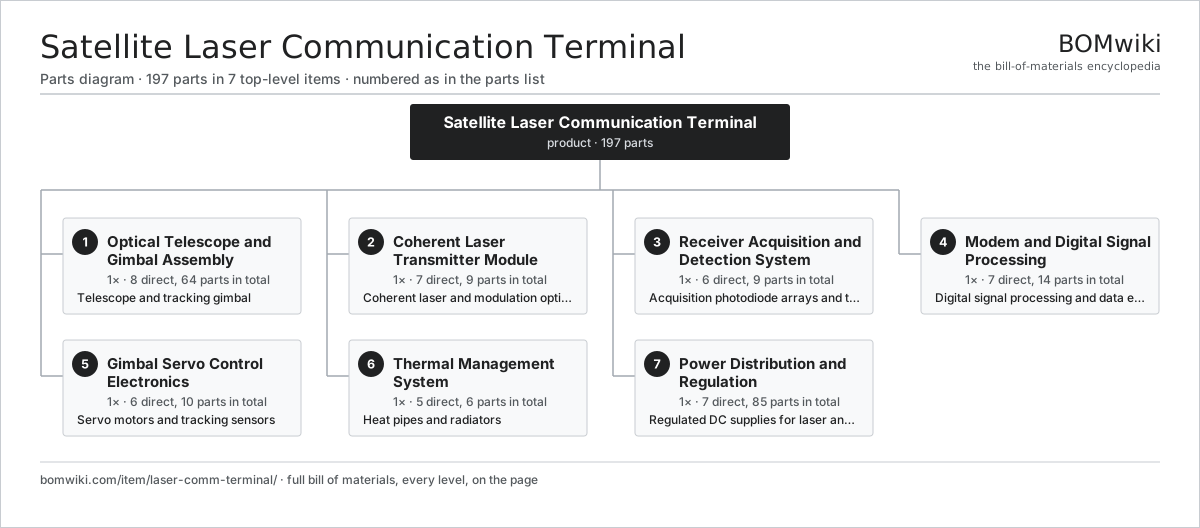
| # | Part | Qty | What it does |
|---|---|---|---|
| 1 | Optical Telescope and Gimbal Assembly 8 parts | 1× | Telescope and tracking gimbal |
| 2 | Coherent Laser Transmitter Module 7 parts | 1× | Coherent laser and modulation optics |
| 3 | Receiver Acquisition and Detection System 6 parts | 1× | Acquisition photodiode arrays and telescope focus |
| 4 | Modem and Digital Signal Processing 7 parts | 1× | Digital signal processing and data encoding |
| 5 | Gimbal Servo Control Electronics 6 parts | 1× | Servo motors and tracking sensors |
| 6 | Thermal Management System 5 parts | 1× | Heat pipes and radiators |
| 7 | Power Distribution and Regulation 7 parts | 1× | Regulated DC supplies for laser and electronics |
3D model
No 3D model yet. Have a CAD file of this? Add a 3D model. STL renders right on this page; STEP, FreeCAD, and OpenSCAD sources are welcome too (openly licensed, like all 3D models on BOMwiki).
Build & assembly graph
expand / collapse · shared sub-assemblies converge · links to related products · est. labourTap an assembly to expand/collapse · tap a part to open it · use “Open page” for any node · drag to pan, scroll to zoom.
Bill of materials for Satellite Laser Communication Terminal
7 top-level lines · 64 rows shown · 197 parts total · indented to 3 levels| # | Item / sub-assembly | Part no. | Qty/assy | Ext. qty | Parts | Type |
|---|---|---|---|---|---|---|
| 1 | Optical Telescope and Gimbal Assembly 8 parts | lct-optical-head | 1× | 1 | 64 | assembly |
| 1.1 | Cassegrain Primary Mirror | lct-primary-mirror | 1× | 1 | · | part |
| 1.2 | Cassegrain Secondary Mirror | lct-secondary-mirror | 1× | 1 | · | part |
| 1.3 | Mirror Cell and Support | lct-mirror-cell | 1× | 1 | · | part |
| 1.4 | Two-Axis Gimbal Frame | lct-gimbal-frame | 1× | 1 | · | part |
| 1.5 | Servo Motor 4 parts | servo-motor | 2× | 2 | 24 | assembly |
| 1.5.1 | Stator Assembly 3 parts + deeper › | stator-assembly | 1× | 2 | 3 | assembly |
| 1.5.2 | Rotor Assembly 4 parts + deeper › | rotor-assembly | 1× | 2 | 19 | assembly |
| 1.5.3 | Encoder | encoder | 1× | 2 | · | part |
| 1.5.4 | Motor Housing | motor-housing | 1× | 2 | · | part |
| 1.6 | Ball Bearing | ball-bearing | 8× | 8 | · | part |
| 1.7 | Encoder | encoder | 2× | 2 | · | part |
| 1.8 | Fastener Set | fastener-set | 2× | 2 | · | part |
| 2 | Coherent Laser Transmitter Module 7 parts | lct-laser-transmitter | 1× | 1 | 9 | assembly |
| 2.1 | DFB Laser Diode 1550 nm | lct-laser-diode | 1× | 1 | · | part |
| 2.2 | Temperature-Stabilized Laser Mount | lct-laser-mount | 1× | 1 | · | part |
| 2.3 | Electro-Optic Mach-Zehnder Modulator | lct-eom-modulator | 1× | 1 | · | part |
| 2.4 | Polarizing Beam Splitter | lct-beam-splitter | 2× | 2 | · | part |
| 2.5 | Fiber Collimator and Coupler | lct-fiber-coupler | 1× | 1 | · | part |
| 2.6 | Polarization-Maintaining Fiber | lct-pm-fiber | 1× | 1 | · | part |
| 2.7 | Connector | connector | 2× | 2 | · | part |
| 3 | Receiver Acquisition and Detection System 6 parts | lct-receiver-optics | 1× | 1 | 9 | assembly |
| 3.1 | PIN Photodiode Quad Array | lct-acquisition-photodiode | 4× | 4 | · | part |
| 3.2 | Receiver Focus Optics | lct-focus-lens | 1× | 1 | · | part |
| 3.3 | TX/RX Dichroic Beamsplitter | lct-dichroic-mirror | 1× | 1 | · | part |
| 3.4 | Transimpedance Amplifier | lct-lna-amplifier | 1× | 1 | · | part |
| 3.5 | High-Speed Analog-to-Digital Converter | lct-adc-board | 1× | 1 | · | part |
| 3.6 | Bare PCB | pcb-bare | 1× | 1 | · | part |
| 4 | Modem and Digital Signal Processing 7 parts | lct-modem-electronics | 1× | 1 | 14 | assembly |
| 4.1 | Xilinx Artix-7 FPGA Module | lct-fpga-module | 1× | 1 | · | part |
| 4.2 | Dual Digital-to-Analog Converter | lct-dac-board | 1× | 1 | · | part |
| 4.3 | DRAM and Configuration Memory | lct-memory-board | 1× | 1 | · | part |
| 4.4 | Spacecraft Interface Module | lct-interface-board | 1× | 1 | · | part |
| 4.5 | Power MOSFET | mosfet | 4× | 4 | · | part |
| 4.6 | Bare PCB | pcb-bare | 2× | 2 | · | part |
| 4.7 | Connector | connector | 4× | 4 | · | part |
| 5 | Gimbal Servo Control Electronics 6 parts | lct-gimbal-control | 1× | 1 | 10 | assembly |
| 5.1 | MEMS Inertial Measurement Unit | lct-imu-sensor | 1× | 1 | · | part |
| 5.2 | Miniature Star Tracker | lct-star-tracker | 1× | 1 | · | part |
| 5.3 | Gimbal Servo Motor H-Bridge Driver | lct-motor-driver | 2× | 2 | · | part |
| 5.4 | Encoder | encoder | 2× | 2 | · | part |
| 5.5 | Bare PCB | pcb-bare | 1× | 1 | · | part |
| 5.6 | Connector | connector | 3× | 3 | · | part |
| 6 | Thermal Management System 5 parts | lct-thermal-management | 1× | 1 | 6 | assembly |
| 6.1 | Copper Heat Pipe | lct-heat-pipe | 2× | 2 | · | part |
| 6.2 | Deployable Radiator Panel | lct-radiator-panel | 1× | 1 | · | part |
| 6.3 | Radiator Deployment Mechanism | lct-radiator-support | 1× | 1 | · | part |
| 6.4 | Radiator Louver Thermal Control | lct-louver-system | 1× | 1 | · | part |
| 6.5 | Fastener Set | fastener-set | 1× | 1 | · | part |
| 7 | Power Distribution and Regulation 7 parts | lct-power-supply | 1× | 1 | 85 | assembly |
| 7.1 | Main DCDC Converter 48V→12V | lct-dcdc-primary | 1× | 1 | · | part |
| 7.2 | Laser Low-Ripple DCDC | lct-dcdc-laser | 1× | 1 | · | part |
| 7.3 | Dual ±5V Analog Supply | lct-dcdc-analog | 1× | 1 | · | part |
| 7.4 | Digital Supply DCDC 3.3V | lct-dcdc-digital | 1× | 1 | · | part |
| 7.5 | Power Supply | power-supply | 1× | 1 | · | part |
| 7.6 | Power Factor Capacitor Bank 7 parts | capacitor-bank | 1× | 1 | 78 | product |
| 7.6.1 | Enclosure 3 parts + deeper › | capbank-enclosure | 1× | 1 | 9 | assembly |
| 7.6.2 | Capacitor Power Stage 2 parts + deeper › | capbank-power-stage | 1× | 1 | 20 | assembly |
| 7.6.3 | Step Switching 3 parts + deeper › | capbank-switching | 1× | 1 | 30 | assembly |
| 7.6.4 | Detuning Reactor | capbank-reactor | 3× | 3 | · | part |
| 7.6.5 | Power-Factor Controller 5 parts + deeper › | capbank-controller | 1× | 1 | 10 | assembly |
| 7.6.6 | Copper Busbar | capbank-busbar | 3× | 3 | · | part |
| 7.6.7 | Cooling System 2 parts + deeper › | capbank-cooling | 1× | 1 | 3 | assembly |
| 7.7 | Connector | connector | 2× | 2 | · | part |
Something wrong in this list? Report a problem with this BOM.
Related products
same domain, ranked by shared parts Space Station Treadmill
151 parts · shares 24 with this page
Space Station Treadmill
151 parts · shares 24 with this page
 Crewed Space Capsule
7,222 parts · shares 13 with this page
Crewed Space Capsule
7,222 parts · shares 13 with this page
 Satellite Ground Station Antenna
274 parts · shares 12 with this page
Solar Sail Spacecraft
170 parts · shares 12 with this page
Satellite Ground Station Antenna
274 parts · shares 12 with this page
Solar Sail Spacecraft
170 parts · shares 12 with this page
 GPS Navigation Satellite
2,640 parts · shares 13 with this page
GPS Navigation Satellite
2,640 parts · shares 13 with this page
 Lunar Lander
1,803 parts · shares 13 with this page
Lunar Lander
1,803 parts · shares 13 with this page
Sourcing: possible vendors
Browse the supplier directory → Prices, MOQ, and lead times are algorithmic estimates, not quotes, and not claims about these companies. Company mappings are curated by keyword; est. price band $50k–$500M. How estimates work| Vendor | HQ | Specialty | MOQ | Lead time |
|---|---|---|---|---|
|
🇺🇸SpaceX
spacex.com ↗
|
Hawthorne, US | Launch & spacecraft | made to order | 52–104 wks |
| northropgrumman.com ↗ | Falls Church, US | Space & defense | made to order | 52–104 wks |
|
🇫🇷Airbus
airbus.com ↗
|
Toulouse, FR | Aerospace OEM | made to order | 52–104 wks |
| rocketlabusa.com ↗ | Long Beach, US | Launch & spacecraft | made to order | 52–104 wks |
| thalesaleniaspace.com ↗ | Cannes, FR | Satellites | made to order | 52–104 wks |
1,528-word article