Letterpress Printing Press
ProductOverview
The letterpress printing press is a mechanical machine that transfers inked relief type and cuts onto paper through direct platen or cylinder impression. Operating on the principle of direct contact between raised metal type and inked rollers, it was the dominant printing method from Gutenberg's era through the mid-20th century. Unlike flexographic or lithographic presses, letterpress relies on mechanical pressure and physical contact to achieve sharp, tactile impressions characteristic of fine printing.
The basic mechanism consists of a rotating crankshaft driven by a treadle or motor, which coordinates the descent of the platen against the inked type through a system of cams and linkages. The Inking System distributes ink continuously, while the Feed System advances single sheets through the machine.
Construction
The Frame is a heavy cast iron skeleton, typically weighing 300–600 kg, providing the rigidity necessary to support repeated 50–200 N/cm² impression forces without deflection. All major assemblies bolt directly to this frame using Fastener Set. The frame bottom is a large casting that serves as a machine-anchoring point; vertical Side Rails connect the base to the top assembly, with Crossbeams bracing them laterally.
The Platen System is the impression surface. The hardened Platen itself is a disc of 100–200 mm diameter, polished and hardened to approximately 55–62 HRC (Rockwell hardness). Behind it lies a Platen Backing Plate plate that is backed by four Coil Spring elements providing pneumatic return force. When the platen descends, the springs compress, storing energy for the return stroke. The platen motion is driven by a Platen Linkage, a system of steel levers and connectors translating the rotation of the crankshaft into vertical motion. An Impression Lever or clutch allows manual engagement or continuous operation.
Inking
The Inking System consists of a rotating Ink Disc (250–400 mm diameter) that holds a thin layer of ink. Two rubber Ink Rollers (50–80 mm diameter) rest on this disc under controlled pressure, picking up ink and transferring it to the Type Chase Assembly. The rollers are mounted on Roller Arms that can be adjusted with Roller Adjusters, either eccentric or screw-type mechanisms, to set proper contact pressure. Ball Bearing support the shafts, allowing free rotation.
Ink composition varies: vegetable-oil-based inks for offset and relief, with drying oils (linseed, tung) ensuring adhesion to paper. Viscosity ranges 80–120 Poises at 25 °C for fine detail; thicker inks are used for coarser register.
Type and Chase
The Type Chase Assembly is a rectangular iron frame (400–600 mm × 300–500 mm) that locks into a fixed position on the Platen Bed. Inside the chase, lead or photopolymer type is arranged and locked tight using Quoins, wedge-shaped locking devices that are tightened by hand or screw. The tightness of the quoins is critical; loose type will shift during impression, causing blurred or double prints. Wooden and metal furniture (spacing elements) fill voids and distribute impression pressure evenly.
Drive and Timing
The Drive System converts input power to synchronized platen and roller motion. A Crankshaft rotates continuously at 60–120 rpm (treadle-driven machines are often variable; motor-driven machines run at fixed speed). A Cam Disk is mounted on the crankshaft, its profile engineered to:
- Raise and lower the platen at the correct moment
- Synchronize roller lifting away from the type between cycles
- Maintain consistent dwell time during impression (0.2–0.5 seconds)
A heavy Flywheel (300–500 mm diameter iron disc) smooths torque delivery and stores rotational inertia, preventing speed drop during the high-load impression stroke.
Paper Feed and Impression Control
The Feed System positions single sheets and advances them after each impression. A Feed Board holds the paper stack at a shallow angle. Side Guides align each sheet's edges, ensuring perpendicular feed. Spring-loaded Grippers hold the leading edge during impression; the grippers release as the platen returns, allowing the Feed Rollers to advance the next sheet into position.
Impression pressure is fine-tuned using Impression Adjustment. Two Impression Screws (one on each side of the platen) adjust the height incrementally. A Pressure Indicator (dial gauge) shows the resulting force. Proper impression is critical: too light, and type does not bite into the paper; too heavy, and paper fibers crush, creating embossment bruising. Typical setting for 100 gsm bond is 80–120 N/cm² for sharp, clean print.
Operation
Manual treadle machines require operator rhythm, a skilled printer develops a consistent cycle cadence. The operator's foot drives the treadle, which rocks the crankshaft. As the crank reaches a critical angle, the cam pulls the platen downward. At the bottom of the stroke, the platen lingers, allowing full ink transfer. The return spring then accelerates the platen upward; simultaneously, the rollers lift away from the type, and the grippers release the printed sheet. The Feed Rollers then advance the next sheet into position.
Motor-driven machines (1–2 kW electric motors) run continuously once engaged. A clutch mechanism connects and disconnects the motor from the crankshaft, allowing the operator to stop without shutting down the motor.
Maintenance and Wear
Key wear points include the Platen surface (develops micro-indentations from repeated impression), the rubber Ink Rollers (harden and glaze with age, reducing ink transfer), and the Coil Spring backing the platen (fatigue over 10⁶+ cycles). Preventive maintenance includes daily ink-roller cleaning, weekly platen wiping, and seasonal disassembly of the Inking System for deep cleaning. Quoin tension should be verified before each print run to prevent type slipping.
The letterpress remains in use in fine letterpress printing workshops and artisan operations, valued for its tactile output, durability, and reproducibility of vintage aesthetics.
Letterpress Printing Press parts and their functions
7 top-level parts · 54 parts in total · full bill of materials below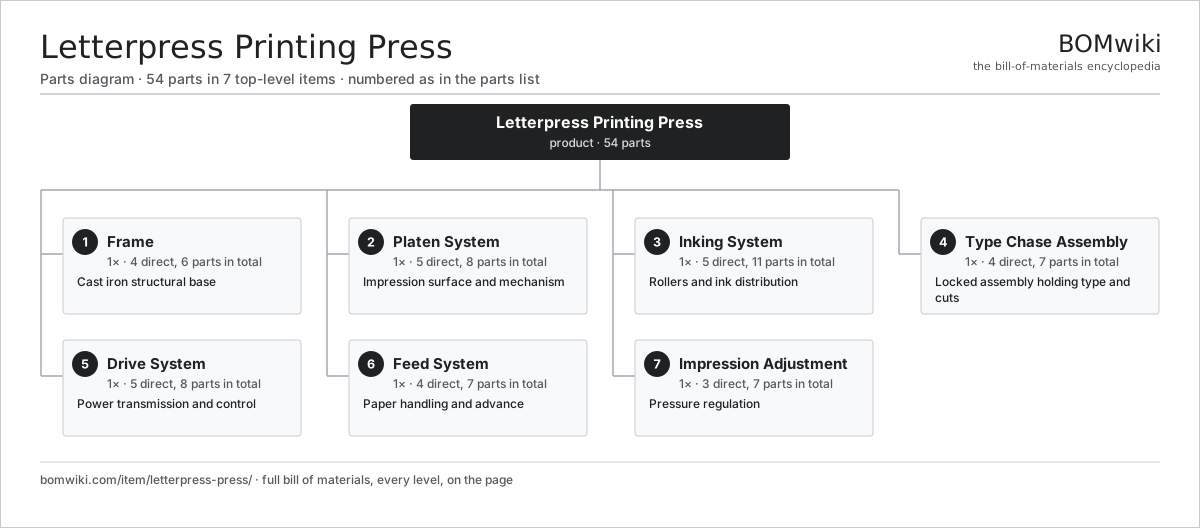
| # | Part | Qty | What it does |
|---|---|---|---|
| 1 | Frame 4 parts | 1× | Cast iron structural base |
| 2 | Platen System 5 parts | 1× | Impression surface and mechanism |
| 3 | Inking System 5 parts | 1× | Rollers and ink distribution |
| 4 | Type Chase Assembly 4 parts | 1× | Locked assembly holding type and cuts |
| 5 | Drive System 5 parts | 1× | Power transmission and control |
| 6 | Feed System 4 parts | 1× | Paper handling and advance |
| 7 | Impression Adjustment 3 parts | 1× | Pressure regulation |
3D model
No 3D model yet. Have a CAD file of this? Add a 3D model. STL renders right on this page; STEP, FreeCAD, and OpenSCAD sources are welcome too (openly licensed, like all 3D models on BOMwiki).
Build & assembly graph
expand / collapse · shared sub-assemblies converge · links to related products · est. labourTap an assembly to expand/collapse · tap a part to open it · use “Open page” for any node · drag to pan, scroll to zoom.
Bill of materials for Letterpress Printing Press
7 top-level lines · 37 rows shown · 54 parts total · indented to 3 levels| # | Item / sub-assembly | Part no. | Qty/assy | Ext. qty | Parts | Type |
|---|---|---|---|---|---|---|
| 1 | Frame 4 parts | letterpress-press-frame | 1× | 1 | 6 | assembly |
| 1.1 | Base Casting | letterpress-press-frame-base | 1× | 1 | · | part |
| 1.2 | Side Rails | letterpress-press-frame-side-rails | 2× | 2 | · | part |
| 1.3 | Crossbeams | letterpress-press-frame-crossbeams | 2× | 2 | · | part |
| 1.4 | Fastener Set | fastener-set | 1× | 1 | · | part |
| 2 | Platen System 5 parts | letterpress-press-platen-system | 1× | 1 | 8 | assembly |
| 2.1 | Platen | letterpress-press-platen | 1× | 1 | · | part |
| 2.2 | Platen Backing Plate | letterpress-press-platen-backing | 1× | 1 | · | part |
| 2.3 | Coil Spring | coil-spring | 4× | 4 | · | part |
| 2.4 | Platen Linkage | letterpress-press-platen-linkage | 1× | 1 | · | part |
| 2.5 | Impression Lever | letterpress-press-impression-lever | 1× | 1 | · | part |
| 3 | Inking System 5 parts | letterpress-press-inking-system | 1× | 1 | 11 | assembly |
| 3.1 | Ink Disc | letterpress-press-ink-disc | 1× | 1 | · | part |
| 3.2 | Ink Rollers | letterpress-press-ink-rollers | 2× | 2 | · | part |
| 3.3 | Roller Arms | letterpress-press-roller-arms | 2× | 2 | · | part |
| 3.4 | Ball Bearing | ball-bearing | 4× | 4 | · | part |
| 3.5 | Roller Adjusters | letterpress-press-roller-adjusters | 2× | 2 | · | part |
| 4 | Type Chase Assembly 4 parts | letterpress-press-type-chase | 1× | 1 | 7 | assembly |
| 4.1 | Chase | letterpress-press-chase | 1× | 1 | · | part |
| 4.2 | Quoins | letterpress-press-quoins | 4× | 4 | · | part |
| 4.3 | Platen Bed | letterpress-press-platen-bed | 1× | 1 | · | part |
| 4.4 | Fastener Set | fastener-set | 1× | 1 | · | part |
| 5 | Drive System 5 parts | letterpress-press-drive | 1× | 1 | 8 | assembly |
| 5.1 | Treadle | letterpress-press-treadle | 1× | 1 | · | part |
| 5.2 | Flywheel | letterpress-press-flywheel | 1× | 1 | · | part |
| 5.3 | Crankshaft | letterpress-press-crankshaft | 1× | 1 | · | part |
| 5.4 | Cam Disk | letterpress-press-cam-disk | 1× | 1 | · | part |
| 5.5 | Ball Bearing | ball-bearing | 4× | 4 | · | part |
| 6 | Feed System 4 parts | letterpress-press-feed-system | 1× | 1 | 7 | assembly |
| 6.1 | Feed Board | letterpress-press-feed-board | 1× | 1 | · | part |
| 6.2 | Side Guides | letterpress-press-side-guides | 2× | 2 | · | part |
| 6.3 | Grippers | letterpress-press-grippers | 2× | 2 | · | part |
| 6.4 | Feed Rollers | letterpress-press-feed-rollers | 2× | 2 | · | part |
| 7 | Impression Adjustment 3 parts | letterpress-press-impression-adjustment | 1× | 1 | 7 | assembly |
| 7.1 | Impression Screw | letterpress-press-impression-screw | 2× | 2 | · | part |
| 7.2 | Pressure Indicator | letterpress-press-pressure-indicator | 1× | 1 | · | part |
| 7.3 | Locking Nuts | letterpress-press-locking-nuts | 4× | 4 | · | part |
Something wrong in this list? Report a problem with this BOM.
Related products
same domain, ranked by shared parts Hot Wire Foam Cutting Line
314 parts · shares 2 with this page
Hot Wire Foam Cutting Line
314 parts · shares 2 with this page
 Ingot Casting Machine
690 parts · shares 2 with this page
Powder Coating Line
5,418 parts · shares 2 with this page
Ingot Casting Machine
690 parts · shares 2 with this page
Powder Coating Line
5,418 parts · shares 2 with this page
Sourcing: possible vendors
Browse the supplier directory → Prices, MOQ, and lead times are algorithmic estimates, not quotes, and not claims about these companies. Company mappings are curated by keyword; est. price band $5k–$2M. How estimates work| Vendor | HQ | Specialty | MOQ | Lead time |
|---|---|---|---|---|
| atlascopco.com ↗ | Stockholm, SE | Compressors & industrial | 10 units | 12–20 wks |
|
🇦🇹Andritz
andritz.com ↗
|
Graz, AT | Process plants & machinery | 10 units | 12–20 wks |
| buhlergroup.com ↗ | Uzwil, CH | Food & materials processing | 10 units | 12–20 wks |
| gea.com ↗ | Düsseldorf, DE | Process technology | 10 units | 12–20 wks |
| mhi.com ↗ | Tokyo, JP | Heavy machinery | 10 units | 12–20 wks |
1,019-word article