Level Crossing Barrier
ProductOverview
A level crossing barrier is the road-facing end of a railway interlocking: a motorised boom that descends across the carriageway when a train approaches and stays down, proved and supervised, until the train has cleared. A complete crossing uses two or four barrier machines (one per road quadrant), each a self-contained unit of Boom Assembly, Drive Mechanism, and Pedestal and Machine Housing, sequenced together with Road Warning Lights and an audible Audible Warning Unit by the Control Cabinet.
The closing sequence
The cycle begins when a train passes a Strike-In Sensor on the approach, placed far enough out that road users get at least 20–30 seconds of warning before the fastest permitted train arrives. The Crossing Controller first starts the Flasher Lamp Head pairs, twin red lamps flashing alternately at 45–60 flashes per minute, hooded against phantom sunlight by Lamp Hood visors and contrasted by a retroreflective Target Board, together with the Electronic Sounder. After a fixed pre-warning of a few seconds, the booms descend over 6–10 seconds. On four-quadrant crossings the exit booms lower a few seconds after the entrance booms, so a vehicle caught on the crossing can still drive out.
While a train occupies the Island Circuit spanning the roadway, the booms are locked down. Only when Wheel Detector heads have counted every axle out of the section does the controller raise the barriers and extinguish the lights. Full-closure crossings add an Obstacle Detection Radar that scans the enclosed road area; the protecting railway signal clears only after the scan confirms the crossing is empty.
Drive mechanism
The boom itself is nearly weightless to the motor. Cast Counterweight blocks behind the pivot balance the Boom Arm to near-neutral torque, so the Drive Motor, typically only 0.25–0.75 kW, works mainly against friction and wind. Torque passes through a self-locking Worm Gearbox and a Crank Linkage whose geometry goes over-centre at both ends of travel: in the raised and lowered positions the crank is past its dead point, so no back-load from the boom can rotate the mechanism. The worm gear holds position when power is lost, and slightly counterweight-heavy balancing is usually chosen so a totally failed machine can be lowered by gravity or wound by the interlocked Hand Crank.
Cam-driven Limit Switch contacts prove the true boom position to the controller, the logic never assumes; it checks. A Friction Clutch lets the drive slip if the boom meets an obstruction, and a Breakaway Coupling at the arm root sacrifices the boom rather than the machine when a road vehicle strikes it, the most common failure event in service.
Fail-safe control
Crossing logic is vital in the signalling sense: every step must be proved before the next is allowed, and any failure must leave the crossing in its protective state. The Flasher Driver proves current in each lamp; a failed lamp is reported and, beyond a threshold, the crossing is treated as degraded. The Limit Switch proving of "booms down" is a precondition for the railway signal in rear to clear. Float-charged batteries in the Backup Battery Bank keep the whole installation running for 12 hours or more after a mains failure, and an Event Recorder time-stamps every activation, lamp proof, and boom movement, the first artefact examined after any crossing incident.
Structure
Each machine bolts to a concrete foundation through a Foundation Frame sized for the overturning moment of a 9 m boom in design wind. The lockable Machine Housing encloses the drive; the Pivot Shaft passes through sealed Ball Bearing journals to the boom and counterweights outside. Along the arm, Boom Lamp lamps mark its length to road traffic, the tip lamp flashing, the inner lamps steady, and on pedestrian routes a hanging Boom Skirt discourages ducking under a lowered boom.
Level Crossing Barrier parts and their functions
7 top-level parts · 108 parts in total · full bill of materials below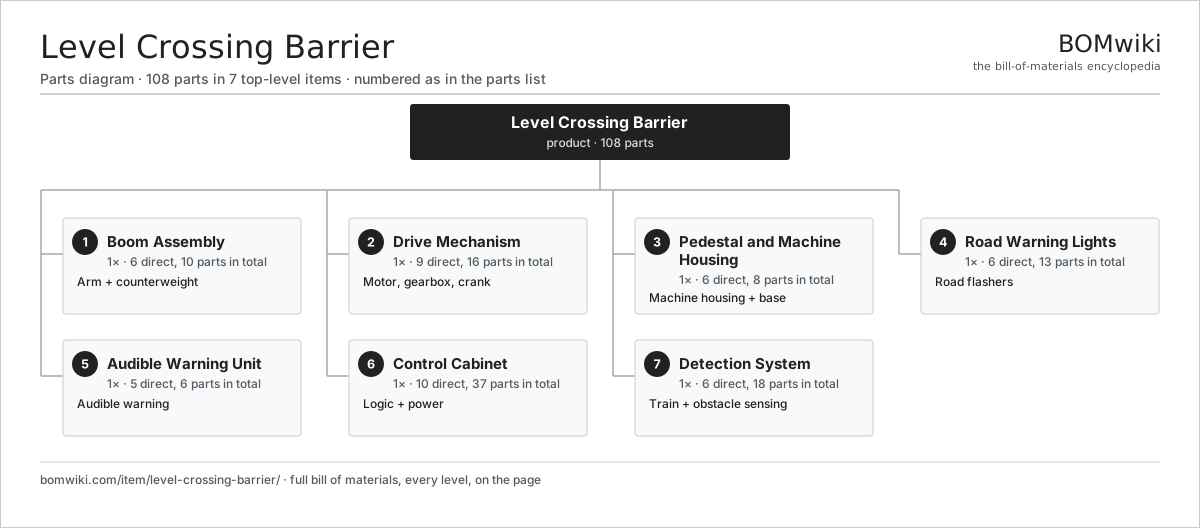
| # | Part | Qty | What it does |
|---|---|---|---|
| 1 | Boom Assembly 6 parts | 1× | Arm + counterweight |
| 2 | Drive Mechanism 9 parts | 1× | Motor, gearbox, crank |
| 3 | Pedestal and Machine Housing 6 parts | 1× | Machine housing + base |
| 4 | Road Warning Lights 6 parts | 1× | Road flashers |
| 5 | Audible Warning Unit 5 parts | 1× | Audible warning |
| 6 | Control Cabinet 10 parts | 1× | Logic + power |
| 7 | Detection System 6 parts | 1× | Train + obstacle sensing |
3D model
No 3D model yet. Have a CAD file of this? Add a 3D model. STL renders right on this page; STEP, FreeCAD, and OpenSCAD sources are welcome too (openly licensed, like all 3D models on BOMwiki).
Build & assembly graph
expand / collapse · shared sub-assemblies converge · links to related products · est. labourTap an assembly to expand/collapse · tap a part to open it · use “Open page” for any node · drag to pan, scroll to zoom.
Bill of materials for Level Crossing Barrier
7 top-level lines · 55 rows shown · 108 parts total · indented to 3 levels| # | Item / sub-assembly | Part no. | Qty/assy | Ext. qty | Parts | Type |
|---|---|---|---|---|---|---|
| 1 | Boom Assembly 6 parts | level-crossing-barrier-boom | 1× | 1 | 10 | assembly |
| 1.1 | Boom Arm | level-crossing-barrier-boom-arm | 1× | 1 | · | part |
| 1.2 | Boom Lamp | level-crossing-barrier-boom-light | 3× | 3 | · | part |
| 1.3 | Counterweight | level-crossing-barrier-counterweight | 2× | 2 | · | part |
| 1.4 | Breakaway Coupling | level-crossing-barrier-breakaway-coupling | 1× | 1 | · | part |
| 1.5 | Boom Skirt | level-crossing-barrier-skirt | 1× | 1 | · | part |
| 1.6 | Fastener Set | fastener-set | 2× | 2 | · | part |
| 2 | Drive Mechanism 9 parts | level-crossing-barrier-drive | 1× | 1 | 16 | assembly |
| 2.1 | Drive Motor | level-crossing-barrier-drive-motor | 1× | 1 | · | part |
| 2.2 | Worm Gearbox | level-crossing-barrier-worm-gearbox | 1× | 1 | · | part |
| 2.3 | Crank Linkage | level-crossing-barrier-crank-linkage | 1× | 1 | · | part |
| 2.4 | Hand Crank | level-crossing-barrier-hand-crank | 1× | 1 | · | part |
| 2.5 | Limit Switch | level-crossing-barrier-limit-switch | 4× | 4 | · | part |
| 2.6 | Friction Clutch | level-crossing-barrier-friction-clutch | 1× | 1 | · | part |
| 2.7 | Helical Gear Pair | gear-pair | 1× | 1 | · | part |
| 2.8 | Ball Bearing | ball-bearing | 4× | 4 | · | part |
| 2.9 | Oil Seal | oil-seal | 2× | 2 | · | part |
| 3 | Pedestal and Machine Housing 6 parts | level-crossing-barrier-pedestal | 1× | 1 | 8 | assembly |
| 3.1 | Machine Housing | level-crossing-barrier-machine-housing | 1× | 1 | · | part |
| 3.2 | Pivot Shaft | level-crossing-barrier-pivot-shaft | 1× | 1 | · | part |
| 3.3 | Foundation Frame | level-crossing-barrier-foundation-frame | 1× | 1 | · | part |
| 3.4 | Ball Bearing | ball-bearing | 2× | 2 | · | part |
| 3.5 | O-Ring Set | oring-set | 1× | 1 | · | part |
| 3.6 | Fastener Set | fastener-set | 2× | 2 | · | part |
| 4 | Road Warning Lights 6 parts | level-crossing-barrier-warning-lights | 1× | 1 | 13 | assembly |
| 4.1 | Flasher Lamp Head | level-crossing-barrier-flasher-head | 2× | 2 | · | part |
| 4.2 | Lamp Hood | level-crossing-barrier-lamp-hood | 4× | 4 | · | part |
| 4.3 | Target Board | level-crossing-barrier-target-board | 1× | 1 | · | part |
| 4.4 | Flasher Driver | level-crossing-barrier-flasher-driver | 1× | 1 | · | part |
| 4.5 | Connector | connector | 4× | 4 | · | part |
| 4.6 | Wire Bundle | wire-bundle | 1× | 1 | · | part |
| 5 | Audible Warning Unit 5 parts | level-crossing-barrier-bell | 1× | 1 | 6 | assembly |
| 5.1 | Electronic Sounder | level-crossing-barrier-electronic-sounder | 1× | 1 | · | part |
| 5.2 | Sounder Mount | level-crossing-barrier-bell-mount | 1× | 1 | · | part |
| 5.3 | Speaker | speaker | 1× | 1 | · | part |
| 5.4 | Microcontroller | mcu | 1× | 1 | · | part |
| 5.5 | Connector | connector | 2× | 2 | · | part |
| 6 | Control Cabinet 10 parts | level-crossing-barrier-control-cabinet | 1× | 1 | 37 | assembly |
| 6.1 | Crossing Controller | level-crossing-barrier-crossing-controller | 1× | 1 | · | part |
| 6.2 | Backup Battery Bank | level-crossing-barrier-battery-bank | 1× | 1 | · | part |
| 6.3 | Event Recorder | level-crossing-barrier-event-recorder | 1× | 1 | · | part |
| 6.4 | Relay | relay | 8× | 8 | · | part |
| 6.5 | Power Supply | power-supply | 2× | 2 | · | part |
| 6.6 | Power MOSFET | mosfet | 4× | 4 | · | part |
| 6.7 | Bare PCB | pcb-bare | 3× | 3 | · | part |
| 6.8 | SMD Passive (R/C/L) | smd-passives | 3× | 3 | · | part |
| 6.9 | Connector | connector | 12× | 12 | · | part |
| 6.10 | Wire Bundle | wire-bundle | 2× | 2 | · | part |
| 7 | Detection System 6 parts | level-crossing-barrier-detection | 1× | 1 | 18 | assembly |
| 7.1 | Strike-In Sensor | level-crossing-barrier-strike-in-sensor | 2× | 2 | · | part |
| 7.2 | Island Circuit | level-crossing-barrier-island-circuit | 1× | 1 | · | part |
| 7.3 | Obstacle Detection Radar | level-crossing-barrier-obstacle-radar | 1× | 1 | · | part |
| 7.4 | Wheel Detector | level-crossing-barrier-wheel-detector | 4× | 4 | · | part |
| 7.5 | Pressure Sensor | pressure-sensor | 2× | 2 | · | part |
| 7.6 | Connector | connector | 8× | 8 | · | part |
Something wrong in this list? Report a problem with this BOM.
Related products
same domain, ranked by shared parts Commuter EMU
14,010 parts · shares 4 with this page
Commuter EMU
14,010 parts · shares 4 with this page
 Mobile Library Bus
924 parts · shares 3 with this page
Mobile Library Bus
924 parts · shares 3 with this page
 Funicular Car
355 parts · shares 3 with this page
Funicular Car
355 parts · shares 3 with this page
 Metro Car
1,156 parts · shares 3 with this page
Metro Car
1,156 parts · shares 3 with this page
 High-Speed Trainset
1,445,128 parts · shares 2 with this page
High-Speed Trainset
1,445,128 parts · shares 2 with this page
 Double-Decker Bus
864 parts · shares 1 with this page
Double-Decker Bus
864 parts · shares 1 with this page
Sourcing: possible vendors
Browse the supplier directory → Prices, MOQ, and lead times are algorithmic estimates, not quotes, and not claims about these companies. Company mappings are curated by keyword; est. price band $500k–$60M. How estimates work| Vendor | HQ | Specialty | MOQ | Lead time |
|---|---|---|---|---|
|
🇨🇳CRRC
crrcgc.cc ↗
|
Beijing, CN | Rolling stock & rail systems | made to order | 40–72 wks |
|
🇫🇷Alstom
alstom.com ↗
|
Saint-Ouen, FR | Rail rolling stock | made to order | 40–72 wks |
| mobility.siemens.com ↗ | Munich, DE | Rail systems | made to order | 40–72 wks |
| stadlerrail.com ↗ | Bussnang, CH | Rail rolling stock | made to order | 40–72 wks |
|
🇺🇸Wabtec
wabteccorp.com ↗
|
Pittsburgh, US | Rail equipment | made to order | 40–72 wks |
734-word article