Library Self-Checkout
ProductOverview
A self-checkout station is a kiosk enabling library patrons to independently borrow materials without staff assistance. Using RFID or barcode technology, the machine reads book tags, verifies patron eligibility, calculates due dates, and prints receipts, all within 15–30 seconds. Modern libraries deploy these to reduce checkout desk congestion, enable 24/7 borrowing in manned locations, and shift staff to readers' advisory and collection development roles.
The system combines RFID reader hardware, touchscreen interface, thermal receipt printer, and a control application linked to the library's Integrated Library System (ILS), such as Evergreen, Koha, or Polaris, that manages patron accounts, item records, and transaction logging.
How It Works
The patron approaches the station and taps their library card or driver's license barcode against the Patron ID Barcode Scanner. The Embedded PLC/Microcontroller queries the ILS for the patron's account, checking standing and fine balance. If clear, the interface prompts the patron to place items on the RFID Read/Write Antenna Pad.
The RFID Reader Module integrated with the RFID Planar Antenna Coil detects the RFID tag embedded in each book's spine or back cover. Most library RFID tags store only a unique item identifier (EPC, or electronic product code); the PLC sends this to the ILS, which returns full bibliographic data and item status.
The display shows each detected item: title, call number, due date, and request status. The patron confirms each item by tapping "Add to Checkout" or reviews the list before finalizing. Once confirmed, the RFID Security Gate Deactivator transmits a high-field RF pulse deactivating the item's security gate function (rendering it transparent to exit-gate alarms).
The Thermal Receipt Printer prints a receipt with due dates, item list, and fines balance. The entire transaction is logged in the ILS.
RFID Tag Architecture
Most library RFID tags (ISO 18000-3 or EPC Gen2 standard) operate at 865–928 MHz (UHF band) and store approximately 96–512 bits of data. Many use read-only tags to prevent patron tampering, though writable tags enable dual-use: check-in/check-out status bits, item-level censoring, and self-charging (RFID library fees).
The library-self-checkout-antenna-pad is typically a flat 30×30 cm coil mounted into the kiosk countertop, read range 10–30 cm depending on tag orientation and kiosk shielding. Better reads occur when books are stacked perpendicular to the pad rather than parallel.
RFID Deactivation and Security Gates
Library exit gates use portal antennas detecting active RFID tags, triggering alarms if an item has not been checked out. The RFID Security Gate Deactivator is a high-field RF oscillator outputting 900+ MHz at 1 kW peak for 100–500 microseconds, "flipping" security bits in the RFID tag IC's configuration register. This deactivates the tag's alarm function while leaving the item identifier intact, allowing future re-activation at check-in or reshelving.
Deactivator coils are tuned to high field strength (>5 kV/m), located behind or inside the checkout pad. Exposure to patrons is minimal due to shielding.
Touchscreen Interaction
The Touchscreen Display & Controller uses a capacitive touch controller sensitive to gloved fingers (important for winter) and supports multi-touch gestures for intuitive navigation. Text is high-contrast, large font (18–24pt) for readability. The interface supports English and optional secondary languages.
Accessibility features include audio cues for button presses, adjustable brightness, and ADA-compliant on-screen keyboard for patron search or account lookup without a barcode.
Integration with Library Management Systems
The Ethernet Interface Module connects to the library's LAN, communicating with the ILS via HTTP, SOAP, or proprietary API. The PLC sends:
- Patron ID and PIN verification requests
- Item RFID EPC lookups
- Checkout transaction records (item ID, patron ID, due date)
- Standing/fine balance queries
The ILS returns:
- Patron eligibility (no holds on account, acceptable fines)
- Item checkout policies (loan period, renewal count)
- Due date calculations (7, 14, or 21 days typical)
Network outages trigger offline mode: the kiosk accepts items and stores transactions locally, syncing when network restores.
Receipt Printing
The Thermal Receipt Printer uses thermal printing (no ink), producing compact receipts 80 mm wide with:
- Patron name and card number (partial masking for privacy)
- Each item title, call number, due date
- Total items checked out
- Fines balance and payment instructions
- Library contact and renewal info (e.g., "Renew online at library.org or call 555-0100")
Thermal paper fades over 3–5 years in sunlight, but patron retention is typically 1–2 weeks.
Failure Modes and Recovery
If the RFID pad fails to detect an item after 3 attempts, the interface prompts the patron to move the item or flip orientation. Persistent failures allow the patron to skip the item or request staff assistance.
If the ILS is unavailable, offline mode allows checkout; the transaction is queued and processed once network restores. However, deactivation commands may fail, leaving security bits active, the exit gate may alarm even though the checkout is recorded.
Deployment and Library Impact
Libraries typically deploy 1–3 self-checkout kiosks depending on patron volume. High-traffic systems (>300 checkouts/day) benefit from dedicated hardware and 24/7 availability. Systems are usually complemented by a staffed desk for special requests, renewals, and lost-item disputes.
Staff time shifts from transaction processing to patron engagement, and libraries report 5–15% improvement in checkout throughput. Patron adoption is highest for regular borrowers and self-service-comfortable demographics.
Library Self-Checkout parts and their functions
8 top-level parts · 37 parts in total · full bill of materials below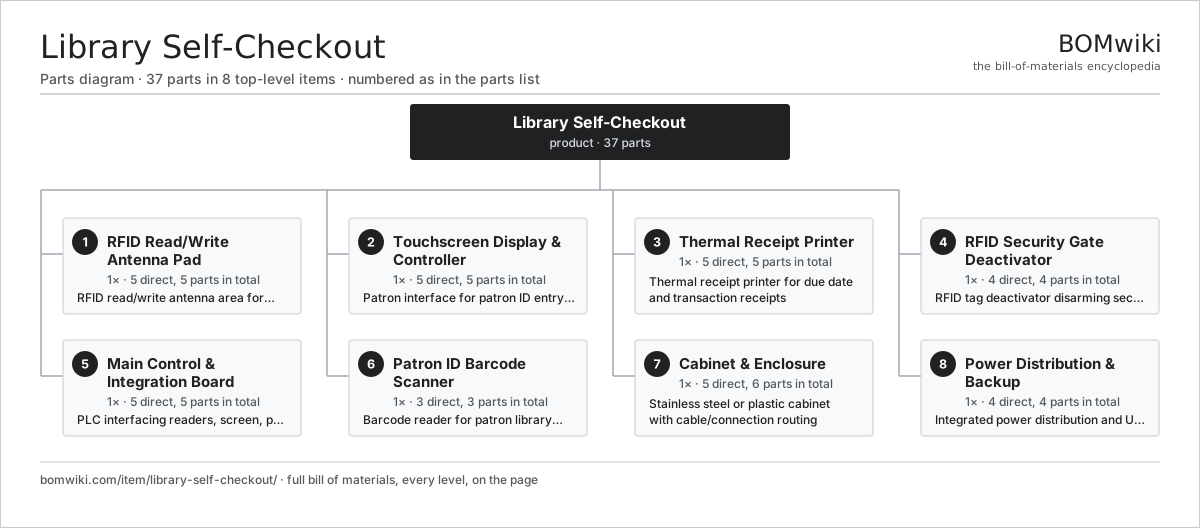
| # | Part | Qty | What it does |
|---|---|---|---|
| 1 | RFID Read/Write Antenna Pad 5 parts | 1× | RFID read/write antenna area for material identification |
| 2 | Touchscreen Display & Controller 5 parts | 1× | Patron interface for patron ID entry and transaction confirm |
| 3 | Thermal Receipt Printer 5 parts | 1× | Thermal receipt printer for due date and transaction receipts |
| 4 | RFID Security Gate Deactivator 4 parts | 1× | RFID tag deactivator disarming security alarms after checkout |
| 5 | Main Control & Integration Board 5 parts | 1× | PLC interfacing readers, screen, printer, and library system |
| 6 | Patron ID Barcode Scanner 3 parts | 1× | Barcode reader for patron library card or ID document |
| 7 | Cabinet & Enclosure 5 parts | 1× | Stainless steel or plastic cabinet with cable/connection routing |
| 8 | Power Distribution & Backup 4 parts | 1× | Integrated power distribution and UPS backup |
3D model
No 3D model yet. Have a CAD file of this? Add a 3D model. STL renders right on this page; STEP, FreeCAD, and OpenSCAD sources are welcome too (openly licensed, like all 3D models on BOMwiki).
Build & assembly graph
expand / collapse · shared sub-assemblies converge · links to related products · est. labourTap an assembly to expand/collapse · tap a part to open it · use “Open page” for any node · drag to pan, scroll to zoom.
Bill of materials for Library Self-Checkout
8 top-level lines · 44 rows shown · 37 parts total · indented to 3 levels| # | Item / sub-assembly | Part no. | Qty/assy | Ext. qty | Parts | Type |
|---|---|---|---|---|---|---|
| 1 | RFID Read/Write Antenna Pad 5 parts | library-self-checkout-rfid-pad | 1× | 1 | 5 | assembly |
| 1.1 | RFID Planar Antenna Coil | library-self-checkout-antenna-coil | 1× | 1 | · | part |
| 1.2 | Antenna Substrate PCB | library-self-checkout-antenna-pcb | 1× | 1 | · | part |
| 1.3 | RFID Reader Module | library-self-checkout-reader-ic | 1× | 1 | · | part |
| 1.4 | Antenna Matching Network | library-self-checkout-matching-network | 1× | 1 | · | part |
| 1.5 | Antenna Shielding Enclosure | library-self-checkout-antenna-shield | 1× | 1 | · | part |
| 2 | Touchscreen Display & Controller 5 parts | library-self-checkout-touchscreen | 1× | 1 | 5 | assembly |
| 2.1 | LCD Display Panel | library-self-checkout-lcd-panel | 1× | 1 | · | part |
| 2.2 | Capacitive Touch Controller | library-self-checkout-touch-controller | 1× | 1 | · | part |
| 2.3 | Backlight PWM Driver | library-self-checkout-backlight-driver | 1× | 1 | · | part |
| 2.4 | Display Signal Cable | library-self-checkout-display-connector | 1× | 1 | · | part |
| 2.5 | Display Bezel & Frame | library-self-checkout-bezel-frame | 1× | 1 | · | part |
| 3 | Thermal Receipt Printer 5 parts | library-self-checkout-receipt-printer | 1× | 1 | 5 | assembly |
| 3.1 | Thermal Print Head | library-self-checkout-thermal-head | 1× | 1 | · | part |
| 3.2 | Paper Feed Stepper Motor | library-self-checkout-printer-motor | 1× | 1 | · | part |
| 3.3 | Paper Guide Assembly | library-self-checkout-paper-guide | 1× | 1 | · | part |
| 3.4 | Printer Control PCB | library-self-checkout-printer-pcb | 1× | 1 | · | part |
| 3.5 | Printer Enclosure | library-self-checkout-printer-housing | 1× | 1 | · | part |
| 4 | RFID Security Gate Deactivator 4 parts | library-self-checkout-desensitizer | 1× | 1 | 4 | assembly |
| 4.1 | Deactivator RF Coil | library-self-checkout-deactivator-coil | 1× | 1 | · | part |
| 4.2 | Deactivator Pulse Generator | library-self-checkout-deactivator-circuit | 1× | 1 | · | part |
| 4.3 | Deactivator Capacitor Bank | library-self-checkout-energy-storage | 1× | 1 | · | part |
| 4.4 | Deactivation Trigger Relay | library-self-checkout-deactivator-switch | 1× | 1 | · | part |
| 5 | Main Control & Integration Board 5 parts | library-self-checkout-controller-board | 1× | 1 | 5 | assembly |
| 5.1 | Embedded PLC/Microcontroller | library-self-checkout-plc-module | 1× | 1 | · | part |
| 5.2 | Ethernet Interface Module | library-self-checkout-ethernet-module | 1× | 1 | · | part |
| 5.3 | I/O Multiplexer Board | library-self-checkout-io-board | 1× | 1 | · | part |
| 5.4 | Backup Power Cell | library-self-checkout-backup-battery | 1× | 1 | · | part |
| 5.5 | Bare PCB | pcb-bare | 1× | 1 | · | part |
| 6 | Patron ID Barcode Scanner 3 parts | library-self-checkout-id-scanner | 1× | 1 | 3 | assembly |
| 6.1 | Barcode Scanner Engine | library-self-checkout-scanner-engine | 1× | 1 | · | part |
| 6.2 | Scanner Interface PCB | library-self-checkout-scanner-pcb | 1× | 1 | · | part |
| 6.3 | Scanner Connection Cable | library-self-checkout-scanner-cable | 1× | 1 | · | part |
| 7 | Cabinet & Enclosure 5 parts | library-self-checkout-housing | 1× | 1 | 6 | assembly |
| 7.1 | Stainless Steel Frame | library-self-checkout-steel-frame | 1× | 1 | · | part |
| 7.2 | Side Panel | library-self-checkout-side-panel | 2× | 2 | · | part |
| 7.3 | Base Stand | library-self-checkout-base-plinth | 1× | 1 | · | part |
| 7.4 | Service Access Cover | library-self-checkout-top-cover | 1× | 1 | · | part |
| 7.5 | Fastener Set | fastener-set | 1× | 1 | · | part |
| 8 | Power Distribution & Backup 4 parts | library-self-checkout-power-supply | 1× | 1 | 4 | assembly |
| 8.1 | Multi-Output Power Supply | library-self-checkout-main-psu | 1× | 1 | · | part |
| 8.2 | UPS Capacitor Module | library-self-checkout-ups-module | 1× | 1 | · | part |
| 8.3 | AC Surge Protector | library-self-checkout-surge-suppressor | 1× | 1 | · | part |
| 8.4 | Power Entry Panel | library-self-checkout-connector-panel | 1× | 1 | · | part |
Something wrong in this list? Report a problem with this BOM.
Sourcing: possible vendors
Browse the supplier directory → Prices, MOQ, and lead times are algorithmic estimates, not quotes, and not claims about these companies. Company mappings are curated by keyword; est. price band $50–$15k. How estimates work| Vendor | HQ | Specialty | MOQ | Lead time |
|---|---|---|---|---|
|
🇯🇵Canon
canon.com ↗
|
Tokyo, JP | Imaging & optics | 500 units | 8–12 wks |
|
🇯🇵Ricoh
ricoh.com ↗
|
Tokyo, JP | Office imaging | 500 units | 8–12 wks |
|
🇺🇸Xerox
xerox.com ↗
|
Norwalk, US | Printers & copiers | 500 units | 8–12 wks |
|
🇯🇵Epson
epson.com ↗
|
Suwa, JP | Printers & projectors | 500 units | 8–12 wks |
|
🇯🇵Brother
brother.com ↗
|
Nagoya, JP | Printers & sewing | 500 units | 8–12 wks |
917-word article