Inflatable Liferaft
ProductOverview
An inflatable liferaft is the abandon-ship craft carried by merchant vessels, fishing boats, and offshore yachts. Packed under vacuum inside a GRP Deck Container on deck, it remains dormant for years, then inflates to a canopied eight-person raft in under a minute when launched. Design and equipment are governed by the IMO Life-Saving Appliance (LSA) Code under SOLAS; the raft must inflate at −30 °C, withstand repeated drops from 18 m while packed, and support its full complement with one buoyancy chamber deflated.
Redundancy is the central design rule. The Buoyancy Structure comprises four independent gas chambers, Upper Buoyancy Tube, Lower Buoyancy Tube, Inflatable Floor, and Canopy Arch Tube, each fed through its own Inflation Hose & Non-Return Valve with a non-return valve, so a puncture in one cannot bleed the others. Either main tube alone provides enough freeboard and buoyancy for all eight occupants.
How it works
Launching is deliberately simple: secure the Painter Line to a strong point, throw the canister overboard, and haul the painter. The first metres of pull pay line out of the canister; at full extension the painter tugs the firing cable of the Operating Head, which drives a piercing pin through the sealing disc of the CO2/N2 Cylinder. Gas, CO2 cut with about 15% nitrogen, because pure CO2 partially liquefies and stalls in cold water, floods all four chambers. Rising pressure bursts the Breaking Bands, the Canister Shell Half halves fall away, and the raft erects with its canopy raised by the arch tube. Each chamber's Pressure Relief Valve vents the surplus above about 0.25 bar; the cylinder is intentionally overcharged so inflation completes even at −30 °C. Survivors later restore pressure lost to cooling with the Bellows Top-Up Pump through the Topping-Up Valves.
If the crew cannot launch the raft before the vessel sinks, the Hydrostatic Release Unit does it for them. At 1.5–4 m submergence, water pressure on the HRU Body diaphragm drives a knife through the lashing rope, freeing the canister to float up. The still-attached painter then fires the cylinder as the hull drags it taut, and the Weak Link, calibrated near 2.2 kN, parts before the sinking ship can pull the inflated raft under.
Boarding and stability
A raft is entered from the vessel by stepping or jumping onto it, or from the water via the Boarding Ramp, an inflated platform a person in a lifejacket can mount unassisted; a webbing Boarding Ladder serves the opposite entrance, and Grab Lifelines loop the tubes inside and out. Should the raft inflate inverted, one person stands on the cylinder side, hauls the Righting Strap, and flips it.
Capsize resistance in breaking seas comes from the four Water Ballast Pockets under the floor, which fill with seawater within seconds of inflation and add well over 100 kg of low-slung mass. The Drogue (Sea Anchor) streams to windward, slowing drift to keep the raft near the distress position and holding an entrance usable in the lee.
Protection and survival
The Canopy Assembly is the exposure shield: two layers of orange Canopy Fabric with an insulating air gap, opposing Entrance Closures, a Lookout / Observation Port for watchkeeping, and a Rainwater Collection Gutter gutter feeding drinking water inboard. The double-skin floor is inflated to break conduction into the sea, the dominant heat-loss path. For detection, the apex carries the water-activated Exterior Locator Light flashing for at least 12 hours, backed by Retroreflective Tape on tubes and canopy.
The Survival Equipment Pack (SOLAS A) to SOLAS A scale supports an ocean wait: Emergency Water Ration sachets at 1.5 L per person, Emergency Food Ration blocks at 10,000 kJ per person, the Pyrotechnic Set set of four parachute rockets, six hand flares and two smoke signals, plus the First Aid Kit with 48 hours of anti-seasickness medication, Leak Repair Kit clamps for underwater patching, Paddles, Bailer & Sponges, and the Signalling Kit with mirror, whistle, and torch.
Servicing
Liferafts are returned to an approved station for inspection, normally every 12 months, extendable to 30–36 months when sealed in the Vacuum Pack Bag. The raft is unpacked, inflated with working air, held at pressure to check for seepage, and given periodic overpressure and floor tests; the cylinder is weighed against its stamped charge, the operating head inspected, and dated items, rations, water, flares, batteries, first aid, replaced. The HRU is a sealed two-year disposable swapped at expiry. Repacking follows the maker's fold exactly, since the fold pattern determines whether the canopy erects clear of the tubes during the one minute the design gets to work.
Inflatable Liferaft parts and their functions
7 top-level parts · 54 parts in total · full bill of materials below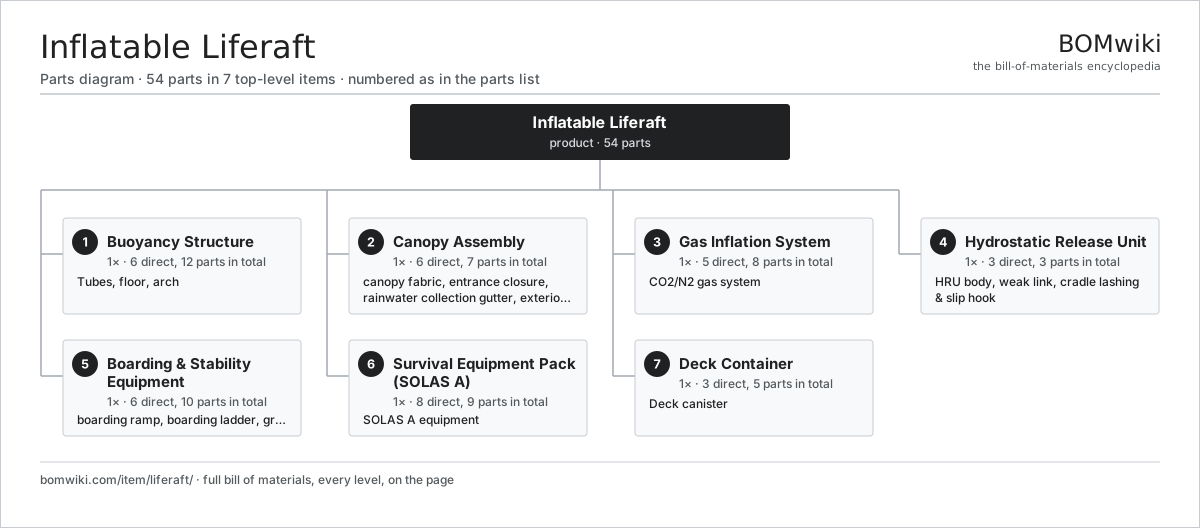
| # | Part | Qty | What it does |
|---|---|---|---|
| 1 | Buoyancy Structure 6 parts | 1× | Tubes, floor, arch |
| 2 | Canopy Assembly 6 parts | 1× | Highly visible double-skin tent over the raft that protects occupants from exposure and collects rainwater. |
| 3 | Gas Inflation System 5 parts | 1× | CO2/N2 gas system |
| 4 | Hydrostatic Release Unit 3 parts | 1× | Depth-triggered release that cuts the container lashing at 1.5–4 m submergence so the raft floats free and inflates from a sinking vessel. |
| 5 | Boarding & Stability Equipment 6 parts | 1× | Ramp, ladder, lifelines, ballast pockets, and drogue that let survivors board from the water and keep the raft upright in waves. |
| 6 | Survival Equipment Pack (SOLAS A) 8 parts | 1× | SOLAS A equipment |
| 7 | Deck Container 3 parts | 1× | Deck canister |
3D model
No 3D model yet. Have a CAD file of this? Add a 3D model. STL renders right on this page; STEP, FreeCAD, and OpenSCAD sources are welcome too (openly licensed, like all 3D models on BOMwiki).
Build & assembly graph
expand / collapse · shared sub-assemblies converge · links to related products · est. labourTap an assembly to expand/collapse · tap a part to open it · use “Open page” for any node · drag to pan, scroll to zoom.
Bill of materials for Inflatable Liferaft
7 top-level lines · 44 rows shown · 54 parts total · indented to 3 levels| # | Item / sub-assembly | Part no. | Qty/assy | Ext. qty | Parts | Type |
|---|---|---|---|---|---|---|
| 1 | Buoyancy Structure 6 parts | liferaft-buoyancy-structure | 1× | 1 | 12 | assembly |
| 1.1 | Upper Buoyancy Tube | liferaft-upper-tube | 1× | 1 | · | part |
| 1.2 | Lower Buoyancy Tube | liferaft-lower-tube | 1× | 1 | · | part |
| 1.3 | Inflatable Floor | liferaft-inflatable-floor | 1× | 1 | · | part |
| 1.4 | Canopy Arch Tube | liferaft-arch-tube | 1× | 1 | · | part |
| 1.5 | Pressure Relief Valve | liferaft-relief-valve | 4× | 4 | · | part |
| 1.6 | Topping-Up Valve | liferaft-topping-valve | 4× | 4 | · | part |
| 2 | Canopy Assembly 6 parts | liferaft-canopy | 1× | 1 | 7 | assembly |
| 2.1 | Canopy Fabric | liferaft-canopy-fabric | 1× | 1 | · | part |
| 2.2 | Entrance Closure | liferaft-entrance-closure | 2× | 2 | · | part |
| 2.3 | Rainwater Collection Gutter | liferaft-rain-collector | 1× | 1 | · | part |
| 2.4 | Exterior Locator Light | liferaft-exterior-light | 1× | 1 | · | part |
| 2.5 | Retroreflective Tape | liferaft-retroreflective-tape | 1× | 1 | · | part |
| 2.6 | Lookout / Observation Port | liferaft-lookout-port | 1× | 1 | · | part |
| 3 | Gas Inflation System 5 parts | liferaft-inflation-system | 1× | 1 | 8 | assembly |
| 3.1 | CO2/N2 Cylinder | liferaft-gas-cylinder | 1× | 1 | · | part |
| 3.2 | Operating Head | liferaft-operating-head | 1× | 1 | · | part |
| 3.3 | Inflation Hose & Non-Return Valve | liferaft-inflation-hose | 4× | 4 | · | part |
| 3.4 | Painter Line | liferaft-painter-line | 1× | 1 | · | part |
| 3.5 | Bellows Top-Up Pump | liferaft-bellows-pump | 1× | 1 | · | part |
| 4 | Hydrostatic Release Unit 3 parts | liferaft-hydrostatic-release | 1× | 1 | 3 | assembly |
| 4.1 | HRU Body | liferaft-hru-body | 1× | 1 | · | part |
| 4.2 | Weak Link | liferaft-weak-link | 1× | 1 | · | part |
| 4.3 | Cradle Lashing & Slip Hook | liferaft-lashing-strap | 1× | 1 | · | part |
| 5 | Boarding & Stability Equipment 6 parts | liferaft-boarding-stability | 1× | 1 | 10 | assembly |
| 5.1 | Boarding Ramp | liferaft-boarding-ramp | 1× | 1 | · | part |
| 5.2 | Boarding Ladder | liferaft-boarding-ladder | 1× | 1 | · | part |
| 5.3 | Grab Lifeline | liferaft-lifeline | 2× | 2 | · | part |
| 5.4 | Water Ballast Pocket | liferaft-ballast-pocket | 4× | 4 | · | part |
| 5.5 | Righting Strap | liferaft-righting-strap | 1× | 1 | · | part |
| 5.6 | Drogue (Sea Anchor) | liferaft-drogue | 1× | 1 | · | part |
| 6 | Survival Equipment Pack (SOLAS A) 8 parts | liferaft-survival-pack | 1× | 1 | 9 | assembly |
| 6.1 | Emergency Water Ration | liferaft-water-ration | 1× | 1 | · | part |
| 6.2 | Emergency Food Ration | liferaft-food-ration | 1× | 1 | · | part |
| 6.3 | Pyrotechnic Set | liferaft-pyrotechnics | 1× | 1 | · | part |
| 6.4 | First Aid Kit | liferaft-first-aid-kit | 1× | 1 | · | part |
| 6.5 | Leak Repair Kit | liferaft-repair-kit | 1× | 1 | · | part |
| 6.6 | Paddle | liferaft-paddle | 2× | 2 | · | part |
| 6.7 | Bailer & Sponges | liferaft-bailer-sponge | 1× | 1 | · | part |
| 6.8 | Signalling Kit | liferaft-signal-kit | 1× | 1 | · | part |
| 7 | Deck Container 3 parts | liferaft-container | 1× | 1 | 5 | assembly |
| 7.1 | Canister Shell Half | liferaft-canister-shell | 2× | 2 | · | part |
| 7.2 | Breaking Band | liferaft-breaking-band | 2× | 2 | · | part |
| 7.3 | Vacuum Pack Bag | liferaft-vacuum-bag | 1× | 1 | · | part |
Something wrong in this list? Report a problem with this BOM.
Sourcing: possible vendors
Browse the supplier directory → Prices, MOQ, and lead times are algorithmic estimates, not quotes, and not claims about these companies. Company mappings are curated by keyword; est. price band $2k–$500M. How estimates work| Vendor | HQ | Specialty | MOQ | Lead time |
|---|---|---|---|---|
| hd.com ↗ | Ulsan, KR | Shipbuilder | made to order | 52–104 wks |
| fincantieri.com ↗ | Trieste, IT | Shipbuilder | made to order | 52–104 wks |
| damen.com ↗ | Gorinchem, NL | Shipbuilder | made to order | 52–104 wks |
| brunswick.com ↗ | Mettawa, US | Marine & boats | made to order | 52–104 wks |
|
🇨🇳CSSC
cssc.net.cn ↗
|
Shanghai, CN | Shipbuilding conglomerate | made to order | 52–104 wks |
798-word article