Photographic Light Meter
ProductOverview
A handheld light meter measures how much light is falling on (or reflected from) a subject and converts it into camera settings. In-camera meters read only reflected light and are fooled by subjects that are themselves bright or dark, a black cat and a white wedding dress both get rendered grey. A handheld meter held at the subject with its Lumisphere facing the camera reads the incident light itself, independent of subject reflectance, which is why it remains standard equipment in studio, portrait, and cinema work.
The instrument is three stages: the Sensor Head turns photons into current, the Metering Board turns current into an exposure value, and the Display Assembly and Control Set turn that value into the shutter/aperture/ISO triplet the photographer actually dials in.
The sensor head
The receptor is a Silicon Photodiode, silicon, blue-enhanced, with photocurrent linear over more than seven decades of illuminance. Silicon's raw spectral response peaks in the near-infrared, so a Spectral Correction Filter stack reshapes it toward the eye's photopic curve; without that correction, tungsten light would read almost a stop hotter than daylight of equal visual brightness.
Over the diode sits the Lumisphere, the white hemisphere that defines incident metering. It integrates light from the entire hemisphere in front of the subject with approximately cosine weighting, the same way a three-dimensional face gathers light from key, fill, and rim sources at once. For flat originals or for measuring illuminance contrast between individual sources, the Lumisphere Slide Ring retracts the sphere so the Flat Diffuser Disc reads only light arriving on one plane. The whole head rotates about 270° on its Head Swivel Mount, so the receptor points at the camera while the display faces the user.
From photocurrent to exposure
Photocurrents span picoamperes by candlelight to microamperes in full sun. The Transimpedance Op-Amp on the metering board is a transimpedance stage with switched logarithmic ranging that compresses this 20-stop span into the input window of the Microcontroller's ADC. The microcontroller linearises, applies the photopic and lumisphere calibration constants, and produces an exposure value: EV at ISO 100, resolved to a tenth of a stop and repeatable to ±0.1 EV.
From EV, the exposure equation is solved for whichever variable the user left free. In aperture priority the Jog Dial sets f-number and the meter returns shutter time; in shutter priority the reverse; the dial also scrolls through every equivalent pair (f/8 at 1/60 ≡ f/5.6 at 1/125 …) so the photographer can trade depth of field against motion blur at a glance. ISO from 3 to 8000 enters as a simple offset. Cine modes substitute frame rate and shutter angle for shutter time.
Flash metering
Studio strobes are the second half of the job. In cord mode, a press of the Measure Button closes the Flash Sync Port circuit, a standard PC socket wired through a Wire Bundle to the board, firing the strobes, while the front end captures and integrates the millisecond-long pulse riding on the ambient level. Cordless mode instead arms the meter to wait up to about 90 seconds for a pulse triggered by hand. The display then shows the required aperture (f/1.0 to f/128 at ISO 100) plus the ambient-flash ratio in 10% steps, which is how a photographer balances strobe against window light deliberately rather than by trial frames. The Sync Terminal Cap keeps the socket clean between sessions.
Power and packaging
Everything runs from one AA Cell behind the Battery Door, held by Battery Contacts and a Coil Spring; a boost regulator gives the electronics a constant rail down to the last fraction of a volt, and auto power-off via the Power Switch stretches a single cell to roughly a year. The custom segment LCD Panel draws microamps, with the Display Backlight cutting in automatically below about EV 5, exactly the conditions in which a meter gets used most.
The Front Shell and Rear Shell close over an O-Ring Set of splash seals, with the Display Window bonded into the front and a Wrist Strap Lug for the wrist lanyard. The form factor is deliberate: gripped in one hand at arm's length with the sphere at the subject's nose, thumb on the measure button, display readable without turning the wrist.
Photographic Light Meter parts and their functions
8 top-level parts · 93 parts in total · full bill of materials below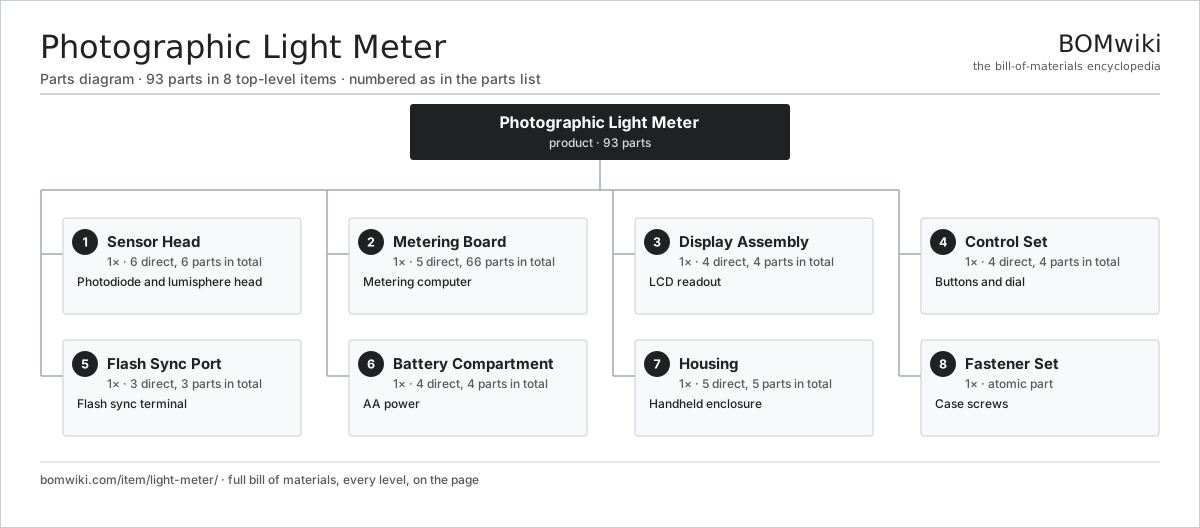
| # | Part | Qty | What it does |
|---|---|---|---|
| 1 | Sensor Head 6 parts | 1× | Photodiode and lumisphere head |
| 2 | Metering Board 5 parts | 1× | Metering computer |
| 3 | Display Assembly 4 parts | 1× | LCD readout |
| 4 | Control Set 4 parts | 1× | Buttons and dial |
| 5 | Flash Sync Port 3 parts | 1× | Flash sync terminal |
| 6 | Battery Compartment 4 parts | 1× | AA power |
| 7 | Housing 5 parts | 1× | Handheld enclosure |
| 8 | Fastener Set | 1× | Case screws |
3D model
No 3D model yet. Have a CAD file of this? Add a 3D model. STL renders right on this page; STEP, FreeCAD, and OpenSCAD sources are welcome too (openly licensed, like all 3D models on BOMwiki).
Build & assembly graph
expand / collapse · shared sub-assemblies converge · links to related products · est. labourTap an assembly to expand/collapse · tap a part to open it · use “Open page” for any node · drag to pan, scroll to zoom.
Bill of materials for Photographic Light Meter
8 top-level lines · 39 rows shown · 93 parts total · indented to 3 levels| # | Item / sub-assembly | Part no. | Qty/assy | Ext. qty | Parts | Type |
|---|---|---|---|---|---|---|
| 1 | Sensor Head 6 parts | light-meter-sensor-head | 1× | 1 | 6 | assembly |
| 1.1 | Silicon Photodiode | light-meter-photodiode | 1× | 1 | · | part |
| 1.2 | Lumisphere | light-meter-lumisphere | 1× | 1 | · | part |
| 1.3 | Lumisphere Slide Ring | light-meter-slide-ring | 1× | 1 | · | part |
| 1.4 | Flat Diffuser Disc | light-meter-flat-diffuser | 1× | 1 | · | part |
| 1.5 | Spectral Correction Filter | light-meter-filter-glass | 1× | 1 | · | part |
| 1.6 | Head Swivel Mount | light-meter-swivel-mount | 1× | 1 | · | part |
| 2 | Metering Board 5 parts | light-meter-metering-board | 1× | 1 | 66 | assembly |
| 2.1 | Bare PCB | pcb-bare | 1× | 1 | · | part |
| 2.2 | Transimpedance Op-Amp | light-meter-op-amp | 1× | 1 | · | part |
| 2.3 | Microcontroller | mcu | 1× | 1 | · | part |
| 2.4 | SMD Passive (R/C/L) | smd-passives | 60× | 60 | · | part |
| 2.5 | Connector | connector | 3× | 3 | · | part |
| 3 | Display Assembly 4 parts | light-meter-display | 1× | 1 | 4 | assembly |
| 3.1 | LCD Panel | lcd-panel | 1× | 1 | · | part |
| 3.2 | Display Backlight | light-meter-backlight | 1× | 1 | · | part |
| 3.3 | Display Window | light-meter-display-window | 1× | 1 | · | part |
| 3.4 | Connector | connector | 1× | 1 | · | part |
| 4 | Control Set 4 parts | light-meter-controls | 1× | 1 | 4 | assembly |
| 4.1 | Measure Button | light-meter-measure-button | 1× | 1 | · | part |
| 4.2 | Mode Button | light-meter-mode-button | 1× | 1 | · | part |
| 4.3 | Jog Dial | light-meter-jog-dial | 1× | 1 | · | part |
| 4.4 | Power Switch | light-meter-power-switch | 1× | 1 | · | part |
| 5 | Flash Sync Port 3 parts | light-meter-sync-port | 1× | 1 | 3 | assembly |
| 5.1 | Connector | connector | 1× | 1 | · | part |
| 5.2 | Sync Terminal Cap | light-meter-sync-cap | 1× | 1 | · | part |
| 5.3 | Wire Bundle | wire-bundle | 1× | 1 | · | part |
| 6 | Battery Compartment 4 parts | light-meter-battery-compartment | 1× | 1 | 4 | assembly |
| 6.1 | AA Cell | light-meter-aa-cell | 1× | 1 | · | part |
| 6.2 | Battery Door | light-meter-battery-door | 1× | 1 | · | part |
| 6.3 | Battery Contacts | light-meter-battery-contacts | 1× | 1 | · | part |
| 6.4 | Coil Spring | coil-spring | 1× | 1 | · | part |
| 7 | Housing 5 parts | light-meter-housing | 1× | 1 | 5 | assembly |
| 7.1 | Front Shell | light-meter-front-shell | 1× | 1 | · | part |
| 7.2 | Rear Shell | light-meter-rear-shell | 1× | 1 | · | part |
| 7.3 | Wrist Strap Lug | light-meter-strap-lug | 1× | 1 | · | part |
| 7.4 | O-Ring Set | oring-set | 1× | 1 | · | part |
| 7.5 | Fastener Set | fastener-set | 1× | 1 | · | part |
| 8 | Fastener Set | fastener-set | 1× | 1 | · | part |
Something wrong in this list? Report a problem with this BOM.
Related products
same domain, ranked by shared parts Computerized GoTo Telescope
320 parts · shares 5 with this page
Computerized GoTo Telescope
320 parts · shares 5 with this page
 DSLR Camera
553 parts · shares 5 with this page
DSLR Camera
553 parts · shares 5 with this page
 Motorized Camera Slider
41 parts · shares 5 with this page
Motorized Camera Slider
41 parts · shares 5 with this page
 Night Vision Goggles
33 parts · shares 4 with this page
Night Vision Goggles
33 parts · shares 4 with this page
 Underwater Camera Housing
118 parts · shares 4 with this page
Underwater Camera Housing
118 parts · shares 4 with this page
 Instant Camera
140 parts · shares 4 with this page
Instant Camera
140 parts · shares 4 with this page
Sourcing: possible vendors
Browse the supplier directory → Prices, MOQ, and lead times are algorithmic estimates, not quotes, and not claims about these companies. Company mappings are curated by keyword; est. price band $100–$8k. How estimates work| Vendor | HQ | Specialty | MOQ | Lead time |
|---|---|---|---|---|
|
🇯🇵Canon
canon.com ↗
|
Tokyo, JP | Imaging & optics | 500 units | 10–16 wks |
|
🇯🇵Nikon
nikon.com ↗
|
Tokyo, JP | Imaging & optics | 500 units | 10–16 wks |
|
🇩🇪ZEISS
zeiss.com ↗
|
Oberkochen, DE | Optics & optoelectronics | 500 units | 10–16 wks |
| leica-camera.com ↗ | Wetzlar, DE | Cameras & optics | 500 units | 10–16 wks |
| flir.com ↗ | Wilsonville, US | Thermal imaging | 500 units | 10–16 wks |
767-word article