Lighthouse Rotating Beacon
ProductOverview
A lighthouse identifies itself by rhythm. Every station on a coast is assigned a unique flash character, two white flashes every ten seconds, one every five, a group of three, and a navigator who times the flashes against the chart knows exactly which light is on the horizon. The rotating beacon is the machine that produces that rhythm: a fixed light source surrounded by a rotating ring of lens panels, each panel sweeping a narrow pencil beam around the horizon. An observer sees a flash each time a beam crosses their eye; the number of panels and the rotation period together fix the character.
The architecture is Augustin Fresnel's, from 1822, and it survives because it is close to optimal. Concentrating a source into a tight rotating beam yields a vastly higher peak intensity than burning the same power omnidirectionally, on the order of 100,000 to 1,000,000 cd, which is what carries the light 18–25 nautical miles to the visual horizon of a ship's bridge.
Optics
The Fresnel Lens Array is built around several Bullseye Fresnel Panel elements, concentric stepped lenses that do the work of a thick convex lens at a fraction of the glass mass. Each bullseye collimates light from the common focus into a beam of 2–5° divergence. Above and below, Catadioptric Prism Ring rows catch the steep-angle light a lens alone would waste, redirecting it by total internal reflection into the same beam; in a full classical optic these catadioptric rings captured more than half the total flux. The panels mount in a rigid Lens Frame whose register matters: every panel must aim through the exact focal point, set during commissioning with the Focus Adjustment Mount, because a source displaced even millimetres from focus visibly fattens and weakens the beam.
At the focus sits the Light Source. Modernised stations use the LED Array Module, a few dozen High-Power White LED dies drawing 60–250 W in place of the 1,000 W incandescent or metal-halide lamps of the previous generation, with a Source Heatsink holding junction temperature down. Reliability is layered rather than assumed: the Automatic Lamp Changer swings a standby source into the focus within seconds of a failure, a mechanism dating from the first unstaffed conversions and retained in LED form.
Rotation
The Rotation Drive drive must hold rotation rate within a fraction of a percent, since the rate is the character. A Servo Motor drives through a Drive Belt and reduction Helical Gear Pair to the Lens Turntable, with an Encoder closing the speed loop. The turntable rides a large Ball Bearing race; the great classical optics, weighing several tonnes, instead floated on a circular trough of mercury, which gave such low friction that a hand could turn a four-tonne lens, and many heritage stations still run their mercury floats. A Slip-Ring Assembly passes power across the rotating joint, and a flexible Drive Coupling isolates the optic from gear ripple that would otherwise flicker the beam. The whole optic stands on the Pedestal, a hollow Pedestal Column bolted and levelled at its Base Flange; levelling here puts the swept beam on the horizon, where it must stay.
Control and power
No lighthouse in most national systems has had a keeper for decades, so the Beacon Controller runs the station. Its Controller PCB closes the rotation speed loop, supervises source current, fires the changeover on lamp failure, and switches the light on the Daylight Sensor at dusk and dawn. The Remote Telemetry Modem reports rotation, light status, and battery voltage to the coastal authority's monitoring centre; a stopped optic or dark light raises an alarm and, if it cannot be remotely cleared, a Notice to Mariners.
The Power System system assumes the grid will fail. A Power Supply charger floats a 24 or 48 V 12 V Battery bank through the Charge Controller, with solar input at off-grid stations; changeover is automatic and the bank is sized for three to ten days of autonomy. The LED conversion is what made such figures practical: cutting source power by an order of magnitude shrank the battery and solar array to sizes that fit a lantern room.
Service
Maintenance visits run every six to twelve months. The optic is cleaned, since salt film on the panels measurably cuts range; the drive train is inspected and the encoder calibration checked against a stopwatch timing of the character; batteries are load-tested and the standby source exercised. A well-kept rotating beacon is a long-lived machine: many first-order lenses in service today have been turning since the nineteenth century, outlasting every generation of source, drive, and controller installed beneath them.
Lighthouse Rotating Beacon parts and their functions
8 top-level parts · 250 parts in total · full bill of materials below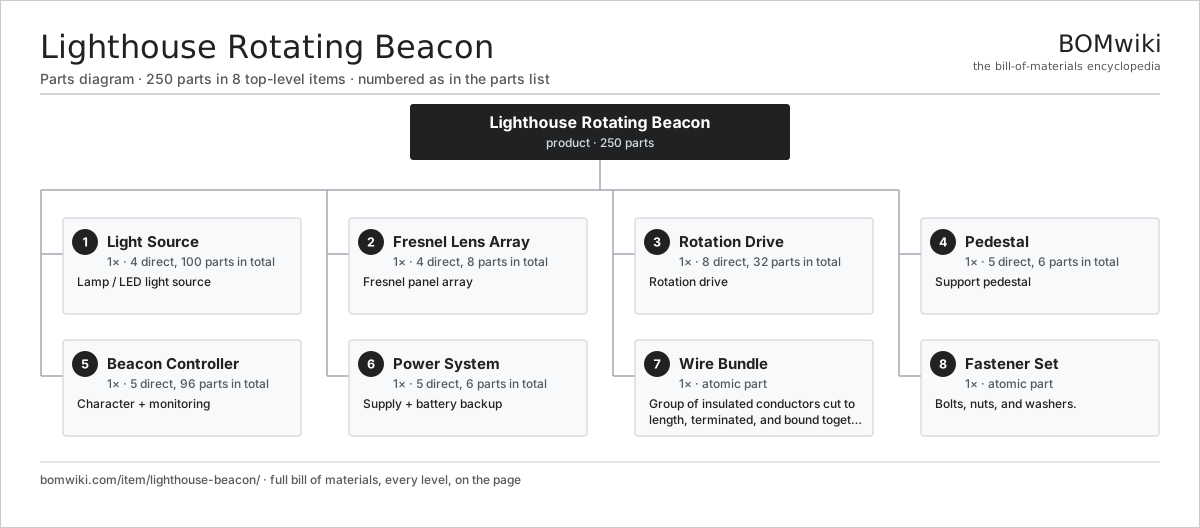
| # | Part | Qty | What it does |
|---|---|---|---|
| 1 | Light Source 4 parts | 1× | Lamp / LED light source |
| 2 | Fresnel Lens Array 4 parts | 1× | Fresnel panel array |
| 3 | Rotation Drive 8 parts | 1× | Rotation drive |
| 4 | Pedestal 5 parts | 1× | Support pedestal |
| 5 | Beacon Controller 5 parts | 1× | Character + monitoring |
| 6 | Power System 5 parts | 1× | Supply + battery backup |
| 7 | Wire Bundle | 1× | Group of insulated conductors cut to length, terminated, and bound together to carry power and signals between the assemblies of a machine. |
| 8 | Fastener Set | 1× | Bolts, nuts, and washers. |
3D model
No 3D model yet. Have a CAD file of this? Add a 3D model. STL renders right on this page; STEP, FreeCAD, and OpenSCAD sources are welcome too (openly licensed, like all 3D models on BOMwiki).
Build & assembly graph
expand / collapse · shared sub-assemblies converge · links to related products · est. labourTap an assembly to expand/collapse · tap a part to open it · use “Open page” for any node · drag to pan, scroll to zoom.
Bill of materials for Lighthouse Rotating Beacon
8 top-level lines · 51 rows shown · 250 parts total · indented to 3 levels| # | Item / sub-assembly | Part no. | Qty/assy | Ext. qty | Parts | Type |
|---|---|---|---|---|---|---|
| 1 | Light Source 4 parts | lighthouse-beacon-source | 1× | 1 | 100 | assembly |
| 1.1 | LED Array Module 3 parts | lighthouse-beacon-led-array | 1× | 1 | 97 | assembly |
| 1.1.1 | Bare PCB | pcb-bare | 1× | 1 | · | part |
| 1.1.2 | High-Power White LED | lighthouse-beacon-led-emitter | 36× | 36 | · | part |
| 1.1.3 | SMD Passive (R/C/L) | smd-passives | 60× | 60 | · | part |
| 1.2 | Automatic Lamp Changer | lighthouse-beacon-lamp-changer | 1× | 1 | · | part |
| 1.3 | Source Heatsink | lighthouse-beacon-source-heatsink | 1× | 1 | · | part |
| 1.4 | Focus Adjustment Mount | lighthouse-beacon-focus-mount | 1× | 1 | · | part |
| 2 | Fresnel Lens Array 4 parts | lighthouse-beacon-lens | 1× | 1 | 8 | assembly |
| 2.1 | Bullseye Fresnel Panel | lighthouse-beacon-bullseye-panel | 4× | 4 | · | part |
| 2.2 | Catadioptric Prism Ring | lighthouse-beacon-prism-ring | 2× | 2 | · | part |
| 2.3 | Lens Frame | lighthouse-beacon-lens-frame | 1× | 1 | · | part |
| 2.4 | Fastener Set | fastener-set | 1× | 1 | · | part |
| 3 | Rotation Drive 8 parts | lighthouse-beacon-rotation | 1× | 1 | 32 | assembly |
| 3.1 | Servo Motor 4 parts | servo-motor | 1× | 1 | 24 | assembly |
| 3.1.1 | Stator Assembly 3 parts + deeper › | stator-assembly | 1× | 1 | 3 | assembly |
| 3.1.2 | Rotor Assembly 4 parts + deeper › | rotor-assembly | 1× | 1 | 19 | assembly |
| 3.1.3 | Encoder | encoder | 1× | 1 | · | part |
| 3.1.4 | Motor Housing | motor-housing | 1× | 1 | · | part |
| 3.2 | Helical Gear Pair | gear-pair | 1× | 1 | · | part |
| 3.3 | Drive Belt | drive-belt | 1× | 1 | · | part |
| 3.4 | Encoder | encoder | 1× | 1 | · | part |
| 3.5 | Lens Turntable | lighthouse-beacon-turntable | 1× | 1 | · | part |
| 3.6 | Ball Bearing | ball-bearing | 2× | 2 | · | part |
| 3.7 | Slip-Ring Assembly | lighthouse-beacon-slip-ring | 1× | 1 | · | part |
| 3.8 | Drive Coupling | lighthouse-beacon-drive-coupling | 1× | 1 | · | part |
| 4 | Pedestal 5 parts | lighthouse-beacon-pedestal | 1× | 1 | 6 | assembly |
| 4.1 | Pedestal Column | lighthouse-beacon-column | 1× | 1 | · | part |
| 4.2 | Base Flange | lighthouse-beacon-base-flange | 1× | 1 | · | part |
| 4.3 | Access Panel | lighthouse-beacon-access-panel | 1× | 1 | · | part |
| 4.4 | Cable Gland | lighthouse-beacon-cable-gland | 2× | 2 | · | part |
| 4.5 | Fastener Set | fastener-set | 1× | 1 | · | part |
| 5 | Beacon Controller 5 parts | lighthouse-beacon-controller | 1× | 1 | 96 | assembly |
| 5.1 | Controller PCB 5 parts | lighthouse-beacon-controller-pcb | 1× | 1 | 87 | assembly |
| 5.1.1 | Bare PCB | pcb-bare | 1× | 1 | · | part |
| 5.1.2 | Microcontroller | mcu | 1× | 1 | · | part |
| 5.1.3 | SMD Passive (R/C/L) | smd-passives | 80× | 80 | · | part |
| 5.1.4 | Relay | relay | 3× | 3 | · | part |
| 5.1.5 | Power MOSFET | mosfet | 2× | 2 | · | part |
| 5.2 | Daylight Sensor | lighthouse-beacon-daylight-sensor | 1× | 1 | · | part |
| 5.3 | Remote Telemetry Modem | lighthouse-beacon-remote-modem | 1× | 1 | · | part |
| 5.4 | LCD Panel | lcd-panel | 1× | 1 | · | part |
| 5.5 | Connector | connector | 6× | 6 | · | part |
| 6 | Power System 5 parts | lighthouse-beacon-power | 1× | 1 | 6 | assembly |
| 6.1 | Power Supply | power-supply | 1× | 1 | · | part |
| 6.2 | 12 V Battery | lv-battery | 2× | 2 | · | part |
| 6.3 | Charge Controller | lighthouse-beacon-charge-controller | 1× | 1 | · | part |
| 6.4 | Relay | relay | 1× | 1 | · | part |
| 6.5 | Wire Bundle | wire-bundle | 1× | 1 | · | part |
| 7 | Wire Bundle | wire-bundle | 1× | 1 | · | part |
| 8 | Fastener Set | fastener-set | 1× | 1 | · | part |
Something wrong in this list? Report a problem with this BOM.
Related products
same domain, ranked by shared parts Moving Head Stage Light
478 parts · shares 15 with this page
Moving Head Stage Light
478 parts · shares 15 with this page
 Mobile Light Tower
194 parts · shares 13 with this page
Mobile Light Tower
194 parts · shares 13 with this page
 LED Grow Light
369 parts · shares 11 with this page
LED Grow Light
369 parts · shares 11 with this page
 Studio Strobe Light
48 parts · shares 4 with this page
Studio Strobe Light
48 parts · shares 4 with this page
Sourcing: possible vendors
Browse the supplier directory → Prices, MOQ, and lead times are algorithmic estimates, not quotes, and not claims about these companies. Company mappings are curated by keyword; est. price band $3–$2k. How estimates work| Vendor | HQ | Specialty | MOQ | Lead time |
|---|---|---|---|---|
|
🇳🇱Signify
signify.com ↗
|
Eindhoven, NL | Lighting (Philips Hue) | 2,000 units | 6–10 wks |
| acuitybrands.com ↗ | Atlanta, US | Lighting & controls | 2,000 units | 6–10 wks |
|
🇦🇹Zumtobel
zumtobelgroup.com ↗
|
Dornbirn, AT | Lighting | 2,000 units | 6–10 wks |
| creelighting.com ↗ | Racine, US | LED lighting | 2,000 units | 6–10 wks |
|
🇮🇳Havells
havells.com ↗
|
Noida, IN | Electrical & lighting | 2,000 units | 6–10 wks |
815-word article