Liquid Rocket Engine
ProductOverview
A liquid rocket engine converts the chemical energy of liquid propellants into directed kinetic energy at power densities no other machine approaches: the engine described here releases roughly 2.5 GW of thermal power from a package the size of a small car. It burns liquid oxygen and kerosene at about 10 MPa in a regeneratively cooled Thrust Chamber Assembly, fed by a Turbopump Assembly driven on the gas-generator cycle, producing ~850 kN at sea level, the class of engine that powers most first stages flying today.
The gas-generator cycle is the pragmatic choice among engine cycles: a small fraction of propellant burns in the Gas Generator to drive the turbine, and its exhaust is dumped overboard rather than recovered. That open cycle costs a few seconds of specific impulse against staged combustion but keeps the turbine environment benign and the engine simple enough to develop, throttle, and manufacture at scale.
Propellant path
Propellants arrive from the vehicle tanks at a few hundred kPa, far too low to enter a 10 MPa chamber. The Turbopump Assembly does the work: a single shaft carrying the LOX Pump and Fuel Pump centrifugal stages, spun at ~18,000 rpm by a two-stage impulse Turbine extracting about 25 MW from fuel-rich generator gas. An Inducer ahead of each impeller suppresses cavitation at low inlet pressure, and the Shaft Seal Package, a purged stack of seals between the pumps, guarantees that oxygen and kerosene never meet along the shaft, a failure that destroys the engine in milliseconds.
The fuel takes the long way to the chamber. From the pump it enters the Coolant Manifold at the nozzle and flows up through hundreds of milled channels in the Chamber Liner, holding the copper-alloy wall near 600 K against 3,600 K combustion gas before arriving, preheated, at the injector. This regenerative cooling is what makes a reusable steady-state chamber possible at all: the propellant itself is the heat sink, and the absorbed energy returns to the cycle instead of being lost.
Combustion
The Injector Head meters, atomizes, and mixes ~300 kg/s of propellant through about 280 coaxial-swirl Injector Element units, each sheeting LOX inside a swirling kerosene film. Injector design is the hardest empirical art in the engine because of combustion instability: acoustic modes of the chamber can couple to heat release and grow until they destroy the engine in fractions of a second. The defenses are geometric, the radial Injector Baffle Set on the faceplate breaks up tangential modes, and the Acoustic Cavity Ring ring at the chamber rim absorbs energy at the dangerous frequencies, both tuned during hot-fire development.
Ignition is hypergolic: the Hypergol Cartridge releases a slug of TEA-TEB that bursts into flame on contact with oxygen, confirmed by the Ignition Monitor before the main valves commit full flow. The start sequence, spin the pump with the GG Igniter-lit gas generator, light the chamber, ramp the Main Fuel Valve, is choreographed by the Engine Control Unit with millisecond timing, because a wrong-order start floods the chamber with unburned propellant (a "hard start" that can detonate).
Control and steering
Thrust is set by turbine power: the GG Valve Pair trims gas-generator flow, which sets pump speed, which sets chamber pressure, allowing throttle between roughly 70% and 100%. Red-line monitoring through the Engine Sensor Suite, chamber pressure, turbine speed, bearing temperatures, gives the dual-channel controller authority to shut the engine down faster than a failure can propagate.
The whole engine vectors on the Gimbal Block, a cross-axis bearing passing the full 850 kN to the vehicle while two Hydraulic Actuator units steer ±8° in pitch and yaw; the Flex Line Set lets the propellant feedlines follow the motion. Steering the thrust vector is the rocket's only meaningful control authority through first-stage flight, so actuator commands close the loop with the vehicle flight computer through the Servo Valve at tens of hertz.
At shutdown, the Purge Valve Set floods the manifolds with helium, sweeping residual propellant overboard through the Drain Line Network so nothing is left to burn where it should not. A first-stage engine of this class runs about 160 seconds per flight; reusable variants accumulate dozens of starts between overhauls, with turbopump bearings and the chamber liner as the life-limiting items.
Liquid Rocket Engine parts and their functions
8 top-level parts · 392 parts in total · full bill of materials below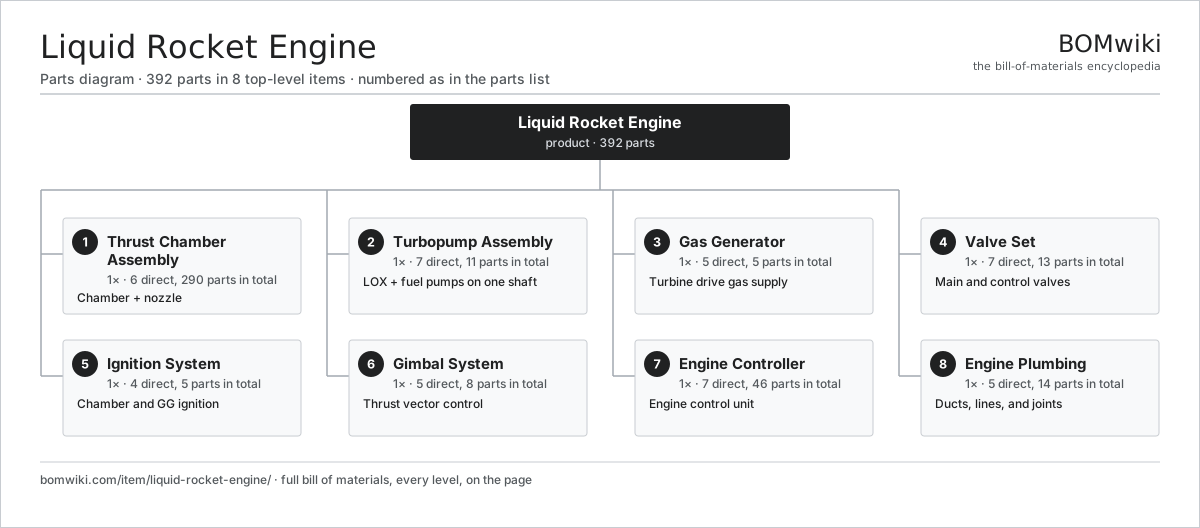
| # | Part | Qty | What it does |
|---|---|---|---|
| 1 | Thrust Chamber Assembly 6 parts | 1× | Chamber + nozzle |
| 2 | Turbopump Assembly 7 parts | 1× | LOX + fuel pumps on one shaft |
| 3 | Gas Generator 5 parts | 1× | Turbine drive gas supply |
| 4 | Valve Set 7 parts | 1× | Main and control valves |
| 5 | Ignition System 4 parts | 1× | Chamber and GG ignition |
| 6 | Gimbal System 5 parts | 1× | Thrust vector control |
| 7 | Engine Controller 7 parts | 1× | Engine control unit |
| 8 | Engine Plumbing 5 parts | 1× | Ducts, lines, and joints |
3D model
No 3D model yet. Have a CAD file of this? Add a 3D model. STL renders right on this page; STEP, FreeCAD, and OpenSCAD sources are welcome too (openly licensed, like all 3D models on BOMwiki).
Build & assembly graph
expand / collapse · shared sub-assemblies converge · links to related products · est. labourTap an assembly to expand/collapse · tap a part to open it · use “Open page” for any node · drag to pan, scroll to zoom.
Bill of materials for Liquid Rocket Engine
8 top-level lines · 59 rows shown · 392 parts total · indented to 3 levels| # | Item / sub-assembly | Part no. | Qty/assy | Ext. qty | Parts | Type |
|---|---|---|---|---|---|---|
| 1 | Thrust Chamber Assembly 6 parts | liquid-rocket-engine-thrust-chamber | 1× | 1 | 290 | assembly |
| 1.1 | Injector Head 5 parts | liquid-rocket-engine-injector | 1× | 1 | 284 | assembly |
| 1.1.1 | Injector Element | liquid-rocket-engine-injector-element | 280× | 280 | · | part |
| 1.1.2 | Injector Faceplate | liquid-rocket-engine-injector-faceplate | 1× | 1 | · | part |
| 1.1.3 | LOX Dome | liquid-rocket-engine-lox-dome | 1× | 1 | · | part |
| 1.1.4 | Fuel Manifold Ring | liquid-rocket-engine-fuel-manifold-ring | 1× | 1 | · | part |
| 1.1.5 | Injector Baffle Set | liquid-rocket-engine-baffle-set | 1× | 1 | · | part |
| 1.2 | Chamber Liner | liquid-rocket-engine-chamber-liner | 1× | 1 | · | part |
| 1.3 | Chamber Jacket | liquid-rocket-engine-chamber-jacket | 1× | 1 | · | part |
| 1.4 | Nozzle Extension | liquid-rocket-engine-nozzle-extension | 1× | 1 | · | part |
| 1.5 | Coolant Manifold | liquid-rocket-engine-coolant-manifold | 2× | 2 | · | part |
| 1.6 | Acoustic Cavity Ring | liquid-rocket-engine-acoustic-cavity | 1× | 1 | · | part |
| 2 | Turbopump Assembly 7 parts | liquid-rocket-engine-turbopump | 1× | 1 | 11 | assembly |
| 2.1 | LOX Pump | liquid-rocket-engine-lox-pump | 1× | 1 | · | part |
| 2.2 | Fuel Pump | liquid-rocket-engine-fuel-pump | 1× | 1 | · | part |
| 2.3 | Turbine | liquid-rocket-engine-turbine | 1× | 1 | · | part |
| 2.4 | Inducer | liquid-rocket-engine-inducer | 2× | 2 | · | part |
| 2.5 | Shaft Seal Package | liquid-rocket-engine-shaft-seal-pack | 1× | 1 | · | part |
| 2.6 | Ball Bearing | ball-bearing | 4× | 4 | · | part |
| 2.7 | Pump Housing | liquid-rocket-engine-pump-housing | 1× | 1 | · | part |
| 3 | Gas Generator 5 parts | liquid-rocket-engine-gas-generator | 1× | 1 | 5 | assembly |
| 3.1 | GG Injector | liquid-rocket-engine-gg-injector | 1× | 1 | · | part |
| 3.2 | GG Chamber | liquid-rocket-engine-gg-chamber | 1× | 1 | · | part |
| 3.3 | GG Igniter | liquid-rocket-engine-gg-igniter | 1× | 1 | · | part |
| 3.4 | Hot Gas Duct | liquid-rocket-engine-hot-gas-duct | 1× | 1 | · | part |
| 3.5 | Turbine Exhaust Duct | liquid-rocket-engine-turbine-exhaust | 1× | 1 | · | part |
| 4 | Valve Set 7 parts | liquid-rocket-engine-valve-set | 1× | 1 | 13 | assembly |
| 4.1 | Main LOX Valve | liquid-rocket-engine-main-lox-valve | 1× | 1 | · | part |
| 4.2 | Main Fuel Valve | liquid-rocket-engine-main-fuel-valve | 1× | 1 | · | part |
| 4.3 | GG Valve Pair | liquid-rocket-engine-gg-valve-pair | 1× | 1 | · | part |
| 4.4 | Purge Valve Set | liquid-rocket-engine-purge-valve-set | 1× | 1 | · | part |
| 4.5 | Pneumatic Pack | liquid-rocket-engine-pneumatic-pack | 1× | 1 | · | part |
| 4.6 | O-Ring Set | oring-set | 2× | 2 | · | part |
| 4.7 | Pressure Sensor | pressure-sensor | 6× | 6 | · | part |
| 5 | Ignition System 4 parts | liquid-rocket-engine-ignition-system | 1× | 1 | 5 | assembly |
| 5.1 | Hypergol Cartridge | liquid-rocket-engine-hypergol-cartridge | 1× | 1 | · | part |
| 5.2 | Ignition Monitor | liquid-rocket-engine-ignition-monitor | 1× | 1 | · | part |
| 5.3 | Ignition Harness | liquid-rocket-engine-ignition-harness | 1× | 1 | · | part |
| 5.4 | Relay | relay | 2× | 2 | · | part |
| 6 | Gimbal System 5 parts | liquid-rocket-engine-gimbal-system | 1× | 1 | 8 | assembly |
| 6.1 | Gimbal Block | liquid-rocket-engine-gimbal-block | 1× | 1 | · | part |
| 6.2 | Hydraulic Actuator | liquid-rocket-engine-hydraulic-actuator | 2× | 2 | · | part |
| 6.3 | Flex Line Set | liquid-rocket-engine-flex-line-set | 1× | 1 | · | part |
| 6.4 | Servo Valve | liquid-rocket-engine-actuator-servo-valve | 2× | 2 | · | part |
| 6.5 | Encoder | encoder | 2× | 2 | · | part |
| 7 | Engine Controller 7 parts | liquid-rocket-engine-controller | 1× | 1 | 46 | assembly |
| 7.1 | Engine Control Unit | liquid-rocket-engine-ecu | 2× | 2 | · | part |
| 7.2 | Engine Sensor Suite | liquid-rocket-engine-sensor-suite | 1× | 1 | · | part |
| 7.3 | Bare PCB | pcb-bare | 4× | 4 | · | part |
| 7.4 | Microcontroller | mcu | 2× | 2 | · | part |
| 7.5 | SMD Passive (R/C/L) | smd-passives | 1× | 1 | · | part |
| 7.6 | Wire Bundle | wire-bundle | 6× | 6 | · | part |
| 7.7 | Connector | connector | 30× | 30 | · | part |
| 8 | Engine Plumbing 5 parts | liquid-rocket-engine-plumbing | 1× | 1 | 14 | assembly |
| 8.1 | High-Pressure Duct Set | liquid-rocket-engine-hp-duct-set | 1× | 1 | · | part |
| 8.2 | Bellows Joint | liquid-rocket-engine-bellows-joint | 6× | 6 | · | part |
| 8.3 | Drain Line Network | liquid-rocket-engine-drain-lines | 1× | 1 | · | part |
| 8.4 | Fastener Set | fastener-set | 3× | 3 | · | part |
| 8.5 | O-Ring Set | oring-set | 3× | 3 | · | part |
Something wrong in this list? Report a problem with this BOM.
Related products
same domain, ranked by shared parts Cargo Resupply Spacecraft
574 parts · shares 3 with this page
Cargo Resupply Spacecraft
574 parts · shares 3 with this page
 Crewed Space Capsule
7,222 parts · shares 3 with this page
Crewed Space Capsule
7,222 parts · shares 3 with this page
 GPS Navigation Satellite
2,640 parts · shares 3 with this page
GPS Navigation Satellite
2,640 parts · shares 3 with this page
 Lunar Lander
1,803 parts · shares 3 with this page
Lunar Lander
1,803 parts · shares 3 with this page
 Rocket Upper Stage
1,459 parts · shares 3 with this page
Rocket Upper Stage
1,459 parts · shares 3 with this page
 Space Station Module
700 parts · shares 3 with this page
Space Station Module
700 parts · shares 3 with this page
Sourcing: possible vendors
Browse the supplier directory → Prices, MOQ, and lead times are algorithmic estimates, not quotes, and not claims about these companies. Company mappings are curated by keyword; est. price band $50k–$500M. How estimates work| Vendor | HQ | Specialty | MOQ | Lead time |
|---|---|---|---|---|
|
🇺🇸SpaceX
spacex.com ↗
|
Hawthorne, US | Launch & spacecraft | made to order | 52–104 wks |
| northropgrumman.com ↗ | Falls Church, US | Space & defense | made to order | 52–104 wks |
|
🇫🇷Airbus
airbus.com ↗
|
Toulouse, FR | Aerospace OEM | made to order | 52–104 wks |
| rocketlabusa.com ↗ | Long Beach, US | Launch & spacecraft | made to order | 52–104 wks |
| thalesaleniaspace.com ↗ | Cannes, FR | Satellites | made to order | 52–104 wks |
803-word article