Live Bait Vending Machine
ProductOverview
A live bait vending machine is an automated kiosk that stores live fish, worms, insects, and crustaceans in temperature and oxygen-controlled compartments, allowing anglers and fishermen to purchase fresh bait 24/7 without visiting a tackle shop. The machine maintains each species in its own refrigerated bin (8–12 °C), continuously aerates the water, filters out waste products, and dispenses a metered weight into a customer's cup via solenoid valve control.
The Main Cabinet Structure contains eight independent compartments, each a 50 L tank holding minnows, worms, shrimp, crickets, or other live baits. The Chiller System system maintains 8–12 °C, slowing fish metabolism and extending survivorship (fish at higher temperatures consume more oxygen and metabolize food faster, producing ammonia toxicity). The Aeration System system circulates compressed air into bubble stones in each tank, providing dissolved oxygen (O₂) that enables fish respiration. A Water Filtration & Conditioning continuously circulates water through charcoal and mechanical filters, removing ammonia (toxic metabolic waste), excess food particles, and chlorine (if refilled from tap water). A customer navigates the Customer Selection & Payment (touchscreen showing species, live inventory counts, and price per ounce), selects a species and desired weight, makes payment via Payment Reader, and a solenoid valve opens, dispensing live bait into a cup. A Weight Measurement Scale measures the weight in real time; once the target weight is reached, the valve closes. The filled cup drops into a collection tray for pickup.
These machines are deployed at fishing piers, marinas, bait-and-tackle shops, convenience stores, and boat launch facilities. The principal challenge is maintaining fish health (oxygen, ammonia control, temperature stability) in a fully automated unattended environment, preventing disease outbreaks, and managing the complexity of multiple live-stock compartments.
How it works
The Main Cabinet Structure houses eight independent tanks, each isolated from the others by stainless steel partition walls. Each tank is a 50 L polycarbonate or stainless container with a drain plug at the bottom. The tanks are open at the top (or have a removable lid) for daily bait restocking by the operator. Each tank sits above the others in a stacked vertical arrangement, with space between tanks for plumbing and sensor access.
The Chiller System system is a sealed vapor-compression cycle. A 1 kW hermetic compressor pressurizes R134a refrigerant. The high-pressure liquid cools via an evaporator coil submerged in a central water circulation loop (not directly in the bait tanks, but in a dedicated chiller). A circulating Water Circulation Pump (24 V DC, 10–15 L/min) draws cold water from the chiller, distributes it through flexible tubing into each tank (via a distribution header), allowing it to cool the tank water via conduction, then returns the warmed water to the chiller. A Temperature Control Board, a PID loop with an RTD sensor in the main chiller reservoir, maintains 8–12 °C (user-selectable per species). When water temperature rises above the setpoint (e.g., 12 °C), the controller energizes the compressor. When temperature falls below the setpoint minus 2 °C (hysteresis), the compressor de-energizes. This prevents compressor short-cycling.
The Aeration System system provides dissolved oxygen critical for fish respiration. A 24 V DC diaphragm air pump (20 L/min delivery at 1 psi back-pressure) draws ambient air, pressurizes it slightly, and delivers it through tubing to a brass Air Distribution Manifold with eight outlet ports (one per tank). Each outlet connects to a Bubble Stone Aerator, a ceramic diffuser submerged in the tank. As air bubbles rise through the water, gas exchange occurs at the bubble interface: O₂ dissolves into the water, and CO₂ escapes. A One-Way Check Valve (flapper type) at the pump outlet prevents backflow when the pump is idle or during power loss. The pump is cycled on a timer: 5 minutes on, 2 minutes off, repeating. This intermittent aeration conserves power while maintaining adequate O₂ (most fresh and saltwater baits tolerate brief anoxic periods without mortality).
Water quality is maintained by the Water Filtration & Conditioning. Fish excrete ammonia (NH₃) and urine; excess food decays into ammonia and nitrite. Both are toxic at concentrations above 0.5 ppm. The system includes a circulation pump and two-stage filtration: a 20 micron pleated cartridge (mechanical filter catching fish waste, food particles, dead algae) and an activated charcoal stage (removing chlorine from tap water top-ups and absorbing some organic compounds and odours). The Water Circulation Pump runs continuously (or on a timer: 15 minutes every 2 hours), recirculating water through the filter cartridge and back into the tanks. A pH Sensor Probe, a continuous pH sensor probe in the main loop, logs pH (target 6.5–7.5). The Master Control PLC alert the operator if pH drifts outside range (indicating ammonia accumulation or bacterial activity changes), signalling the need for a 50% water change.
When a customer selects a species and weight via the Customer Selection & Payment (touchscreen showing available species and inventory counts), the Master Control PLC confirm payment via the Payment Reader. Once payment is authorized, the control board energizes the solenoid valve for the selected tank (one of eight Solenoid Dispensing Valves, a 2-way diaphragm valve rated for 5 L/min). The valve opens, allowing water and live bait to flow down a smooth polycarbonate Bait Chute into a waiting cup positioned on the Weight Measurement Scale.
The scale, based on a strain-gauge Strain Gauge Load Cell (5 kg max capacity, ±0.1 oz resolution), continuously measures the cup's weight. The Master Control PLC read the load cell voltage and compute the live bait weight (cup tare weight minus full cup weight equals bait weight). As the cup fills, the measured weight increases. When the weight reaches the customer's target (e.g., 4 ounces), the Master Control PLC de-energize the solenoid valve, stopping flow. The cup, now filled with live bait in water (or damp media for worms), drops into a collection tray. The customer retrieves the cup and leaves.
Between each order, a brief rinse may be triggered: the valve is pulsed open for 1 second to clear the chute of stray bait or debris, preventing clogging. Every 7 days, the operator performs a 50% water change in each tank (draining via the tank drain plug, refilling with treated tap water and the Activated Charcoal Filter removing chlorine). The filter cartridges are replaced monthly or when flow rate visibly decreases.
The Master Control PLC, an industrial PLC with an ARM Cortex-M0 MCU, orchestrates all operations: refrigeration thermostat feedback, aeration pump timer, circulation pump timer, pH and water-level sensor monitoring, solenoid valve activation, load cell signal processing, and payment validation. The control board also logs temperature, aeration events, and valve activation times for remote monitoring (WiFi or cellular upload to a cloud platform for operator alerts if temperature drifts or a tank's bait dies).
Power is supplied by a 1.2 kW industrial switched-mode power supply converting 240 V AC single-phase to 24 V DC (controls, solenoids, sensors) and 12 V DC (pump motors). Peak draw (refrigeration compressor + circulation pump + air pump simultaneously active) is ~900 W. A 10 A thermal breaker protects the mains input.
Health and safety considerations: the machine must not dispense bait that shows signs of disease (fungal spots, torn fins, lethargic behavior). The operator visually inspects tanks daily. If mortality is detected, the affected tank is quarantined and the water changed entirely. The aeration timer and water temperature are logged to a cloud platform; if temperature rises above 15 °C (compressor failure indicator), an SMS alert is sent immediately. Storage of dead specimens is not permitted; all bait must be consumed by the customer or humanely euthanized by the operator.
Live Bait Vending Machine parts and their functions
10 top-level parts · 407 parts in total · full bill of materials below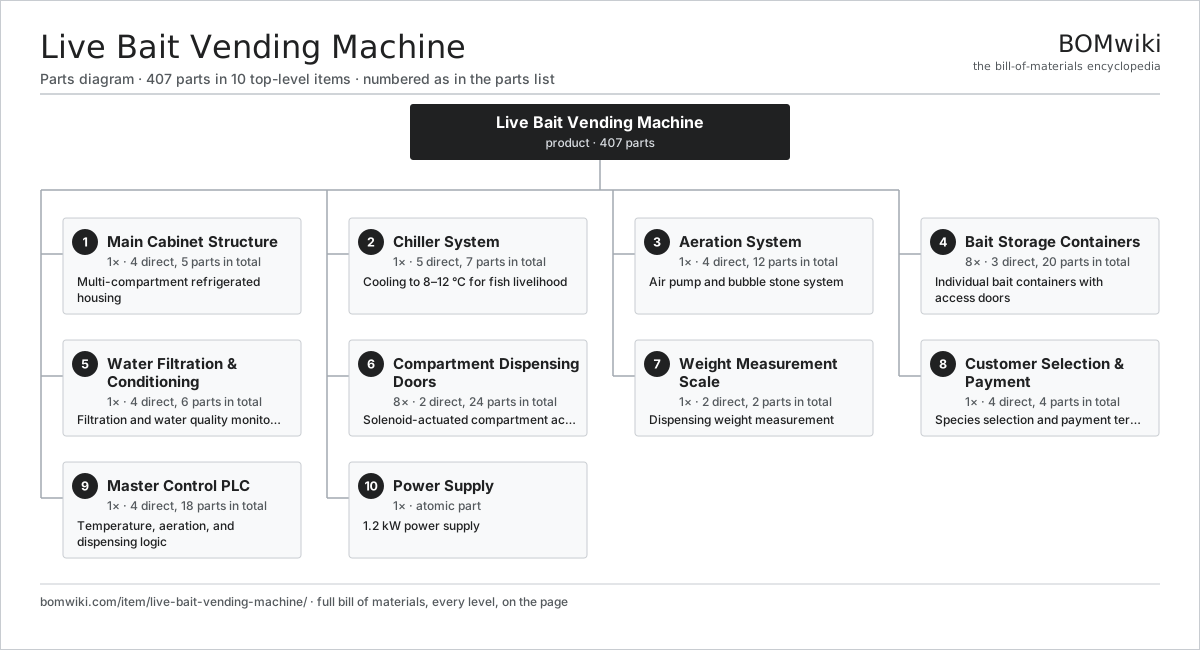
| # | Part | Qty | What it does |
|---|---|---|---|
| 1 | Main Cabinet Structure 4 parts | 1× | Multi-compartment refrigerated housing |
| 2 | Chiller System 5 parts | 1× | Cooling to 8–12 °C for fish livelihood |
| 3 | Aeration System 4 parts | 1× | Air pump and bubble stone system |
| 4 | Bait Storage Containers 3 parts | 8× | Individual bait containers with access doors |
| 5 | Water Filtration & Conditioning 4 parts | 1× | Filtration and water quality monitoring |
| 6 | Compartment Dispensing Doors 2 parts | 8× | Solenoid-actuated compartment access |
| 7 | Weight Measurement Scale 2 parts | 1× | Dispensing weight measurement |
| 8 | Customer Selection & Payment 4 parts | 1× | Species selection and payment terminal |
| 9 | Master Control PLC 4 parts | 1× | Temperature, aeration, and dispensing logic |
| 10 | Power Supply | 1× | 1.2 kW power supply |
3D model
No 3D model yet. Have a CAD file of this? Add a 3D model. STL renders right on this page; STEP, FreeCAD, and OpenSCAD sources are welcome too (openly licensed, like all 3D models on BOMwiki).
Build & assembly graph
expand / collapse · shared sub-assemblies converge · links to related products · est. labourTap an assembly to expand/collapse · tap a part to open it · use “Open page” for any node · drag to pan, scroll to zoom.
Bill of materials for Live Bait Vending Machine
10 top-level lines · 51 rows shown · 407 parts total · indented to 3 levels| # | Item / sub-assembly | Part no. | Qty/assy | Ext. qty | Parts | Type |
|---|---|---|---|---|---|---|
| 1 | Main Cabinet Structure 4 parts | live-bait-vending-machine-cabinet | 1× | 1 | 5 | assembly |
| 1.1 | Stainless Frame | live-bait-vending-machine-frame | 1× | 1 | · | part |
| 1.2 | Cabinet Side Panel | live-bait-vending-machine-side-panel | 2× | 2 | · | part |
| 1.3 | Thermal Insulation | live-bait-vending-machine-insulation | 1× | 1 | · | part |
| 1.4 | Drain Collection Tray | live-bait-vending-machine-drain-tray | 1× | 1 | · | part |
| 2 | Chiller System 5 parts | live-bait-vending-machine-refrigeration | 1× | 1 | 7 | assembly |
| 2.1 | Hermetic Compressor | live-bait-vending-machine-compressor | 1× | 1 | · | part |
| 2.2 | Condenser Coil | live-bait-vending-machine-condenser | 1× | 1 | · | part |
| 2.3 | Evaporator Coil | live-bait-vending-machine-evaporator | 1× | 1 | · | part |
| 2.4 | Expansion Valve | live-bait-vending-machine-expansion-valve | 1× | 1 | · | part |
| 2.5 | Temperature Control Board 3 parts | live-bait-vending-machine-thermostat-controller | 1× | 1 | 3 | assembly |
| 2.5.1 | Bare PCB | pcb-bare | 1× | 1 | · | part |
| 2.5.2 | Microcontroller | mcu | 1× | 1 | · | part |
| 2.5.3 | Relay | relay | 1× | 1 | · | part |
| 3 | Aeration System 4 parts | live-bait-vending-machine-aeration | 1× | 1 | 12 | assembly |
| 3.1 | Diaphragm Air Pump 2 parts | live-bait-vending-machine-air-pump | 1× | 1 | 2 | assembly |
| 3.1.1 | Motor Housing | motor-housing | 1× | 1 | · | part |
| 3.1.2 | Connector | connector | 1× | 1 | · | part |
| 3.2 | Air Distribution Manifold | live-bait-vending-machine-manifold | 1× | 1 | · | part |
| 3.3 | Bubble Stone Aerator | live-bait-vending-machine-bubble-stone | 8× | 8 | · | part |
| 3.4 | One-Way Check Valve | live-bait-vending-machine-check-valve | 1× | 1 | · | part |
| 4 | Bait Storage Containers 3 parts | live-bait-vending-machine-compartments | 8× | 8 | 20 | assembly |
| 4.1 | Individual Bait Compartment | live-bait-vending-machine-container | 8× | 64 | · | part |
| 4.2 | Internal Divider | live-bait-vending-machine-partition-wall | 4× | 32 | · | part |
| 4.3 | Water Level Probe | live-bait-vending-machine-water-level-sensor | 8× | 64 | · | part |
| 5 | Water Filtration & Conditioning 4 parts | live-bait-vending-machine-water-system | 1× | 1 | 6 | assembly |
| 5.1 | Water Circulation Pump 2 parts | live-bait-vending-machine-circulation-pump | 1× | 1 | 3 | assembly |
| 5.1.1 | Motor Housing | motor-housing | 1× | 1 | · | part |
| 5.1.2 | Ball Bearing | ball-bearing | 2× | 2 | · | part |
| 5.2 | Mechanical Filter Cartridge | live-bait-vending-machine-filter-cartridge | 1× | 1 | · | part |
| 5.3 | Activated Charcoal Filter | live-bait-vending-machine-charcoal-filter | 1× | 1 | · | part |
| 5.4 | pH Sensor Probe | live-bait-vending-machine-ph-monitor | 1× | 1 | · | part |
| 6 | Compartment Dispensing Doors 2 parts | live-bait-vending-machine-dispensing-doors | 8× | 8 | 24 | assembly |
| 6.1 | Solenoid Dispensing Valve 2 parts | live-bait-vending-machine-door-valve | 8× | 64 | 2 | assembly |
| 6.1.1 | Relay | relay | 1× | 64 | · | part |
| 6.1.2 | Connector | connector | 1× | 64 | · | part |
| 6.2 | Bait Chute | live-bait-vending-machine-door-chute | 8× | 64 | · | part |
| 7 | Weight Measurement Scale 2 parts | live-bait-vending-machine-weigh-scale | 1× | 1 | 2 | assembly |
| 7.1 | Strain Gauge Load Cell | live-bait-vending-machine-load-cell | 1× | 1 | · | part |
| 7.2 | Weight Display Panel | live-bait-vending-machine-display-module | 1× | 1 | · | part |
| 8 | Customer Selection & Payment 4 parts | live-bait-vending-machine-ui | 1× | 1 | 4 | assembly |
| 8.1 | 5 inch Touchscreen | live-bait-vending-machine-display | 1× | 1 | · | part |
| 8.2 | LCD Panel | lcd-panel | 1× | 1 | · | part |
| 8.3 | Touch Digitizer | touch-digitizer | 1× | 1 | · | part |
| 8.4 | Payment Reader | live-bait-vending-machine-payment-terminal | 1× | 1 | · | part |
| 9 | Master Control PLC 4 parts | live-bait-vending-machine-controls | 1× | 1 | 18 | assembly |
| 9.1 | Bare PCB | pcb-bare | 1× | 1 | · | part |
| 9.2 | Microcontroller | mcu | 1× | 1 | · | part |
| 9.3 | Relay | relay | 6× | 6 | · | part |
| 9.4 | Connector | connector | 10× | 10 | · | part |
| 10 | Power Supply | power-supply | 1× | 1 | · | part |
Something wrong in this list? Report a problem with this BOM.
Related products
same domain, ranked by shared parts Book Vending Machine
108 parts · shares 3 with this page
Disc Rental Kiosk
272 parts · shares 3 with this page
Flower Vending Machine
103 parts · shares 3 with this page
Book Vending Machine
108 parts · shares 3 with this page
Disc Rental Kiosk
272 parts · shares 3 with this page
Flower Vending Machine
103 parts · shares 3 with this page
 French Fry Vending Machine
65 parts · shares 3 with this page
French Fry Vending Machine
65 parts · shares 3 with this page
 Fresh Juice Vending Machine
73 parts · shares 3 with this page
Fresh Juice Vending Machine
73 parts · shares 3 with this page
 Hot Ramen Vending Machine
101 parts · shares 3 with this page
Hot Ramen Vending Machine
101 parts · shares 3 with this page
Sourcing: possible vendors
Browse the supplier directory → Prices, MOQ, and lead times are algorithmic estimates, not quotes, and not claims about these companies. Company mappings are curated by keyword; est. price band $1k–$30k. How estimates work| Vendor | HQ | Specialty | MOQ | Lead time |
|---|---|---|---|---|
| cranems.com ↗ | Williston, US | Vending machines | 50 units | 10–16 wks |
|
🇪🇸Azkoyen
azkoyen.com ↗
|
Peralta, ES | Vending & payment | 50 units | 10–16 wks |
| fujielectric.com ↗ | Tokyo, JP | Vending & power electronics | 50 units | 10–16 wks |
| sanden-rs.com ↗ | Isesaki, JP | Vending & retail systems | 50 units | 10–16 wks |
| tcnvend.com ↗ | Changsha, CN | Vending machines | 50 units | 10–16 wks |
1,373-word article