Livestock Monitoring Collar
ProductOverview
A Livestock Monitoring Collar is a wearable activity sensor that uses an accelerometer to detect jaw motion (rumination) and body motion (standing, walking, lying, activity). Changes in these patterns precede visible illness by 12-48 hours, making the collar a canary in the coal mine for early disease detection in dairy herds. When a cow stops eating (illness, pain, or stress), her chewing frequency and rumination time drop measurably. A spike in activity (restlessness, head tossing) can signal heat, aggression, or estrus. By continuously monitoring these metrics and sending alerts to the farmer's smartphone, the collar turns invisible health problems into actionable intelligence before the cow shows clinical signs.
The technology is relatively new (widespread adoption since ~2015) but proven. Major studies from veterinary schools show:
- Estrus detection: 70-95 % accuracy (competitive with tail painting or visual observation).
- Mastitis early warning: 40-60 % of cases detected 24+ hours before visual signs.
- Metritis and ketosis: Detectable via rumination drop and activity change before the cow is visibly sick.
For a 100-cow herd, one or two cases of early-detected mastitis per year (avoiding culture-negative losses and reduced milk quality) can justify the cost.
Accelerometer and activity algorithm
The Accelerometer is a three-axis MEMS (microelectromechanical) sensor, typically a ±2-16 g range device sampled at 100-400 Hz. The Main Controller processes the raw acceleration data to extract:
- Rumination: A characteristic low-frequency (0.5-2 Hz) oscillation in one or two axes indicates jaw chewing. The algorithm counts chews and total chewing time per day (normal: 600-900 minutes; sick cows: <400 minutes).
- Standing/activity: High-frequency or large-magnitude accelerations indicate active movement; prolonged zero acceleration indicates lying/resting.
- Movement intensity: Quantified as "activity units" or "steps"; a 10-20 % increase often signals estrus, lameness, or pain.
The algorithm is proprietary to each manufacturer, but the underlying physics is consistent: jaw chewing creates a characteristic acceleration signature that is difficult to spoof. Some systems also use a MEMS Microphone to record audible vocalizations (bleating, mooing, pain-related calls), which the algorithm analyzes for stress indicators, though this is less reliable than acceleration data.
Wireless communication
The collar communicates via a Radio Modem modem, typically LoRaWAN (long-range, low-bandwidth) or Bluetooth Low Energy (BLE). LoRaWAN is preferred for large barn deployments: it offers 500+ m range, low power draw, and works well outdoors and in metal-roofed structures. BLE is simpler but shorter range (50-100 m) and requires a nearby smartphone or gateway. The Main Controller collects data every 1-5 minutes and transmits a summary (rumination time, activity level, temperature proxy) every 5-15 minutes, reducing bandwidth and power draw compared to raw sensor streaming.
The data is relayed through a Base Station (a fixed gateway with antenna mounted on the barn) to a cloud platform (e.g., Zoetis DairyLivestock, Sensocure, Nedap, or open-source solutions like OpenHAB). The cloud platform runs anomaly detection algorithms, generating alerts when a cow's metrics deviate significantly from her baseline.
Battery and collar design
The Battery Pack is typically two AA alkaline cells (replaceable by the farmer, ~USD 2-3 cost), providing 60-180 days of operation at default transmission settings. Some systems offer rechargeable Li-ion packs (recharged weekly, longer cycle life, but more complex). The collar is designed to be light (<100 g) and non-invasive; a heavy collar alters the cow's behavior and can cause neck lesions.
The Collar Assembly is webbing (nylon or polyester) with an adjustment buckle, sized to fit 45-65 cm neck circumference. Critically, the collar includes a Breakaway Release, a magnetic or spring-loaded breakaway coupling that separates if the collar is caught on a fence post or overhead object, preventing strangulation. This is a common failure mode in older systems; modern collars are designed to snap off under 15-20 kg tension.
Base station and cloud integration
The Base Station is a stationary gateway powered by 12-24 VDC mains or PoE (Power over Ethernet) mounted on a barn wall. Its antenna has line-of-sight to the herd area; range is 500-1000 m for LoRaWAN, 50-100 m for BLE. The gateway runs relay firmware receiving collar transmissions and forwarding them to the cloud platform via WiFi, cellular, or Ethernet.
Most systems offer optional local logging (the gateway stores data offline), allowing the farm to continue operating during internet outages. The cloud platform provides:
- Real-time dashboards: Herd overview showing each cow's current status (healthy, alert, sick).
- Trend plots: 30-day history of rumination time, activity, and temperature for any cow.
- Alerts: SMS or app notifications when a cow's metrics deviate by >2 SD from her baseline (customizable sensitivity).
- Reports: PDF exports for veterinary records and milk-quality troubleshooting.
Health detection principles
The collar does not diagnose disease; it detects behavior change. The farmer or veterinarian interprets the alert in context. Common patterns:
- Estrus: 10-20 % activity spike 12-18 hours before visible standing heat; rumination usually normal. High specificity, used for timed AI.
- Mastitis: 20-30 % drop in rumination, often with 10-15 % activity increase (restlessness). Usually detectable 24+ hours before milk clots or fever.
- Metritis: Severe rumination drop (>50 %) and lying down; may or may not have fever visible to the eye.
- Lameness: Normal rumination but activity restricted to slow walking; often asymmetric (more standing on three legs suggests one painful foot).
- Ketosis/metabolic disease: Mild rumination drop (10-20 %) and decreased appetite; often detected via weight loss + activity decline.
- Heat stress: Normal rumination but increased activity (panting, restlessness, seeking water); often detected before visible symptoms.
Challenges and limitations
- Accuracy depends on baseline: Estrus detection is 70-95 % accurate in well-managed herds but drops to 50-60 % if a cow has chronic lameness or is in early lactation (high baseline activity variability).
- Noise tolerance: Collar must tolerate dust, water splash, and occasional hard contact; ruggedized designs address this, but failures still occur (~5 % per year).
- Behavioral variability: Individual cows have different rumination patterns; the algorithm must learn each cow's baseline over 1-2 weeks, making early detection less reliable for new collars.
- False positives: An alert is triggered if rumination drops >30 %; this can happen due to estrus, transient stress, change in feed, or other non-disease causes.
- User adoption: Farmers must remember to replace batteries, respond to alerts, and integrate collar data into decision-making; a collar alone doesn't improve outcomes if ignored.
Economic case
Cost per cow per year:
- Collar (amortized over 3-5 years): USD 30-80/cow/year.
- Battery (2x AA every 60-180 days): USD 5-10/cow/year.
- Cloud service: USD 15-30/cow/year (some systems charge per collar, others per herd).
- Total: USD 50-120/cow/year.
Benefits (studies and farm data):
- Estrus detection: 1-2 % increase in conception rate (worth ~USD 50-100/cow if used for AI).
- Mastitis early detection: Reduces treatment duration and severity, worth ~USD 50-150/case if caught early (prevented > 1 case per year per 50 cows on average).
- Metritis and metabolic disease: Early intervention reduces culling and improves lactation recovery; worth ~USD 100-200/case.
For a 100-cow herd preventing 2-3 cases per year via early detection, ROI is positive; for herds with lower disease incidence or manual management, payback extends beyond 3-5 years.
Adoption and integration
Collar adoption is fastest in:
- Robot milking dairies: Already using technology; collar data integrates naturally into the robotic management system.
- Large herds (> 150 cows): Labor savings in monitoring justify cost per cow.
- Premium milk contracts: Organic, A2 protein, or grass-fed programs demand high health and welfare standards; early disease detection is expected.
Adoption is slower in:
- Small dairies (< 50 cows): Farmer can often do visual observation daily, making collar redundant.
- Low-labor-cost regions: Where hiring a full-time herd health monitor is cheaper than technology.
- Farmers skeptical of data: Prefer traditional visual assessment or veterinary consultation.
Modern collar systems are trending toward open APIs and integration with existing farm management software (e.g., DHIA or DHI systems, robotic parlor controllers), making data more valuable as part of the broader farm IT ecosystem.
Livestock Monitoring Collar parts and their functions
5 top-level parts · 25 parts in total · full bill of materials below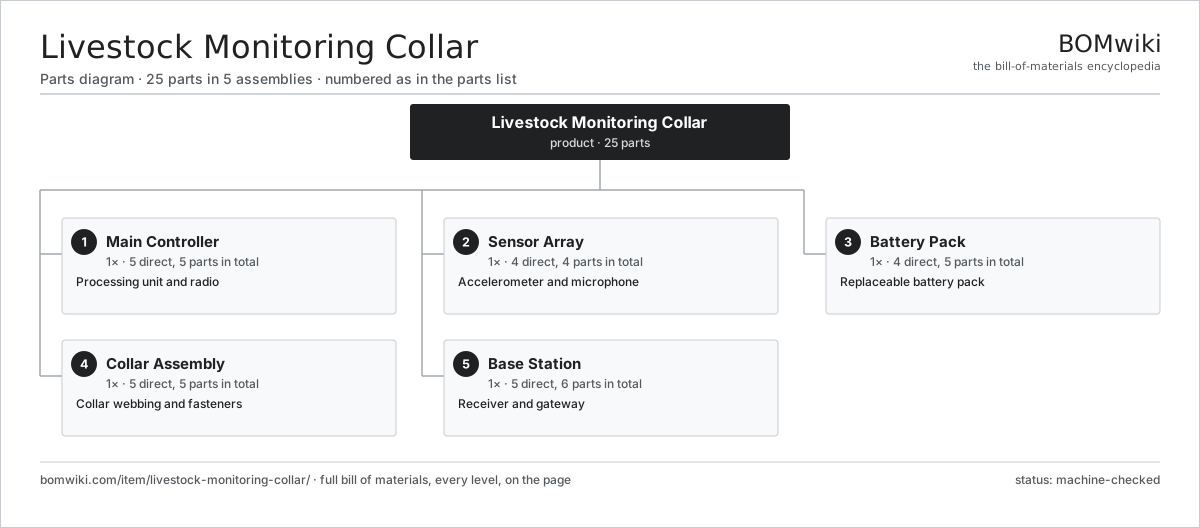
| # | Part | Qty | What it does |
|---|---|---|---|
| 1 | Main Controller 5 parts | 1× | Processing unit and radio |
| 2 | Sensor Array 4 parts | 1× | Accelerometer and microphone |
| 3 | Battery Pack 4 parts | 1× | Replaceable battery pack |
| 4 | Collar Assembly 5 parts | 1× | Collar webbing and fasteners |
| 5 | Base Station 5 parts | 1× | Receiver and gateway |
3D model
No 3D model yet. Have a CAD file of this? Add a 3D model — STL renders right on this page; STEP, FreeCAD, and OpenSCAD sources are welcome too (openly licensed, like all 3D models on BOMwiki).
Build & assembly graph
expand / collapse · shared sub-assemblies converge · links to related products · est. labourTap an assembly to expand/collapse · tap a part to open it · use “Open page” for any node · drag to pan, scroll to zoom.
Bill of materials for Livestock Monitoring Collar
5 top-level lines · 28 rows shown · 25 parts total · indented to 3 levels| # | Item / sub-assembly | Part no. | Qty/assy | Ext. qty | Parts | Type |
|---|---|---|---|---|---|---|
| 1 | Main Controller 5 parts | livestock-monitoring-collar-mcu | 1× | 1 | 5 | assembly |
| 1.1 | ARM Microcontroller | livestock-monitoring-collar-processor | 1× | 1 | · | part |
| 1.2 | Radio Modem | livestock-monitoring-collar-radio | 1× | 1 | · | part |
| 1.3 | Collar PCB | livestock-monitoring-collar-pcb | 1× | 1 | · | part |
| 1.4 | SMD Passive (R/C/L) | smd-passives | 1× | 1 | · | part |
| 1.5 | Connector | connector | 1× | 1 | · | part |
| 2 | Sensor Array 4 parts | livestock-monitoring-collar-sensor-array | 1× | 1 | 4 | assembly |
| 2.1 | Accelerometer | livestock-monitoring-collar-accelerometer | 1× | 1 | · | part |
| 2.2 | MEMS Microphone | livestock-monitoring-collar-microphone | 1× | 1 | · | part |
| 2.3 | Thermistor | livestock-monitoring-collar-temp-sensor | 1× | 1 | · | part |
| 2.4 | Analog-to-Digital Converter | livestock-monitoring-collar-adc | 1× | 1 | · | part |
| 3 | Battery Pack 4 parts | livestock-monitoring-collar-battery | 1× | 1 | 5 | assembly |
| 3.1 | Battery Cells | livestock-monitoring-collar-battery-cell | 2× | 2 | · | part |
| 3.2 | Battery Module | livestock-monitoring-collar-battery-housing | 1× | 1 | · | part |
| 3.3 | Charging Connector | livestock-monitoring-collar-charge-port | 1× | 1 | · | part |
| 3.4 | Thermal Fuse | thermal-fuse | 1× | 1 | · | part |
| 4 | Collar Assembly 5 parts | livestock-monitoring-collar-strap | 1× | 1 | 5 | assembly |
| 4.1 | Collar Webbing | livestock-monitoring-collar-webbing | 1× | 1 | · | part |
| 4.2 | Adjustment Buckle | livestock-monitoring-collar-buckle | 1× | 1 | · | part |
| 4.3 | Breakaway Release | livestock-monitoring-collar-release | 1× | 1 | · | part |
| 4.4 | PCB Enclosure | livestock-monitoring-collar-enclosure | 1× | 1 | · | part |
| 4.5 | Fastener Set | fastener-set | 1× | 1 | · | part |
| 5 | Base Station 5 parts | livestock-monitoring-collar-base-station | 1× | 1 | 6 | assembly |
| 5.1 | Gateway Radio | livestock-monitoring-collar-gateway-radio | 1× | 1 | · | part |
| 5.2 | Gateway MCU | livestock-monitoring-collar-gateway-controller | 1× | 1 | · | part |
| 5.3 | Antenna | livestock-monitoring-collar-antenna | 1× | 1 | · | part |
| 5.4 | AC Adapter | livestock-monitoring-collar-power-supply | 1× | 1 | · | part |
| 5.5 | Connector | connector | 2× | 2 | · | part |
Related products
same domain, ranked by shared parts Agricultural Spray Drone
721 parts · shares 1 with this page
Agricultural Spray Drone
721 parts · shares 1 with this page
 Air Seeder and Cart
502 parts · shares 1 with this page
Air Seeder and Cart
502 parts · shares 1 with this page
 Articulated Tractor
1,229 parts · shares 1 with this page
Articulated Tractor
1,229 parts · shares 1 with this page
 Beet Cleaner Loader
228 parts · shares 1 with this page
Beet Cleaner Loader
228 parts · shares 1 with this page
 Boom Sprayer
356 parts · shares 1 with this page
Boom Sprayer
356 parts · shares 1 with this page
Sourcing: possible vendors
Prices, MOQ, and lead times are algorithmic estimates, not quotes, and not claims about these companies. Company mappings are curated by keyword; est. price band $5k–$800k. How estimates work| Vendor | HQ | Specialty | MOQ | Lead time |
|---|---|---|---|---|
| deere.com ↗ | Moline, US | Agriculture & turf | made to order | 14–24 wks |
| cnh.com ↗ | Basildon, GB | Agriculture (Case IH, New Holland) | made to order | 14–24 wks |
|
🇺🇸AGCO
agcocorp.com ↗
|
Duluth, US | Agriculture (Fendt, Massey Ferguson) | made to order | 14–24 wks |
|
🇩🇪Claas
claas.com ↗
|
Harsewinkel, DE | Harvesters & tractors | made to order | 14–24 wks |
|
🇯🇵Kubota
kubota.com ↗
|
Osaka, JP | Compact tractors & equipment | made to order | 14–24 wks |
1,385-word article