LNG Vaporizer (ORV)
ProductOverview
An open rack vaporizer is the workhorse regasification unit of a baseload LNG import terminal. It converts liquefied natural gas stored at -162 °C back into pipeline-quality gas by exchanging heat with seawater, free, abundant, and warm enough at most coastal sites year-round. A single unit handles 180–200 tonnes of LNG per hour; a terminal lines up several with one or two on standby.
The unit is essentially a wall of vertical heat-exchange panels (Heat Exchanger Panel Bank) hung from a galvanized steel rack (Support Structure). Seawater is pumped to open troughs (Seawater Trough) along the top of each panel and overflows serrated weir plates (Weir Plate) to sheet down both panel faces as a thin falling film. Inside the panels, LNG rises through dozens of parallel finned tubes (Finned Aluminum Tube) and vaporizes against the warm film.
How it works
High-pressure LNG from the terminal's send-out pumps enters through the LNG Inlet Manifold, passing a fail-close ESD Shutdown Valve and a LNG Flow Control Valve before splitting into the Bottom LNG Header of each panel. The fluid is already above its critical pressure (4.6 MPa for methane), so there is no boiling in the ordinary sense: the supercritical fluid simply warms and its density falls smoothly as it climbs the tubes. By the Top NG Header it has become dense gas at 1–5 °C, which the NG Outlet Manifold collects into the send-out pipeline through the Outlet Isolation Valve.
The thermal duty is brutal at the panel bottom, where the tube wall faces -162 °C fluid inside and near-freezing water outside. Ice inevitably forms a thin sleeve on the lower 1–2 m of each tube; the star-fin extrusion profile of the Finned Aluminum Tube is designed so this ice stays thin and non-bridging rather than choking the water film. Heat flux runs around 30–50 kW/m² in the lower zone and tapers up the panel. The spent seawater, chilled by roughly 5 °C, falls into the Collection Basin and returns to the sea through an outfall sized to limit thermal impact.
Materials and corrosion
Aluminum alloy gives the panels the thermal conductivity and cryogenic toughness the duty demands, but bare aluminum corrodes quickly in chlorinated seawater. Every wetted panel surface therefore carries a flame-sprayed zinc-aluminum sacrificial layer (Zn-Al Thermal Spray Coating), typically 150–250 µm thick, renewed every 10–15 years when inspection shows thinning. Marine growth in the troughs and supply piping is held down by continuous low-level chlorination at the Hypochlorite Dosing Point point. Cryogenic piping upstream of the panels is TP304L stainless (Cryogenic Inlet Pipe) under cellular-glass Cryogenic Pipe Insulation; the warm side reverts to low-temperature carbon steel (Gas Outlet Pipe).
Control and protection
The controlling variable is send-out gas temperature. Three Pt100 elements (Outlet Temperature RTD) vote two-out-of-three: the control loop trims LNG flow to hold the setpoint, and a trip at -1 °C closes the ESD valve before cold gas can embrittle downstream carbon steel. Seawater flow is the slave variable, modulated by the Seawater Control Valve so the water leaving the panels stays above 0 °C. Send-out is metered by a multipath Ultrasonic Flow Meter, and four infrared Methane Gas Detector points watch the rack perimeter for methane. All signals marshal through the Local Control Panel to the terminal DCS and safety system.
Blocked-in cryogenic liquid expands ferociously as it warms, so every isolatable section carries a thermal relief valve (Pressure Safety Valve) discharging to the flare or cold vent via the Relief Vent Line. A Nitrogen Purge Connection connection allows inerting before maintenance.
Mechanical design
Cooldown from ambient to -162 °C shrinks each panel by roughly 25 mm, so the panels hang from sliding Panel Hanger fittings rather than rigid mounts, with Panel Stiffener Bar bars restraining lateral bowing. The rack itself (Rack Frame) is designed for the combined panel, water, and seismic loads and is bolted to the basin civil works through cast-in Anchor Bolt Set. Grated Access Platform levels give operators reach to the weirs, whose serrations are individually adjusted during commissioning until the falling film wets each face evenly, uneven wetting shows up immediately as asymmetric frost lines on the panel.
Variants
Where seawater is too cold (below about 5 °C) or intake permits are restrictive, terminals use submerged combustion vaporizers, which burn ~1.5% of the send-out gas, or intermediate-fluid vaporizers using a propane loop. ORVs dominate wherever seawater conditions allow because their operating cost is essentially the seawater pumping power, around 0.1% of the energy throughput.
LNG Vaporizer (ORV) parts and their functions
7 top-level parts · 603 parts in total · full bill of materials below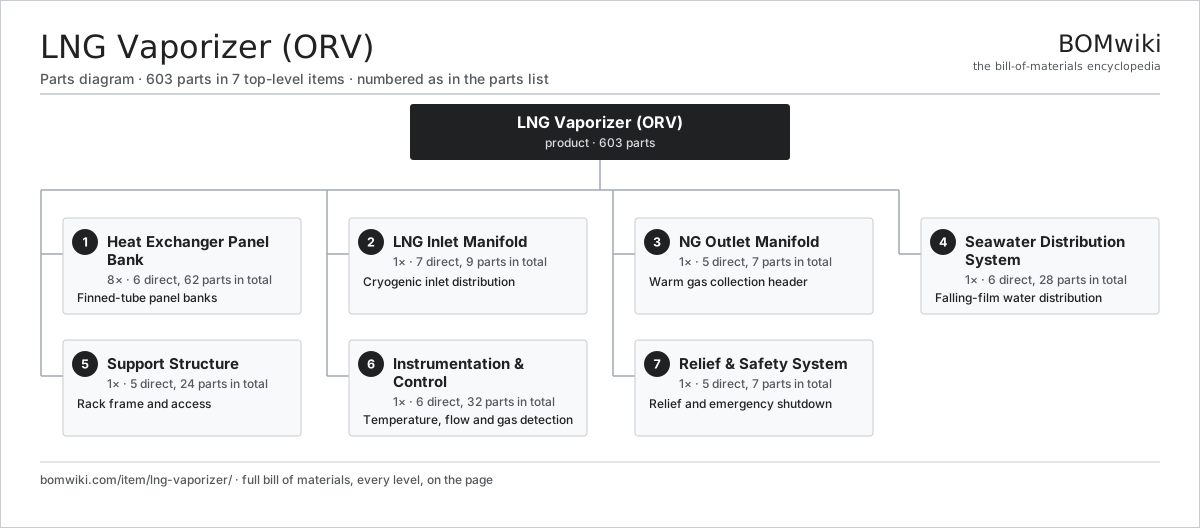
| # | Part | Qty | What it does |
|---|---|---|---|
| 1 | Heat Exchanger Panel Bank 6 parts | 8× | Finned-tube panel banks |
| 2 | LNG Inlet Manifold 7 parts | 1× | Cryogenic inlet distribution |
| 3 | NG Outlet Manifold 5 parts | 1× | Warm gas collection header |
| 4 | Seawater Distribution System 6 parts | 1× | Falling-film water distribution |
| 5 | Support Structure 5 parts | 1× | Rack frame and access |
| 6 | Instrumentation & Control 6 parts | 1× | Temperature, flow and gas detection |
| 7 | Relief & Safety System 5 parts | 1× | Relief and emergency shutdown |
3D model
No 3D model yet. Have a CAD file of this? Add a 3D model. STL renders right on this page; STEP, FreeCAD, and OpenSCAD sources are welcome too (openly licensed, like all 3D models on BOMwiki).
Build & assembly graph
expand / collapse · shared sub-assemblies converge · links to related products · est. labourTap an assembly to expand/collapse · tap a part to open it · use “Open page” for any node · drag to pan, scroll to zoom.
Bill of materials for LNG Vaporizer (ORV)
7 top-level lines · 53 rows shown · 603 parts total · indented to 3 levels| # | Item / sub-assembly | Part no. | Qty/assy | Ext. qty | Parts | Type |
|---|---|---|---|---|---|---|
| 1 | Heat Exchanger Panel Bank 6 parts | lng-vaporizer-hx-panels | 8× | 8 | 62 | assembly |
| 1.1 | Finned Aluminum Tube | lng-vaporizer-finned-tube | 54× | 432 | · | part |
| 1.2 | Bottom LNG Header | lng-vaporizer-bottom-header | 1× | 8 | · | part |
| 1.3 | Top NG Header | lng-vaporizer-top-header | 1× | 8 | · | part |
| 1.4 | Zn-Al Thermal Spray Coating | lng-vaporizer-thermal-spray-coating | 1× | 8 | · | part |
| 1.5 | Panel Stiffener Bar | lng-vaporizer-panel-stiffener | 4× | 32 | · | part |
| 1.6 | Fastener Set | fastener-set | 1× | 8 | · | part |
| 2 | LNG Inlet Manifold 7 parts | lng-vaporizer-lng-manifold | 1× | 1 | 9 | assembly |
| 2.1 | Cryogenic Inlet Pipe | lng-vaporizer-inlet-pipe | 1× | 1 | · | part |
| 2.2 | ESD Shutdown Valve | lng-vaporizer-esd-valve | 1× | 1 | · | part |
| 2.3 | LNG Flow Control Valve | lng-vaporizer-flow-control-valve | 1× | 1 | · | part |
| 2.4 | Cone Strainer | lng-vaporizer-cone-strainer | 1× | 1 | · | part |
| 2.5 | Cryogenic Pipe Insulation | lng-vaporizer-pipe-insulation | 1× | 1 | · | part |
| 2.6 | O-Ring Set | oring-set | 2× | 2 | · | part |
| 2.7 | Fastener Set | fastener-set | 2× | 2 | · | part |
| 3 | NG Outlet Manifold 5 parts | lng-vaporizer-ng-manifold | 1× | 1 | 7 | assembly |
| 3.1 | Gas Outlet Pipe | lng-vaporizer-outlet-pipe | 1× | 1 | · | part |
| 3.2 | Outlet Isolation Valve | lng-vaporizer-outlet-isolation-valve | 1× | 1 | · | part |
| 3.3 | Temperature Trim Valve | lng-vaporizer-temp-trim-valve | 1× | 1 | · | part |
| 3.4 | Pressure Sensor | pressure-sensor | 2× | 2 | · | part |
| 3.5 | Fastener Set | fastener-set | 2× | 2 | · | part |
| 4 | Seawater Distribution System 6 parts | lng-vaporizer-seawater-system | 1× | 1 | 28 | assembly |
| 4.1 | Seawater Trough | lng-vaporizer-seawater-trough | 8× | 8 | · | part |
| 4.2 | Weir Plate | lng-vaporizer-weir-plate | 16× | 16 | · | part |
| 4.3 | Seawater Supply Pipe | lng-vaporizer-seawater-supply-pipe | 1× | 1 | · | part |
| 4.4 | Seawater Control Valve | lng-vaporizer-seawater-control-valve | 1× | 1 | · | part |
| 4.5 | Collection Basin | lng-vaporizer-collection-basin | 1× | 1 | · | part |
| 4.6 | Hypochlorite Dosing Point | lng-vaporizer-hypochlorite-dosing | 1× | 1 | · | part |
| 5 | Support Structure 5 parts | lng-vaporizer-support-structure | 1× | 1 | 24 | assembly |
| 5.1 | Rack Frame | lng-vaporizer-rack-frame | 1× | 1 | · | part |
| 5.2 | Panel Hanger | lng-vaporizer-panel-hanger | 16× | 16 | · | part |
| 5.3 | Access Platform | lng-vaporizer-access-platform | 2× | 2 | · | part |
| 5.4 | Anchor Bolt Set | lng-vaporizer-anchor-bolts | 1× | 1 | · | part |
| 5.5 | Fastener Set | fastener-set | 4× | 4 | · | part |
| 6 | Instrumentation & Control 6 parts | lng-vaporizer-instrumentation | 1× | 1 | 32 | assembly |
| 6.1 | Outlet Temperature RTD | lng-vaporizer-outlet-rtd | 3× | 3 | · | part |
| 6.2 | Ultrasonic Flow Meter | lng-vaporizer-flow-meter | 1× | 1 | · | part |
| 6.3 | Local Control Panel 6 parts | lng-vaporizer-control-panel | 1× | 1 | 19 | assembly |
| 6.3.1 | Bare PCB | pcb-bare | 2× | 2 | · | part |
| 6.3.2 | Microcontroller | mcu | 1× | 1 | · | part |
| 6.3.3 | Relay | relay | 6× | 6 | · | part |
| 6.3.4 | Power Supply | power-supply | 1× | 1 | · | part |
| 6.3.5 | SMD Passive (R/C/L) | smd-passives | 1× | 1 | · | part |
| 6.3.6 | Connector | connector | 8× | 8 | · | part |
| 6.4 | Pressure Sensor | pressure-sensor | 3× | 3 | · | part |
| 6.5 | Methane Gas Detector | lng-vaporizer-gas-detector | 4× | 4 | · | part |
| 6.6 | Wire Bundle | wire-bundle | 2× | 2 | · | part |
| 7 | Relief & Safety System 5 parts | lng-vaporizer-safety-system | 1× | 1 | 7 | assembly |
| 7.1 | Pressure Safety Valve | lng-vaporizer-psv | 2× | 2 | · | part |
| 7.2 | Relief Vent Line | lng-vaporizer-vent-line | 1× | 1 | · | part |
| 7.3 | Nitrogen Purge Connection | lng-vaporizer-nitrogen-purge | 1× | 1 | · | part |
| 7.4 | Coil Spring | coil-spring | 2× | 2 | · | part |
| 7.5 | O-Ring Set | oring-set | 1× | 1 | · | part |
Something wrong in this list? Report a problem with this BOM.
Related products
same domain, ranked by shared parts Amine Gas Sweetening Unit
3,543 parts · shares 3 with this page
Amine Gas Sweetening Unit
3,543 parts · shares 3 with this page
 Condensate Stabilizer Column
2,234 parts · shares 3 with this page
Condensate Stabilizer Column
2,234 parts · shares 3 with this page
 Gas Metering Skid
1,491 parts · shares 3 with this page
Gas Metering Skid
1,491 parts · shares 3 with this page
 Gas Pressure Regulating Station
133 parts · shares 3 with this page
Gas Pressure Regulating Station
133 parts · shares 3 with this page
 Inline Inspection Pig
248 parts · shares 3 with this page
JT Gas Dew Point Skid
441 parts · shares 3 with this page
Inline Inspection Pig
248 parts · shares 3 with this page
JT Gas Dew Point Skid
441 parts · shares 3 with this page
Sourcing: possible vendors
Browse the supplier directory → Prices, MOQ, and lead times are algorithmic estimates, not quotes, and not claims about these companies. Company mappings are curated by keyword; est. price band $10k–$50M. How estimates work| Vendor | HQ | Specialty | MOQ | Lead time |
|---|---|---|---|---|
|
🇺🇸SLB
slb.com ↗
|
Houston, US | Oilfield services & equipment | made to order | 24–48 wks |
| halliburton.com ↗ | Houston, US | Oilfield services | made to order | 24–48 wks |
| bakerhughes.com ↗ | Houston, US | Energy technology | made to order | 24–48 wks |
|
🇺🇸NOV
nov.com ↗
|
Houston, US | Drilling equipment | made to order | 24–48 wks |
| technipfmc.com ↗ | London, GB | Subsea & surface systems | made to order | 24–48 wks |
820-word article