Log Flume Ride
ProductOverview
A log flume is a gravity-based water ride where passengers board boat-shaped vehicles and traverse a themed channel network. Boats are lifted uphill via powered conveyor or chain mechanisms, released at the crest, and descend steeply into a splash pool that creates a final water effect. The route is typically 400–800 meters, combining level channels (slow narrative sections), powered climbs, and gravity drops. Water is continuously recirculated via centrifugal pump, maintaining depth and flow for successive boat launches.
Log flumes emerged in the 1970s as a hybrid of log-ride log walls (wooden flume rides) and modern theme-park water attractions. They remain popular for combining thrilling splashdown moments with long themed experiences and relatively low operational complexity compared to roller coasters.
How It Works
Boat and Channel Design
Log boats are hollow fiberglass or rotationally molded plastic pontoons, typically 2–3 meters long and 1–2 meters wide, with a draught of 0.3–0.5 meters. Internal buoyancy chambers keep the boat afloat even if water breaches the passenger compartment. A sloped floor allows water to drain toward a center trough, reducing post-ride floor pooling.
Six to twelve passengers sit in rows, facing forward. Lap bars or simple restraint belts prevent ejection during splashdown impacts (3–5 g lateral, 1–2 g vertical). Guide wheels or external fins keep boats centered on guide rails along the channel walls.
The main channel is typically 3–4 meters wide and 1.5–2.5 meters deep. Water is maintained at a constant level by the return pump. Baffles and guide rails keep the path straight and narrow, forcing the boat to travel the intended route.
Powered Lift
At the base of the ride (or partway through), boats enter the lift section, a conveyor or chain mechanism inclined 20–45°. Boats are pushed uphill by friction with the moving belt (or engaged directly by slat chains). Load cells detect if a boat stalls on the lift; if so, a jam sensor alerts the operator and halts the lift motor to prevent overflow.
Boats reach the crest 15–25 meters above the starting water level. A mechanical gate or solenoid-controlled dam holds them briefly, building anticipation.
Drop and Splash
The gate opens, releasing the boat into a steep drop section inclined 35–50°. Gravity accelerates the boat to 8–15 m/s (roughly 30–54 km/h) over 8–12 meters of vertical fall. Passengers experience brief weightlessness and intense spray as the boat slides downward.
At the bottom, a splash pool (3–4 meters deep, 10–15 meters long) arrests the boat's descent and converts kinetic energy into water spray. Deflector ramps aim spray at nearby spectators. The boat floats for 2–3 seconds in the pool, allowing water to drain, then resumes a slower, calmer channel segment to return to the loading station.
Water Recirculation
A centrifugal pump (3–7.5 kW) draws water from a sump tank at the splash-pool low point. Water passes through a sand or cartridge filter (20–50 µm media) to remove algae, debris, and silt. Filtered water is then piped back to the main channel at the lift location, maintaining constant level and flow.
System pressure is typically 3–5 bar. A check valve prevents backflow when the pump stops. Dissolved-chlorine or ozone injection maintains water quality in warm climates; in cooler regions, algae growth is minimal and monthly filter cleaning suffices.
Control and Dispatch
A PLC monitors:
- Boat proximity sensors (photoeyes) at key stations.
- Water level in the main channel (pressure transducer on the sump).
- Lift jam detection (load cell under the conveyor or line-pull sensor on the chain).
- Pump discharge pressure.
The dispatcher manually presses a "launch" button, which signals the lift gate to open when a boat is queued at the crest. Proximity sensors ensure that the downstream boat has cleared the splash pool before opening the gate. If water level drops (indicating a leak or pump failure), the PLC shuts down the lift to prevent boats from becoming stuck mid-channel.
Structural and Mechanical Details
Channel Materials
Modern log flumes use fiberglass-reinforced plastic (FRP) for the main channel, it is lighter than concrete, allows colored and textured finishes, and requires no curing time on-site. Older parks may still operate concrete channels, which are heavier but more durable for high-traffic sites.
Channel is typically assembled from 2–4 meter-wide modular panels, bolted together at seams and sealed with marine-grade silicone. Slopes are integral; no separate decking is required.
Boat Materials and Maintenance
Fiberglass or plastic boats are lightweight (150–250 kg empty) and require minimal maintenance. Buoyancy compartments are sealed and do not require inspection unless water is suspected inside. Lap bars and guide-wheel bearings are serviced annually.
Boats are inspected for stress cracks every 500 operating hours (typically 1–2 times per year). A cracked boat is removed from service, repaired with fiberglass cloth and resin, and returned to inventory. Typical boat lifespan is 10–15 years.
Lift Mechanism
The conveyor drive is either:
- Belt drive: Rubber belt on steel pulleys, powered by a variable-frequency-drive (VFD) motor. Belt tensioner maintains 50–100 N load. Slips if a boat stalls, preventing motor overload.
- Chain drive: Roller chain with pockets or pads that grip boat frame edges or a special engagement rail. Less prone to slippage but requires more maintenance (chain stretch, pin lubrication).
Most modern parks prefer belt drives for simplicity and lower noise.
Splash Pool Engineering
The splash pool is 10–15 meters long, 3–4 meters deep, and typically L-shaped to direct spray away from operators. The floor slopes to the sump at 5–8°. A sump tank (15,000–50,000 liter underground basin) collects return water.
Deflector ramps or impact lips at the pool entry concentrate water spray toward guests and provide visual spectacle. Large parks add animatronics or fire effects triggered by boat passage.
Theme and Scenery
Log flume theming ranges from rustic (wood and rock facades) to elaborate jungle or mine-adventure narratives. Scenery typically includes:
- FRP rock formations and cave entrances.
- Animated figures or drop-down props (mechanically operated or pneumatic).
- Colored lighting, especially in indoor sections.
- Water spray and misting effects, synchronized to boat passage via proximity sensors.
Theming adds 15–30 % to ride cost but significantly boosts operational revenue by increasing re-ride value.
Standards and Safety
Log flumes are governed by ASTM F24 (F2291, F2374 for passenger rides) and international EN standards. Key requirements:
- Restraint hold forces: 1–2 kN per connection (less aggressive than coasters, since impact is primarily water-based rather than air-based).
- Water quality: Chlorine residual 1–3 ppm; pH 7.2–7.8; clarity > 1 meter (ability to see boat in channel).
- Emergency procedures: Pump shutoff should stop lift conveyor within 5 seconds; boats must not free-fall uncontrolled from lift if power is lost.
- Drainage: Splash-pool sump must drain within 30 minutes if supply is cut off, preventing standing water and mosquito breeding.
Operational Costs and Economics
A typical 500-meter log flume with themed scenery costs $8–20 million to design, construct, and install. Annual operating costs (labor, electricity, water treatment, maintenance) are $200,000–$600,000.
Revenue potential is $1–3 million per season at busy parks. Seasonal operations (6 months) are common in temperate climates; year-round operation requires heated water and indoor sections in colder regions.
Log flumes are especially popular in family-oriented parks and waterpark chains. Their combination of thrills (the big drop), scenery, and water effects appeals to a broad age range and drives high capacity (800–1,500 riders per hour with adequate boat inventory).
Variants and Modern Innovations
Recent models include:
- Splashboat effect: Larger drop (15–18 m) and deeper splash pool (4–5 m) for more dramatic spray.
- Reverse sections: Boats climb backward up a second lift before a second drop.
- Interactive water cannons: Spectators aim water guns at passing boats; rider splashes trigger cannons pointed back at spectators.
- Trackless boats: No guide rails; boats navigate the channel via pressure spray or gentle underwater walls, allowing more freedom and more realistic "log" dynamics.
Modern indoor log flumes in waterparks are merging with river-rapids and wave-pool designs, creating hybrid attractions that extend operational season and capacity.
Log Flume Ride parts and their functions
7 top-level parts · 486 parts in total · full bill of materials below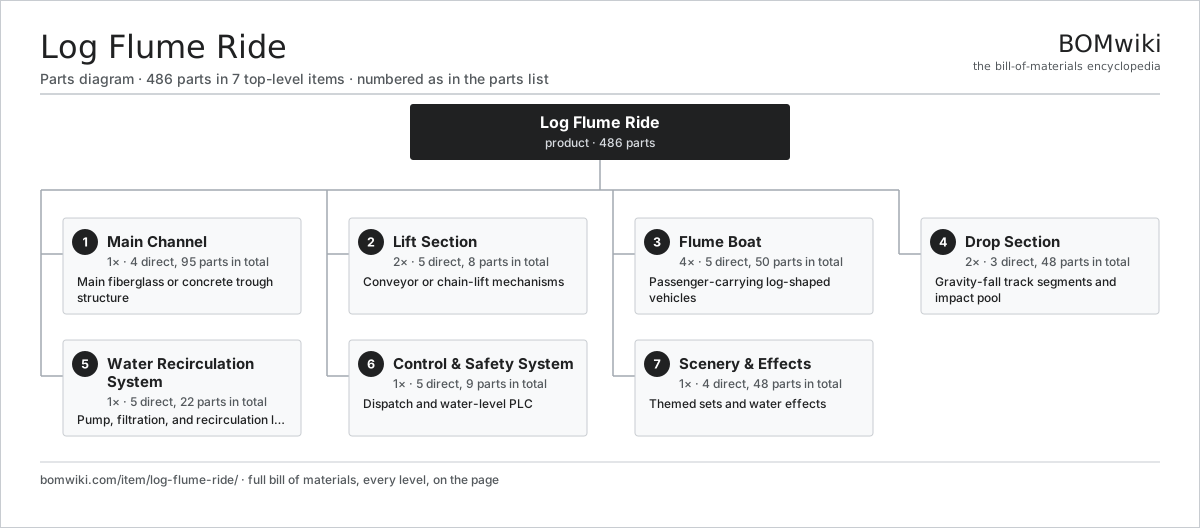
| # | Part | Qty | What it does |
|---|---|---|---|
| 1 | Main Channel 4 parts | 1× | Main fiberglass or concrete trough structure |
| 2 | Lift Section 5 parts | 2× | Conveyor or chain-lift mechanisms |
| 3 | Flume Boat 5 parts | 4× | Passenger-carrying log-shaped vehicles |
| 4 | Drop Section 3 parts | 2× | Gravity-fall track segments and impact pool |
| 5 | Water Recirculation System 5 parts | 1× | Pump, filtration, and recirculation loop |
| 6 | Control & Safety System 5 parts | 1× | Dispatch and water-level PLC |
| 7 | Scenery & Effects 4 parts | 1× | Themed sets and water effects |
3D model
No 3D model yet. Have a CAD file of this? Add a 3D model. STL renders right on this page; STEP, FreeCAD, and OpenSCAD sources are welcome too (openly licensed, like all 3D models on BOMwiki).
Build & assembly graph
expand / collapse · shared sub-assemblies converge · links to related products · est. labourTap an assembly to expand/collapse · tap a part to open it · use “Open page” for any node · drag to pan, scroll to zoom.
Bill of materials for Log Flume Ride
7 top-level lines · 52 rows shown · 486 parts total · indented to 3 levels| # | Item / sub-assembly | Part no. | Qty/assy | Ext. qty | Parts | Type |
|---|---|---|---|---|---|---|
| 1 | Main Channel 4 parts | log-flume-channel | 1× | 1 | 95 | assembly |
| 1.1 | Sheet Metal Panel | sheet-panel | 80× | 80 | · | part |
| 1.2 | Fastener Set | fastener-set | 10× | 10 | · | part |
| 1.3 | Boat Guide Rail | guide-rail-assembly | 3× | 3 | · | part |
| 1.4 | Drain & Isolation Valve | drain-valve-assembly | 2× | 2 | · | part |
| 2 | Lift Section 5 parts | log-flume-lift-section | 2× | 2 | 8 | assembly |
| 2.1 | Blower Motor | blower-motor | 1× | 2 | · | part |
| 2.2 | Drive Belt | drive-belt | 1× | 2 | · | part |
| 2.3 | Gearbox Housing | gearbox-housing | 1× | 2 | · | part |
| 2.4 | Ball Bearing | ball-bearing | 4× | 8 | · | part |
| 2.5 | Pressure Sensor | pressure-sensor | 1× | 2 | · | part |
| 3 | Flume Boat 5 parts | log-flume-boats | 4× | 4 | 50 | assembly |
| 3.1 | Seat Assembly 5 parts | seat-assembly | 6× | 24 | 7 | assembly |
| 3.1.1 | Seat Frame | seat-frame | 1× | 24 | · | part |
| 3.1.2 | Seat Foam | seat-foam | 2× | 48 | · | part |
| 3.1.3 | Seat Cover | seat-cover | 1× | 24 | · | part |
| 3.1.4 | Seat Motor | seat-motor | 2× | 48 | · | part |
| 3.1.5 | Seat Heater Mat | seat-heater | 1× | 24 | · | part |
| 3.2 | Ball Bearing | ball-bearing | 2× | 8 | · | part |
| 3.3 | Fastener Set | fastener-set | 3× | 12 | · | part |
| 3.4 | O-Ring Set | oring-set | 2× | 8 | · | part |
| 3.5 | Connector | connector | 1× | 4 | · | part |
| 4 | Drop Section 3 parts | log-flume-drop-section | 2× | 2 | 48 | assembly |
| 4.1 | Sheet Metal Panel | sheet-panel | 40× | 80 | · | part |
| 4.2 | Fastener Set | fastener-set | 6× | 12 | · | part |
| 4.3 | Impact Absorber Pads | impact-absorber-pads | 2× | 4 | · | part |
| 5 | Water Recirculation System 5 parts | log-flume-water-system | 1× | 1 | 22 | assembly |
| 5.1 | Blower Motor | blower-motor | 1× | 1 | · | part |
| 5.2 | Pressure Sensor | pressure-sensor | 2× | 2 | · | part |
| 5.3 | Filter Cartridge | water-filter-cartridge | 1× | 1 | · | part |
| 5.4 | Pipe Fitting Assembly | pipe-fitting-assembly | 4× | 4 | · | part |
| 5.5 | Swing / Wafer Check Valve 9 parts | check-valve | 1× | 1 | 14 | product |
| 5.5.1 | Valve Body | check-valve-body | 1× | 1 | · | part |
| 5.5.2 | Swing Check Valve Disc and Hinge 3 parts + deeper › | check-valve-disc-assy | 1× | 1 | 3 | assembly |
| 5.5.3 | Spring Check Valve Poppet 3 parts + deeper › | check-valve-poppet-assy | 1× | 1 | 3 | assembly |
| 5.5.4 | Seat Ring | check-valve-seat-ring | 1× | 1 | · | part |
| 5.5.5 | Access Cover | check-valve-cover | 1× | 1 | · | part |
| 5.5.6 | Arm & Stop 2 parts + deeper › | check-valve-arm-stop | 1× | 1 | 2 | assembly |
| 5.5.7 | Flange Set | check-valve-flange-set | 1× | 1 | · | part |
| 5.5.8 | O-Ring Set | oring-set | 1× | 1 | · | part |
| 5.5.9 | Fastener Set | fastener-set | 1× | 1 | · | part |
| 6 | Control & Safety System 5 parts | log-flume-control-system | 1× | 1 | 9 | assembly |
| 6.1 | Microcontroller | mcu | 1× | 1 | · | part |
| 6.2 | Relay | relay | 4× | 4 | · | part |
| 6.3 | Bare PCB | pcb-bare | 1× | 1 | · | part |
| 6.4 | LCD Panel | lcd-panel | 1× | 1 | · | part |
| 6.5 | Connector | connector | 2× | 2 | · | part |
| 7 | Scenery & Effects 4 parts | log-flume-scenery-package | 1× | 1 | 48 | assembly |
| 7.1 | Sheet Metal Panel | sheet-panel | 30× | 30 | · | part |
| 7.2 | Fastener Set | fastener-set | 4× | 4 | · | part |
| 7.3 | Spray Nozzle Assembly | spray-nozzle-assembly | 6× | 6 | · | part |
| 7.4 | LED Lighting Module | led-lighting-module | 8× | 8 | · | part |
Something wrong in this list? Report a problem with this BOM.
Related products
same domain, ranked by shared parts Bumper Boats
268 parts · shares 23 with this page
Bumper Boats
268 parts · shares 23 with this page
 Dark Ride System
1,005 parts · shares 13 with this page
Dark Ride System
1,005 parts · shares 13 with this page
 Roller Coaster
657 parts · shares 14 with this page
Roller Coaster
657 parts · shares 14 with this page
 Drop Tower Ride
308 parts · shares 13 with this page
Drop Tower Ride
308 parts · shares 13 with this page
 Pirate Ship Ride
478 parts · shares 13 with this page
Pirate Ship Ride
478 parts · shares 13 with this page
 Teacup Ride
660 parts · shares 13 with this page
Teacup Ride
660 parts · shares 13 with this page
Sourcing: possible vendors
Browse the supplier directory → Prices, MOQ, and lead times are algorithmic estimates, not quotes, and not claims about these companies. Company mappings are curated by keyword; est. price band $20–$3k. How estimates work| Vendor | HQ | Specialty | MOQ | Lead time |
|---|---|---|---|---|
|
🇩🇰LEGO
lego.com ↗
|
Billund, DK | Construction toys | 2,000 units | 6–10 wks |
|
🇺🇸Mattel
mattel.com ↗
|
El Segundo, US | Toys | 2,000 units | 6–10 wks |
|
🇺🇸Hasbro
hasbro.com ↗
|
Pawtucket, US | Toys & games | 2,000 units | 6–10 wks |
| bandainamco.co.jp ↗ | Tokyo, JP | Toys & amusement | 2,000 units | 6–10 wks |
| spinmaster.com ↗ | Toronto, CA | Toys | 2,000 units | 6–10 wks |
1,421-word article