Knuckleboom Log Loader
ProductOverview
A knuckleboom loader is a hydraulic crane mounted on a truck or fixed platform, used to load, unload, and position logs in lumber mills, log yards, and forest operations. The distinctive "knuckle" is a pivot joint midway along the boom that allows the upper boom section to fold independently, providing exceptional reach and precision for stacking logs in tight spaces.
The carrier vehicle (a heavy truck or fixed base) supports the rotating turntable, which carries the articulated boom. The boom consists of a main boom and a secondary extension, connected at the knuckle joint. Each section is powered by a hydraulic cylinder. At the end of the boom hangs the Log Grapple, a bucket with closing Grapple Arms that grip logs. The entire system is controlled from an operator cab with joystick controls, powered by a diesel or electric engine that drives a hydraulic pump.
How it works
The diesel engine (typically 80–150 horsepower) drives the Hydraulic Pump, a variable-displacement pump producing 80–150 cc/rev of flow at pressures up to 3,500 psi. The pump output is directed through a pilot-operated directional solenoid valve block, where it is routed to the appropriate actuators based on joystick input.
The operator grips the main joystick, which commands the Boom Cylinders for the main boom and extension. Moving the joystick forward extends the main boom; backward retracts it. Left-right motion angles the boom side to side. A secondary joystick or button controls the grapple closure and slew rotation.
To load a log: The loader operator positions the truck or base near the log. The boom is extended to reach the log, the Grapple Arms open, and the Log Grapple is lowered onto the log. The operator triggers the Grapple Cylinder, which drives the Grapple Arms together, gripping the log with the teeth. The boom is then lifted and rotated 180 degrees via the Slew Drive, positioning the log over the truck bed or deck. The boom is lowered and extended to place the log, the grapple is released, and the cycle repeats.
Typical cycle time: 30–60 seconds per log (depending on log size and lift distance).
Boom kinematics
The power of the knuckleboom design lies in its articulation. A simple single-boom crane can reach far but loses lifting capacity as reach increases. The knuckleboom solves this with the knuckle joint, which divides the boom into two segments:
- Main boom (base): Fixed at the Slew Bearing and angled by the main boom cylinder.
- Extension (tip): Hinged at the knuckle and angled independently by the extension cylinder.
By independently controlling both angles, the operator can achieve:
- Maximum reach: Both booms angle upward and forward, reaching 25–45 feet.
- Maximum lift height: Both angled upward, lifting 12–20 feet.
- Maximum load: Both angled downward, concentrating force over a shorter reach.
- Precise placement: The knuckle allows the grapple to move smoothly over and around obstacles.
A typical scenario: reach extends to grab a log on the ground (both booms mostly horizontal), then lift occurs (both boom angles increase), then the boom rotates sideways to position over a truck bed, then the extension is retracted slightly to place the log gently. This flexibility makes knucklelooms far superior to simple cranes for congested mill yards.
Grapple design
The Log Grapple is typically a rotating bucket or claw with two opposing Grapple Arms. The arms are powered by the Grapple Cylinder, which drives them together (closing) or releases them (opening). Each arm carries steel teeth or claws that dig into the log, preventing slip.
Grapples come in two main types:
Rotating grapple: The entire bucket can rotate 360 degrees around its attachment point, allowing logs to be oriented before placement (e.g., pointing the log butt first into a pile).
Fixed grapple: The bucket faces down always; the log is only rotated by rotating the entire boom.
Rotating grapples provide more flexibility but add complexity and hydraulic requirements.
Slew drive and rotation
The Slew Drive allows the entire boom assembly to rotate. The Slew Bearing is a large-diameter slew ring bearing (a rolling element bearing with internal and external toothed races) that allows rotation while supporting load. A Slew Motor (typically a small hydraulic motor) drives a Slew Gearbox (a planetary gearbox with a 50:1 to 100:1 ratio), which meshes with the teeth on the slew bearing.
Slew speed is typically 360 degrees in 6–15 seconds, providing swift rotation for loading parallel logs or orienting logs for stacking.
Hydraulic system
The Hydraulic System is the heart of the loader. The Hydraulic Pump, driven directly by the diesel engine, produces variable flow up to 80–150 cc/rev at 3,500 psi maximum. The pump output enters a proportional solenoid directional valve block, which distributes flow to the three main actuator groups:
Main boom and extension cylinders: Each Boom Cylinder is a double-acting cylinder (extend and retract). The control valve meters flow to both sides of each cylinder for smooth motion.
Grapple cylinder: The Grapple Cylinder is controlled via a spool or solenoid valve, opening and closing the jaws.
Slew motor: The Slew Motor receives continuous or proportional flow for rotation at variable speed.
The Hydraulic Tank (100–200 gallons) stores fluid and allows air to escape. A Relief Valve protects the system from overpressure if a cylinder stalls or load exceeds capacity.
Modern proportional valve blocks allow smooth, infinitely variable control: the operator moving the joystick slightly produces slow, precise motion; moving it fully produces maximum speed. This is vastly superior to older on-off solenoid valves.
Operator cab
The Operator Cab is an enclosed cab mounted on the rotating turntable, moving with the boom. The operator has 360-degree visibility via large Cab Windows and can see the log being loaded. A comfortable Operator Seat (often with suspension) and intuitive controls allow 8–10 hours of daily operation with minimal fatigue.
The Main Joystick is a proportional joystick with spring centering; pushing forward/back controls the main boom, left/right controls the extension boom angle (or side-to-side slew, depending on cab design). A secondary Secondary Joystick or button panel controls grapple closure, rotation, and auxiliary functions.
Modern cabs include air conditioning, radio, and instrument displays showing hydraulic pressure, engine RPM, and load estimates.
Power source
Mobile loaders use a diesel engine (typically 80–150 hp) mounted on the truck frame. The diesel engine also powers the truck's transmission for mobility. Some loaders feature hybrid or fully electric engines for reduced emissions.
Fixed-base loaders (stationary at a mill) may use an electric motor instead, eliminating fuel consumption but requiring electrical infrastructure.
Load capacity and reach
The Articulated Boom reach and capacity vary by design:
- Short reach (20 ft), high capacity (8 tons): Used for loading trucks or short-distance unloading.
- Long reach (40 ft), lower capacity (2–3 tons): Used for stacking logs high or reaching across wide log piles.
Load capacity decreases with reach: a loader rated 8 tons at 6 feet of reach may only lift 1 ton at 40 feet.
Load pins and pressure sensors can optionally estimate the load, alerting the operator before overload.
Applications
Log yards: Loading logs from the ground onto trucks for transport to the mill.
Mill infeed: Positioning logs from trucks onto the debarker infeed conveyor.
Log deck management: Stacking logs in organized piles for species or grade separation.
Chip and bark handling: Some mills use knucklelooms to handle chips or bark, using a bucket grapple instead of a log grapple.
Forest operations: Mobile truck-mounted loaders are used by logging contractors to load logs from the forest floor onto logging trucks.
A typical knuckleboom loader costs $200,000–$400,000 (truck-mounted) or $150,000–$300,000 (fixed base). Annual operating cost (fuel, maintenance, operator) is $60,000–$100,000. They typically last 15–20 years with proper maintenance, making them essential equipment in any scale lumber operation.
Knuckleboom Log Loader parts and their functions
7 top-level parts · 52 parts in total · full bill of materials below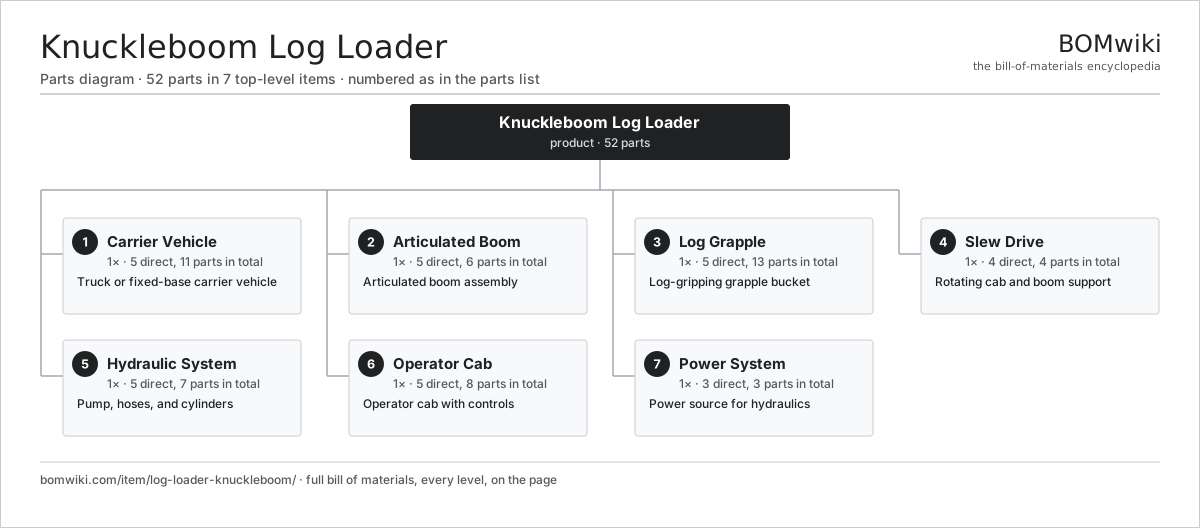
| # | Part | Qty | What it does |
|---|---|---|---|
| 1 | Carrier Vehicle 5 parts | 1× | Truck or fixed-base carrier vehicle |
| 2 | Articulated Boom 5 parts | 1× | Articulated boom assembly |
| 3 | Log Grapple 5 parts | 1× | Log-gripping grapple bucket |
| 4 | Slew Drive 4 parts | 1× | Rotating cab and boom support |
| 5 | Hydraulic System 5 parts | 1× | Pump, hoses, and cylinders |
| 6 | Operator Cab 5 parts | 1× | Operator cab with controls |
| 7 | Power System 3 parts | 1× | Power source for hydraulics |
3D model
No 3D model yet. Have a CAD file of this? Add a 3D model. STL renders right on this page; STEP, FreeCAD, and OpenSCAD sources are welcome too (openly licensed, like all 3D models on BOMwiki).
Build & assembly graph
expand / collapse · shared sub-assemblies converge · links to related products · est. labourTap an assembly to expand/collapse · tap a part to open it · use “Open page” for any node · drag to pan, scroll to zoom.
Bill of materials for Knuckleboom Log Loader
7 top-level lines · 39 rows shown · 52 parts total · indented to 3 levels| # | Item / sub-assembly | Part no. | Qty/assy | Ext. qty | Parts | Type |
|---|---|---|---|---|---|---|
| 1 | Carrier Vehicle 5 parts | log-loader-knuckleboom-carrier | 1× | 1 | 11 | assembly |
| 1.1 | Truck Frame | log-loader-knuckleboom-frame | 1× | 1 | · | part |
| 1.2 | Axle | log-loader-knuckleboom-axle | 2× | 2 | · | part |
| 1.3 | Wheel | log-loader-knuckleboom-wheel | 6× | 6 | · | part |
| 1.4 | Main Engine | log-loader-knuckleboom-engine-main | 1× | 1 | · | part |
| 1.5 | Transmission | log-loader-knuckleboom-transmission | 1× | 1 | · | part |
| 2 | Articulated Boom 5 parts | log-loader-knuckleboom-boom | 1× | 1 | 6 | assembly |
| 2.1 | Main Boom | log-loader-knuckleboom-main-boom | 1× | 1 | · | part |
| 2.2 | Knuckle Joint | log-loader-knuckleboom-knuckle-joint | 1× | 1 | · | part |
| 2.3 | Boom Extension | log-loader-knuckleboom-extension | 1× | 1 | · | part |
| 2.4 | Hose Carrier | log-loader-knuckleboom-hose-carrier | 1× | 1 | · | part |
| 2.5 | Boom Cylinder | log-loader-knuckleboom-boom-cylinder | 2× | 2 | · | part |
| 3 | Log Grapple 5 parts | log-loader-knuckleboom-grapple | 1× | 1 | 13 | assembly |
| 3.1 | Grapple Shell | log-loader-knuckleboom-grapple-shell | 1× | 1 | · | part |
| 3.2 | Grapple Arm | log-loader-knuckleboom-grapple-arm | 2× | 2 | · | part |
| 3.3 | Grapple Cylinder | log-loader-knuckleboom-grapple-cylinder | 1× | 1 | · | part |
| 3.4 | Grapple Pin | log-loader-knuckleboom-grapple-pin | 1× | 1 | · | part |
| 3.5 | Grapple Tooth | log-loader-knuckleboom-grapple-tooth | 8× | 8 | · | part |
| 4 | Slew Drive 4 parts | log-loader-knuckleboom-slew-drive | 1× | 1 | 4 | assembly |
| 4.1 | Slew Bearing | log-loader-knuckleboom-slew-bearing | 1× | 1 | · | part |
| 4.2 | Slew Motor | log-loader-knuckleboom-slew-motor | 1× | 1 | · | part |
| 4.3 | Slew Gearbox | log-loader-knuckleboom-slew-gearbox | 1× | 1 | · | part |
| 4.4 | Slew Brake | log-loader-knuckleboom-slew-brake | 1× | 1 | · | part |
| 5 | Hydraulic System 5 parts | log-loader-knuckleboom-hydraulic-system | 1× | 1 | 7 | assembly |
| 5.1 | Hydraulic Pump | log-loader-knuckleboom-hydraulic-pump | 1× | 1 | · | part |
| 5.2 | Hose Bundle | log-loader-knuckleboom-hose-bundle | 1× | 1 | · | part |
| 5.3 | Control Valve | log-loader-knuckleboom-control-valve | 3× | 3 | · | part |
| 5.4 | Relief Valve | log-loader-knuckleboom-relief-valve | 1× | 1 | · | part |
| 5.5 | Hydraulic Tank | log-loader-knuckleboom-hydraulic-tank | 1× | 1 | · | part |
| 6 | Operator Cab 5 parts | log-loader-knuckleboom-control-cabin | 1× | 1 | 8 | assembly |
| 6.1 | Cab Frame | log-loader-knuckleboom-cab-frame | 1× | 1 | · | part |
| 6.2 | Main Joystick | log-loader-knuckleboom-joystick-main | 1× | 1 | · | part |
| 6.3 | Secondary Joystick | log-loader-knuckleboom-joystick-secondary | 1× | 1 | · | part |
| 6.4 | Cab Window | log-loader-knuckleboom-cab-window | 4× | 4 | · | part |
| 6.5 | Operator Seat | log-loader-knuckleboom-seat | 1× | 1 | · | part |
| 7 | Power System 3 parts | log-loader-knuckleboom-engine | 1× | 1 | 3 | assembly |
| 7.1 | Power Engine | log-loader-knuckleboom-engine-power | 1× | 1 | · | part |
| 7.2 | Engine Coupling | log-loader-knuckleboom-engine-coupling | 1× | 1 | · | part |
| 7.3 | Fuel Tank | log-loader-knuckleboom-fuel-tank | 1× | 1 | · | part |
Something wrong in this list? Report a problem with this BOM.
Sourcing: possible vendors
Browse the supplier directory → Prices, MOQ, and lead times are algorithmic estimates, not quotes, and not claims about these companies. Company mappings are curated by keyword; est. price band $5k–$2M. How estimates work| Vendor | HQ | Specialty | MOQ | Lead time |
|---|---|---|---|---|
| atlascopco.com ↗ | Stockholm, SE | Compressors & industrial | 10 units | 12–20 wks |
|
🇦🇹Andritz
andritz.com ↗
|
Graz, AT | Process plants & machinery | 10 units | 12–20 wks |
| buhlergroup.com ↗ | Uzwil, CH | Food & materials processing | 10 units | 12–20 wks |
| gea.com ↗ | Düsseldorf, DE | Process technology | 10 units | 12–20 wks |
| mhi.com ↗ | Tokyo, JP | Heavy machinery | 10 units | 12–20 wks |
1,564-word article