Logic Analyzer
ProductOverview
A logic analyzer is a digital oscilloscope specialized for capturing and displaying timing relationships between multiple digital signals, typically 16 to 64 channels, with nanosecond resolution. Unlike analog oscilloscopes that sample voltage continuously, logic analyzers sample only digital levels (high or low) and record the precise timing of state transitions. This allows engineers to debug embedded systems, verify protocol timing, and analyze state machine behavior in microcontrollers, FPGAs, and communication interfaces.
Modern FPGA-based logic analyzers replace older microprocessor-based designs with programmable samplers, triggering logic, and memory management. The FPGA can be reconfigured for different sampling rates, trigger patterns, and data routing on the fly, making a single hardware unit suitable for diverse applications, from basic I²C/SPI protocol analysis to deep statistical protocol capture at 1 billion samples per second.
How it Works
The Input Conditioning converts analog voltage levels to digital logic using precision comparators. Each of the comparator channels has a user-programmable threshold voltage, typically 1.4V for CMOS logic, 2.0V for TTL. Voltages above the threshold are sampled as logic high; below threshold is logic low. The TVS clamp diodes protect inputs from transient overvoltages that occur during probe contact or cable movement.
The FPGA sampling engine digitizes all input channels in parallel at a user-configurable clock rate. A phase-locked loop generates the sampling clock from a reference oscillator, offering rates from 1 MHz to 1 GHz depending on the FPGA I/O speed. The FPGA samples all channels synchronously, critical for capturing true timing relationships between signals.
At each clock edge, the FPGA stores the 16–64 bit sample word into the dual-port SRAM or DDR buffer. A dedicated write pointer advances through memory sequentially. Simultaneously, the ARM MCU services USB requests, reading samples out via a parallel read pointer. This dual-access design allows continuous capture without halting the acquisition.
Triggering is where FPGA-based units excel. The trigger state machine, implemented entirely in FPGA logic, recognizes arbitrary bit patterns across any subset of channels. For example, a trigger can be set to capture only when signal A transitions high AND signal B is low AND 100 nanoseconds have passed since the last event. This pattern-matching capability lets engineers isolate the exact moment of interest in a multi-hour capture, rather than manually scrolling through terabytes of data.
Sampling Depth and Bandwidth
A 16-channel analyzer sampling at 1 GHz requires 16 bits per nanosecond, 16 Gbps of memory bandwidth. Over one second of capture, that is 2 GB of data. Most commercial units offer memory depths of 8 MB to 2 GB, corresponding to capture windows of 8 microseconds at 1 GHz down to 2 seconds at 1 MHz. Deeper buffer allows longer pre-trigger history, critical for diagnosing intermittent glitches that occur once per minute.
The USB Interface Module streams captured data to the host computer via USB 2.0 (480 Mbps = 60 MB/s raw) or USB 3.0 (5 Gbps = 400 MB/s). At USB 2.0 rates, uploading a full 1 MB capture takes ~16 ms, acceptable for interactive debugging. Larger captures or faster streaming requires USB 3.0.
Trigger Capabilities
Triggering is essential for finding rare events in long captures. Basic triggers watch for a specific logic level or edge transition on a single channel. Intermediate triggers check if multiple channels have a specific pattern (e.g., address bus = 0x2000 while write strobe is active). Advanced triggers count events, "capture when channel A toggles 500 times, then trigger", allowing isolation of a specific iteration in a loop.
The Trigger State Machine is implemented as a finite-state machine in FPGA fabric. Users define trigger conditions via software (e.g., a Python script) that configures the FSM. Time-qualified triggers add temporal logic: "trigger when A goes high at least 50 nanoseconds after B went low."
Input Flexibility and Probing
The Input Conditioning supports adjustable thresholds, essential for mixed-signal environments. A single probe can monitor 3.3V CMOS logic on one channel and 5V TTL on another by setting per-channel threshold voltages. The resistor divider network attenuates higher voltages to safe comparator input ranges.
Shielded probe cables terminate in replaceable tips, hook clips for IC pins, pogo probes for bed-of-nails fixtures, or simple alligator clips for temporary connections. Each channel has a dedicated ground return wire within the shield, minimizing ground loops and maintaining signal integrity at nanosecond resolution.
Protocol Analysis
Modern logic analyzers include software decoders for common protocols: I²C (TWI), SPI, UART, CAN, USB, DDR, PCI Express, and others. The host software correlates raw sample data with protocol specifications, displaying decoded messages instead of raw bit streams. For example, an I²C decoder recognizes START and STOP bits, interprets 7-bit addresses and data bytes, and displays a transaction log: "Master write 0xA0 addr 0x10, slave ACK, master write 0xC0 addr 0x20, slave NACK."
FPGA Advantages
FPGA-based logic analyzers offer several advantages over fixed-function designs. The sampling clock, trigger logic, and even data formatting can be reconfigured in milliseconds. A unit designed for 1 GHz, 16-channel sampling can be reprogrammed for 100 MHz, 64-channel simultaneous capture. Manufacturers can issue firmware updates adding new trigger capabilities or protocol decoders without hardware changes.
On-chip multipliers in modern FPGAs enable real-time data compression. Instead of streaming raw samples, the FPGA can compute statistics, edge transition counts, timing histograms, frequency spectra, and send only summaries to the host, dramatically reducing USB bandwidth requirements for statistical analysis.
Practical Debugging Applications
Logic analyzers excel at timing verification in embedded systems. When a microcontroller fails to read sensor data, a logic analyzer captures the I²C bus and shows the exact moment the slave stopped responding, was the clock stopped? Did the slave pull SDA low and hold it indefinitely? Did the master send an incorrect address?
In FPGA design, logic analyzers act as internal observability tools. Engineers implement "debug port" outputs in the FPGA, exposing internal FSM states, pipeline signals, or memory transactions, and capture these internal signals via the logic analyzer. A trigger can be set to capture the exact cycle when a pipeline stall occurs.
Complex protocol work (Ethernet, USB, DDR) requires analyzing multi-signal dependencies and timing margins. A logic analyzer with pattern triggering isolates rare protocol violations (e.g., setup/hold violations) that occur once per million cycles.
Logic Analyzer parts and their functions
8 top-level parts · 148 parts in total · full bill of materials below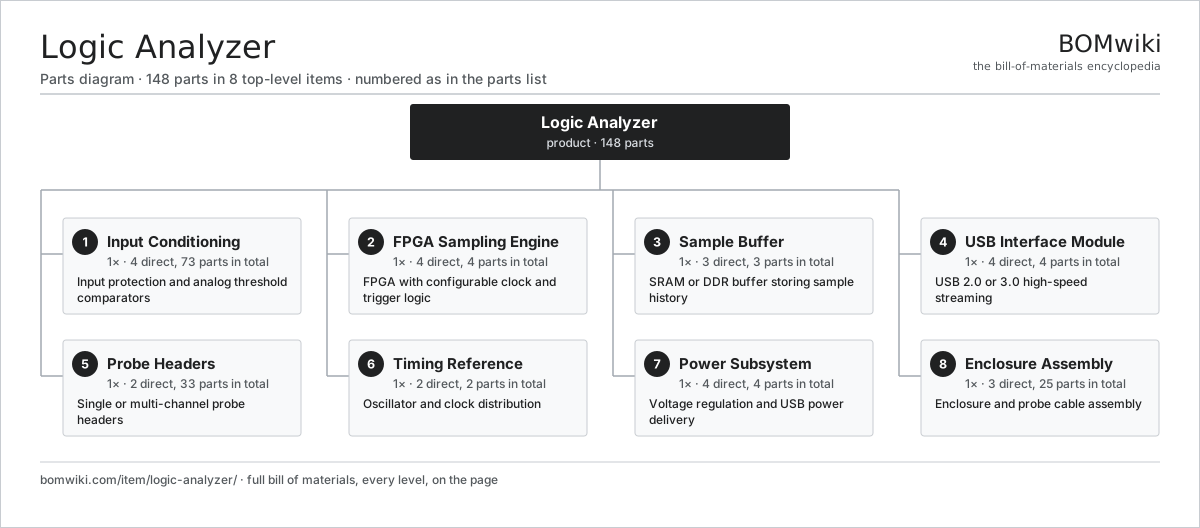
| # | Part | Qty | What it does |
|---|---|---|---|
| 1 | Input Conditioning 4 parts | 1× | Input protection and analog threshold comparators |
| 2 | FPGA Sampling Engine 4 parts | 1× | FPGA with configurable clock and trigger logic |
| 3 | Sample Buffer 3 parts | 1× | SRAM or DDR buffer storing sample history |
| 4 | USB Interface Module 4 parts | 1× | USB 2.0 or 3.0 high-speed streaming |
| 5 | Probe Headers 2 parts | 1× | Single or multi-channel probe headers |
| 6 | Timing Reference 2 parts | 1× | Oscillator and clock distribution |
| 7 | Power Subsystem 4 parts | 1× | Voltage regulation and USB power delivery |
| 8 | Enclosure Assembly 3 parts | 1× | Enclosure and probe cable assembly |
3D model
No 3D model yet. Have a CAD file of this? Add a 3D model. STL renders right on this page; STEP, FreeCAD, and OpenSCAD sources are welcome too (openly licensed, like all 3D models on BOMwiki).
Build & assembly graph
expand / collapse · shared sub-assemblies converge · links to related products · est. labourTap an assembly to expand/collapse · tap a part to open it · use “Open page” for any node · drag to pan, scroll to zoom.
Bill of materials for Logic Analyzer
8 top-level lines · 34 rows shown · 148 parts total · indented to 3 levels| # | Item / sub-assembly | Part no. | Qty/assy | Ext. qty | Parts | Type |
|---|---|---|---|---|---|---|
| 1 | Input Conditioning 4 parts | logic-analyzer-input-stage | 1× | 1 | 73 | assembly |
| 1.1 | TVS Diode Array | logic-analyzer-esd-diode | 32× | 32 | · | part |
| 1.2 | Precision Comparator | logic-analyzer-threshold-comp | 8× | 8 | · | part |
| 1.3 | Voltage Divider | logic-analyzer-divider-network | 32× | 32 | · | part |
| 1.4 | Input Buffer | logic-analyzer-input-buffer | 1× | 1 | · | part |
| 2 | FPGA Sampling Engine 4 parts | logic-analyzer-fpga-sampler | 1× | 1 | 4 | assembly |
| 2.1 | FPGA Fabric | logic-analyzer-fpga | 1× | 1 | · | part |
| 2.2 | PLL Clock Generator | logic-analyzer-pll-clock | 1× | 1 | · | part |
| 2.3 | Trigger State Machine | logic-analyzer-trigger-logic | 1× | 1 | · | part |
| 2.4 | MCU Bridge Controller | logic-analyzer-mcu-interface | 1× | 1 | · | part |
| 3 | Sample Buffer 3 parts | logic-analyzer-memory | 1× | 1 | 3 | assembly |
| 3.1 | Dual-Port SRAM | logic-analyzer-sram | 1× | 1 | · | part |
| 3.2 | DDR Memory Controller | logic-analyzer-ddr-controller | 1× | 1 | · | part |
| 3.3 | Memory Arbiter | logic-analyzer-mem-arbiter | 1× | 1 | · | part |
| 4 | USB Interface Module 4 parts | logic-analyzer-usb-interface | 1× | 1 | 4 | assembly |
| 4.1 | USB Physical Layer | logic-analyzer-usb-phy | 1× | 1 | · | part |
| 4.2 | USB Host Controller | logic-analyzer-usb-controller | 1× | 1 | · | part |
| 4.3 | USB Type-C Connector | logic-analyzer-usb-connector | 1× | 1 | · | part |
| 4.4 | USB ESD Protection | logic-analyzer-usb-esd | 1× | 1 | · | part |
| 5 | Probe Headers 2 parts | logic-analyzer-probe-connectors | 1× | 1 | 33 | assembly |
| 5.1 | Test Point Header | logic-analyzer-header-pins | 32× | 32 | · | part |
| 5.2 | Shrouded Connector | logic-analyzer-pod-connector | 1× | 1 | · | part |
| 6 | Timing Reference 2 parts | logic-analyzer-timing-reference | 1× | 1 | 2 | assembly |
| 6.1 | Crystal Oscillator | logic-analyzer-crystal-osc | 1× | 1 | · | part |
| 6.2 | Frequency Divider | logic-analyzer-freq-divider | 1× | 1 | · | part |
| 7 | Power Subsystem 4 parts | logic-analyzer-power-management | 1× | 1 | 4 | assembly |
| 7.1 | Ideal Diode Switch | logic-analyzer-usb-power-switch | 1× | 1 | · | part |
| 7.2 | 3.3V Regulator | logic-analyzer-linear-reg-3v3 | 1× | 1 | · | part |
| 7.3 | 2.5V Regulator | logic-analyzer-linear-reg-2v5 | 1× | 1 | · | part |
| 7.4 | Bulk Capacitor Bank | logic-analyzer-bulk-caps | 1× | 1 | · | part |
| 8 | Enclosure Assembly 3 parts | logic-analyzer-housing | 1× | 1 | 25 | assembly |
| 8.1 | Case Enclosure | logic-analyzer-case-shell | 1× | 1 | · | part |
| 8.2 | Shielded Probe Cable | logic-analyzer-probe-cable | 8× | 8 | · | part |
| 8.3 | Interchangeable Probe Tip | logic-analyzer-probe-tips | 16× | 16 | · | part |
Something wrong in this list? Report a problem with this BOM.
Sourcing: possible vendors
Browse the supplier directory → Prices, MOQ, and lead times are algorithmic estimates, not quotes, and not claims about these companies. Company mappings are curated by keyword; est. price band $20–$3k. How estimates work| Vendor | HQ | Specialty | MOQ | Lead time |
|---|---|---|---|---|
| dell.com ↗ | Round Rock, US | Computers & infrastructure | 1,000 units | 8–14 wks |
|
🇺🇸HP
hp.com ↗
|
Palo Alto, US | Computers & printers | 1,000 units | 8–14 wks |
|
🇨🇳Lenovo
lenovo.com ↗
|
Beijing, CN | Computers | 1,000 units | 8–14 wks |
|
🇹🇼ASUS
asus.com ↗
|
Taipei, TW | Computers & components | 1,000 units | 8–14 wks |
|
🇨🇳Foxconn
foxconn.com ↗
|
Shenzhen, CN | Electronics contract mfg | 1,000 units | 8–14 wks |
1,110-word article