Lollipop Forming Machine
ProductOverview
A lollipop forming machine is a production-grade candy apparatus that takes pre-made molten candy rope, cuts and shapes it into lollipops using precision dies, inserts sticks, and cools the finished candies all in a single continuous process. The system combines rope extrusion, die-form shaping, stick insertion, and drum cooling into a synchronized workflow driven by a single servo motor. Output ranges from 600–1,200 lollipops per hour depending on die configuration and cavity count. Lollipop shapes are determined by interchangeable die inserts; changeover takes 15–30 minutes and requires no recalibration of the machine.
The lollipop former is the standard choice for medium- to high-volume lollipop production in North America and Europe. It offers superior speed and consistency compared to hand-rolling, and greater recipe and shape flexibility than fixed single-cavity presses. Most confectioners use lollipop formers as part of a larger production line, with upstream gummy deposition or hard-candy cooking feeding into the rope sizer.
How it works
The production cycle begins at the Rope Sizer & Extruder, where molten candy (heated to 70–85 °C) is forced through a precision die by a rotating single-flight screw. The heating barrel is divided into three zones: zone 1 melts the solid input, zone 2 homogenizes and conditions, and zone 3 equilibrates temperature at the die exit. The continuous rope emerges at 5–20 mm diameter and drops onto the rotating die drum.
The drum is a horizontal cylinder 300 mm in diameter with 8–16 hemispherical or flat cavities drilled radially across its width. As the drum rotates in sync with the rope feed speed, a cavity aligns beneath the falling rope and receives a measured length (approximately 30–50 mm). A descending platen then closes the cavity, cutting off the rope and compressing the candy into a sphere, oval, or flat shape. Chilled water (5–10 °C) flows through both the drum and platen, setting the lollipop surface to ~40 °C in 3–5 seconds so it can be handled without distortion.
As the drum continues its rotation, the formed lollipop is now positioned under the Stick Insertion Unit. A pneumatically driven gripper seizes the warm lollipop (avoiding deformation), and a pneumatic piston pushes a wooden or paper stick downward into a pre-indent on the lollipop's surface. Insertion depth is adjustable via a mechanical stop on the nozzle; typical depth is 10–15 mm for a 20 mm lollipop.
The formed and sticked lollipop then rolls onto the Cooling & Conveying Drum, a large rotating cylinder with an elastomer friction surface. Chilled water circulates inside the drum, cooling the lollipop from 40 °C to <20 °C in 2–3 minutes of drum rotation. By the time the lollipop exits the drum onto a takeaway conveyor, it is firm enough for wrapping or packaging.
Drive synchronization
All moving parts, rope extrusion speed, die drum rotation, stick insertion timing, and cooling drum speed, are mechanically synchronized by a single servo motor (1.5 kW) via a 10:1 planetary gearbox and HTD 5M belts. The servo speed is continuously adjusted by the PLC based on product weight feedback from an optional inline scale, or manually via the touchscreen. This master-slave architecture eliminates the complexity of multiple independent motors while maintaining tight cycle timing.
Control and user interface
The control cabinet contains a Siemens S7-1200 PLC, servo amplifier, pneumatic solenoid driver board, and 7-inch touchscreen HMI. The operator enters recipe parameters, rope diameter (die orifice size), forming pressure, cooling target, and cycle time, and the PLC adjusts servo speed, pneumatic valve hold times, and solenoid timing. Safety interlocks prevent unsafe states: if a gripper jam occurs, the PLC detects pressure overshoot and halts the main drive, triggering an audible alarm. Emergency stop buttons (E-stop) on the machine frame cut power to all motors and pilot solenoids.
Interchangeable die blocks and shape variety
Lollipop dies are precision-engineered aluminum or ductile iron blocks with cavity patterns machined to tolerances of ±0.1 mm. A 10 mm sphere die differs from a 12 mm oval or flat die; swapping dies requires removing the die drum from its bearings, unbolting the old drum, installing the new one, and updating the rope diameter on the HMI. Most confectioners maintain a library of 5–10 dies for seasonal flavors and promotional shapes. Each die costs €500–1,500 depending on cavity count and material.
Rope extrusion and die orifice control
The rope sizer extrudes continuous candy rope at 5–20 mm diameter, controlled by the orifice size of the extrusion die. A 5 mm die produces thin rope suitable for small lollipops; a 20 mm die is used for large bulk candy or economy lollipops. Changing die orifice requires removing the die head (quick-change coupling), unscrewing the die insert, installing a new one, and re-torquing. Orifice changes alone take 5–10 minutes; if coupled with a drum change, total setup time is 30–45 minutes.
Cooling and demolding
The cooling drum is the critical path for throughput. Faster cooling means faster drum rotation, which means higher overall output. A chiller unit (not included) that delivers 5–10 °C water at 1–2 bar flow rate is standard in high-volume plants. Some facilities use ambient air only (lower capex) but are limited to 500–600 lollipops/hour. With active chilling, the same machine achieves 1,000–1,200/hour.
Production metrics and typical line integration
A mid-size lollipop former with 12-cavity dies and 4-second cycle time produces 180 lollipops per minute, or 10,800 per hour. Most plants run two 8-hour shifts (21,600/day) or three 8-hour shifts (32,400/day). The machine is often paired with a color and flavor mixing station upstream, and a wrapper or packaging machine downstream. Total installed line cost for rope + form + wrap is approximately €150,000–200,000.
Maintenance and wear
The extrusion die orifice is subject to abrasion and occasional partial blockage from hard candy fragments; cleaning with hot water and a soft brush is routine. The metering screw bearing sees continuous thermal cycling and is regreased every 500 operating hours. The drum friction coating wears gradually and is resurfaced or replaced every 2–3 years (cost ~€2,000). Motor and gearbox life expectancy is 10+ years with regular maintenance.
Lollipop Forming Machine parts and their functions
7 top-level parts · 94 parts in total · full bill of materials below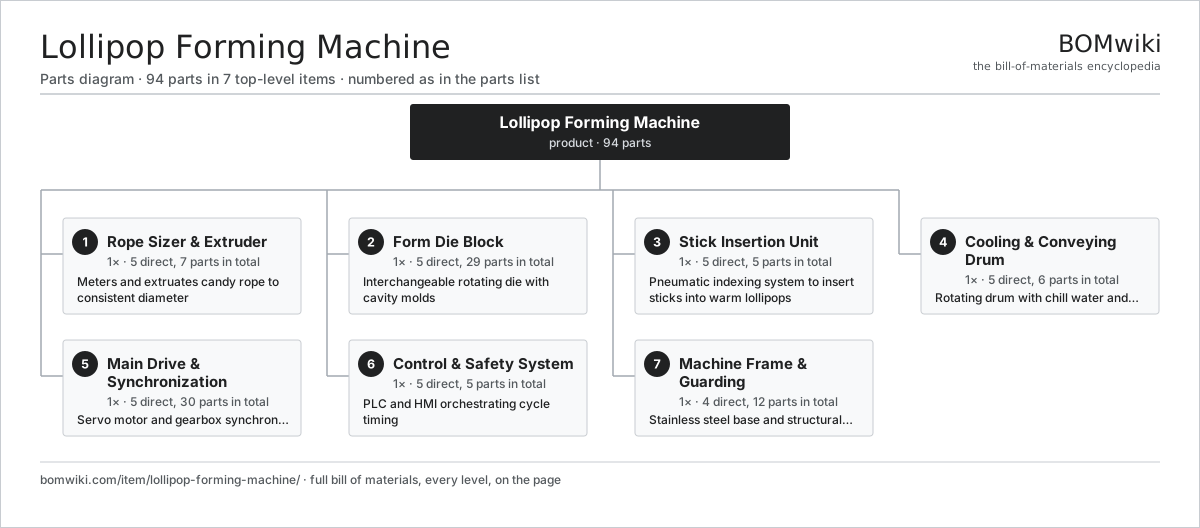
| # | Part | Qty | What it does |
|---|---|---|---|
| 1 | Rope Sizer & Extruder 5 parts | 1× | Meters and extruates candy rope to consistent diameter |
| 2 | Form Die Block 5 parts | 1× | Interchangeable rotating die with cavity molds |
| 3 | Stick Insertion Unit 5 parts | 1× | Pneumatic indexing system to insert sticks into warm lollipops |
| 4 | Cooling & Conveying Drum 5 parts | 1× | Rotating drum with chill water and conveyor surface |
| 5 | Main Drive & Synchronization 5 parts | 1× | Servo motor and gearbox synchronizing all moving parts |
| 6 | Control & Safety System 5 parts | 1× | PLC and HMI orchestrating cycle timing |
| 7 | Machine Frame & Guarding 4 parts | 1× | Stainless steel base and structural support |
3D model
No 3D model yet. Have a CAD file of this? Add a 3D model. STL renders right on this page; STEP, FreeCAD, and OpenSCAD sources are welcome too (openly licensed, like all 3D models on BOMwiki).
Build & assembly graph
expand / collapse · shared sub-assemblies converge · links to related products · est. labourTap an assembly to expand/collapse · tap a part to open it · use “Open page” for any node · drag to pan, scroll to zoom.
Bill of materials for Lollipop Forming Machine
7 top-level lines · 49 rows shown · 94 parts total · indented to 3 levels| # | Item / sub-assembly | Part no. | Qty/assy | Ext. qty | Parts | Type |
|---|---|---|---|---|---|---|
| 1 | Rope Sizer & Extruder 5 parts | lollipop-forming-machine-rope-sizer | 1× | 1 | 7 | assembly |
| 1.1 | Extrusion Barrel | lollipop-forming-machine-heating-barrel | 1× | 1 | · | part |
| 1.2 | Metering Screw | lollipop-forming-machine-screw | 1× | 1 | · | part |
| 1.3 | Extrusion Die | lollipop-forming-machine-extrusion-die | 1× | 1 | · | part |
| 1.4 | Motor Housing | motor-housing | 1× | 1 | · | part |
| 1.5 | Heating Element | heating-element | 3× | 3 | · | part |
| 2 | Form Die Block 5 parts | lollipop-forming-machine-die-block | 1× | 1 | 29 | assembly |
| 2.1 | Die Drum | lollipop-forming-machine-die-drum | 1× | 1 | · | part |
| 2.2 | Forming Platen | lollipop-forming-machine-forming-head | 1× | 1 | · | part |
| 2.3 | Servo Motor 4 parts | servo-motor | 1× | 1 | 24 | assembly |
| 2.3.1 | Stator Assembly 3 parts + deeper › | stator-assembly | 1× | 1 | 3 | assembly |
| 2.3.2 | Rotor Assembly 4 parts + deeper › | rotor-assembly | 1× | 1 | 19 | assembly |
| 2.3.3 | Encoder | encoder | 1× | 1 | · | part |
| 2.3.4 | Motor Housing | motor-housing | 1× | 1 | · | part |
| 2.4 | Chilled Water Circuit | lollipop-forming-machine-coolant-jacket | 1× | 1 | · | part |
| 2.5 | Ball Bearing | ball-bearing | 2× | 2 | · | part |
| 3 | Stick Insertion Unit 5 parts | lollipop-forming-machine-stick-inserter | 1× | 1 | 5 | assembly |
| 3.1 | Gripper Jaws | lollipop-forming-machine-gripper-jaw | 1× | 1 | · | part |
| 3.2 | Stick Hopper | lollipop-forming-machine-stick-magazine | 1× | 1 | · | part |
| 3.3 | Stick Guide Nozzle | lollipop-forming-machine-insertion-nozzle | 1× | 1 | · | part |
| 3.4 | Insertion Cylinder | lollipop-forming-machine-pneumatic-cylinder | 1× | 1 | · | part |
| 3.5 | Connector | connector | 1× | 1 | · | part |
| 4 | Cooling & Conveying Drum 5 parts | lollipop-forming-machine-cooling-drum | 1× | 1 | 6 | assembly |
| 4.1 | Drum Shell | lollipop-forming-machine-drum-shell | 1× | 1 | · | part |
| 4.2 | Drum Bearing Block | lollipop-forming-machine-drum-bearing | 2× | 2 | · | part |
| 4.3 | Drum Drive Pulley | lollipop-forming-machine-drum-pulley | 1× | 1 | · | part |
| 4.4 | Drum Friction Coating | lollipop-forming-machine-drum-surface | 1× | 1 | · | part |
| 4.5 | Coolant Circulation Pump | lollipop-forming-machine-coolant-pump | 1× | 1 | · | part |
| 5 | Main Drive & Synchronization 5 parts | lollipop-forming-machine-drive-unit | 1× | 1 | 30 | assembly |
| 5.1 | Servo Motor 4 parts | servo-motor | 1× | 1 | 24 | assembly |
| 5.1.1 | Stator Assembly 3 parts + deeper › | stator-assembly | 1× | 1 | 3 | assembly |
| 5.1.2 | Rotor Assembly 4 parts + deeper › | rotor-assembly | 1× | 1 | 19 | assembly |
| 5.1.3 | Encoder | encoder | 1× | 1 | · | part |
| 5.1.4 | Motor Housing | motor-housing | 1× | 1 | · | part |
| 5.2 | Planetary Gearbox | lollipop-forming-machine-planetary-gearbox | 1× | 1 | · | part |
| 5.3 | Drive Belt | drive-belt | 2× | 2 | · | part |
| 5.4 | Belt Tensioner | lollipop-forming-machine-tensioner | 2× | 2 | · | part |
| 5.5 | Flexible Shaft Coupler | lollipop-forming-machine-shaft-coupler | 1× | 1 | · | part |
| 6 | Control & Safety System 5 parts | lollipop-forming-machine-control-cabinet | 1× | 1 | 5 | assembly |
| 6.1 | Microcontroller | mcu | 1× | 1 | · | part |
| 6.2 | Servo Amplifier | lollipop-forming-machine-servo-drive | 1× | 1 | · | part |
| 6.3 | Bare PCB | pcb-bare | 1× | 1 | · | part |
| 6.4 | Power Supply | power-supply | 1× | 1 | · | part |
| 6.5 | LCD Panel | lcd-panel | 1× | 1 | · | part |
| 7 | Machine Frame & Guarding 4 parts | lollipop-forming-machine-frame | 1× | 1 | 12 | assembly |
| 7.1 | Sheet Metal Panel | sheet-panel | 4× | 4 | · | part |
| 7.2 | Fastener Set | fastener-set | 3× | 3 | · | part |
| 7.3 | Vibration Isolator Feet | lollipop-forming-machine-feet | 4× | 4 | · | part |
| 7.4 | Wire Bundle | wire-bundle | 1× | 1 | · | part |
Something wrong in this list? Report a problem with this BOM.
Sourcing: possible vendors
Browse the supplier directory → Prices, MOQ, and lead times are algorithmic estimates, not quotes, and not claims about these companies. Company mappings are curated by keyword; est. price band $1k–$500k. How estimates work| Vendor | HQ | Specialty | MOQ | Lead time |
|---|---|---|---|---|
| gea.com ↗ | Düsseldorf, DE | Process technology | 20 units | 12–20 wks |
| buhlergroup.com ↗ | Uzwil, CH | Food & materials processing | 20 units | 12–20 wks |
| tetrapak.com ↗ | Pully, CH | Food packaging & processing | 20 units | 12–20 wks |
| jbtc.com ↗ | Chicago, US | Food processing equipment | 20 units | 12–20 wks |
| alfalaval.com ↗ | Lund, SE | Heat transfer & separation | 20 units | 12–20 wks |
1,151-word article