Machine Vision Camera
ProductOverview
A machine vision camera is the image source in industrial inspection, robot guidance, and measurement systems. It differs from a consumer camera in what it refuses to do: no autofocus, no auto-exposure surprises, no compression artefacts, no unpredictable timing. A production line photographing 20 bottles per second needs every frame taken at an exact microsecond, with identical settings, delivered raw to a PC that decides pass or fail before the next bottle arrives. Everything in the design serves determinism.
The camera is three stacked boards in a palm-sized machined block: the Sensor Board with the imager, the Processing Board with the FPGA, and the Interface and I/O Board with the link and isolated I/O, all inside the Industrial Housing behind a C-mount Lens Mount.
Global shutter
The defining component is the global-shutter CMOS Image Sensor. A rolling-shutter sensor (as in phones) exposes rows sequentially, so anything moving during readout skews and smears, a bottle moving at 1 m/s shifts measurably between the first and last row. A global-shutter pixel adds a shielded in-pixel storage node: every pixel starts and stops integrating at the same instant, then reads out from storage at leisure. Moving objects are frozen in correct geometry, which is what makes the image usable for measurement rather than just viewing. Typical sensors in this class are 5 MP, 2/3-inch, 3.45 µm pixels (the Sony IMX264 generation), running around 75 fps at full resolution with exposures as short as 10 µs.
Image quality at the measurement level depends on small physical details: the Sensor Alignment Frame holds the die parallel to the lens flange within tens of microns so focus is uniform across the field; the Low-Noise LDO Bank keeps switching noise off the analog rails, where millivolts become visible row noise; and the Thermal Management path matters because dark current doubles roughly every 6–8 °C of sensor temperature.
The FPGA pipeline
Raw pixels stream from the sensor into the FPGA at several gigabits per second. The FPGA applies the fixed pipeline, black-level offset, gain, defect-pixel substitution, optional binning or region-of-interest cropping, packetisation, in hardware, at line rate, with cycle-exact timing. There is deliberately no operating system in the image path. The DDR Frame Buffer buffer absorbs the mismatch when the sensor briefly outruns the link, and the Configuration Flash holds the bitstream plus user parameter sets so a camera power-cycles back into a validated configuration.
The register map the FPGA exposes follows GenICam, the industry standard that makes every compliant camera look the same to software: one API enumerates features (exposure, gain, trigger mode) regardless of vendor, over GigE Vision or USB3 Vision transport.
Triggering and I/O
Hardware triggering is the feature that separates this class of camera from webcams. A photoelectric sensor on the conveyor fires when a part crosses the line; the pulse enters through the Opto-Isolated I/O Channel on the M8 connector, and the camera begins exposure within microseconds, with sub-microsecond jitter. The opto-isolated output fires the strobe light, often with a programmed delay so a 50 µs LED flash lands exactly inside a 60 µs exposure, short flash plus short exposure is how fast-moving parts are imaged sharply while rejecting ambient light. Isolation matters because the trigger source is typically a 24 V PLC circuit electrically distinct from camera logic, and the TVS Protection Array absorbs the surges that factory wiring delivers.
GigE Vision cameras add IEEE 1588 precision time protocol, letting multiple cameras on one network expose simultaneously to microsecond agreement, the basis of multi-view and stereo rigs.
Interface choice
GigE Vision runs 100 m over Cat6A with power over the same cable (PoE), which suits factory topologies, at ~115 MB/s, about 22 fps for this 5 MP sensor, so full sensor speed needs USB3 Vision (5 Gbit/s, ~3 m cables) or newer 2.5/5/10 GigE variants. Both use screw-locking connectors on the Locking Data Receptacle receptacle and drag-chain-rated Data Cable cabling, because cameras ride robot wrists through millions of flex cycles.
Mechanical conventions
The 29×29 mm body cross-section, C-mount thread, and face-pattern mounting holes are de facto standards across vendors, so cameras interchange in fixtures. The C-mount's 17.526 mm flange distance is trimmed per camera with the Back-Focus Shim Set set; in calibrated metrology setups, replacing a camera without re-shimming shifts focus and scale. The Body Shell doubles as the heatsink, there is no fan, since fans mean vibration and dust, and the Temperature Sensor is readable over GenICam so the inspection system can flag thermal drift before measurements do.
Machine Vision Camera parts and their functions
8 top-level parts · 348 parts in total · full bill of materials below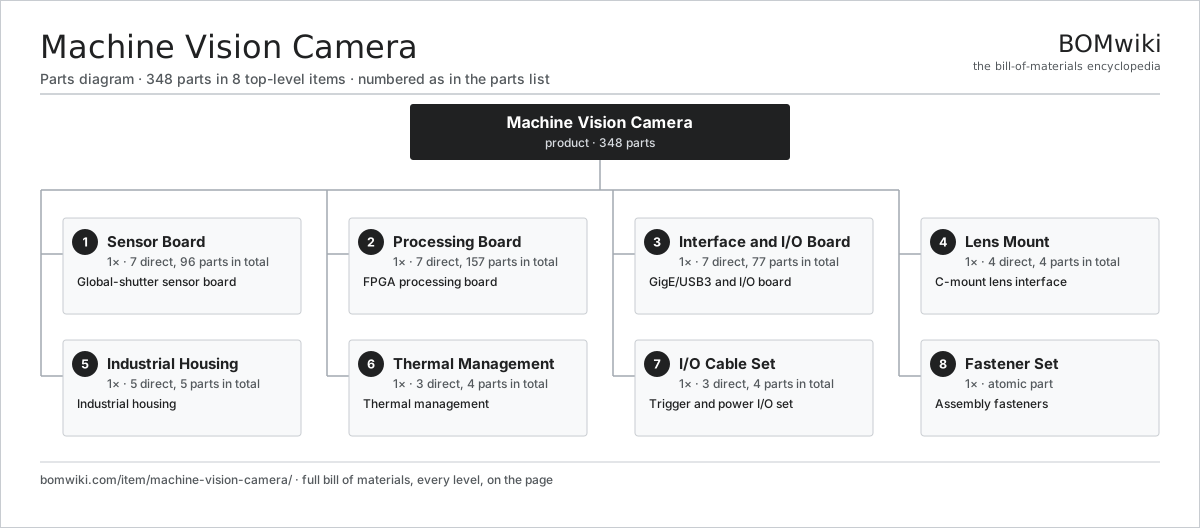
| # | Part | Qty | What it does |
|---|---|---|---|
| 1 | Sensor Board 7 parts | 1× | Global-shutter sensor board |
| 2 | Processing Board 7 parts | 1× | FPGA processing board |
| 3 | Interface and I/O Board 7 parts | 1× | GigE/USB3 and I/O board |
| 4 | Lens Mount 4 parts | 1× | C-mount lens interface |
| 5 | Industrial Housing 5 parts | 1× | Industrial housing |
| 6 | Thermal Management 3 parts | 1× | Thermal management |
| 7 | I/O Cable Set 3 parts | 1× | Trigger and power I/O set |
| 8 | Fastener Set | 1× | Assembly fasteners |
3D model
No 3D model yet. Have a CAD file of this? Add a 3D model. STL renders right on this page; STEP, FreeCAD, and OpenSCAD sources are welcome too (openly licensed, like all 3D models on BOMwiki).
Build & assembly graph
expand / collapse · shared sub-assemblies converge · links to related products · est. labourTap an assembly to expand/collapse · tap a part to open it · use “Open page” for any node · drag to pan, scroll to zoom.
Bill of materials for Machine Vision Camera
8 top-level lines · 44 rows shown · 348 parts total · indented to 3 levels| # | Item / sub-assembly | Part no. | Qty/assy | Ext. qty | Parts | Type |
|---|---|---|---|---|---|---|
| 1 | Sensor Board 7 parts | machine-vision-camera-sensor-board | 1× | 1 | 96 | assembly |
| 1.1 | CMOS Image Sensor | image-sensor | 1× | 1 | · | part |
| 1.2 | Bare PCB | pcb-bare | 1× | 1 | · | part |
| 1.3 | Sensor Alignment Frame | machine-vision-camera-sensor-socket | 1× | 1 | · | part |
| 1.4 | Low-Noise LDO Bank | machine-vision-camera-ldo-bank | 1× | 1 | · | part |
| 1.5 | Pixel Clock Oscillator | machine-vision-camera-osc | 1× | 1 | · | part |
| 1.6 | SMD Passive (R/C/L) | smd-passives | 90× | 90 | · | part |
| 1.7 | Connector | connector | 1× | 1 | · | part |
| 2 | Processing Board 7 parts | machine-vision-camera-processing-board | 1× | 1 | 157 | assembly |
| 2.1 | FPGA | machine-vision-camera-fpga | 1× | 1 | · | part |
| 2.2 | DDR Frame Buffer | machine-vision-camera-ddr | 1× | 1 | · | part |
| 2.3 | Configuration Flash | machine-vision-camera-config-flash | 1× | 1 | · | part |
| 2.4 | Microcontroller | mcu | 1× | 1 | · | part |
| 2.5 | Bare PCB | pcb-bare | 1× | 1 | · | part |
| 2.6 | SMD Passive (R/C/L) | smd-passives | 150× | 150 | · | part |
| 2.7 | Connector | connector | 2× | 2 | · | part |
| 3 | Interface and I/O Board 7 parts | machine-vision-camera-interface-board | 1× | 1 | 77 | assembly |
| 3.1 | Link PHY / Controller | machine-vision-camera-phy | 1× | 1 | · | part |
| 3.2 | Locking Data Receptacle | machine-vision-camera-rj45 | 1× | 1 | · | part |
| 3.3 | M8 I/O Receptacle | machine-vision-camera-m8-io | 1× | 1 | · | part |
| 3.4 | Opto-Isolated I/O Channel | machine-vision-camera-optocoupler | 2× | 2 | · | part |
| 3.5 | TVS Protection Array | machine-vision-camera-tvs-array | 1× | 1 | · | part |
| 3.6 | Bare PCB | pcb-bare | 1× | 1 | · | part |
| 3.7 | SMD Passive (R/C/L) | smd-passives | 70× | 70 | · | part |
| 4 | Lens Mount 4 parts | machine-vision-camera-lens-mount | 1× | 1 | 4 | assembly |
| 4.1 | C-Mount Ring | machine-vision-camera-cmount-ring | 1× | 1 | · | part |
| 4.2 | Back-Focus Shim Set | machine-vision-camera-backfocus-shim | 1× | 1 | · | part |
| 4.3 | IR-Cut / Window Filter | machine-vision-camera-ir-filter | 1× | 1 | · | part |
| 4.4 | Mount Dust Seal | machine-vision-camera-dust-seal | 1× | 1 | · | part |
| 5 | Industrial Housing 5 parts | machine-vision-camera-housing | 1× | 1 | 5 | assembly |
| 5.1 | Body Shell | machine-vision-camera-body-shell | 1× | 1 | · | part |
| 5.2 | Front Flange | machine-vision-camera-front-flange | 1× | 1 | · | part |
| 5.3 | Rear Cap | machine-vision-camera-rear-cap | 1× | 1 | · | part |
| 5.4 | Mounting Plate | machine-vision-camera-mount-plate | 1× | 1 | · | part |
| 5.5 | Status LED | machine-vision-camera-status-led | 1× | 1 | · | part |
| 6 | Thermal Management 3 parts | machine-vision-camera-thermal | 1× | 1 | 4 | assembly |
| 6.1 | Thermal Gap Pad | machine-vision-camera-thermal-pad | 2× | 2 | · | part |
| 6.2 | Heat Spreader Plate | machine-vision-camera-heat-spreader | 1× | 1 | · | part |
| 6.3 | Temperature Sensor | machine-vision-camera-temp-sensor | 1× | 1 | · | part |
| 7 | I/O Cable Set 3 parts | machine-vision-camera-io-cabling | 1× | 1 | 4 | assembly |
| 7.1 | Data Cable | machine-vision-camera-data-cable | 1× | 1 | · | part |
| 7.2 | Power / Trigger Cable | machine-vision-camera-io-cable | 1× | 1 | · | part |
| 7.3 | Cable Strain Clamp | machine-vision-camera-cable-clamp | 2× | 2 | · | part |
| 8 | Fastener Set | fastener-set | 1× | 1 | · | part |
Something wrong in this list? Report a problem with this BOM.
Related products
same domain, ranked by shared parts 360 Panoramic Camera
339 parts · shares 3 with this page
360 Panoramic Camera
339 parts · shares 3 with this page
 Action Camera
271 parts · shares 3 with this page
Action Camera
271 parts · shares 3 with this page
 Borescope Inspection Camera
169 parts · shares 3 with this page
Borescope Inspection Camera
169 parts · shares 3 with this page
 Dashcam
221 parts · shares 3 with this page
Dashcam
221 parts · shares 3 with this page
 Digital Cinema Camera
305 parts · shares 3 with this page
Digital Cinema Camera
305 parts · shares 3 with this page
 Digital Microscope
88 parts · shares 3 with this page
Digital Microscope
88 parts · shares 3 with this page
Sourcing: possible vendors
Browse the supplier directory → Prices, MOQ, and lead times are algorithmic estimates, not quotes, and not claims about these companies. Company mappings are curated by keyword; est. price band $100–$8k. How estimates work| Vendor | HQ | Specialty | MOQ | Lead time |
|---|---|---|---|---|
|
🇯🇵Canon
canon.com ↗
|
Tokyo, JP | Imaging & optics | 500 units | 10–16 wks |
|
🇯🇵Nikon
nikon.com ↗
|
Tokyo, JP | Imaging & optics | 500 units | 10–16 wks |
|
🇩🇪ZEISS
zeiss.com ↗
|
Oberkochen, DE | Optics & optoelectronics | 500 units | 10–16 wks |
| leica-camera.com ↗ | Wetzlar, DE | Cameras & optics | 500 units | 10–16 wks |
| flir.com ↗ | Wilsonville, US | Thermal imaging | 500 units | 10–16 wks |
827-word article