Maglev Trainset
ProductOverview
A maglev trainset of the electromagnetic-suspension (EMS) type carries no wheels, axles, or traction motors in the conventional sense. Each Car Body wraps around a T-shaped elevated guideway, and rows of Levitation Bogie frames reach under the guideway edges. Electromagnets mounted on those frames pull the vehicle upward toward laminated stator packs fixed to the underside of the guideway, lifting the whole train about 10 mm clear of any mechanical contact. Propulsion comes from the guideway itself: the stator packs carry a three-phase winding that forms one long linear motor, and the vehicle's Levitation Magnet Module modules act as its moving excitation poles. The Shanghai Transrapid line operates this arrangement at 430 km/h in daily service.
Levitation and guidance
The Levitation Magnet System is inherently unstable: an attracting electromagnet either snaps onto the rail or falls away unless its current is actively regulated. Each magnet module therefore carries two Air-Gap Sensor units and a dedicated Magnet Control Unit that samples the air gap several thousand times per second and chops the coil current through an IGBT Power Module stage to hold 10 mm within fractions of a millimetre. A single section runs sixteen such loops, and the system is laid out so that any one magnet, sensor, or controller can fail without the vehicle touching down.
Lateral position is handled separately by the Guidance Magnet System. Horizontal-axis Guidance Magnet units face steel guidance rails on the flanks of the guideway and pull the vehicle back toward centre whenever a Lateral Gap Sensor reports drift, including crosswind loads of the aerodynamic Aerodynamic Nose Cone ends at speed.
Propulsion and braking
Unlike a rotary-motor train, thrust is generated wayside. Substation converters feed a travelling magnetic field into the active stator section ahead of and beneath the train; the field locks onto the vehicle's excitation magnets and drags it forward synchronously. The onboard Propulsion Interface supplies what the wayside needs to do this: Pole Position Sensor units read the stator slot pitch so the converters know the exact pole position, and redundant Vehicle Radio Unit links stream speed and position telegrams to propulsion control. Reversing the field phase turns the motor into a generator, so service braking is regenerative and likewise contact-free. If wayside power is lost entirely, battery-fed Eddy-Current Brake Magnet magnets induce drag in the guidance rails and bring the train to a controlled stop at a designated set-down point.
Suspension and set-down
Magnet control alone would transmit high-frequency corrections straight into the floor, so a Secondary Suspension stage sits between the levitation frames and the body: Air Spring bellows with Hydraulic Damper units, trimmed by Levelling Valve hardware to hold floor height as passengers board, with Coil Spring emergency springs underneath. In curves the Traverse Link and Anti-Roll Link joints let the C-frames follow the guideway while the body sweeps a different path.
When levitation shuts down in a station, the vehicle settles a few millimetres onto the Landing Skid System. Replaceable Landing Skid pads on Skid Carrier mounts slide on a set-down strip; for depot moves a Support Roller set can be deployed to tow the dead vehicle at walking pace.
Onboard power and control
Because there is no pantograph contact at 430 km/h, the Onboard Power Supply system harvests energy from the motor itself. Linear Generator Winding windings embedded in the magnet pole faces pick up slot-harmonic flux and deliver usable power above roughly 100 km/h. Below that, and when parked, Onboard Battery Bank strings carry the magnet load, sized to hold full levitation for several minutes, and a retractable Charging Contact Shoe recharges them from a rail in stations. DC-DC Converter units tie generators and batteries onto the 440 V magnet bus, supervised by BMS Board electronics.
Supervision converges in the Vehicle Control System: a hot-standby pair of Vehicle Control Computer units coordinates the magnet loops, doors, and batteries, while an Absolute Location Unit decodes coded flags on the guideway to fix absolute position within a few centimetres. The train itself is driverless in the conventional sense; an attendant monitors a Attendant Display while the wayside operation control centre commands speed and stopping through the safe radio link.
Maglev Trainset parts and their functions
9 top-level parts · 1,133 parts in total · full bill of materials below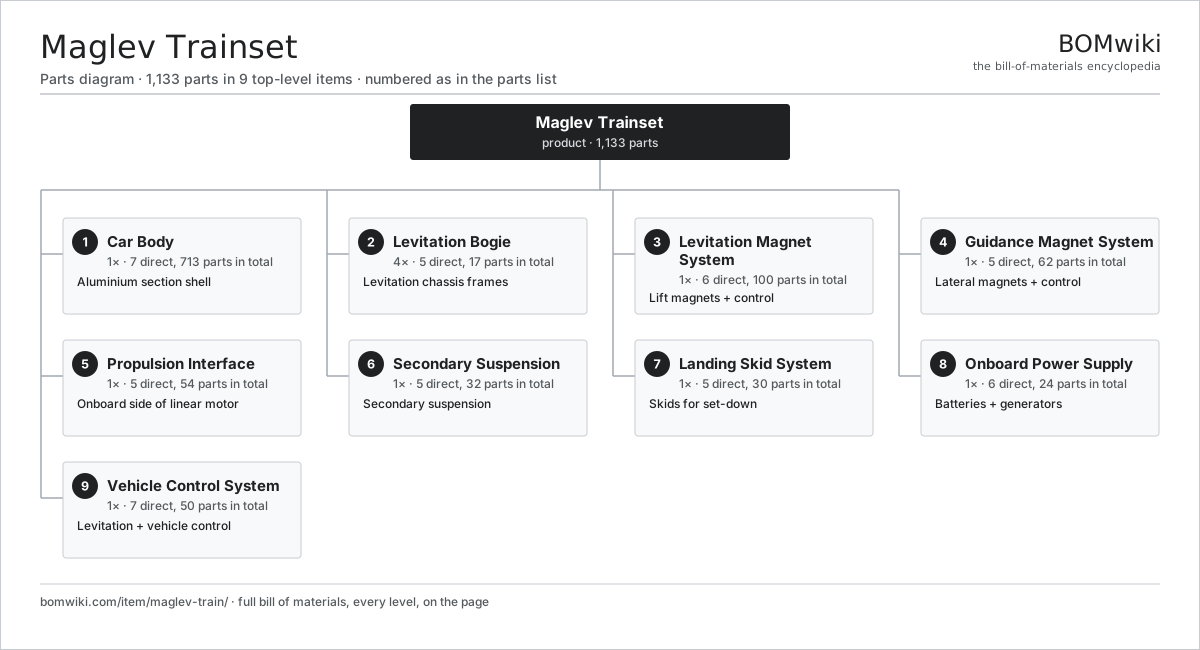
| # | Part | Qty | What it does |
|---|---|---|---|
| 1 | Car Body 7 parts | 1× | Aluminium section shell |
| 2 | Levitation Bogie 5 parts | 4× | Levitation chassis frames |
| 3 | Levitation Magnet System 6 parts | 1× | Lift magnets + control |
| 4 | Guidance Magnet System 5 parts | 1× | Lateral magnets + control |
| 5 | Propulsion Interface 5 parts | 1× | Onboard side of linear motor |
| 6 | Secondary Suspension 5 parts | 1× | Secondary suspension |
| 7 | Landing Skid System 5 parts | 1× | Skids for set-down |
| 8 | Onboard Power Supply 6 parts | 1× | Batteries + generators |
| 9 | Vehicle Control System 7 parts | 1× | Levitation + vehicle control |
Diagrams & photos


_Maglev_train_-_img_01.jpg)

3D model
No 3D model yet. Have a CAD file of this? Add a 3D model. STL renders right on this page; STEP, FreeCAD, and OpenSCAD sources are welcome too (openly licensed, like all 3D models on BOMwiki).
Build & assembly graph
expand / collapse · shared sub-assemblies converge · links to related products · est. labourTap an assembly to expand/collapse · tap a part to open it · use “Open page” for any node · drag to pan, scroll to zoom.
Bill of materials for Maglev Trainset
9 top-level lines · 65 rows shown · 1,133 parts total · indented to 3 levels| # | Item / sub-assembly | Part no. | Qty/assy | Ext. qty | Parts | Type |
|---|---|---|---|---|---|---|
| 1 | Car Body 7 parts | maglev-train-car-body | 1× | 1 | 713 | assembly |
| 1.1 | Aluminium Body Shell | maglev-train-body-shell | 1× | 1 | · | part |
| 1.2 | Aerodynamic Nose Cone | maglev-train-nose-cone | 2× | 2 | · | part |
| 1.3 | Plug Door | maglev-train-plug-door | 4× | 4 | · | part |
| 1.4 | Cabin Window | maglev-train-cabin-window | 24× | 24 | · | part |
| 1.5 | Seat Assembly 5 parts | seat-assembly | 92× | 92 | 7 | assembly |
| 1.5.1 | Seat Frame | seat-frame | 1× | 92 | · | part |
| 1.5.2 | Seat Foam | seat-foam | 2× | 184 | · | part |
| 1.5.3 | Seat Cover | seat-cover | 1× | 92 | · | part |
| 1.5.4 | Seat Motor | seat-motor | 2× | 184 | · | part |
| 1.5.5 | Seat Heater Mat | seat-heater | 1× | 92 | · | part |
| 1.6 | Sheet Metal Panel | sheet-panel | 30× | 30 | · | part |
| 1.7 | Fastener Set | fastener-set | 8× | 8 | · | part |
| 2 | Levitation Bogie 5 parts | maglev-train-levitation-bogie | 4× | 4 | 17 | assembly |
| 2.1 | Levitation Frame | maglev-train-bogie-frame | 1× | 4 | · | part |
| 2.2 | Magnet Bracket | maglev-train-magnet-bracket | 8× | 32 | · | part |
| 2.3 | Anti-Roll Link | maglev-train-anti-roll-link | 2× | 8 | · | part |
| 2.4 | Traverse Link | maglev-train-traverse-link | 2× | 8 | · | part |
| 2.5 | Fastener Set | fastener-set | 4× | 16 | · | part |
| 3 | Levitation Magnet System 6 parts | maglev-train-levitation-system | 1× | 1 | 100 | assembly |
| 3.1 | Levitation Magnet Module | maglev-train-levitation-magnet | 16× | 16 | · | part |
| 3.2 | Air-Gap Sensor | maglev-train-gap-sensor | 32× | 32 | · | part |
| 3.3 | Magnet Control Unit | maglev-train-magnet-controller | 16× | 16 | · | part |
| 3.4 | Copper Winding | copper-winding | 16× | 16 | · | part |
| 3.5 | IGBT Power Module | igbt-module | 16× | 16 | · | part |
| 3.6 | Wire Bundle | wire-bundle | 4× | 4 | · | part |
| 4 | Guidance Magnet System 5 parts | maglev-train-guidance-system | 1× | 1 | 62 | assembly |
| 4.1 | Guidance Magnet | maglev-train-guidance-magnet | 12× | 12 | · | part |
| 4.2 | Lateral Gap Sensor | maglev-train-lateral-sensor | 24× | 24 | · | part |
| 4.3 | Magnet Control Unit | maglev-train-magnet-controller | 12× | 12 | · | part |
| 4.4 | Copper Winding | copper-winding | 12× | 12 | · | part |
| 4.5 | Wire Bundle | wire-bundle | 2× | 2 | · | part |
| 5 | Propulsion Interface 5 parts | maglev-train-propulsion-interface | 1× | 1 | 54 | assembly |
| 5.1 | Pole Position Sensor | maglev-train-pole-sensor | 8× | 8 | · | part |
| 5.2 | Linear Generator Winding | maglev-train-linear-generator | 16× | 16 | · | part |
| 5.3 | Eddy-Current Brake Magnet | maglev-train-eddy-brake | 4× | 4 | · | part |
| 5.4 | Vehicle Radio Unit | maglev-train-radio-unit | 2× | 2 | · | part |
| 5.5 | Connector | connector | 24× | 24 | · | part |
| 6 | Secondary Suspension 5 parts | maglev-train-suspension | 1× | 1 | 32 | assembly |
| 6.1 | Air Spring | maglev-train-air-spring | 8× | 8 | · | part |
| 6.2 | Hydraulic Damper | maglev-train-hydraulic-damper | 8× | 8 | · | part |
| 6.3 | Levelling Valve | maglev-train-levelling-valve | 4× | 4 | · | part |
| 6.4 | Coil Spring | coil-spring | 8× | 8 | · | part |
| 6.5 | Pressure Sensor | pressure-sensor | 4× | 4 | · | part |
| 7 | Landing Skid System 5 parts | maglev-train-landing-system | 1× | 1 | 30 | assembly |
| 7.1 | Landing Skid | maglev-train-landing-skid | 8× | 8 | · | part |
| 7.2 | Skid Carrier | maglev-train-skid-carrier | 8× | 8 | · | part |
| 7.3 | Support Roller | maglev-train-support-roller | 4× | 4 | · | part |
| 7.4 | Ball Bearing | ball-bearing | 8× | 8 | · | part |
| 7.5 | Fastener Set | fastener-set | 2× | 2 | · | part |
| 8 | Onboard Power Supply 6 parts | maglev-train-onboard-power | 1× | 1 | 24 | assembly |
| 8.1 | Onboard Battery Bank | maglev-train-battery-bank | 4× | 4 | · | part |
| 8.2 | DC-DC Converter | maglev-train-dc-converter | 4× | 4 | · | part |
| 8.3 | Charging Contact Shoe | maglev-train-contact-shoe | 4× | 4 | · | part |
| 8.4 | BMS Board | bms-board | 4× | 4 | · | part |
| 8.5 | Power Supply | power-supply | 2× | 2 | · | part |
| 8.6 | Wire Bundle | wire-bundle | 6× | 6 | · | part |
| 9 | Vehicle Control System 7 parts | maglev-train-control-system | 1× | 1 | 50 | assembly |
| 9.1 | Vehicle Control Computer | maglev-train-vehicle-computer | 2× | 2 | · | part |
| 9.2 | Absolute Location Unit | maglev-train-location-unit | 2× | 2 | · | part |
| 9.3 | Attendant Display | maglev-train-cab-display | 2× | 2 | · | part |
| 9.4 | Microcontroller | mcu | 12× | 12 | · | part |
| 9.5 | Bare PCB | pcb-bare | 8× | 8 | · | part |
| 9.6 | SMD Passive (R/C/L) | smd-passives | 8× | 8 | · | part |
| 9.7 | Connector | connector | 16× | 16 | · | part |
Something wrong in this list? Report a problem with this BOM.
Related products
same domain, ranked by shared parts Tram
705 parts · shares 10 with this page
Tram
705 parts · shares 10 with this page
 Commuter EMU
14,010 parts · shares 13 with this page
Commuter EMU
14,010 parts · shares 13 with this page
 Metro Car
1,156 parts · shares 5 with this page
Metro Car
1,156 parts · shares 5 with this page
 Passenger Locomotive
10,641 parts · shares 12 with this page
Passenger Locomotive
10,641 parts · shares 12 with this page
 Track Geometry Car
122 parts · shares 5 with this page
Track Geometry Car
122 parts · shares 5 with this page
 Diesel-Electric Locomotive
181,216 parts · shares 10 with this page
Diesel-Electric Locomotive
181,216 parts · shares 10 with this page
Sourcing: possible vendors
Browse the supplier directory → Prices, MOQ, and lead times are algorithmic estimates, not quotes, and not claims about these companies. Company mappings are curated by keyword; est. price band $500k–$60M. How estimates work| Vendor | HQ | Specialty | MOQ | Lead time |
|---|---|---|---|---|
|
🇨🇳CRRC
crrcgc.cc ↗
|
Beijing, CN | Rolling stock & rail systems | made to order | 40–72 wks |
|
🇫🇷Alstom
alstom.com ↗
|
Saint-Ouen, FR | Rail rolling stock | made to order | 40–72 wks |
| mobility.siemens.com ↗ | Munich, DE | Rail systems | made to order | 40–72 wks |
| stadlerrail.com ↗ | Bussnang, CH | Rail rolling stock | made to order | 40–72 wks |
|
🇺🇸Wabtec
wabteccorp.com ↗
|
Pittsburgh, US | Rail equipment | made to order | 40–72 wks |
759-word article