Magnetic Coupling
ProductOverview
Magnetic couplings transmit torque across a sealed non-magnetic barrier using permanent-magnet fields, eliminating rotating shaft penetration. This enables hermetic sealing, making them ideal for pumping hazardous fluids (caustic, toxic, radioactive), food-contact applications (no lubrication contamination), and cryogenic services (liquid nitrogen at −196 °C).
The principle is elegant: a motor-coupled rotor with permanent magnets induces a rotating magnetic field that synchronously drives an identical load rotor separated by a thin non-magnetic aluminum shroud. No mechanical contact occurs between input and output, enabling absolute hermetic isolation while maintaining torque synchronism.
Industrial applications span chemical transfer (pickling, electroplating), pharmaceutical manufacturing (no particulate shedding), and cryogenic liquid transfer. Cost is higher than mechanical couplings, but total cost of ownership (eliminating dual-seal pump failures, catastrophic chemical spills, production loss) often favors magnetic designs.
Magnetic principle and operation
Radially magnetized permanent magnets (neodymium N52 grade or samarium-cobalt) are affixed to pole pieces on driver and driven rotors. Magnets are arranged in 8–16 pole pairs, alternating north and south around the circumference.
As the driver rotates, the magnetic field polarity pattern also rotates. The driven rotor, immersed in this rotating field, experiences a torque that synchronously drives it forward. The magnetic flux density is typically 0.5–1.2 tesla at the rotor surface, sufficient to transmit 1–500 N·m depending on magnet strength and air gap.
The shroud separates the rotors with 5–50 mm air gap depending on design. Torque transmission is limited by magnetic saturation and pole-piece design; unlike mechanical clutches, magnetic couplings have a smooth slip characteristic. If load torque exceeds magnetic capacity, the driven rotor slips backward relative to the driver, dissipating excess torque as eddy currents in the shroud and rotor steel.
Slip torque (10–20% overload) is typical; the coupling smoothly slips rather than stalling abruptly, protecting downstream machinery. Heat generation during slip is minimal (<2% of transmitted power) due to the absence of sliding friction.
Magnet selection and thermal limits
Neodymium magnets (N52 grade, ~1.4 T remnant flux) are cost-effective and offer strong force in compact envelope. Curie temperature is ~150 °C; operation above this permanently demagnetizes the material. Practical operating range is −20 to +80 °C with N52; above 80 °C, torque capacity degrades ~0.1% per °C.
Samarium-Cobalt magnets (SM2-H grade, ~1.0 T but Curie >300 °C) are specified for high-temperature services (200+ °C continuous). They are more expensive and produce slightly lower force per unit volume, requiring larger couplings for the same torque. Cryogenic services (−196 °C liquid nitrogen) can use either grade; magnetic strength actually increases at cryogenic temperatures, improving torque capacity ~5–10%.
Hermetic sealing advantage
The shroud is a sealed, non-rotating aluminum or composite tube. No shaft penetration means zero risk of seal leakage. This is transformative in chemical service: a centrifugal pump driven by magnetic coupling never contaminates product with bearing seal grease or motor oil. In food contact, organic seals are not required, eliminating compliance risk.
Pressure-sealed shrouds rated to 100 bar are available, enabling submerged operation (submersible pump drive through sealed tank wall). The barrier provides complete electrical isolation, critical when pumping conductive salt solutions or where motor earthing is essential.
Efficiency and thermal behavior
Efficiency is >98% under load (no sliding friction or electric losses). Magnetic coupling efficiency rivals mechanical couplings and exceeds fluid couplings by 5–10%. The small thermal loss (~2% at rated load) is due to eddy currents induced in the shroud and rotor steel by the rotating field; this loss scales with slip percentage and magnet strength.
Continuous operation at 1.1–1.2× rated torque (slight slip) raises shroud temperature moderately; a 50 N·m coupling at 1.1× duty dissipates ~3 kW, raising shroud temperature 10–20 °C above ambient in still air. Heat sinking is passive (radiant and convective cooling through shroud surface); no active cooling is required in normal duty.
Installation and alignment
Magnetic couplings are forgiving of alignment error compared to mechanical shafts. Radial runout of ±0.5 mm and angular misalignment of ±2° do not significantly reduce torque capacity; the magnetic field self-centers the driven rotor. Axial misalignment (axial gap between shroud and rotor) does reduce torque (~1% per mm of increased gap), so shroud position should be maintained within ±2 mm during installation.
Bearing preload is critical; if rotors drift axially, friction from contact with the shroud end cap can create noise and heat. Spring or shim preload on both bearing cartridges maintains axial spacing even under side loads.
Applications and special cases
Chemical transfer pumps rely on magnetic coupling to isolate hazardous fluids (sodium hydroxide 50%, nitric acid 98%, benzene, hydrogen peroxide). A magnetic coupling allows safe maintenance: drain the pump sump, decouple the motor (no shaft withdrawal), change seals on the pump side independently. Total downtime is 2–4 hours versus 8+ hours with traditional shaft-seal pumps.
Submersible motors (sump pumps, mine dewatering) benefit from sealed drives. A submerged motor shaft driving a pump through a magnetic coupling wall penetration requires no dynamic seal; the pump sealing is simplified to static gaskets.
Cryogenic liquid nitrogen transfer systems use magnetic couplings because conventional seals stiffen and fail below −150 °C. Samarium-cobalt or optimized neodymium designs enable reliable 24/7 transfer at −196 °C liquid temperature.
Diagnostics and maintenance
Sealed magnetic couplings have no wearing parts in normal operation. Bearing life is 5000+ hours; thermal behavior is stable over the life. Failure modes are rare: magnet debonding (impact damage), shroud corrosion (seawater or acid mist), or rotor demagnetization (extreme temperature excursion).
Diagnostic indicators are simple:
- Noise increase (grinding sound indicates bearing wear).
- Slip during normal load (suggests magnet loss or shroud gap increase).
- Thermal runaway (coupling temperature >100 °C at constant load indicates slip overload).
Replacement requires motor and load disconnection but no shaft realignment; new coupling drops in place with simple bolt-on process. Total replacement time is 30 minutes.
Magnetic Coupling parts and their functions
6 top-level parts · 25 parts in total · full bill of materials below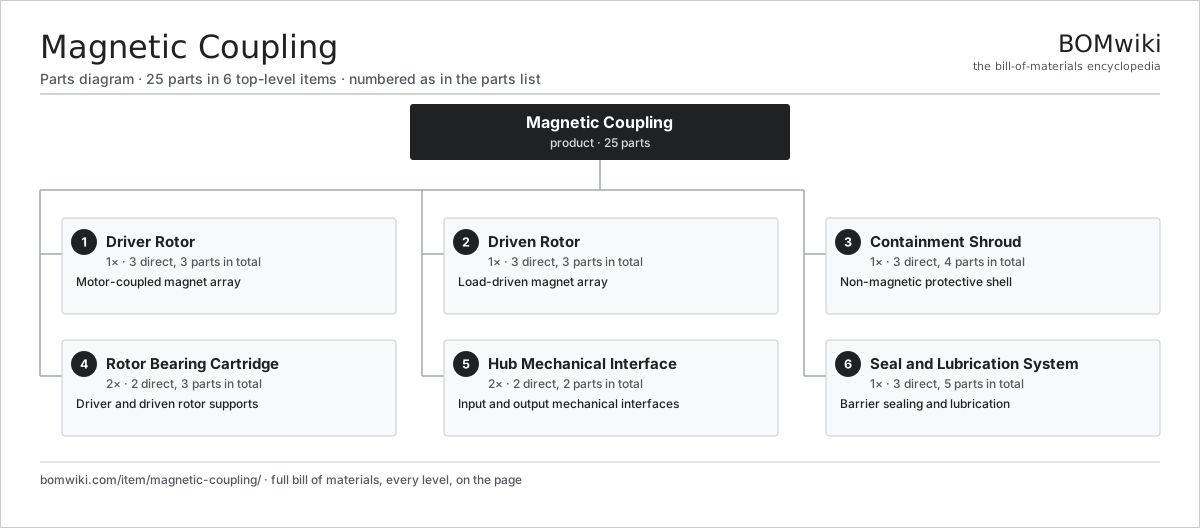
| # | Part | Qty | What it does |
|---|---|---|---|
| 1 | Driver Rotor 3 parts | 1× | Motor-coupled magnet array |
| 2 | Driven Rotor 3 parts | 1× | Load-driven magnet array |
| 3 | Containment Shroud 3 parts | 1× | Non-magnetic protective shell |
| 4 | Rotor Bearing Cartridge 2 parts | 2× | Driver and driven rotor supports |
| 5 | Hub Mechanical Interface 2 parts | 2× | Input and output mechanical interfaces |
| 6 | Seal and Lubrication System 3 parts | 1× | Barrier sealing and lubrication |
3D model
No 3D model yet. Have a CAD file of this? Add a 3D model. STL renders right on this page; STEP, FreeCAD, and OpenSCAD sources are welcome too (openly licensed, like all 3D models on BOMwiki).
Build & assembly graph
expand / collapse · shared sub-assemblies converge · links to related products · est. labourTap an assembly to expand/collapse · tap a part to open it · use “Open page” for any node · drag to pan, scroll to zoom.
Bill of materials for Magnetic Coupling
6 top-level lines · 22 rows shown · 25 parts total · indented to 3 levels| # | Item / sub-assembly | Part no. | Qty/assy | Ext. qty | Parts | Type |
|---|---|---|---|---|---|---|
| 1 | Driver Rotor 3 parts | magnetic-coupling-driver-rotor | 1× | 1 | 3 | assembly |
| 1.1 | Magnet Array | magnetic-coupling-magnet-set | 1× | 1 | · | part |
| 1.2 | Rotor Hub | magnetic-coupling-rotor-hub | 1× | 1 | · | part |
| 1.3 | Rotor Coupling Key | magnetic-coupling-rotor-key | 1× | 1 | · | part |
| 2 | Driven Rotor 3 parts | magnetic-coupling-driven-rotor | 1× | 1 | 3 | assembly |
| 2.1 | Magnet Array | magnetic-coupling-magnet-set | 1× | 1 | · | part |
| 2.2 | Rotor Hub | magnetic-coupling-rotor-hub | 1× | 1 | · | part |
| 2.3 | Driven Coupling Interface | magnetic-coupling-driven-coupling | 1× | 1 | · | part |
| 3 | Containment Shroud 3 parts | magnetic-coupling-containment-shroud | 1× | 1 | 4 | assembly |
| 3.1 | Shroud Tube | magnetic-coupling-shroud-tube | 1× | 1 | · | part |
| 3.2 | Shroud End Cap | magnetic-coupling-shroud-end-caps | 2× | 2 | · | part |
| 3.3 | Fill and Vent Port | magnetic-coupling-fill-drain | 1× | 1 | · | part |
| 4 | Rotor Bearing Cartridge 2 parts | magnetic-coupling-bearing-set | 2× | 2 | 3 | assembly |
| 4.1 | Ball Bearing | ball-bearing | 2× | 4 | · | part |
| 4.2 | Bearing Preload | magnetic-coupling-bearing-preload | 1× | 2 | · | part |
| 5 | Hub Mechanical Interface 2 parts | magnetic-coupling-hub-assembly | 2× | 2 | 2 | assembly |
| 5.1 | Hub Shaft | magnetic-coupling-hub-shaft | 1× | 2 | · | part |
| 5.2 | Coupling Flange | magnetic-coupling-coupling-flange | 1× | 2 | · | part |
| 6 | Seal and Lubrication System 3 parts | magnetic-coupling-seal-system | 1× | 1 | 5 | assembly |
| 6.1 | Oil Seal | oil-seal | 2× | 2 | · | part |
| 6.2 | Shroud Gasket | magnetic-coupling-shroud-gasket | 2× | 2 | · | part |
| 6.3 | Shroud Breather | magnetic-coupling-breather | 1× | 1 | · | part |
Something wrong in this list? Report a problem with this BOM.
Related products
same domain, ranked by shared parts Blow Molding Machine
83 parts · shares 2 with this page
Blown Film Extrusion Line
436 parts · shares 2 with this page
Blow Molding Machine
83 parts · shares 2 with this page
Blown Film Extrusion Line
436 parts · shares 2 with this page
Sourcing: possible vendors
Browse the supplier directory → Prices, MOQ, and lead times are algorithmic estimates, not quotes, and not claims about these companies. Company mappings are curated by keyword; est. price band $5k–$2M. How estimates work| Vendor | HQ | Specialty | MOQ | Lead time |
|---|---|---|---|---|
| atlascopco.com ↗ | Stockholm, SE | Compressors & industrial | 10 units | 12–20 wks |
|
🇦🇹Andritz
andritz.com ↗
|
Graz, AT | Process plants & machinery | 10 units | 12–20 wks |
| buhlergroup.com ↗ | Uzwil, CH | Food & materials processing | 10 units | 12–20 wks |
| gea.com ↗ | Düsseldorf, DE | Process technology | 10 units | 12–20 wks |
| mhi.com ↗ | Tokyo, JP | Heavy machinery | 10 units | 12–20 wks |
1,027-word article