Magnetic Utility Locator
ProductOverview
A magnetic utility locator is a handheld electromagnetic sensor that detects alternating magnetic fields radiated by buried metallic conductors, power cables, telephone lines, water mains, gas pipes, and conduits. Unlike active (signal-injection) locators that require connecting a transmitter to the utility, passive locators work by sensing the 50–60 Hz magnetic field naturally present on energized electrical conductors. This makes passive locators ideal for rapid utility scanning before excavation: an operator walks the probe across the ground, and audio/visual feedback indicates when the probe is above a conductor. Once detected, the operator can mark the utility's location and notify excavators to exercise caution.
Passive magnetic locators are ubiquitous on construction sites, utility right-of-ways, and anywhere pre-excavation utility mapping is required by law. They detect live electrical cables with high sensitivity (0.5–2 meter range) but are blind to non-energized pipes and de-energized cables. For complete utility detection, locators are often used in combination with ground-penetrating radar (GPR) or active signal-injection systems.
How it works
The locator's sensor coils are wound on high-permeability ferrite cores, typically in two perpendicular orientations (X and Y axes). As the probe is moved near a buried power cable carrying alternating 50–60 Hz current, the current creates a circumferential magnetic field that circles the wire (right-hand rule: thumb points along current, fingers curl around the field). This time-varying magnetic field induces a voltage in the secondary coil wound on the ferrite core.
The induced voltage is typically microvolt-scale; the low-noise preamplifier (60 dB gain) boosts this to millivolt range. The bandpass filter (40–400 Hz) rejects DC, low-frequency noise (vibrations), and high-frequency noise (switching power supplies, RF). The filtered signal is then sent to the microcontroller, which:
- Measures RMS voltage on each axis (X and Y).
- Determines field strength by combining RMS values: total field = √(X² + Y²).
- Calculates direction: If the X coil has stronger signal than Y, the utility is running north-south.
- Drives audio feedback: The tone generator produces a pitch proportional to field strength: low-frequency beep for weak fields, high-frequency beep when directly over a cable.
The 8-element LED bar simultaneously shows signal strength: few LEDs lit for weak signals, all LEDs lit when saturated (directly over cable).
Ferrite coil design and frequency response
The dual ferrite-core sensors provide high sensitivity in the 40–400 Hz range (power-line and telephone frequencies). Ferrite is a ceramic material with permeability μ ≈ 2000, meaning magnetic fields are concentrated in the core ~2000× more than free space. A 0.5 inch ferrite rod with 200-turn secondary coil can detect magnetic fields as small as 5 milligauss (5 × 10⁻⁵ Tesla).
The resonance of the coil-capacitor network (LC tank) is tuned to ~60 Hz (North America) or 50 Hz (Europe and Asia), maximizing sensitivity at power-line frequency. Off-resonance frequencies (e.g., cell phone transmitters at 900 MHz) pass through the bandpass filter with minimal gain, reducing false signals.
The dual-axis design provides directional information: if current flows in a cable buried north-south, the circumferential magnetic field is strongest on the east and west sides of the cable, i.e., perpendicular to the cable. The X and Y coils can resolve this: the E-W coil (Y-axis) will pick up the stronger signal than the N-S coil (X-axis), indicating utility direction.
Detection range and utility type
Power cables (most sensitive):
- High-current feeds (100+ A) produce strong 50–60 Hz fields.
- Detection range: 0.5–2 m depending on cable size and burial depth.
- A typical residential power cable (100 A) is detectable at 1 m depth.
- Large transmission cables (500+ A) can be detected at 2–3 m depth.
Telephone and data cables:
- Typically carry <100 mA of audio frequency current (300 Hz − 3 kHz modulation).
- Detection range is shorter: 0.3–1 m.
- Modern fiber-optic cables carry no electrical current; not detectable.
Water and gas pipes:
- Non-metallic (plastic) pipes are invisible.
- Metallic pipes (steel, copper, ductile iron) are conductive but generate no magnetic field unless they are carrying electrical current (rare for passive detection; active locators that inject a signal are needed).
Conduits:
- Empty PVC conduits are non-conductive; not detectable.
- Conduits with electrical wire inside (power feed, security system, etc.) are detectable at cable current.
- Metal conduits are conductive and can be detected if they carry return current (ground bond).
For comprehensive utility location, crews often combine:
- Passive magnetic locator (detects live electrical).
- Active signal-injection locator (operator connects to conductor, sends 8 kHz signal for detection).
- Ground-penetrating radar (GPR) (detects any buried conductive or dielectric structure).
Audio feedback and field operation
The audio tone starts at a low frequency (~200 Hz) when the signal is weak, and sweeps upward (200–800 Hz) as the operator approaches the utility. When directly over a buried cable, the tone reaches maximum frequency and the LED bar saturates. The three-beep sequence confirms the operator is at the utility's location.
Field operation:
- Coarse scan: Operator walks parallel lines spaced 1–2 meters apart, sweeping the probe side-to-side. Audio feedback alerts when a utility is detected.
- Find exact location: Once a signal is heard, operator adjusts position (walking perpendicular to initial scan) until the tone peaks. This marks the utility's centerline.
- Mark and depth estimation: Spray paint marks the ground. The LED bar brightness can be correlated to burial depth (rough estimate): fewer LEDs lit ≈ deeper utility.
- Document and communicate: Marked locations are photographed or drawn on a site map. Excavators are notified of buried utilities before equipment moves.
Limitations and failure modes
Cannot detect:
- De-energized (powered-off) cables.
- Non-conductive pipes (plastic water main, PVC conduit without wire).
- Fiber-optic cables (no electrical current).
- Shielded cables with grounded shield (field cancelled; only active locators work).
False positives:
- Nearby power lines: A distribution line 20 m away can create ambient 50–60 Hz fields; the locator may trigger if operator is not careful to interpret direction.
- RF interference: Cell phone towers, broadcast antennas, or switching power supplies radiate noise. Bandpass filtering (40–400 Hz) rejects most, but massive RF sources can saturate the Preamplifier Module.
- Ground-coupled current loops: If a live cable runs parallel to a ground rod, return current through the earth can be detected; this is legitimate (it indicates a utility) but can be confusing if the operator expected only a direct cable.
Depth estimation challenges: The LED bar brightness is a rough proxy for distance, but burial depth depends on cable size, shielding, and soil conductivity. A small phone cable at 0.3 m depth can appear weaker than a large power cable at 1.5 m depth. Professional locators also use active signal-injection or GPR to confirm depth.
Safety and electromagnetic exposure
Passive locators operate at power-line frequencies (50–60 Hz) and generate no RF fields; they are non-radiating and safe. The detected 50–60 Hz fields are present naturally due to utility operation; locator use does not increase exposure.
However, operators should be aware of live-cable hazards when using active locators (which inject signals) or when excavating near detected utilities. Routine procedure is to call the utility locate service (typically managed by the US 811 national clearinghouse or equivalents in other countries) before excavation; professional locators use GPS-marked records and advanced equipment to verify utility locations before any digging occurs.
Integration with site mapping and GIS
Modern construction projects integrate utility locates with GIS (geographic information systems):
- Passive and active locator findings are marked and photographed with GPS coordinates.
- Locations are uploaded to a site GIS database.
- Excavation plans are overlaid on the GIS map, highlighting buried utilities as exclusion zones.
- Real-time updates allow crews in the field to access current utility maps on tablets.
This workflow, standard on infrastructure megaprojects, has reduced utility strikes (damages to buried lines) by 30–50% compared to purely manual locate methods.
Magnetic Utility Locator parts and their functions
7 top-level parts · 24 parts in total · full bill of materials below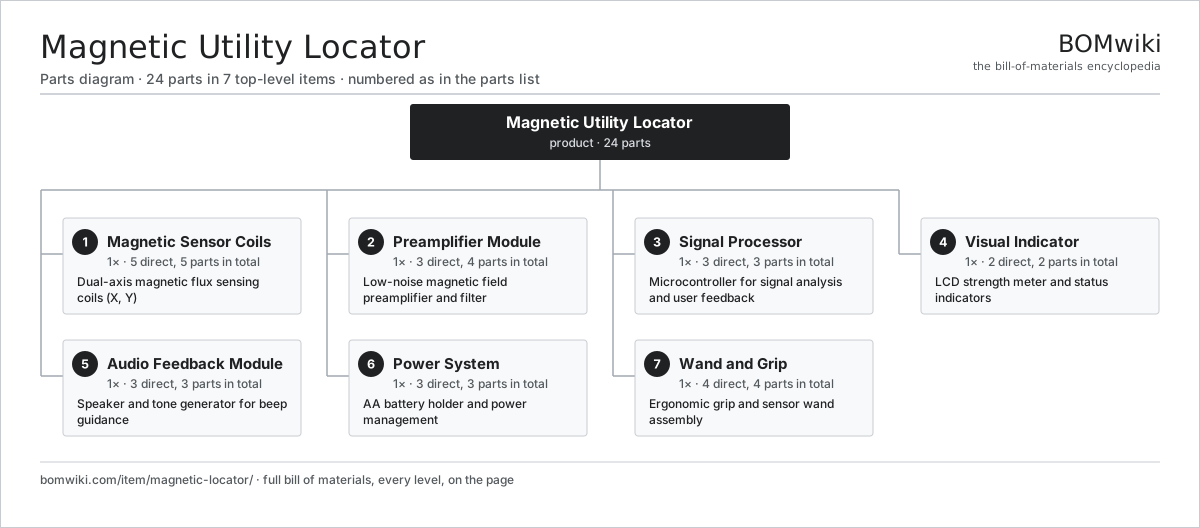
| # | Part | Qty | What it does |
|---|---|---|---|
| 1 | Magnetic Sensor Coils 5 parts | 1× | Dual-axis magnetic flux sensing coils (X, Y) |
| 2 | Preamplifier Module 3 parts | 1× | Low-noise magnetic field preamplifier and filter |
| 3 | Signal Processor 3 parts | 1× | Microcontroller for signal analysis and user feedback |
| 4 | Visual Indicator 2 parts | 1× | LCD strength meter and status indicators |
| 5 | Audio Feedback Module 3 parts | 1× | Speaker and tone generator for beep guidance |
| 6 | Power System 3 parts | 1× | AA battery holder and power management |
| 7 | Wand and Grip 4 parts | 1× | Ergonomic grip and sensor wand assembly |
3D model
No 3D model yet. Have a CAD file of this? Add a 3D model. STL renders right on this page; STEP, FreeCAD, and OpenSCAD sources are welcome too (openly licensed, like all 3D models on BOMwiki).
Build & assembly graph
expand / collapse · shared sub-assemblies converge · links to related products · est. labourTap an assembly to expand/collapse · tap a part to open it · use “Open page” for any node · drag to pan, scroll to zoom.
Bill of materials for Magnetic Utility Locator
7 top-level lines · 30 rows shown · 24 parts total · indented to 3 levels| # | Item / sub-assembly | Part no. | Qty/assy | Ext. qty | Parts | Type |
|---|---|---|---|---|---|---|
| 1 | Magnetic Sensor Coils 5 parts | magnetic-locator-coil-array | 1× | 1 | 5 | assembly |
| 1.1 | Ferrite Rod X-Axis | magnetic-locator-ferrite-core-x | 1× | 1 | · | part |
| 1.2 | Ferrite Rod Y-Axis | magnetic-locator-ferrite-core-y | 1× | 1 | · | part |
| 1.3 | X-Axis Secondary Coil | magnetic-locator-pickup-coil-x | 1× | 1 | · | part |
| 1.4 | Y-Axis Secondary Coil | magnetic-locator-pickup-coil-y | 1× | 1 | · | part |
| 1.5 | SMD Passive (R/C/L) | smd-passives | 1× | 1 | · | part |
| 2 | Preamplifier Module 3 parts | magnetic-locator-amplifier | 1× | 1 | 4 | assembly |
| 2.1 | Instrumentation Amplifier IC | magnetic-locator-inamp-ic | 1× | 1 | · | part |
| 2.2 | Filter Amplifier IC | magnetic-locator-filter-ic | 1× | 1 | · | part |
| 2.3 | SMD Passive (R/C/L) | smd-passives | 2× | 2 | · | part |
| 3 | Signal Processor 3 parts | magnetic-locator-processor | 1× | 1 | 3 | assembly |
| 3.1 | Microcontroller | mcu | 1× | 1 | · | part |
| 3.2 | Bare PCB | pcb-bare | 1× | 1 | · | part |
| 3.3 | SMD Passive (R/C/L) | smd-passives | 1× | 1 | · | part |
| 4 | Visual Indicator 2 parts | magnetic-locator-display | 1× | 1 | 2 | assembly |
| 4.1 | LED Bar Graph | magnetic-locator-led-array | 1× | 1 | · | part |
| 4.2 | SMD Passive (R/C/L) | smd-passives | 1× | 1 | · | part |
| 5 | Audio Feedback Module 3 parts | magnetic-locator-audio | 1× | 1 | 3 | assembly |
| 5.1 | Speaker | speaker | 1× | 1 | · | part |
| 5.2 | Tone Generator IC | magnetic-locator-tone-gen | 1× | 1 | · | part |
| 5.3 | SMD Passive (R/C/L) | smd-passives | 1× | 1 | · | part |
| 6 | Power System 3 parts | magnetic-locator-battery | 1× | 1 | 3 | assembly |
| 6.1 | AA Battery Case | magnetic-locator-battery-holder | 1× | 1 | · | part |
| 6.2 | Low-Battery Detector | magnetic-locator-voltage-detector | 1× | 1 | · | part |
| 6.3 | SMD Passive (R/C/L) | smd-passives | 1× | 1 | · | part |
| 7 | Wand and Grip 4 parts | magnetic-locator-handle | 1× | 1 | 4 | assembly |
| 7.1 | Probe Wand | magnetic-locator-wand-body | 1× | 1 | · | part |
| 7.2 | Grip Handle | magnetic-locator-grip-sleeve | 1× | 1 | · | part |
| 7.3 | Power Switch | magnetic-locator-switch | 1× | 1 | · | part |
| 7.4 | Connector | connector | 1× | 1 | · | part |
Something wrong in this list? Report a problem with this BOM.
Sourcing: possible vendors
Browse the supplier directory → Prices, MOQ, and lead times are algorithmic estimates, not quotes, and not claims about these companies. Company mappings are curated by keyword; est. price band $1k–$500k. How estimates work| Vendor | HQ | Specialty | MOQ | Lead time |
|---|---|---|---|---|
| thermofisher.com ↗ | Waltham, US | Lab instruments | 100 units | 10–18 wks |
|
🇺🇸Agilent
agilent.com ↗
|
Santa Clara, US | Analytical instruments | 100 units | 10–18 wks |
|
🇺🇸Bruker
bruker.com ↗
|
Billerica, US | Scientific instruments | 100 units | 10–18 wks |
|
🇯🇵Shimadzu
shimadzu.com ↗
|
Kyoto, JP | Analytical instruments | 100 units | 10–18 wks |
|
🇺🇸Waters
waters.com ↗
|
Milford, US | Chromatography & MS | 100 units | 10–18 wks |
1,397-word article