Makeup Air Unit
ProductOverview
A makeup air unit is a dedicated outdoor-air conditioning appliance installed when the building exhaust fans (kitchen hoods, bathroom vents, dryers, dust collectors) remove more air than infiltration naturally replaces. Rather than let the building depressurize and suck unconditioned air through envelope leaks, a makeup unit deliberately supplies filtered, heated outdoor air, "makeup", to rebalance the building and maintain indoor comfort and pressure.
The unit is compact and self-contained: a cabinet that holds a supply fan, heating section, filter stage, motorized intake and relief dampers, and a simple control loop. Sizes range from 0.5 m³/s for a single-family home with a strong range hood, to 20 m³/s (72,000 m³/h) for a commercial kitchen or industrial spray booth. Gas-fired units are common where heating is plentiful; electric units suit mild climates or where gas is unavailable.
Airflow path
Outdoor air is drawn in through a Intake Damper that opens modulating amounts based on building pressure or manual demand. The Pleated Prefilter catches outdoor dust, pollen, and debris, essential in urban or agricultural areas. The air then passes through the Heat Exchanger, where it is warmed by either a gas flame in a sealed-combustion chamber or by electric Heating Element banks. A Outlet Mixing Damper blends cooler bypass air with the heated stream to prevent overshoot, and a Limit Thermostat caps discharge temperature for safety. The Supply Fan Section then pushes the conditioned air into the building supply ductwork at 150–500 Pa.
Heating: gas versus electric
Gas-fired units burn natural gas or propane in a Burner Head, drawing combustion air via a Combustion Blower in a sealed-combustion design. The Gas Shutoff Valve is solenoid-operated and springs closed on loss of Flame Sensor signal, a fail-safe interlock. The Gas Pressure Regulator holds gas pressure stable at the burner. Electric units use banks of 5–10 kW resistance heating elements switched by the Control Board; they are simpler and quieter but consume more electricity.
Cabinet and isolation
The Insulated Cabinet is a double-wall Steel Frame, typically 1.5–3 m long and 0.8–1.2 m tall, with 25–50 mm foam Foam Insulation for thermal and acoustic performance. Access doors at the Access Door points allow filter replacement and burner cleaning. The fan and motor sit on Vibration Isolator elastomer pads to decouple vibration from the building structure; modern units are designed to be quiet enough to run during meal service in a restaurant.
Controls and integration
Simple units run on a single thermostat dial: user sets discharge temperature (say, 35 °C), the controller modulates the heating valve or electric element to hold it, and the intake damper either opens wide or closes in response to a room thermostat. More sophisticated units accept a 4–20 mA signal from a building management system, or integrate via Modbus or BACnet, allowing the building automation system to coordinate makeup supply with exhaust load and building static pressure. The Control Board executes the sequence: ignition lockout during startup, ramp-up of fan speed over 10–30 seconds, modulation of the heating source, and shutdown with purge. A Discharge Temperature Sensor measures actual outlet temperature; a Airflow Sensor can signal low airflow as a clogged filter.
Installation and interconnection
The unit is mounted horizontally in an attic, plenum, or mechanical room, or vertically on a roof pad. The Supply Collar connects to supply ductwork via Flexible Insulated Duct and Duct Vibration Hanger; the Relief Collar ties to a relief or exhaust duct that vents displaced air back to the outdoors, typically through the building roof or a wall louver. A gas-heated unit requires a Gas Shutoff Valve supply line and exhaust vent for combustion products. All electrical connections are field-wired on-site; thermostats and controls are commissioned to match the building envelope and exhaust load.
Makeup Air Unit parts and their functions
8 top-level parts · 193 parts in total · full bill of materials below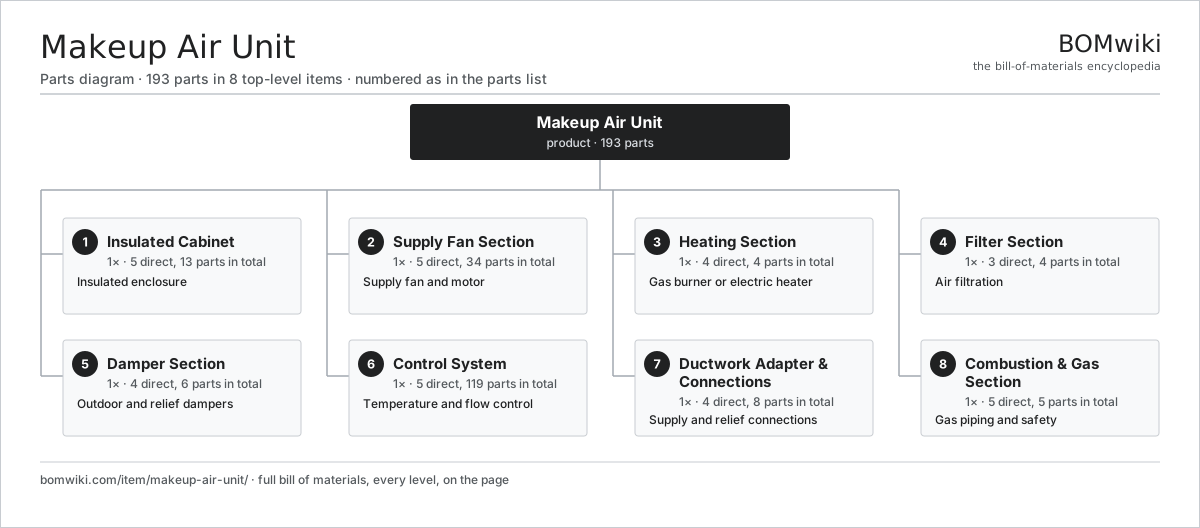
| # | Part | Qty | What it does |
|---|---|---|---|
| 1 | Insulated Cabinet 5 parts | 1× | Insulated enclosure |
| 2 | Supply Fan Section 5 parts | 1× | Supply fan and motor |
| 3 | Heating Section 4 parts | 1× | Gas burner or electric heater |
| 4 | Filter Section 3 parts | 1× | Air filtration |
| 5 | Damper Section 4 parts | 1× | Outdoor and relief dampers |
| 6 | Control System 5 parts | 1× | Temperature and flow control |
| 7 | Ductwork Adapter & Connections 4 parts | 1× | Supply and relief connections |
| 8 | Combustion & Gas Section 5 parts | 1× | Gas piping and safety |
3D model
No 3D model yet. Have a CAD file of this? Add a 3D model. STL renders right on this page; STEP, FreeCAD, and OpenSCAD sources are welcome too (openly licensed, like all 3D models on BOMwiki).
Build & assembly graph
expand / collapse · shared sub-assemblies converge · links to related products · est. labourTap an assembly to expand/collapse · tap a part to open it · use “Open page” for any node · drag to pan, scroll to zoom.
Bill of materials for Makeup Air Unit
8 top-level lines · 53 rows shown · 193 parts total · indented to 3 levels| # | Item / sub-assembly | Part no. | Qty/assy | Ext. qty | Parts | Type |
|---|---|---|---|---|---|---|
| 1 | Insulated Cabinet 5 parts | makeup-air-unit-cabinet | 1× | 1 | 13 | assembly |
| 1.1 | Steel Frame | makeup-air-unit-frame | 1× | 1 | · | part |
| 1.2 | Sheet Metal Panel | sheet-panel | 8× | 8 | · | part |
| 1.3 | Foam Insulation | makeup-air-unit-insulation-layer | 1× | 1 | · | part |
| 1.4 | Access Door | makeup-air-unit-access-panel | 2× | 2 | · | part |
| 1.5 | O-Ring Set | oring-set | 1× | 1 | · | part |
| 2 | Supply Fan Section 5 parts | makeup-air-unit-fan-section | 1× | 1 | 34 | assembly |
| 2.1 | Fan Impeller | makeup-air-unit-fan-wheel | 1× | 1 | · | part |
| 2.2 | Fan Motor 5 parts | makeup-air-unit-fan-motor | 1× | 1 | 26 | assembly |
| 2.2.1 | Stator Assembly 3 parts + deeper › | stator-assembly | 1× | 1 | 3 | assembly |
| 2.2.2 | Rotor Assembly 4 parts + deeper › | rotor-assembly | 1× | 1 | 19 | assembly |
| 2.2.3 | Copper Winding | copper-winding | 1× | 1 | · | part |
| 2.2.4 | Motor Housing | motor-housing | 1× | 1 | · | part |
| 2.2.5 | Ball Bearing | ball-bearing | 2× | 2 | · | part |
| 2.3 | Shaft Bearing | makeup-air-unit-fan-shaft-bearing | 2× | 2 | · | part |
| 2.4 | Vibration Isolator | makeup-air-unit-vibration-mount | 4× | 4 | · | part |
| 2.5 | Motor Coupling | makeup-air-unit-motor-coupling | 1× | 1 | · | part |
| 3 | Heating Section 4 parts | makeup-air-unit-heating-section | 1× | 1 | 4 | assembly |
| 3.1 | Heat Exchanger | makeup-air-unit-heat-exchanger | 1× | 1 | · | part |
| 3.2 | Temperature Modulation Control | makeup-air-unit-temperature-control | 1× | 1 | · | part |
| 3.3 | Limit Thermostat | makeup-air-unit-limit-thermostat | 1× | 1 | · | part |
| 3.4 | Outlet Mixing Damper | makeup-air-unit-outlet-damper | 1× | 1 | · | part |
| 4 | Filter Section 3 parts | makeup-air-unit-filter-section | 1× | 1 | 4 | assembly |
| 4.1 | Pleated Prefilter | makeup-air-unit-prefilter | 2× | 2 | · | part |
| 4.2 | Filter Frame | makeup-air-unit-filter-frame | 1× | 1 | · | part |
| 4.3 | Filter Manometer | makeup-air-unit-filter-manometer | 1× | 1 | · | part |
| 5 | Damper Section 4 parts | makeup-air-unit-damper-section | 1× | 1 | 6 | assembly |
| 5.1 | Intake Damper | makeup-air-unit-intake-damper | 1× | 1 | · | part |
| 5.2 | Relief Damper | makeup-air-unit-relief-damper | 1× | 1 | · | part |
| 5.3 | Damper Actuator | makeup-air-unit-damper-actuator | 2× | 2 | · | part |
| 5.4 | Damper Linkage | makeup-air-unit-damper-linkage | 2× | 2 | · | part |
| 6 | Control System 5 parts | makeup-air-unit-controls | 1× | 1 | 119 | assembly |
| 6.1 | Control Board 5 parts | makeup-air-unit-controller-board | 1× | 1 | 108 | assembly |
| 6.1.1 | Bare PCB | pcb-bare | 1× | 1 | · | part |
| 6.1.2 | Microcontroller | mcu | 1× | 1 | · | part |
| 6.1.3 | SMD Passive (R/C/L) | smd-passives | 100× | 100 | · | part |
| 6.1.4 | Relay | relay | 2× | 2 | · | part |
| 6.1.5 | Connector | connector | 4× | 4 | · | part |
| 6.2 | Discharge Temperature Sensor | makeup-air-unit-discharge-sensor | 1× | 1 | · | part |
| 6.3 | Airflow Sensor | makeup-air-unit-flow-sensor | 1× | 1 | · | part |
| 6.4 | Relay | relay | 3× | 3 | · | part |
| 6.5 | Connector | connector | 6× | 6 | · | part |
| 7 | Ductwork Adapter & Connections 4 parts | makeup-air-unit-ductwork-adapter | 1× | 1 | 8 | assembly |
| 7.1 | Supply Collar | makeup-air-unit-supply-collar | 1× | 1 | · | part |
| 7.2 | Relief Collar | makeup-air-unit-relief-collar | 1× | 1 | · | part |
| 7.3 | Flexible Insulated Duct | makeup-air-unit-flexible-duct | 2× | 2 | · | part |
| 7.4 | Duct Vibration Hanger | makeup-air-unit-vibration-duct-hanger | 4× | 4 | · | part |
| 8 | Combustion & Gas Section 5 parts | makeup-air-unit-combustion-section | 1× | 1 | 5 | assembly |
| 8.1 | Gas Shutoff Valve | makeup-air-unit-gas-valve | 1× | 1 | · | part |
| 8.2 | Burner Head | makeup-air-unit-burner-head | 1× | 1 | · | part |
| 8.3 | Combustion Blower | makeup-air-unit-combustion-fan | 1× | 1 | · | part |
| 8.4 | Flame Sensor | makeup-air-unit-flame-sensor | 1× | 1 | · | part |
| 8.5 | Gas Pressure Regulator | makeup-air-unit-pressure-regulator | 1× | 1 | · | part |
Something wrong in this list? Report a problem with this BOM.
Related products
same domain, ranked by shared parts Air Handling Unit
631 parts · shares 17 with this page
Air Handling Unit
631 parts · shares 17 with this page
 Gas Furnace
308 parts · shares 17 with this page
Steam Humidifier
207 parts · shares 17 with this page
Gas Furnace
308 parts · shares 17 with this page
Steam Humidifier
207 parts · shares 17 with this page
 Heat Pump
117 parts · shares 16 with this page
Heat Pump
117 parts · shares 16 with this page
 Centrifugal Chiller
340 parts · shares 16 with this page
Centrifugal Chiller
340 parts · shares 16 with this page
 Fan Coil Unit
118 parts · shares 16 with this page
Fan Coil Unit
118 parts · shares 16 with this page
Sourcing: possible vendors
Browse the supplier directory → Prices, MOQ, and lead times are algorithmic estimates, not quotes, and not claims about these companies. Company mappings are curated by keyword; est. price band $100–$20k. How estimates work| Vendor | HQ | Specialty | MOQ | Lead time |
|---|---|---|---|---|
|
🇺🇸Carrier
carrier.com ↗
|
Palm Beach Gardens, US | HVAC | 500 units | 8–14 wks |
| tranetechnologies.com ↗ | Davidson, US | HVAC | 500 units | 8–14 wks |
|
🇯🇵Daikin
daikin.com ↗
|
Osaka, JP | HVAC | 500 units | 8–14 wks |
|
🇺🇸Lennox
lennox.com ↗
|
Richardson, US | HVAC | 500 units | 8–14 wks |
| johnsoncontrols.com ↗ | Milwaukee, US | Building systems | 500 units | 8–14 wks |
713-word article