Mandolin
ProductOverview
The mandolin is a small plectrum-played string instrument carrying eight steel strings arranged in four unison pairs, tuned in fifths to the same pitches as a violin: G3-D4-A4-E5. The doubled courses are its signature; the two strings of each pair are struck together, and their slight detuning and phase drift produce the instrument's shimmering, sustaining chorus effect, exploited most famously in the rapid tremolo picking of Italian and bluegrass playing.
The modern American carved mandolin, standardized by Gibson under acoustic engineer Lloyd Loar in the early 1920s (the F-5 model of 1922–24 remains the template), abandoned the bowl-back Neapolitan construction in favor of violin-making practice: a carved arched Carved Spruce Top and Carved Maple Back, paired f-holes, an elevated Fretboard extension, and a floating Floating Bridge Assembly pressed onto the top by string down-force. Two body styles dominate: the plain teardrop A-style and the F-style with its decorative scroll and body points.
How it works
The player's pick drives a string pair; the vibration path runs through the Bridge Saddle and Bridge Base into the carved top. Because the strings break over the bridge at an angle on their way from the Tailpiece Assembly to the Nut, they press the bridge down with a static force of several kilograms. The arched top, carved from solid spruce and graduated from roughly 6 mm at the bridge area to 2.5 mm at the recurve near the edges, carries this load in compression the way a violin plate does, while remaining flexible enough to pump air through the f-holes.
Two parallel Tone Bar braces run under the top, flanking the f-holes; their height and taper are shaved during voicing to place the main plate resonances. The maple Carved Maple Back and bent Side Rim sides close the cavity, joined through Kerfed Lining strips and the Neck Block and Tail Block. The enclosed air volume and f-hole area set a Helmholtz resonance near 270–300 Hz on a typical f-hole instrument, supporting the low G course.
String tension totals roughly 68–80 kg across the eight strings, far more per unit size than a guitar, so the structure is correspondingly stout: a hard maple Neck Blank with an adjustable Truss Rod, a glued Dovetail Joint into the neck block, and a 350 mm scale Fretboard in ebony carrying twenty or more narrow Fret Wires. Strings anchor at the Tailpiece Baseplate by their loop ends, hooked over stamped tabs and hidden by the Tailpiece Cover; at the other end each winds onto a Tuner String Post.
Bridge and setup
Unlike a guitar bridge, the mandolin bridge is not glued: it floats, located only by string pressure, which lets the player or repairer set intonation by sliding it. The two-piece design carries a compensated Bridge Saddle on threaded posts; turning the two Bridge Thumbwheels raises or lowers the action without restringing. The bridge feet are individually fitted to the top arch so the contact is continuous, since any gap costs transmission efficiency. Correct position puts the saddle crown at twice the nut-to-12th-fret distance, nominally 350 mm from the nut, between the f-hole notches.
Hardware and strings
Tuning machines are mounted four to a side on two Tuner Plate Assembly assemblies, each plate carrying four worm-and-wheel Helical Gear Pair sets on a common Tuner Baseplate. The E and A courses use plain steel strings of 0.010–0.016 in; the D and G courses are phosphor-bronze wound, 0.024–0.040 in (Plain Steel String, Wound String). All use loop ends rather than ball ends.
The Pickguard Plate on quality instruments is elevated on a Pickguard Bracket clamped to the rim, floating above the top rather than glued to it, so the guard adds no damping mass to the soundboard. Body edges carry Body Binding, and the traditional finish is a shaded sunburst in nitrocellulose lacquer (Finish Lacquer).
Variants and family
The bowl-back (Neapolitan) mandolin survives in classical and folk use, with a deep ribbed body and a canted flat top. Flat-top and oval-hole carved instruments trade the f-hole model's cutting attack for a rounder tone favored in Celtic music. The mandolin heads a family tuned in fifths a register apart: the mandola (C3-G3-D4-A4), octave mandolin, and mandocello (C2-G2-D3-A3), all built on the same doubled-course principle. Electric mandolins replace the carved body with a solid plank and magnetic pickups, usually carrying four single strings instead of pairs.
Mandolin parts and their functions
7 top-level parts · 95 parts in total · full bill of materials below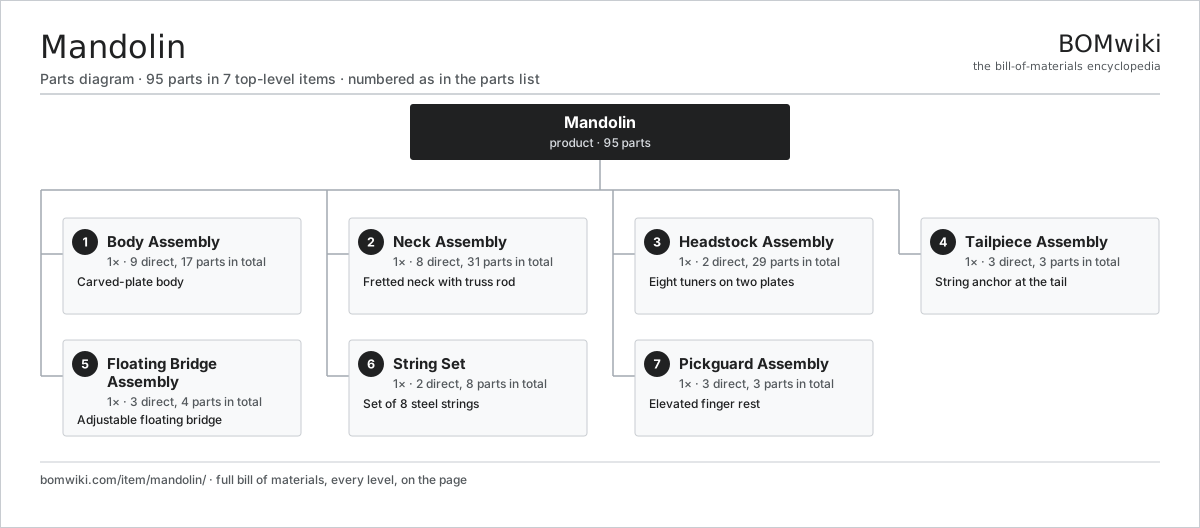
| # | Part | Qty | What it does |
|---|---|---|---|
| 1 | Body Assembly 9 parts | 1× | Carved-plate body |
| 2 | Neck Assembly 8 parts | 1× | Fretted neck with truss rod |
| 3 | Headstock Assembly 2 parts | 1× | Eight tuners on two plates |
| 4 | Tailpiece Assembly 3 parts | 1× | String anchor at the tail |
| 5 | Floating Bridge Assembly 3 parts | 1× | Adjustable floating bridge |
| 6 | String Set 2 parts | 1× | Set of 8 steel strings |
| 7 | Pickguard Assembly 3 parts | 1× | Elevated finger rest |
3D model
No 3D model yet. Have a CAD file of this? Add a 3D model. STL renders right on this page; STEP, FreeCAD, and OpenSCAD sources are welcome too (openly licensed, like all 3D models on BOMwiki).
Build & assembly graph
expand / collapse · shared sub-assemblies converge · links to related products · est. labourTap an assembly to expand/collapse · tap a part to open it · use “Open page” for any node · drag to pan, scroll to zoom.
Bill of materials for Mandolin
7 top-level lines · 42 rows shown · 95 parts total · indented to 3 levels| # | Item / sub-assembly | Part no. | Qty/assy | Ext. qty | Parts | Type |
|---|---|---|---|---|---|---|
| 1 | Body Assembly 9 parts | mandolin-body | 1× | 1 | 17 | assembly |
| 1.1 | Carved Spruce Top | mandolin-top | 1× | 1 | · | part |
| 1.2 | Carved Maple Back | mandolin-back | 1× | 1 | · | part |
| 1.3 | Side Rim | mandolin-rim | 2× | 2 | · | part |
| 1.4 | Tone Bar | mandolin-tone-bar | 2× | 2 | · | part |
| 1.5 | Kerfed Lining | mandolin-lining | 4× | 4 | · | part |
| 1.6 | Neck Block | mandolin-neck-block | 1× | 1 | · | part |
| 1.7 | Tail Block | mandolin-tail-block | 1× | 1 | · | part |
| 1.8 | Body Binding | mandolin-binding | 4× | 4 | · | part |
| 1.9 | Finish Lacquer | mandolin-finish | 1× | 1 | · | part |
| 2 | Neck Assembly 8 parts | mandolin-neck | 1× | 1 | 31 | assembly |
| 2.1 | Neck Blank | mandolin-neck-blank | 1× | 1 | · | part |
| 2.2 | Fretboard | mandolin-fretboard | 1× | 1 | · | part |
| 2.3 | Fret Wire | mandolin-fret | 20× | 20 | · | part |
| 2.4 | Truss Rod | mandolin-truss-rod | 1× | 1 | · | part |
| 2.5 | Nut | mandolin-nut | 1× | 1 | · | part |
| 2.6 | Position Dot | mandolin-position-dot | 5× | 5 | · | part |
| 2.7 | Neck Heel | mandolin-heel | 1× | 1 | · | part |
| 2.8 | Dovetail Joint | mandolin-dovetail-joint | 1× | 1 | · | part |
| 3 | Headstock Assembly 2 parts | mandolin-headstock | 1× | 1 | 29 | assembly |
| 3.1 | Headstock Veneer | mandolin-headplate | 1× | 1 | · | part |
| 3.2 | Tuner Plate Assembly 5 parts | mandolin-tuner-plate | 2× | 2 | 14 | assembly |
| 3.2.1 | Helical Gear Pair | gear-pair | 4× | 8 | · | part |
| 3.2.2 | Tuner String Post | mandolin-tuner-post | 4× | 8 | · | part |
| 3.2.3 | Tuner Button | mandolin-tuner-button | 4× | 8 | · | part |
| 3.2.4 | Tuner Baseplate | mandolin-tuner-baseplate | 1× | 2 | · | part |
| 3.2.5 | Fastener Set | fastener-set | 1× | 2 | · | part |
| 4 | Tailpiece Assembly 3 parts | mandolin-tailpiece | 1× | 1 | 3 | assembly |
| 4.1 | Tailpiece Baseplate | mandolin-tailpiece-base | 1× | 1 | · | part |
| 4.2 | Tailpiece Cover | mandolin-tailpiece-cover | 1× | 1 | · | part |
| 4.3 | Fastener Set | fastener-set | 1× | 1 | · | part |
| 5 | Floating Bridge Assembly 3 parts | mandolin-bridge | 1× | 1 | 4 | assembly |
| 5.1 | Bridge Base | mandolin-bridge-base | 1× | 1 | · | part |
| 5.2 | Bridge Saddle | mandolin-bridge-saddle | 1× | 1 | · | part |
| 5.3 | Bridge Thumbwheel | mandolin-bridge-thumbwheel | 2× | 2 | · | part |
| 6 | String Set 2 parts | mandolin-string-set | 1× | 1 | 8 | assembly |
| 6.1 | Plain Steel String | mandolin-string-plain | 4× | 4 | · | part |
| 6.2 | Wound String | mandolin-string-wound | 4× | 4 | · | part |
| 7 | Pickguard Assembly 3 parts | mandolin-pickguard-assembly | 1× | 1 | 3 | assembly |
| 7.1 | Pickguard Plate | mandolin-pickguard | 1× | 1 | · | part |
| 7.2 | Pickguard Bracket | mandolin-pickguard-bracket | 1× | 1 | · | part |
| 7.3 | Fastener Set | fastener-set | 1× | 1 | · | part |
Something wrong in this list? Report a problem with this BOM.
Related products
same domain, ranked by shared parts

Sourcing: possible vendors
Browse the supplier directory → Prices, MOQ, and lead times are algorithmic estimates, not quotes, and not claims about these companies. Company mappings are curated by keyword; est. price band $50–$5k. How estimates work| Vendor | HQ | Specialty | MOQ | Lead time |
|---|---|---|---|---|
| yamaha.com ↗ | Hamamatsu, JP | Audio & instruments | 200 units | 8–14 wks |
|
🇺🇸Fender
fender.com ↗
|
Los Angeles, US | Guitars & amps | 200 units | 8–14 wks |
|
🇺🇸Gibson
gibson.com ↗
|
Nashville, US | Guitars | 200 units | 8–14 wks |
|
🇯🇵Roland
roland.com ↗
|
Hamamatsu, JP | Electronic instruments | 200 units | 8–14 wks |
| steinway.com ↗ | New York, US | Pianos | 200 units | 8–14 wks |
786-word article