Manure Scraper System
ProductOverview
A manure scraper is one of the most effective labor-saving systems in dairy barn management. A herd of 100 cows produces roughly 2000-2500 kg of manure daily, a massive cleaning burden if done by hand. The Manure Scraper System eliminates this: an electric motor drives a continuous loop Cable System with a low-profile Scraper Blade that automatically drags manure and bedding toward a Collection Pit collection point, 2-6 times per day on a timer.
The technology is straightforward and robust. No hydraulics, no electronics beyond a simple timer, and no air blower means the system is quiet, affordable, and repairable by any electrician. The payback period (labor saved) is typically 3-5 years; the lifespan is 15-20 years. Adoption is widespread in progressive dairy regions, particularly in Northern Europe and North America, where labor costs are high and barn automation is expected.
Cable loop and blade
The Cable System is a continuous loop of wire rope (3/8 - 1/2" diameter) anchored at two pulley blocks, one at the pit end of the barn, one at the far end. The Scraper Blade is attached to the cable via a connector that rides freely along the rope. As the motor drives the cable loop, the blade drags along the Barn Rail System (fixed guide tracks), pushing manure toward the collection pit.
The Blade Insert is a replaceable insert of high-durometer rubber or composite material, 1-2 mm thick, that slides along the concrete floor. It wears constantly but is inexpensive to replace (USD 500-1000 per set, every 6-12 months depending on herd size and bedding type).
The blade is designed to be low-profile and gentle on concrete, reducing floor damage compared to older chain-and-pusher designs. The blade height is set so it does not catch on feed or water troughs.
Winch and motor
The Winch Motor is typically a 1-3 HP electric motor at 220/380 VAC 50-60 Hz, powered via a simple contactor and timer. The motor drives the cable loop at 0.3-0.5 m/s (18-30 m/min), which is slow enough to avoid violent manure spraying but fast enough to traverse a 50 m barn in 2-3 minutes. Some operations use a hydraulic motor powered by an existing barn hydraulic system (e.g., from a milking parlor vacuum pump backup system).
A Holding Brake (friction, spring-applied) engages when power is cut, holding the cable and blade stationary and preventing drift. This is critical for safety, a loose cable can tangle or pose a tripping hazard.
Barn rail and guide system
The Barn Rail System are fixed steel or aluminum channels, U-shaped or angle-iron, mounted securely to the barn floor every meter or so. The cable rides in the channel, which guides the blade in a straight path. At corners or transitions (e.g., where the scraper transitions from one row of pens to another), Corner Block reinforcements are welded on to handle the change in cable tension.
A removable Rail Cover sits over the rail channel when the scraper is not running, allowing workers to walk or move equipment across the barn without tripping on the rail or the underside of the cable.
Control and timing
The Control Panel are intentionally simple. A Cycle Timer (mechanical or digital) is set to energize the motor once every 1-4 hours, depending on barn conditions. A typical schedule is:
- Morning milking start: first scrape
- Late morning (9-10 AM): second scrape
- Afternoon: third scrape
- Evening milking start: fourth scrape
Some systems add a Safety Switch (door interlock) that stops the scraper if a gate or pen access door is opened, preventing cattle or workers from contacting the moving cable.
Modern systems include a push-button allowing workers to call an extra scrape on demand (e.g., if visibly more manure accumulates than usual).
Collection pit and manure handling
The Collection Pit is a below-floor sump, typically 1.5-2.5 m deep, cored out during barn construction. The pit sits at the terminus of the scraper path. As the blade pushes manure, it falls through an opening into the pit. The Pit Floor is a concrete slab sloped toward a Drain Sump (a sunken pump sump) where liquid collects. Periodically (weekly or every few days), a submersible pump evacuates the liquid to a slurry tank, and a manure spreader or vacuum tanker removes solid manure from the pit via a Manure Gate (hinged or slide gate opening to the barn floor).
Without timely pit cleanup, manure can back up into the barn, creating a health and ammonia hazard. Pit design is critical, if sloped shallow or clogged, manure will not drain to the pump sump, creating stagnant pools that breed bacteria and flies.
Bedding and manure management interaction
Scrapers work best with deep-bedded systems (sand, sawdust, or compost-based bedding) that are scraped daily or every other day. In rubber-matted, slotted-floor (manure drops to a pit below), or composted-bedding systems, scraper requirements differ. A rubber-mat barn with a slotted area may use a scraper only for the rubber-mat zone; slotted areas do not need scraping.
In contrast, a heavily bedded freestall barn (sand bedding, total confinement) relies on frequent scraping to remove accumulated manure and soiled bedding, preventing hoof disease and environmental mastitis. Farmers in sand-bedded systems often run scrapers every 2-3 hours, 8+ times per day, accepting higher electricity cost (negligible: ~USD 50-100/year) to maintain clean stalls.
Benefits and limitations
Benefits:
- Eliminates 1-2 hours per day of manual labor (per person equivalent).
- Keeps barn floors clean and dry, reducing hoof disease incidence (digital dermatitis, foot rot) by 30-50 %.
- Reduces fly and ammonia generation, improving herd health and worker environment.
- Payback period: 3-5 years on a 100-cow herd.
Limitations:
- Requires concrete floor and pit infrastructure; retrofit cost is USD 15,000-40,000 for a 100-cow barn.
- Does not handle deep bedding fully; periodic hand-removal or composting of dense bedding buildup is still needed.
- Occasional rope slippage or misalignment requires manual correction.
- Blade wear (every 6-12 months) is a predictable cost.
Comparison to other manure removal systems
- Slotted floor (no scraper needed): Manure drops directly to a pit below; cleanest for cattle, but requires blind udders below (high cost) and limits bedding options.
- Robotic scraper (newer): Uses a small autonomous robot to push manure; better for variable barn layouts but higher cost (USD 80,000+) and more maintenance.
- Hydraulic push-off system: Uses a full-width hydraulic blade (less common); noisier and wears faster than cable-driven.
For a typical free stall barn, the cable scraper remains the standard.
Barn design and retrofit
Installing a Manure Scraper System in a new barn is straightforward: the pit is dug during construction, rails are mounted as the floor is finished, and the motor and cable are installed last. Retrofit into an existing barn (cutting a pit into an existing floor, routing rails, etc.) is disruptive and expensive, USD 15,000-40,000 depending on barn size and pit depth requirements, but still justified on older barns if labor availability is poor.
A typical 100-cow freestall barn with a scraper system has a pit capacity of 20-30 m³ and holds 7-10 days of solid manure plus liquid. The pit is typically emptied twice weekly via a slurry tanker contractor.
Manure Scraper System parts and their functions
6 top-level parts · 37 parts in total · full bill of materials below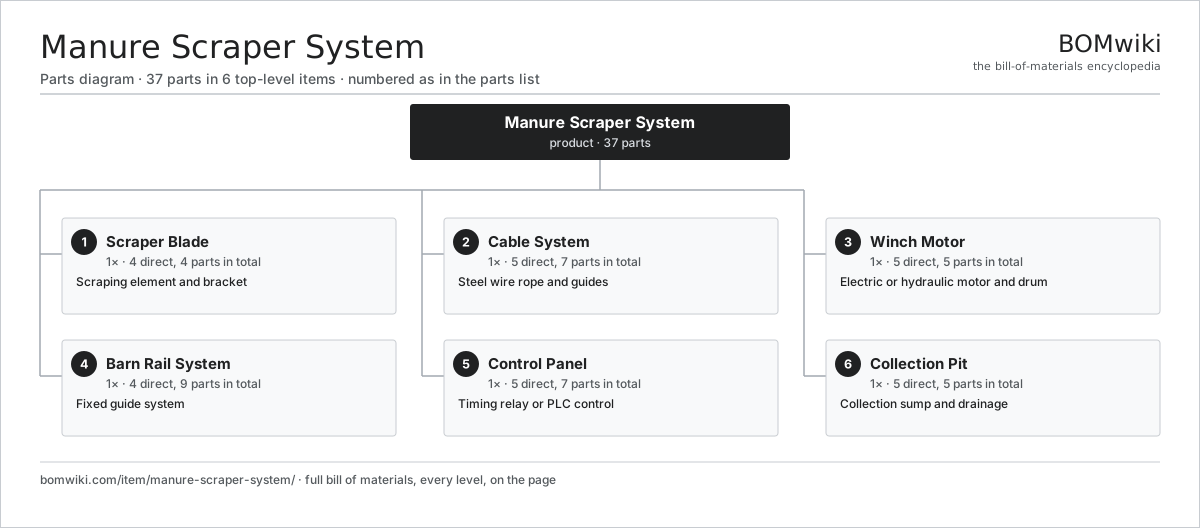
| # | Part | Qty | What it does |
|---|---|---|---|
| 1 | Scraper Blade 4 parts | 1× | Scraping element and bracket |
| 2 | Cable System 5 parts | 1× | Steel wire rope and guides |
| 3 | Winch Motor 5 parts | 1× | Electric or hydraulic motor and drum |
| 4 | Barn Rail System 4 parts | 1× | Fixed guide system |
| 5 | Control Panel 5 parts | 1× | Timing relay or PLC control |
| 6 | Collection Pit 5 parts | 1× | Collection sump and drainage |
3D model
No 3D model yet. Have a CAD file of this? Add a 3D model. STL renders right on this page; STEP, FreeCAD, and OpenSCAD sources are welcome too (openly licensed, like all 3D models on BOMwiki).
Build & assembly graph
expand / collapse · shared sub-assemblies converge · links to related products · est. labourTap an assembly to expand/collapse · tap a part to open it · use “Open page” for any node · drag to pan, scroll to zoom.
Bill of materials for Manure Scraper System
6 top-level lines · 34 rows shown · 37 parts total · indented to 3 levels| # | Item / sub-assembly | Part no. | Qty/assy | Ext. qty | Parts | Type |
|---|---|---|---|---|---|---|
| 1 | Scraper Blade 4 parts | manure-scraper-blade | 1× | 1 | 4 | assembly |
| 1.1 | Blade Insert | manure-scraper-blade-element | 1× | 1 | · | part |
| 1.2 | Blade Mounting | manure-scraper-blade-bracket | 1× | 1 | · | part |
| 1.3 | Cable Attachment | manure-scraper-blade-connector | 1× | 1 | · | part |
| 1.4 | Fastener Set | fastener-set | 1× | 1 | · | part |
| 2 | Cable System 5 parts | manure-scraper-cable | 1× | 1 | 7 | assembly |
| 2.1 | Main Cable | manure-scraper-main-cable | 1× | 1 | · | part |
| 2.2 | Guide Rail | manure-scraper-guide-rail | 1× | 1 | · | part |
| 2.3 | Pulley | manure-scraper-pulley | 2× | 2 | · | part |
| 2.4 | Cable Tensioner | manure-scraper-cable-tensioner | 1× | 1 | · | part |
| 2.5 | Fastener Set | fastener-set | 2× | 2 | · | part |
| 3 | Winch Motor 5 parts | manure-scraper-winch | 1× | 1 | 5 | assembly |
| 3.1 | Drive Motor | manure-scraper-motor | 1× | 1 | · | part |
| 3.2 | Gear Reduction | manure-scraper-gearbox | 1× | 1 | · | part |
| 3.3 | Holding Brake | manure-scraper-brake | 1× | 1 | · | part |
| 3.4 | Motor Contactor | manure-scraper-controller | 1× | 1 | · | part |
| 3.5 | Connector | connector | 1× | 1 | · | part |
| 4 | Barn Rail System 4 parts | manure-scraper-barn-rails | 1× | 1 | 9 | assembly |
| 4.1 | Rail Section | manure-scraper-rail-section | 1× | 1 | · | part |
| 4.2 | Corner Block | manure-scraper-corner-block | 4× | 4 | · | part |
| 4.3 | Rail Cover | manure-scraper-rail-cover | 1× | 1 | · | part |
| 4.4 | Fastener Set | fastener-set | 3× | 3 | · | part |
| 5 | Control Panel 5 parts | manure-scraper-controls | 1× | 1 | 7 | assembly |
| 5.1 | Cycle Timer | manure-scraper-timer | 1× | 1 | · | part |
| 5.2 | Relay | relay | 2× | 2 | · | part |
| 5.3 | Safety Switch | manure-scraper-safety-switch | 1× | 1 | · | part |
| 5.4 | Connector | connector | 2× | 2 | · | part |
| 5.5 | Power Supply | power-supply | 1× | 1 | · | part |
| 6 | Collection Pit 5 parts | manure-scraper-pit | 1× | 1 | 5 | assembly |
| 6.1 | Pit Walls | manure-scraper-pit-walls | 1× | 1 | · | part |
| 6.2 | Pit Floor | manure-scraper-pit-floor | 1× | 1 | · | part |
| 6.3 | Drain Sump | manure-scraper-pit-drain | 1× | 1 | · | part |
| 6.4 | Manure Gate | manure-scraper-pit-gate | 1× | 1 | · | part |
| 6.5 | Fastener Set | fastener-set | 1× | 1 | · | part |
Something wrong in this list? Report a problem with this BOM.
Related products
same domain, ranked by shared parts Center-Pivot Irrigator
945 parts · shares 2 with this page
Center-Pivot Irrigator
945 parts · shares 2 with this page
 Continuous Grain Dryer
254 parts · shares 2 with this page
Continuous Grain Dryer
254 parts · shares 2 with this page
 Egg Incubator
47 parts · shares 2 with this page
Egg Incubator
47 parts · shares 2 with this page
 Lateral Move Irrigation Machine
1,054 parts · shares 2 with this page
Lateral Move Irrigation Machine
1,054 parts · shares 2 with this page
 Mobile Grain Dryer
554 parts · shares 2 with this page
Mobile Grain Dryer
554 parts · shares 2 with this page
 Robotic Milking System
153 parts · shares 2 with this page
Robotic Milking System
153 parts · shares 2 with this page
Sourcing: possible vendors
Browse the supplier directory → Prices, MOQ, and lead times are algorithmic estimates, not quotes, and not claims about these companies. Company mappings are curated by keyword; est. price band $5k–$800k. How estimates work| Vendor | HQ | Specialty | MOQ | Lead time |
|---|---|---|---|---|
| deere.com ↗ | Moline, US | Agriculture & turf | made to order | 14–24 wks |
| cnh.com ↗ | Basildon, GB | Agriculture (Case IH, New Holland) | made to order | 14–24 wks |
|
🇺🇸AGCO
agcocorp.com ↗
|
Duluth, US | Agriculture (Fendt, Massey Ferguson) | made to order | 14–24 wks |
|
🇩🇪Claas
claas.com ↗
|
Harsewinkel, DE | Harvesters & tractors | made to order | 14–24 wks |
|
🇯🇵Kubota
kubota.com ↗
|
Osaka, JP | Compact tractors & equipment | made to order | 14–24 wks |
1,274-word article