Marine Navigation Light
ProductOverview
Navigation lights are the night-time language of vessels. The pattern of colored lights a ship shows, and the precise horizontal arcs over which each is visible, tells an observer the vessel's heading, size, and activity: under way, towing, fishing, constrained by draft, or aground. The grammar is fixed by the International Regulations for Preventing Collisions at Sea (COLREGs, 1972): a red sidelight to port and green to starboard each covering 112.5°, a white sternlight covering the remaining 135°, and one or two white masthead lights covering the forward 225°. If an observer sees green alone, the other vessel is crossing left to right; red and green together means it is coming head-on. A navigation light is therefore not a lamp but a calibrated angular instrument, and every element of the design serves arc and intensity accuracy.
The lantern divides into the Light Source, the Optical System that shape the signal, the Lantern Housing, the Monitoring Electronics that regulate and monitor it, and the Mounting Base that fixes its alignment to the ship.
Photometric requirements
COLREG Annex I sets minimum luminous intensity by required visibility range through a formula accounting for atmospheric transmission: about 4.3 cd for a 2-nautical-mile sidelight on a small craft, rising to 94 cd for a 6-mile masthead light on a ship of 50 m or more. Intensity must hold over the full arc and within ±5° of the horizontal, with controlled decay beyond, a rolling sailboat must remain visible at heel angles. Colors must fall inside chromaticity boxes defined in CIE coordinates, which is why the Color Element element is a controlled optical component, not a decorative tint: a red that drifts orange or a green that drifts white changes the meaning of the signal.
The arc cutoffs are equally regulated. Annex I requires sidelight intensities to drop to practical zero within a few degrees outside the prescribed sector, achieved by matte-black Sector Screens set parallel to the centerline. The Alignment Key in the base exists for this reason, a lantern rotated even a few degrees on its mount shows green where red should be, and the COLREGs' collision logic fails.
Optics and source
The classic solution, inherited from lighthouse practice, is the Fresnel Drum Lens: a cylindrical drum lens whose molded ridges collapse the source's vertical spread into a flat fan aimed at the horizon, multiplying horizon-plane intensity several-fold without raising source power. The source sits at the lens focus, historically an incandescent festoon bulb of 25–65 W, today a LED Column of a few watts on a LED Carrier Board positioned at the exact focal height.
LEDs changed the engineering economics of the lantern. Power dropped by an order of magnitude, which matters on sailing yachts running lights all night from a battery; rated life rose past 50,000 hours, eliminating the bulb-change climb to a masthead; and colored signals come from the emitter itself rather than a filtered white source. Two complications came with them. Chromaticity shifts with junction temperature, so the Heatsink Core keeps the emitters cool to hold the color point. And an LED fails differently from a filament, an open string is invisible from deck, so ship lanterns carry a Redundant LED Bank and a Failure Monitor whose current sensing reports any outage to the bridge navigation-light panel through an alarm Relay, a SOLAS requirement. Required lights on SOLAS vessels are also fed by duplicated circuits, terminated on the Terminal Strip with an individual Fuse Holder per lantern.
Electrical and environmental design
Small-craft DC buses are hostile: voltage swings from 9 V on a flat battery to 33 V during charging, with load-dump transients on top. The Current Regulator holds LED current, and therefore certified intensity, constant across that whole range, with TVS Protection clamping the spikes.
The environment is the other adversary. A masthead lantern lives in salt fog, driven spray, UV, and continuous vibration; a sidelight on a fishing vessel may take green water over the bow. The Body Shell is UV-stabilized polycarbonate or anodized aluminum, sealed by O-Ring Set gaskets and the Lens Seal to IP56 or better, with a Drain Vent to bleed off condensation and 316 stainless fasteners throughout. Wiring is tinned copper, entering through the Cable Gland in the base.
Certification
Navigation lights are type-approved equipment. In the EU they carry the Wheelmark under the Marine Equipment Directive; in the US, USCG approval; both trace to IMO performance standards and involve photometric testing of arc, intensity, and chromaticity on production samples. The vessel's size determines the fit: a 7 m sailboat may combine all three arcs in one masthead tricolor, while a 300 m ship carries duplicated lanterns at each station, every one aligned, monitored, and fed twice.
Marine Navigation Light parts and their functions
6 top-level parts · 29 parts in total · full bill of materials below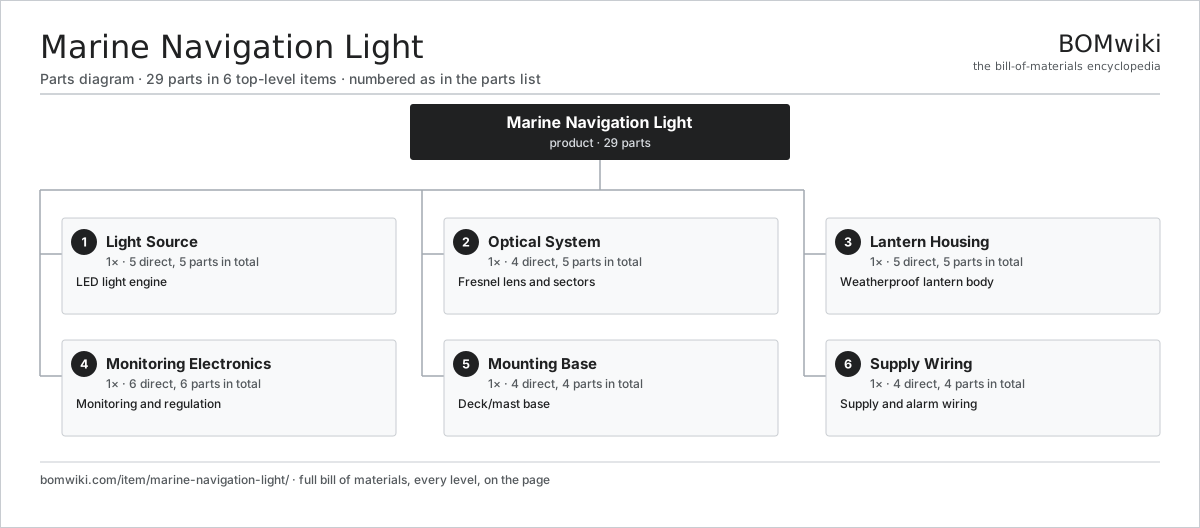
| # | Part | Qty | What it does |
|---|---|---|---|
| 1 | Light Source 5 parts | 1× | LED light engine |
| 2 | Optical System 4 parts | 1× | Fresnel lens and sectors |
| 3 | Lantern Housing 5 parts | 1× | Weatherproof lantern body |
| 4 | Monitoring Electronics 6 parts | 1× | Monitoring and regulation |
| 5 | Mounting Base 4 parts | 1× | Deck/mast base |
| 6 | Supply Wiring 4 parts | 1× | Supply and alarm wiring |
3D model
No 3D model yet. Have a CAD file of this? Add a 3D model. STL renders right on this page; STEP, FreeCAD, and OpenSCAD sources are welcome too (openly licensed, like all 3D models on BOMwiki).
Build & assembly graph
expand / collapse · shared sub-assemblies converge · links to related products · est. labourTap an assembly to expand/collapse · tap a part to open it · use “Open page” for any node · drag to pan, scroll to zoom.
Bill of materials for Marine Navigation Light
6 top-level lines · 34 rows shown · 29 parts total · indented to 3 levels| # | Item / sub-assembly | Part no. | Qty/assy | Ext. qty | Parts | Type |
|---|---|---|---|---|---|---|
| 1 | Light Source 5 parts | marine-navigation-light-light-source | 1× | 1 | 5 | assembly |
| 1.1 | LED Column | marine-navigation-light-led-column | 1× | 1 | · | part |
| 1.2 | LED Carrier Board | marine-navigation-light-led-board | 1× | 1 | · | part |
| 1.3 | Heatsink Core | marine-navigation-light-heatsink-core | 1× | 1 | · | part |
| 1.4 | Redundant LED Bank | marine-navigation-light-redundant-bank | 1× | 1 | · | part |
| 1.5 | Connector | connector | 1× | 1 | · | part |
| 2 | Optical System 4 parts | marine-navigation-light-optics | 1× | 1 | 5 | assembly |
| 2.1 | Fresnel Drum Lens | marine-navigation-light-fresnel-lens | 1× | 1 | · | part |
| 2.2 | Color Element | marine-navigation-light-color-filter | 1× | 1 | · | part |
| 2.3 | Sector Screens | marine-navigation-light-sector-screens | 2× | 2 | · | part |
| 2.4 | Lens Seal | marine-navigation-light-lens-seal | 1× | 1 | · | part |
| 3 | Lantern Housing 5 parts | marine-navigation-light-housing | 1× | 1 | 5 | assembly |
| 3.1 | Body Shell | marine-navigation-light-body-shell | 1× | 1 | · | part |
| 3.2 | Top Cap | marine-navigation-light-top-cap | 1× | 1 | · | part |
| 3.3 | O-Ring Set | oring-set | 1× | 1 | · | part |
| 3.4 | Drain Vent | marine-navigation-light-drain-vent | 1× | 1 | · | part |
| 3.5 | Fastener Set | fastener-set | 1× | 1 | · | part |
| 4 | Monitoring Electronics 6 parts | marine-navigation-light-electronics | 1× | 1 | 6 | assembly |
| 4.1 | Bare PCB | pcb-bare | 1× | 1 | · | part |
| 4.2 | Current Regulator | marine-navigation-light-current-regulator | 1× | 1 | · | part |
| 4.3 | Failure Monitor | marine-navigation-light-failure-monitor | 1× | 1 | · | part |
| 4.4 | TVS Protection | marine-navigation-light-tvs-protection | 1× | 1 | · | part |
| 4.5 | SMD Passive (R/C/L) | smd-passives | 1× | 1 | · | part |
| 4.6 | Relay | relay | 1× | 1 | · | part |
| 5 | Mounting Base 4 parts | marine-navigation-light-mounting-base | 1× | 1 | 4 | assembly |
| 5.1 | Base Plate | marine-navigation-light-base-plate | 1× | 1 | · | part |
| 5.2 | Alignment Key | marine-navigation-light-alignment-key | 1× | 1 | · | part |
| 5.3 | Cable Gland | marine-navigation-light-cable-gland | 1× | 1 | · | part |
| 5.4 | Fastener Set | fastener-set | 1× | 1 | · | part |
| 6 | Supply Wiring 4 parts | marine-navigation-light-wiring | 1× | 1 | 4 | assembly |
| 6.1 | Wire Bundle | wire-bundle | 1× | 1 | · | part |
| 6.2 | Terminal Strip | marine-navigation-light-terminal-strip | 1× | 1 | · | part |
| 6.3 | Fuse Holder | marine-navigation-light-fuse-holder | 1× | 1 | · | part |
| 6.4 | Connector | connector | 1× | 1 | · | part |
Something wrong in this list? Report a problem with this BOM.
Related products
same domain, ranked by shared parts Aviation Obstruction Light
192 parts · shares 2 with this page
Aviation Obstruction Light
192 parts · shares 2 with this page
 Heliport Beacon
39 parts · shares 2 with this page
Long-Range Searchlight
252 parts · shares 2 with this page
Heliport Beacon
39 parts · shares 2 with this page
Long-Range Searchlight
252 parts · shares 2 with this page
 Traffic Signal
91 parts · shares 2 with this page
Industrial UV Curing Lamp
300 parts · shares 1 with this page
Lighthouse Rotating Beacon
250 parts · shares 1 with this page
Traffic Signal
91 parts · shares 2 with this page
Industrial UV Curing Lamp
300 parts · shares 1 with this page
Lighthouse Rotating Beacon
250 parts · shares 1 with this page
Sourcing: possible vendors
Browse the supplier directory → Prices, MOQ, and lead times are algorithmic estimates, not quotes, and not claims about these companies. Company mappings are curated by keyword; est. price band $3–$2k. How estimates work| Vendor | HQ | Specialty | MOQ | Lead time |
|---|---|---|---|---|
|
🇳🇱Signify
signify.com ↗
|
Eindhoven, NL | Lighting (Philips Hue) | 2,000 units | 6–10 wks |
| acuitybrands.com ↗ | Atlanta, US | Lighting & controls | 2,000 units | 6–10 wks |
|
🇦🇹Zumtobel
zumtobelgroup.com ↗
|
Dornbirn, AT | Lighting | 2,000 units | 6–10 wks |
| creelighting.com ↗ | Racine, US | LED lighting | 2,000 units | 6–10 wks |
|
🇮🇳Havells
havells.com ↗
|
Noida, IN | Electrical & lighting | 2,000 units | 6–10 wks |
865-word article