Percussion Massage Gun
ProductOverview
A percussion massage gun drives a padded head into soft tissue with short, rapid strokes, typically 10-16 mm of travel repeated 1,200 to 3,200 times per minute. The rapid mechanical loading increases local blood flow, transiently reduces muscle tone, and raises pressure-pain thresholds, which is why the devices are used for warm-up and post-exercise recovery. Mechanically it is a small Scotch-yoke engine: a Motor Unit spins a Eccentric Cam, which reciprocates a Piston Shaft carrying an interchangeable head from the Head Attachment Set.
Drive and mechanism
The motor is a brushless DC outrunner or inrunner of 40-90 W, running at roughly 2,000-3,500 rpm, note that percussion rate equals motor speed, one stroke per revolution, so no gearbox is needed. Brushless was the enabling choice for the product category: compared with brushed motors it gives the needed torque in a smaller can, survives thousands of hours without brush wear, and is quiet enough (40-60 dB(A)) to use while watching television. Three Hall Sensor elements report rotor position to the Control Board, whose Microcontroller commutates a six-Power MOSFET bridge.
The Percussion Mechanism converts rotation to reciprocation. The Eccentric Cam is a counterweighted disc with a crank pin offset 5-8 mm from the shaft axis; a short Connecting Rod links the pin to the piston, so the head travels twice the offset each revolution. Two Piston Bushing guides constrain the piston to pure linear motion and take the side loads the rod geometry generates. Amplitude is fixed by the cam geometry, what the speed button changes is frequency. The cam's counterweight cancels most of the rotating imbalance, and the Motor Mount elastomer bushings plus the Grip Overmold keep the residual 20-53 Hz vibration out of the user's hand, which matters because hand-arm vibration exposure is the device's own ergonomic hazard.
Stall force and control
The headline spec separating consumer and professional units is stall force: the push the user can apply before the mechanism stops. It is set by motor torque acting through the cam's lever arm; 20-30 lbf is typical for compact guns, 50-60 lbf for full-size professional units. The controller's stall protection cuts drive within tens of milliseconds when commutation stalls, protecting the Power MOSFET bridge and the windings. The Speed Button cycles through the speed table and the LED Indicator Ring shows the selected step and battery state. Field-oriented control keeps torque smooth at the low end, where cogging would otherwise make the lowest speed feel rough against the skin.
Battery
The Battery Pack is usually three Li-ion Cell, 18650 cells, 2S in compact guns, 3S (11.1 V) in full-size, around 2,500 mAh, giving 24-30 Wh. Average draw is far below the motor's peak rating because the head is only loaded against tissue part of the time, so 2-6 hours per charge is normal. The BMS Board handles cell balancing, over-discharge cutoff, and charge control from the Charge Port; the external Power Supply adapter or a USB-C PD source provides 1-2 hour charging. Packs are non-removable in most designs, which puts the BMS's protection thresholds in charge of pack longevity.
Heads and use
Head geometry sets contact pressure for a given push. The Ball Head spreads force for general work on quads and glutes; the Flat Head gives uniform pressure on dense tissue; the Bullet Head concentrates the same force on a fingertip-sized spot for trigger points; the Fork Head straddles the spinous processes or the Achilles tendon so the prongs load the muscle either side of bone; the Cushion Head adds an air gap for bony or sensitive areas. All push-fit into the Head Socket with an O-ring retention feel.
The Housing places the grip axis behind and below the percussion axis, so recoil pushes along the forearm rather than torquing the wrist. Cooling air drawn through the Vent Grille slots crosses the motor can; sustained high-speed, high-pressure use is thermally limited, and most controllers derate or shut down after roughly 10-15 minutes of continuous full-load operation. Usage guidance in the clinical literature is short exposures, 30-120 seconds per muscle group, which sits comfortably inside the thermal envelope.
Percussion Massage Gun parts and their functions
8 top-level parts · 71 parts in total · full bill of materials below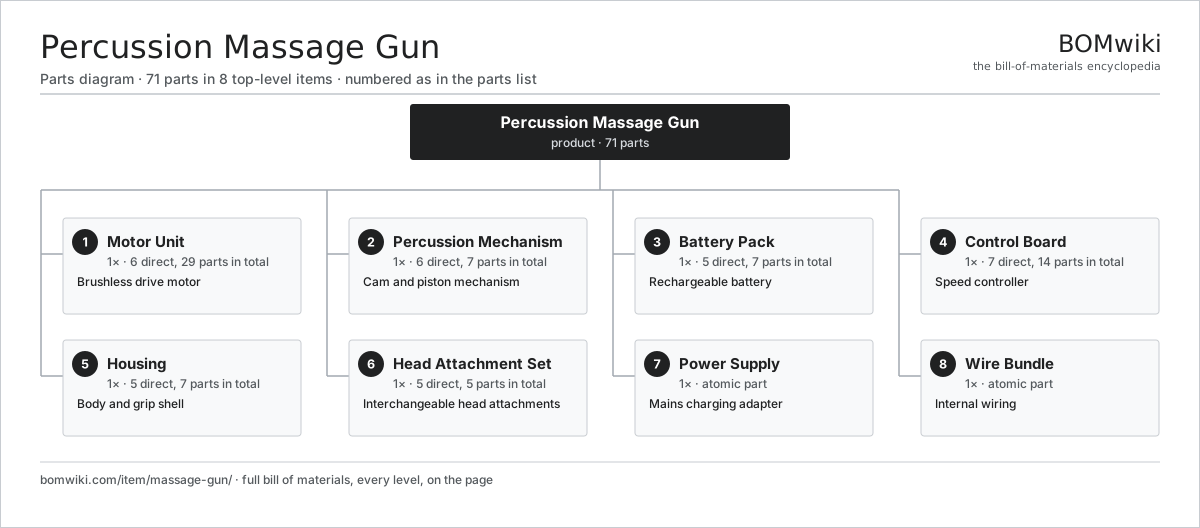
| # | Part | Qty | What it does |
|---|---|---|---|
| 1 | Motor Unit 6 parts | 1× | Brushless drive motor |
| 2 | Percussion Mechanism 6 parts | 1× | Cam and piston mechanism |
| 3 | Battery Pack 5 parts | 1× | Rechargeable battery |
| 4 | Control Board 7 parts | 1× | Speed controller |
| 5 | Housing 5 parts | 1× | Body and grip shell |
| 6 | Head Attachment Set 5 parts | 1× | Interchangeable head attachments |
| 7 | Power Supply | 1× | Mains charging adapter |
| 8 | Wire Bundle | 1× | Internal wiring |
3D model
No 3D model yet. Have a CAD file of this? Add a 3D model. STL renders right on this page; STEP, FreeCAD, and OpenSCAD sources are welcome too (openly licensed, like all 3D models on BOMwiki).
Build & assembly graph
expand / collapse · shared sub-assemblies converge · links to related products · est. labourTap an assembly to expand/collapse · tap a part to open it · use “Open page” for any node · drag to pan, scroll to zoom.
Bill of materials for Percussion Massage Gun
8 top-level lines · 49 rows shown · 71 parts total · indented to 3 levels| # | Item / sub-assembly | Part no. | Qty/assy | Ext. qty | Parts | Type |
|---|---|---|---|---|---|---|
| 1 | Motor Unit 6 parts | massage-gun-motor-unit | 1× | 1 | 29 | assembly |
| 1.1 | Stator Assembly 3 parts | stator-assembly | 1× | 1 | 3 | assembly |
| 1.1.1 | Stator Core (laminations) | stator-core | 1× | 1 | · | part |
| 1.1.2 | Copper Winding | copper-winding | 1× | 1 | · | part |
| 1.1.3 | Slot Insulation | stator-insulation | 1× | 1 | · | part |
| 1.2 | Rotor Assembly 4 parts | rotor-assembly | 1× | 1 | 19 | assembly |
| 1.2.1 | Rotor Shaft | rotor-shaft | 1× | 1 | · | part |
| 1.2.2 | Rotor Core | rotor-core | 1× | 1 | · | part |
| 1.2.3 | Neodymium Magnet | neodymium-magnet | 16× | 16 | · | part |
| 1.2.4 | Ball Bearing | ball-bearing | 1× | 1 | · | part |
| 1.3 | Motor Housing | motor-housing | 1× | 1 | · | part |
| 1.4 | Ball Bearing | ball-bearing | 2× | 2 | · | part |
| 1.5 | Hall Sensor | hall-sensor | 3× | 3 | · | part |
| 1.6 | Motor Mount | massage-gun-motor-mount | 1× | 1 | · | part |
| 2 | Percussion Mechanism 6 parts | massage-gun-percussion-mech | 1× | 1 | 7 | assembly |
| 2.1 | Eccentric Cam | massage-gun-eccentric-cam | 1× | 1 | · | part |
| 2.2 | Connecting Rod | massage-gun-connecting-rod | 1× | 1 | · | part |
| 2.3 | Piston Shaft | massage-gun-piston | 1× | 1 | · | part |
| 2.4 | Piston Bushing | massage-gun-piston-bushing | 2× | 2 | · | part |
| 2.5 | Head Socket | massage-gun-head-socket | 1× | 1 | · | part |
| 2.6 | Ball Bearing | ball-bearing | 1× | 1 | · | part |
| 3 | Battery Pack 5 parts | massage-gun-battery-pack | 1× | 1 | 7 | assembly |
| 3.1 | Li-ion Cell, 18650 | li-cell-18650 | 3× | 3 | · | part |
| 3.2 | BMS Board | bms-board | 1× | 1 | · | part |
| 3.3 | Cell Holder | massage-gun-cell-holder | 1× | 1 | · | part |
| 3.4 | Charge Port | massage-gun-charge-port | 1× | 1 | · | part |
| 3.5 | Connector | connector | 1× | 1 | · | part |
| 4 | Control Board 7 parts | massage-gun-control-board | 1× | 1 | 14 | assembly |
| 4.1 | Bare PCB | pcb-bare | 1× | 1 | · | part |
| 4.2 | Microcontroller | mcu | 1× | 1 | · | part |
| 4.3 | Power MOSFET | mosfet | 6× | 6 | · | part |
| 4.4 | SMD Passive (R/C/L) | smd-passives | 1× | 1 | · | part |
| 4.5 | Speed Button | massage-gun-speed-button | 1× | 1 | · | part |
| 4.6 | LED Indicator Ring | massage-gun-led-ring | 1× | 1 | · | part |
| 4.7 | Connector | connector | 3× | 3 | · | part |
| 5 | Housing 5 parts | massage-gun-housing | 1× | 1 | 7 | assembly |
| 5.1 | Shell Half | massage-gun-shell-half | 2× | 2 | · | part |
| 5.2 | Grip Overmold | massage-gun-grip-overmold | 1× | 1 | · | part |
| 5.3 | Vent Grille | massage-gun-vent-grille | 2× | 2 | · | part |
| 5.4 | Power Switch | massage-gun-power-switch | 1× | 1 | · | part |
| 5.5 | Fastener Set | fastener-set | 1× | 1 | · | part |
| 6 | Head Attachment Set 5 parts | massage-gun-head-set | 1× | 1 | 5 | assembly |
| 6.1 | Ball Head | massage-gun-ball-head | 1× | 1 | · | part |
| 6.2 | Bullet Head | massage-gun-bullet-head | 1× | 1 | · | part |
| 6.3 | Fork Head | massage-gun-fork-head | 1× | 1 | · | part |
| 6.4 | Flat Head | massage-gun-flat-head | 1× | 1 | · | part |
| 6.5 | Cushion Head | massage-gun-cushion-head | 1× | 1 | · | part |
| 7 | Power Supply | power-supply | 1× | 1 | · | part |
| 8 | Wire Bundle | wire-bundle | 1× | 1 | · | part |
Something wrong in this list? Report a problem with this BOM.
Related products
same domain, ranked by shared parts Baseball Pitching Machine
144 parts · shares 17 with this page
Baseball Pitching Machine
144 parts · shares 17 with this page
 Anti-Gravity Treadmill
96 parts · shares 16 with this page
Stair Climber
128 parts · shares 15 with this page
Anti-Gravity Treadmill
96 parts · shares 16 with this page
Stair Climber
128 parts · shares 15 with this page
 Elliptical Trainer
111 parts · shares 14 with this page
Elliptical Trainer
111 parts · shares 14 with this page
 Exercise Bike
93 parts · shares 14 with this page
Exercise Bike
93 parts · shares 14 with this page
 Treadmill
122 parts · shares 14 with this page
Treadmill
122 parts · shares 14 with this page
Sourcing: possible vendors
Browse the supplier directory → Prices, MOQ, and lead times are algorithmic estimates, not quotes, and not claims about these companies. Company mappings are curated by keyword; est. price band $100–$10k. How estimates work| Vendor | HQ | Specialty | MOQ | Lead time |
|---|---|---|---|---|
| lifefitness.com ↗ | Rosemont, US | Fitness equipment | 200 units | 8–14 wks |
| technogym.com ↗ | Cesena, IT | Fitness equipment | 200 units | 8–14 wks |
|
🇺🇸Peloton
onepeloton.com ↗
|
New York, US | Connected fitness | 200 units | 8–14 wks |
| johnsonhealthtech.com ↗ | Taichung, TW | Fitness (Matrix) | 200 units | 8–14 wks |
|
🇺🇸Precor
precor.com ↗
|
Woodinville, US | Fitness equipment | 200 units | 8–14 wks |
766-word article