Mechanical Speed Variator
ProductOverview
Mechanical speed variators provide continuously variable speed transmission (CVT) without clutching or electronic control. They use a pair of variable-diameter pulleys connected by a high-tension belt or chain. By adjusting the distance between pulley flanges, the effective diameter changes, allowing infinite speed ratios within the design range without interruption to power flow.
These transmissions are found in packaging machines, textile mills, woodworking equipment, and industrial fans where smooth load acceleration and precise speed control improve product quality and reduce mechanical shock. Unlike traditional stepped gearboxes or hydraulic drives, mechanical variators require no fluid, control electronics, or slip clutches, making them ideal for harsh, dusty, or food-contact environments.
Operating principle
The primary pulley is motor-driven; two flanges (one fixed, one movable) grip the belt. As the control linkage moves the floating flange outward, the effective pulley diameter increases, causing the belt to spiral outward and slower the secondary pulley. Conversely, pushing the floating flange inward reduces diameter and increases secondary speed.
The belt speed is determined by the smallest pulley diameter in the pair. As primary diameter increases and secondary decreases (or vice versa), the ratio changes smoothly. A typical 5:1 ratio means the output ranges from 20% to 100% of input speed with continuous variation.
The angular-contact bearings support the radial load from belt tension (2000–10,000 N depending on power), while springs in the engagement stack keep the flanges pressed together to prevent slipping.
Speed adjustment mechanisms
Manual handwheel control is simplest: rotating the knob adjusts the control rod length, mechanically pushing and pulling the flanges in synchronous fashion (primary and secondary move inversely). Response time is typically 5–30 seconds for a full speed sweep.
In automated packaging lines, a solenoid-driven cam or hydraulic actuator allows electrical speed command (0–10 V signal) to modulate ratio. This enables operator-free speed scheduling and load profiling.
Belt and chain types
Standard variators use Aramid-reinforced (Kevlar) flat or V-groove belts, 30–100 mm wide, with tensile strength ratings of 5000–20,000 N. The belt is a closed loop, tensioned by a spring-loaded idler or by flange pressure alone.
High-power units (>15 kW) sometimes use roller chain (40–80 mm pitch) instead of belt, gaining higher torque capacity at the cost of slightly less smooth acceleration and discrete pitch steps. Chain variators are common in mining and heavy construction.
Belt wear accelerates under extreme speed ratios (full compression and full extension). Typical belt life is 500–2000 operating hours depending on duty; inspection every 500 hours and replacement at 50% wear is standard.
Speed ratio formulation
For a belt-driven pair, the ratio is determined by flange separation:
Output speed = Input speed × (Primary diameter / Secondary diameter)
If primary diameter is 100 mm and secondary is 500 mm (smallest ratio), output = 20% of input. If primary is 500 mm and secondary is 100 mm (largest ratio), output = 500% (but mechanical stops limit maximum, usually 1:1).
Intermediate ratios are infinitely variable between these extremes. A pressure-cooker example: low speed (25%) for slow stirring, medium speed (60%) for gentle heating, high speed (100%) for fast processing, all without clutching or downtime.
Thermal and efficiency considerations
Efficiency is highest near the 1:1 ratio (90–95%) and drops at extreme ratios due to increased belt slip and material strain. A 5:1 compression or extension dissipates 10–15% of input power as heat in the belt and pulley friction. High-speed or high-power operation (>20 kW, >3000 RPM) can raise belt temperature to 80–100 °C; extended operation above 100 °C damages the elastomer and shortens life significantly.
Ventilated enclosures and occasional water-spray cooling are used in tropical climates or continuous-duty food processing to manage thermal load.
Shock absorption and noise
The elastic belt naturally absorbs torsional shock and input irregularities (motor pulsation, load transients). This damping reduces stress on downstream gearboxes and bearings by 30–50% compared to rigid couplings. Noise is generated by belt slap and pulley-flange engagement; optimized flange geometry and belt tension control reduce radiated noise to 70–80 dB(A).
Load and overload behavior
Unlike clutches, variators cannot suddenly decouple under overload; sustained jam causes increased belt slip and heat generation. If load torque exceeds belt grip, the variator will creep, flange separation increases while input and output slip at partial speed. This slipping action is gradual and prevents mechanical shock, but it risks belt burnout if overload is prolonged.
Load limiting is achieved by mechanical stops on the control rod, preventing flange travel beyond design limits. A conveyor driven by variator cannot achieve infinite reduction; a hard stop (120 mm separation, say) prevents over-compression.
Maintenance and diagnostics
Sealed grease-packed bearings require no lubrication refilling. The critical wear item is the belt. Inspection routine:
- Check belt surface for glazing or material loss (every 250 hours).
- Measure belt thickness (replace at 30% wear depth loss).
- Test flange alignment with feeler gauges (±0.05 mm tolerance).
Belt slipping under load indicates worn flanges or belt damage; replacement is straightforward, requiring disassembly of belt tensioner and control linkage. Typical replacement time is 1–2 hours labor.
Flange wear is slow in normal duty; gradual loss of grip manifests as creeping and increased noise. Flange replacement requires pulley disassembly and hub re-keying, typically done at 3000–5000 operating hours or when grip falls below 80% of nominal.
Mechanical Speed Variator parts and their functions
7 top-level parts · 27 parts in total · full bill of materials below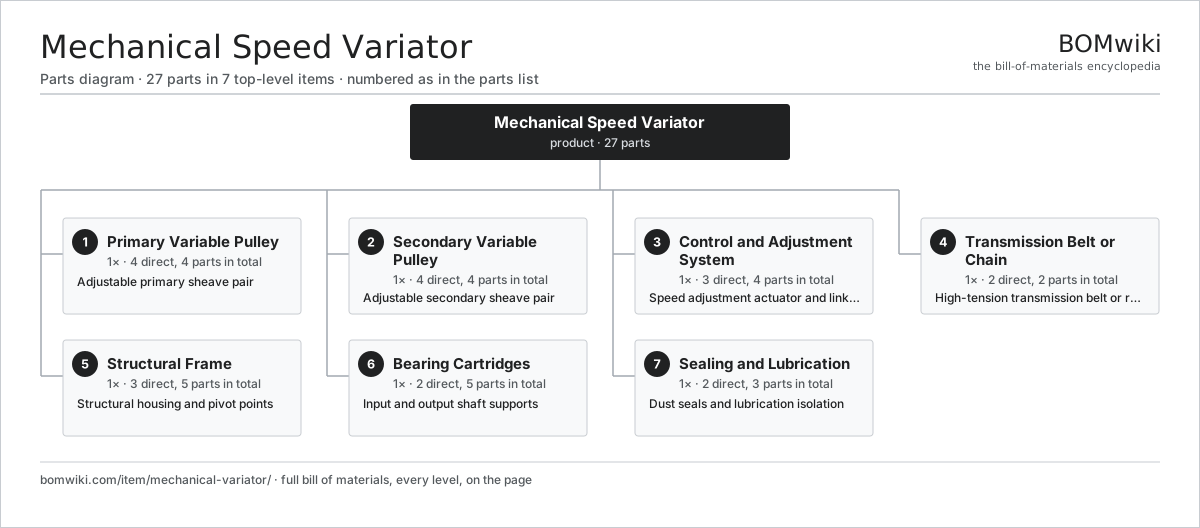
| # | Part | Qty | What it does |
|---|---|---|---|
| 1 | Primary Variable Pulley 4 parts | 1× | Adjustable primary sheave pair |
| 2 | Secondary Variable Pulley 4 parts | 1× | Adjustable secondary sheave pair |
| 3 | Control and Adjustment System 3 parts | 1× | Speed adjustment actuator and linkage |
| 4 | Transmission Belt or Chain 2 parts | 1× | High-tension transmission belt or roller chain |
| 5 | Structural Frame 3 parts | 1× | Structural housing and pivot points |
| 6 | Bearing Cartridges 2 parts | 1× | Input and output shaft supports |
| 7 | Sealing and Lubrication 2 parts | 1× | Dust seals and lubrication isolation |
3D model
No 3D model yet. Have a CAD file of this? Add a 3D model. STL renders right on this page; STEP, FreeCAD, and OpenSCAD sources are welcome too (openly licensed, like all 3D models on BOMwiki).
Build & assembly graph
expand / collapse · shared sub-assemblies converge · links to related products · est. labourTap an assembly to expand/collapse · tap a part to open it · use “Open page” for any node · drag to pan, scroll to zoom.
Bill of materials for Mechanical Speed Variator
7 top-level lines · 27 rows shown · 27 parts total · indented to 3 levels| # | Item / sub-assembly | Part no. | Qty/assy | Ext. qty | Parts | Type |
|---|---|---|---|---|---|---|
| 1 | Primary Variable Pulley 4 parts | mechanical-variator-input-pulley | 1× | 1 | 4 | assembly |
| 1.1 | Fixed Flange | mechanical-variator-fixed-flange | 1× | 1 | · | part |
| 1.2 | Movable Flange | mechanical-variator-movable-flange | 1× | 1 | · | part |
| 1.3 | Pulley Hub | mechanical-variator-hub | 1× | 1 | · | part |
| 1.4 | Engagement Spring Set | mechanical-variator-spring-package | 1× | 1 | · | part |
| 2 | Secondary Variable Pulley 4 parts | mechanical-variator-output-pulley | 1× | 1 | 4 | assembly |
| 2.1 | Fixed Flange | mechanical-variator-fixed-flange | 1× | 1 | · | part |
| 2.2 | Movable Flange | mechanical-variator-movable-flange | 1× | 1 | · | part |
| 2.3 | Pulley Hub | mechanical-variator-hub | 1× | 1 | · | part |
| 2.4 | Engagement Spring Set | mechanical-variator-spring-package | 1× | 1 | · | part |
| 3 | Control and Adjustment System 3 parts | mechanical-variator-control-system | 1× | 1 | 4 | assembly |
| 3.1 | Control Rod | mechanical-variator-control-rod | 1× | 1 | · | part |
| 3.2 | Pivot Bracket | mechanical-variator-pivot-bracket | 2× | 2 | · | part |
| 3.3 | Adjustment Handwheel | mechanical-variator-adjustment-handwheel | 1× | 1 | · | part |
| 4 | Transmission Belt or Chain 2 parts | mechanical-variator-belt-chain | 1× | 1 | 2 | assembly |
| 4.1 | Transmission Belt | mechanical-variator-belt-element | 1× | 1 | · | part |
| 4.2 | Belt Tensioner | mechanical-variator-tensioner | 1× | 1 | · | part |
| 5 | Structural Frame 3 parts | mechanical-variator-frame | 1× | 1 | 5 | assembly |
| 5.1 | Frame Base | mechanical-variator-frame-base | 1× | 1 | · | part |
| 5.2 | Frame Side Rail | mechanical-variator-frame-rails | 2× | 2 | · | part |
| 5.3 | Shaft Pedestal Block | mechanical-variator-shaft-mounting | 2× | 2 | · | part |
| 6 | Bearing Cartridges 2 parts | mechanical-variator-bearing-assemblies | 1× | 1 | 5 | assembly |
| 6.1 | Ball Bearing | ball-bearing | 4× | 4 | · | part |
| 6.2 | Bearing Preload Stack | mechanical-variator-bearing-preload-stack | 1× | 1 | · | part |
| 7 | Sealing and Lubrication 2 parts | mechanical-variator-sealing | 1× | 1 | 3 | assembly |
| 7.1 | Labyrinth Dust Seal | mechanical-variator-labyrinth-seal | 2× | 2 | · | part |
| 7.2 | Bearing Grease Cartridge | mechanical-variator-bearing-grease | 1× | 1 | · | part |
Something wrong in this list? Report a problem with this BOM.
Related products
same domain, ranked by shared parts All-Electric Injection Molding Machine
851 parts · shares 1 with this page
All-Electric Injection Molding Machine
851 parts · shares 1 with this page
 Ampoule Filling-Sealing Machine
53 parts · shares 1 with this page
AOI Machine
38 parts · shares 1 with this page
Automated Paint Spray Line
2,003 parts · shares 1 with this page
Ampoule Filling-Sealing Machine
53 parts · shares 1 with this page
AOI Machine
38 parts · shares 1 with this page
Automated Paint Spray Line
2,003 parts · shares 1 with this page
Sourcing: possible vendors
Browse the supplier directory → Prices, MOQ, and lead times are algorithmic estimates, not quotes, and not claims about these companies. Company mappings are curated by keyword; est. price band $5k–$2M. How estimates work| Vendor | HQ | Specialty | MOQ | Lead time |
|---|---|---|---|---|
| atlascopco.com ↗ | Stockholm, SE | Compressors & industrial | 10 units | 12–20 wks |
|
🇦🇹Andritz
andritz.com ↗
|
Graz, AT | Process plants & machinery | 10 units | 12–20 wks |
| buhlergroup.com ↗ | Uzwil, CH | Food & materials processing | 10 units | 12–20 wks |
| gea.com ↗ | Düsseldorf, DE | Process technology | 10 units | 12–20 wks |
| mhi.com ↗ | Tokyo, JP | Heavy machinery | 10 units | 12–20 wks |
960-word article