Mellotron
ProductOverview
The Mellotron is an electromechanical keyboard instrument that plays back pre-recorded tape loops of orchestral instruments via a unique tape-and-pinch-roller mechanism. Pressing a key triggers a clutch that closes a pinch roller against a rotating capstan, feeding tape past a playback head and reproducing the sound of a violin, cello, flute, or other instrument. Because each tape loop is typically 4–8 seconds long, the Mellotron enables keyboard players to accompany themselves with full orchestral textures, something impossible with traditional keyboards.
The Mellotron was invented by Harry Chamberlin in Los Angeles (1950s) and refined by Mellotrons Ltd. in England (1960s onward). The M400, released in 1969, became the definitive professional model. The Beatles, Yes, King Crimson, and Genesis made it iconic in progressive rock; it also appeared in film scoring and theatrical productions.
Each tape set contains 8–20 different instrument recordings. Common configurations include: violin, cello, flute, French horn, trumpet, pipe organ, harpsichord, and choir. Changing "sounds" required physically swapping cartridge frames, a time-consuming process at live venues. Later solid-state synthesizers eventually replaced the Mellotron in most settings, but the authentic orchestral texture and mechanical warmth made it a studio and live favorite throughout the 1970s–1990s.
How it works
The Mellotron operates as a motorized tape loop player with one critical innovation: each key independently controls its own pinch roller. When a key is pressed downward, a mechanical linkage (a cam bar) engages the corresponding pinch roller against the rotating capstan.
The motor assembly continuously rotates the capstan at precisely 3.75 IPS (inches per second), set by an AC synchronous motor. When a pinch roller closes, tape is gripped between the roller and capstan and is drawn across a playback head, a magnetic transducer identical to tape recorder playback heads. As tape moves past the head, magnetic fluctuations induce a small voltage in the coil, which is amplified by the preamplifier and sent to the mixer.
Here's the clever part: tape loops are recorded starting from different points. The violin tape begins at zero; the cello tape offset by 2 seconds; the flute by 4 seconds, and so on. When all tapes move together at the same speed, each instrument is slightly out of phase with the others, creating a richer, more natural orchestral texture without chorusing artifacts.
When the key is released, a spring closes the pinch roller back against the tape guide, removing tension and stopping playback. The tape winds back to the start via a motor-driven reel mechanism (rewind), ready for the next key press. This mechanical "reset" ensures each note starts fresh without residual decay from the previous performance.
The amplifier and control panel mix signals from all active playback heads into a single stereo output. Potentiometers control volume, tone (bass/treble), and instrument mix. Later models added volume envelopes: a fast attack/decay knob shaped the tape's natural sustain, making shorter stabs feel more "keyboard-like" rather than orchestral.
Historical variants and challenges
The original Chamberlin (1950s) had 3–5 tape loops and a primitive solenoid clutch. Early Mellotron I/II models (early 1960s) had 8–10 tapes. The M400 (late 1960s–1970s) standardized 16 tape positions and became the workhorse. The M4000 (1980s) added MIDI and digital delay but lost some of the mechanical warmth that made earlier models appealing.
Maintenance was a significant burden:
- Tape degradation: Magnetic tape oxide flakes over decades, causing hiss and head wear. Original tapes from the 1960s–70s are now musty and unreliable.
- Capstan drag: The rubber capstan pinch contact generates friction heat, which can soften the rubber and cause speed drift.
- Pinch roller wear: The 60–70 tiny rollers accumulated dust and grime, requiring frequent cleaning.
- Clutch solenoids: Mechanical friction and electrical arcing caused solenoid failures; replacement required complete disassembly.
The Mellotron was ultimately replaced by digital sampler keyboards (like the Fairlight CMI, 1979 onward) that stored samples on floppy disk, avoided tape wear, and offered editing. However, the Mellotron's warm, analog tape-saturation tone and the physical act of playing orchestral instruments kept it alive in studios and nostalgic performers' rigs.
Modern Mellotron owners often have tapes professionally archived to digital files or replaced with quieter, more durable polyester-based tape formulations.
Mellotron parts and their functions
8 top-level parts · 485 parts in total · full bill of materials below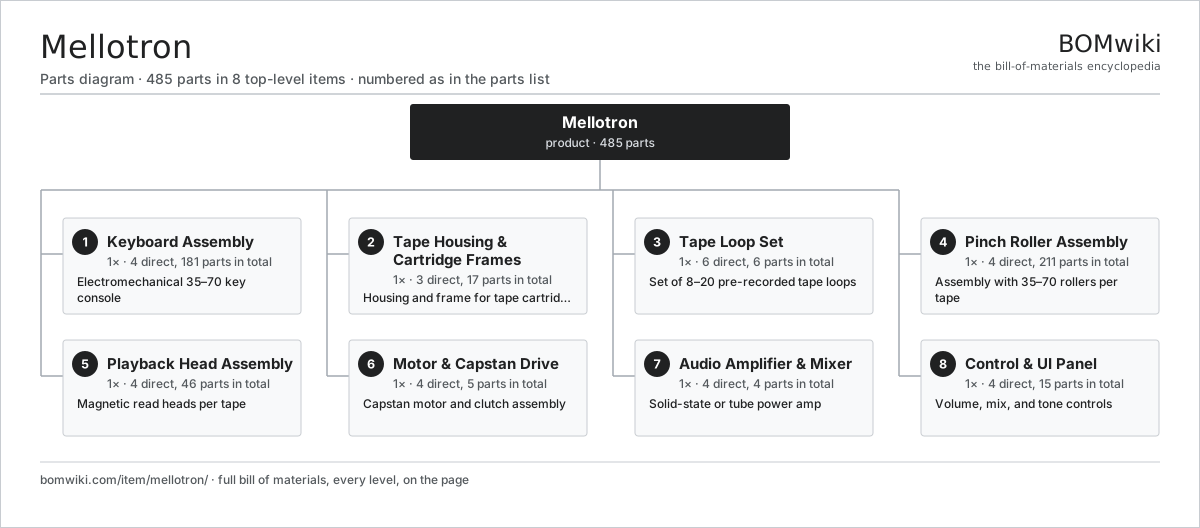
| # | Part | Qty | What it does |
|---|---|---|---|
| 1 | Keyboard Assembly 4 parts | 1× | Electromechanical 35–70 key console |
| 2 | Tape Housing & Cartridge Frames 3 parts | 1× | Housing and frame for tape cartridges |
| 3 | Tape Loop Set 6 parts | 1× | Set of 8–20 pre-recorded tape loops |
| 4 | Pinch Roller Assembly 4 parts | 1× | Assembly with 35–70 rollers per tape |
| 5 | Playback Head Assembly 4 parts | 1× | Magnetic read heads per tape |
| 6 | Motor & Capstan Drive 4 parts | 1× | Capstan motor and clutch assembly |
| 7 | Audio Amplifier & Mixer 4 parts | 1× | Solid-state or tube power amp |
| 8 | Control & UI Panel 4 parts | 1× | Volume, mix, and tone controls |
3D model
No 3D model yet. Have a CAD file of this? Add a 3D model. STL renders right on this page; STEP, FreeCAD, and OpenSCAD sources are welcome too (openly licensed, like all 3D models on BOMwiki).
Build & assembly graph
expand / collapse · shared sub-assemblies converge · links to related products · est. labourTap an assembly to expand/collapse · tap a part to open it · use “Open page” for any node · drag to pan, scroll to zoom.
Bill of materials for Mellotron
8 top-level lines · 41 rows shown · 485 parts total · indented to 3 levels| # | Item / sub-assembly | Part no. | Qty/assy | Ext. qty | Parts | Type |
|---|---|---|---|---|---|---|
| 1 | Keyboard Assembly 4 parts | mellotron-keyboard | 1× | 1 | 181 | assembly |
| 1.1 | Key Top | mellotron-key-blank | 60× | 60 | · | part |
| 1.2 | Key Lever | mellotron-key-mechanism | 60× | 60 | · | part |
| 1.3 | Micro-switch | mellotron-switch-contact | 60× | 60 | · | part |
| 1.4 | Keyboard Frame | mellotron-keyboard-frame | 1× | 1 | · | part |
| 2 | Tape Housing & Cartridge Frames 3 parts | mellotron-tape-frames | 1× | 1 | 17 | assembly |
| 2.1 | Tape Cartridge | mellotron-cartridge | 15× | 15 | · | part |
| 2.2 | Cartridge Master Frame | mellotron-cartridge-frame | 1× | 1 | · | part |
| 2.3 | Fastener Set | fastener-set | 1× | 1 | · | part |
| 3 | Tape Loop Set 6 parts | mellotron-tape-set | 1× | 1 | 6 | assembly |
| 3.1 | Violin Tape Loop | mellotron-tape-violin | 1× | 1 | · | part |
| 3.2 | Cello Tape Loop | mellotron-tape-cello | 1× | 1 | · | part |
| 3.3 | Flute Tape Loop | mellotron-tape-flute | 1× | 1 | · | part |
| 3.4 | Horn Tape Loop | mellotron-tape-horn | 1× | 1 | · | part |
| 3.5 | Organ Tape Loop | mellotron-tape-organ | 1× | 1 | · | part |
| 3.6 | Choir Tape Loop | mellotron-tape-choir | 1× | 1 | · | part |
| 4 | Pinch Roller Assembly 4 parts | mellotron-pinch-roller | 1× | 1 | 211 | assembly |
| 4.1 | Roller Block | mellotron-roller-block | 70× | 70 | · | part |
| 4.2 | Pinch Roller | mellotron-roller-rubber | 70× | 70 | · | part |
| 4.3 | Roller Spring | mellotron-roller-spring | 70× | 70 | · | part |
| 4.4 | Cam Bar | mellotron-cam-bar | 1× | 1 | · | part |
| 5 | Playback Head Assembly 4 parts | mellotron-playback-head | 1× | 1 | 46 | assembly |
| 5.1 | Playback Head Magnet | mellotron-head-magnet | 15× | 15 | · | part |
| 5.2 | Head Coil | mellotron-head-coil | 15× | 15 | · | part |
| 5.3 | Head Gap Assembly | mellotron-head-gap | 15× | 15 | · | part |
| 5.4 | Head Mount | mellotron-head-mount | 1× | 1 | · | part |
| 6 | Motor & Capstan Drive 4 parts | mellotron-motor-drive | 1× | 1 | 5 | assembly |
| 6.1 | AC Motor | mellotron-motor-ac | 1× | 1 | · | part |
| 6.2 | Drive Belt | mellotron-belt | 2× | 2 | · | part |
| 6.3 | Capstan Spindle | mellotron-capstan | 1× | 1 | · | part |
| 6.4 | Flywheel | mellotron-flywheel | 1× | 1 | · | part |
| 7 | Audio Amplifier & Mixer 4 parts | mellotron-amplifier | 1× | 1 | 4 | assembly |
| 7.1 | Preamp Board | mellotron-preamp-board | 1× | 1 | · | part |
| 7.2 | Mixer Board | mellotron-mixer-board | 1× | 1 | · | part |
| 7.3 | Power Amp | mellotron-power-amp | 1× | 1 | · | part |
| 7.4 | Output Transformer | mellotron-output-transformer | 1× | 1 | · | part |
| 8 | Control & UI Panel 4 parts | mellotron-control-panel | 1× | 1 | 15 | assembly |
| 8.1 | Volume Pot | mellotron-volume-pot | 2× | 2 | · | part |
| 8.2 | Mix Pot | mellotron-mix-pot | 8× | 8 | · | part |
| 8.3 | Tone Control | mellotron-tone-control | 4× | 4 | · | part |
| 8.4 | Switch Set | mellotron-switch-set | 1× | 1 | · | part |
Something wrong in this list? Report a problem with this BOM.
Sourcing: possible vendors
Browse the supplier directory → Prices, MOQ, and lead times are algorithmic estimates, not quotes, and not claims about these companies. Company mappings are curated by keyword; est. price band $50–$5k. How estimates work| Vendor | HQ | Specialty | MOQ | Lead time |
|---|---|---|---|---|
| yamaha.com ↗ | Hamamatsu, JP | Audio & instruments | 200 units | 8–14 wks |
|
🇺🇸Fender
fender.com ↗
|
Los Angeles, US | Guitars & amps | 200 units | 8–14 wks |
|
🇺🇸Gibson
gibson.com ↗
|
Nashville, US | Guitars | 200 units | 8–14 wks |
|
🇯🇵Roland
roland.com ↗
|
Hamamatsu, JP | Electronic instruments | 200 units | 8–14 wks |
| steinway.com ↗ | New York, US | Pianos | 200 units | 8–14 wks |
744-word article