Metal Briquetting Press
ProductOverview
A metal briquetting press is a high-pressure hydraulic machine used to consolidate loose metal chips, turnings, fines, and other low-density scrap into compact, dimensioned briquettes. Unlike a baler-shear which produces irregular bales, a briquetting press uses a shaped die cavity to yield uniform round, square, or cylindrical briquettes (2–4 inches diameter, 2–4 inches length).
Briquetting is widely used for:
- Aluminum turnings and chips from machining and grinding
- Steel chips and turnings from drilling, boring, milling operations
- Copper and brass fines from electrical equipment recycling
- Stainless steel swarf commanding premium smelter prices
- Magnesium and titanium chips (which require special handling due to reactivity)
A single briquette press can produce 400–800 briquettes per hour, with each briquette achieving density of 100–150 lbs/ft³ (versus 30–50 lbs/ft³ for loose chips). This 3–5x density reduction dramatically cuts storage footprint and transport cost. Briquetted material is also more conducive to mechanical handling, pneumatic conveying, and automated loading systems.
How it works
Loose metal chips are loaded into the feed hopper. A rotary auger (40–80 rpm, independent drive) continuously meters material downward into the die cavity.
When the operator initiates a compression cycle via the HMI touchscreen, the PLC energizes the proportional control valve, routing high-pressure hydraulic oil to the upper compression ram and lower compression ram.
Both rams advance toward the die cavity simultaneously. As pressure builds, the chips compress plastically (or cold-weld if composed of highly ductile material like aluminum or copper). Pressure rises to 1500–2000 psi over 5–10 seconds. The PLC monitors actual pressure via a transducer and holds at target pressure for 5–15 seconds to ensure complete consolidation.
Once compression is complete, the PLC de-energizes the proportional valve, stopping ram advance. The ejection cylinder then extends, driving the stripper ring upward 2–4 inches at high speed. The stripper ring contacts the top of the formed briquette and ejects it upward out of the die cavity.
The ejected briquette falls down the discharge chute into an optional cooling chamber where water spray or forced-air cooling reduces its temperature from 200–300°C to below 50°C, allowing safe handling within seconds.
The auger has refilled the die cavity with fresh chips during the ejection phase, so the cycle immediately repeats. Cycle time is typically 20–40 seconds, yielding 400–800 briquettes/hour depending on material type and density target.
Die Selection and Customization
Different die blocks produce different briquette shapes:
- Round (cylindrical): 2–4 inches diameter, most common, easiest to eject
- Square: 2–4 inch edges, denser stacking for truck transport
- Pillow/elliptical: 2–3 inches wide, 3–5 inches long, compact and stackable
Die changes typically take 30–60 minutes and are performed by maintenance personnel. Modern systems allow quick-change die cartridges to enable shift-to-shift format changes without major disassembly.
Pressure and Density Tuning
Operating pressure is adjusted via the relief valve (set point 1800–2000 psi). Higher pressure increases density but extends cycle time and increases wear. Most operators target 1500–1800 psi as a balance between density and cycle speed.
Briquette density also depends on material type and chip size:
- Fine aluminum powder: Highest density achievable (120–150 lbs/ft³) due to plastic flow and cold-welding
- Steel turnings (1–3 mm): Moderate density (90–110 lbs/ft³), with pores between chips
- Copper fines: High density (110–140 lbs/ft³), ductile and compactable
- Stainless steel (coarse): Lower density (80–100 lbs/ft³) due to hardness and work-hardening
The PLC can adjust compression dwell time (hold phase) to allow additional plastic deformation, increasing final briquette density by 5–15% at the cost of cycle time.
Cooling System Function
The optional cooling system serves multiple purposes:
- Safety: Briquettes exit at 200–300°C and are impossible to handle directly; cooling to <50°C takes 30–60 seconds per briquette
- Material stability: Some materials (e.g., magnesium) are fire hazards when hot; cooling reduces spontaneous combustion risk
- Humidity control: Water-cooled systems introduce controlled surface moisture (0.5–2%) that helps reduce dust generation during subsequent shipping
- QC verification: Cooled briquettes can be visually inspected for cracks or deformations before collection
Air cooling is typical for aluminum; water cooling is preferred for steel and stainless to avoid oxidation.
Wear Items and Maintenance
The die cavity and stripper ring experience direct contact with chips under high pressure and are the primary wear items. Die life typically ranges from 500–3000 hours depending on material hardness and chip size. Wear is visible as roughening of cavity surfaces and increasing ejection difficulty.
The cylinder rod bearings should be inspected every 500 hours and replaced every 1500–2000 hours if excessive radial play develops (>0.010 inches).
Wiper and o-ring seals on the die block require replacement every 1000–1500 hours; worn seals allow material leakage and contamination of the hydraulic circuit.
Economics and ROI
A briquetting press requires significant capital investment ($200,000–$600,000 depending on size and automation). Payback is typically 2–5 years based on:
- Reduced storage footprint (3–5x density improvement)
- Reduced transport costs (fewer truck loads)
- Higher smelter prices for briquetted material (5–10% premium vs. loose chips)
- Labor cost savings (automated vs. manual chip collection and bagging)
High-volume shops (100+ tons/week of chips) achieve best ROI. Low-volume operations (<20 tons/week) may find portable briquetting equipment or contract with service providers more economical.
Safety Considerations
The compression cylinders exert 200–400 tons force and pose severe crushing hazard. All access to the die cavity must be interlocked to prevent hand insertion during compression. Hydraulic accumulators (if present) are pressure vessels and must be periodically certified.
Hot briquettes exit the die at 200–300°C and must not contact skin or flammable material. The cooling chamber prevents operator burns but requires regular maintenance to prevent mineral scale buildup and equipment failure.
Operators should receive training on emergency stop procedures and lockout/tagout requirements before unsupervised operation.
Metal Briquetting Press parts and their functions
8 top-level parts · 41 parts in total · full bill of materials below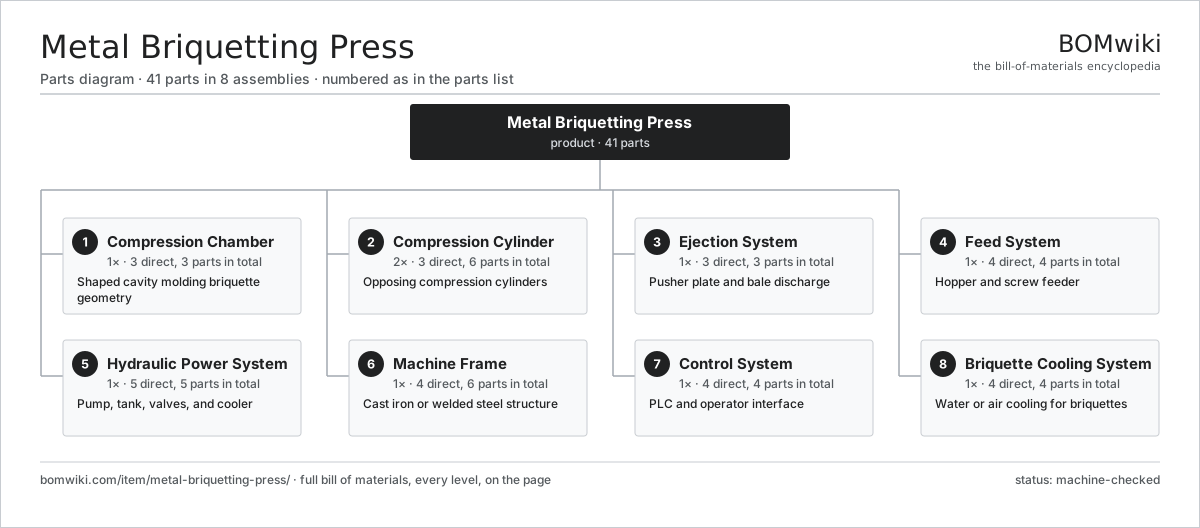
| # | Part | Qty | What it does |
|---|---|---|---|
| 1 | Compression Chamber 3 parts | 1× | Shaped cavity molding briquette geometry |
| 2 | Compression Cylinder 3 parts | 2× | Opposing compression cylinders |
| 3 | Ejection System 3 parts | 1× | Pusher plate and bale discharge |
| 4 | Feed System 4 parts | 1× | Hopper and screw feeder |
| 5 | Hydraulic Power System 5 parts | 1× | Pump, tank, valves, and cooler |
| 6 | Machine Frame 4 parts | 1× | Cast iron or welded steel structure |
| 7 | Control System 4 parts | 1× | PLC and operator interface |
| 8 | Briquette Cooling System 4 parts | 1× | Water or air cooling for briquettes |
3D model
No 3D model yet. Have a CAD file of this? Add a 3D model — STL renders right on this page; STEP, FreeCAD, and OpenSCAD sources are welcome too (openly licensed, like all 3D models on BOMwiki).
Build & assembly graph
expand / collapse · shared sub-assemblies converge · links to related products · est. labourTap an assembly to expand/collapse · tap a part to open it · use “Open page” for any node · drag to pan, scroll to zoom.
Bill of materials for Metal Briquetting Press
8 top-level lines · 38 rows shown · 41 parts total · indented to 3 levels| # | Item / sub-assembly | Part no. | Qty/assy | Ext. qty | Parts | Type |
|---|---|---|---|---|---|---|
| 1 | Compression Chamber 3 parts | metal-briquetting-press-compression-chamber | 1× | 1 | 3 | assembly |
| 1.1 | Die Block | metal-briquetting-press-die-block | 1× | 1 | · | part |
| 1.2 | Stripper Ring | metal-briquetting-press-stripper-ring | 1× | 1 | · | part |
| 1.3 | Chamber Seal Kit | metal-briquetting-press-chamber-seals | 1× | 1 | · | part |
| 2 | Compression Cylinder 3 parts | metal-briquetting-press-hydraulic-rams | 2× | 2 | 6 | assembly |
| 2.1 | Upper Compression Ram | metal-briquetting-press-upper-ram | 1× | 2 | · | part |
| 2.2 | Lower Compression Ram | metal-briquetting-press-lower-ram | 1× | 2 | · | part |
| 2.3 | Ram Rod Bearing | metal-briquetting-press-ram-bearing | 4× | 8 | · | part |
| 3 | Ejection System 3 parts | metal-briquetting-press-ejection-system | 1× | 1 | 3 | assembly |
| 3.1 | Stripper Ejection Cylinder | metal-briquetting-press-ejection-cylinder | 1× | 1 | · | part |
| 3.2 | Discharge Chute | metal-briquetting-press-discharge-chute | 1× | 1 | · | part |
| 3.3 | Brake Valve | metal-briquetting-press-brake-valve | 1× | 1 | · | part |
| 4 | Feed System 4 parts | metal-briquetting-press-feed-unit | 1× | 1 | 4 | assembly |
| 4.1 | Feed Hopper | metal-briquetting-press-feed-hopper | 1× | 1 | · | part |
| 4.2 | Feed Auger Screw | metal-briquetting-press-feed-screw | 1× | 1 | · | part |
| 4.3 | Auger Drive Motor | metal-briquetting-press-feed-motor | 1× | 1 | · | part |
| 4.4 | Hopper Level Sensor | metal-briquetting-press-feed-level-sensor | 1× | 1 | · | part |
| 5 | Hydraulic Power System 5 parts | metal-briquetting-press-hydraulic-power | 1× | 1 | 5 | assembly |
| 5.1 | Hydraulic Pump | metal-briquetting-press-hydraulic-pump | 1× | 1 | · | part |
| 5.2 | Pump Prime Mover | metal-briquetting-press-pump-motor | 1× | 1 | · | part |
| 5.3 | Hydraulic Tank | metal-briquetting-press-hydraulic-tank | 1× | 1 | · | part |
| 5.4 | Proportional Control Valve | metal-briquetting-press-proportional-valve | 1× | 1 | · | part |
| 5.5 | Relief Valve | metal-briquetting-press-relief-valve | 1× | 1 | · | part |
| 6 | Machine Frame 4 parts | metal-briquetting-press-frame | 1× | 1 | 6 | assembly |
| 6.1 | Frame Base | metal-briquetting-press-frame-base | 1× | 1 | · | part |
| 6.2 | Frame Upright | metal-briquetting-press-frame-uprights | 2× | 2 | · | part |
| 6.3 | Ram Guide Way | metal-briquetting-press-ram-guides | 2× | 2 | · | part |
| 6.4 | Fastener Set | fastener-set | 1× | 1 | · | part |
| 7 | Control System 4 parts | metal-briquetting-press-control-system | 1× | 1 | 4 | assembly |
| 7.1 | PLC Controller | metal-briquetting-press-plc | 1× | 1 | · | part |
| 7.2 | Proportional Valve Driver | metal-briquetting-press-proportional-driver | 1× | 1 | · | part |
| 7.3 | HMI Touchscreen | metal-briquetting-press-touchscreen-hmi | 1× | 1 | · | part |
| 7.4 | Safety Circuit | metal-briquetting-press-safety-circuit | 1× | 1 | · | part |
| 8 | Briquette Cooling System 4 parts | metal-briquetting-press-cooling-system | 1× | 1 | 4 | assembly |
| 8.1 | Cooling Chamber | metal-briquetting-press-cooling-chamber | 1× | 1 | · | part |
| 8.2 | Cooling Pump | metal-briquetting-press-cooling-pump | 1× | 1 | · | part |
| 8.3 | Cooling Heat Exchanger | metal-briquetting-press-cooling-heat-exchanger | 1× | 1 | · | part |
| 8.4 | Drain Hopper | metal-briquetting-press-drain-hopper | 1× | 1 | · | part |
Sourcing: possible vendors
Prices, MOQ, and lead times are algorithmic estimates, not quotes, and not claims about these companies. Company mappings are curated by keyword; est. price band $5k–$2M. How estimates work| Vendor | HQ | Specialty | MOQ | Lead time |
|---|---|---|---|---|
| atlascopco.com ↗ | Stockholm, SE | Compressors & industrial | 10 units | 12–20 wks |
|
🇦🇹Andritz
andritz.com ↗
|
Graz, AT | Process plants & machinery | 10 units | 12–20 wks |
| buhlergroup.com ↗ | Uzwil, CH | Food & materials processing | 10 units | 12–20 wks |
| gea.com ↗ | Düsseldorf, DE | Process technology | 10 units | 12–20 wks |
| mhi.com ↗ | Tokyo, JP | Heavy machinery | 10 units | 12–20 wks |
1,119-word article