Microcar
ProductOverview
The microcar is the minimum expression of personal automotive transportation: two seats, monocoque chassis, and enough power to stay out of traffic lanes on city streets. The formula emerged in the late 2010s as EV platforms and regulatory pressure collided. Modern microcars are electric-first (20–30 kW motor, 48–72 V lithium battery, 80–150 km range) though petrol cousins persist in markets where charging infrastructure is sparse. The design goal is urban commuting at 60–80 km/h with zero emissions, high maneuverability, and cost under USD 10,000 for base models.
Monocoque chassis and body
The Monocoque Chassis is a composite-plastic or welded-steel unibody: the floor carries drivetrain and battery; the side panels and roof are bonded or bolted on. No separate frame. The A-pillars are thickened for rollover resistance (mandatory at ~1.5g side load). The entire structure must meet European N1 microcar standards (~1600 kg GVW) or US "neighborhood electric vehicle" regulations (48 V max).
Crash stiffness is poor compared to a traditional car. Many microcars can be crushed if hit broadside by a full-size sedan. Some manufacturers double the side-impact padding with foam or deploy inflatable side curtains. The trade-off is accepted by users who rarely exceed city speeds; the risk is real in highway accidents.
Drivetrain options
EV models use a 20–30 kW brushless motor with a single-speed 10:1 reduction gearbox. The motor output shaft drives a open differential and both rear wheels (rear-drive layout is common). Acceleration is linear and instant: zero to 60 km/h in 6–8 seconds. Top speed is limited by aerodynamic drag (~0.35 Cd) and is typically 100–120 km/h.
Petrol models carry a 0.4–0.6 L turbocharged three-cylinder engine (~40 kW) with a manual five-speed gearbox. Power is modest; empty acceleration is brisk but loaded (two adults) feels sluggish. Turbos keep the displacement small, but under high load (full throttle on a hot day) knock and detonation occur, requiring premium fuel or a knock sensor with spark retard.
Battery and charging (EV)
The 48–72 V lithium-ion pack is mounted under the floor. A 48 V system (four cells in series) is cheaper and safer for DIY conversion; 72 V (six cells) offers 30% more power. Typical capacity is 10–20 kWh, giving 80–150 km range on flat pavement at constant 60 km/h. City driving with stops reduces range 20–30% due to regen braking losses and city traffic patterns.
The Onboard Charger converts 220 V AC mains to DC charging at 3–6 kW. Overnight (8 hours) achieves full state-of-charge; a 240 V home charger halves the time. DC fast-charging (CCS, 50 kW) is rare on budget microcars; most users live within 30 km of work.
Battery degradation is 2–3% per year. After 10 years, range falls to 70–80% of new. Warranty is typically 8 years / 160,000 km. Replacement cost is USD 5,000–8,000.
Steering and suspension
The Steering Column is a simple collapsible tube with a compact 320 mm wheel and rack-and-pinion geometry (not shown as a part, but understood). Effort is light at all speeds because the motor is small and low-mass.
Suspension is cost-engineered for comfort: independent MacPherson struts in front with 80–100 mm travel, and a non-independent torsion-beam axle in rear with 40–60 mm travel. Bump-steer and toe-change are not optimized; the ride is soft and wavey on broken pavement. Handling at speed (>80 km/h) in tight curves shows body roll and understeer.
Brakes
The Brake System is hydraulic dual-circuit: front discs for initial bite, rear drums for low-cost service life and parking brake. Pedal effort is light (power assist is rare on microcars this size). Stopping distance from 60 km/h is 25–30 m on dry pavement. ABS is absent on base models.
EV models add regenerative braking: lifting off the throttle triggers the motor to act as a generator, recovering 10–20% of kinetic energy back to the battery. This extends range and reduces pad wear; on downhill descents, regen can be the only braking force needed.
Electrics and instruments
EV models run 48–72 V throughout; petrol models use 12 V. The instrument cluster is minimal: speed, estimated range (EV) or fuel level (petrol), and basic warning lights. No infotainment; some models accept a phone mount on the dashboard.
Failure modes and service
EV microcars are durable if used within design envelope. Common failures:
- Battery: internal shorts after 300+ charge cycles at fast-charge rates.
- Motor controller: junction overheat if operating at continuous full load.
- Suspension bushings: wear quickly on rough roads, causing creaks and increased slop.
- Windscreen: stress cracks from A-pillar deflection in small impacts.
- Door seals: water ingress after 2–3 years of weather exposure.
Petrol microcars suffer conventional small-engine wear: piston blow-by, valve carbon, turbo bearing clearance. Routine maintenance is simpler than EVs (no battery monitoring, no controller calibration) but parts sourcing is harder after 10 years.
Typical service cost is USD 400–600/year for EV (brake fluid, cabin filter, software updates), USD 600–800/year for petrol (oil changes, tune-up). Battery degradation is the only major EV cost; replacement at 8–10 years is common. Petrol engine rebuild is comparable.
Most microcars remain in use 10–15 years before scrap, partly because low purchase price means owners tolerate high repair costs. EV models are scrapped or converted to stationary power banks when battery capacity falls below 70%.
Microcar parts and their functions
8 top-level parts · 91 parts in total · full bill of materials below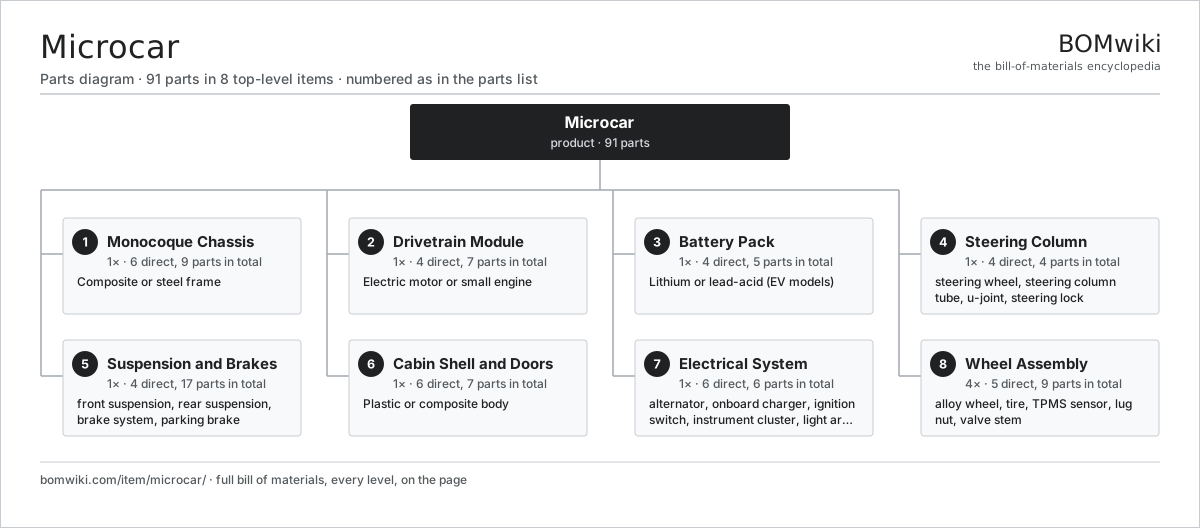
| # | Part | Qty | What it does |
|---|---|---|---|
| 1 | Monocoque Chassis 6 parts | 1× | Composite or steel frame |
| 2 | Drivetrain Module 4 parts | 1× | Electric motor or small engine |
| 3 | Battery Pack 4 parts | 1× | Lithium or lead-acid (EV models) |
| 4 | Steering Column 4 parts | 1× | Collapsible tube carrying steering input from the wheel to the pinion on the rack-and-pinion mechanism. |
| 5 | Suspension and Brakes 4 parts | 1× | Torsion-beam rear and independent struts in front with small drum or disc brakes and cable-operated parking brake. |
| 6 | Cabin Shell and Doors 6 parts | 1× | Plastic or composite body |
| 7 | Electrical System 6 parts | 1× | 12 V (petrol) or 48–72 V (EV) power distribution, charging, lights, and instruments. |
| 8 | Wheel Assembly 5 parts | 4× | Complete road wheel: rim, tyre, valve, pressure sensor, and fasteners, balanced and ready to bolt onto the hub. |
3D model
No 3D model yet. Have a CAD file of this? Add a 3D model. STL renders right on this page; STEP, FreeCAD, and OpenSCAD sources are welcome too (openly licensed, like all 3D models on BOMwiki).
Build & assembly graph
expand / collapse · shared sub-assemblies converge · links to related products · est. labourTap an assembly to expand/collapse · tap a part to open it · use “Open page” for any node · drag to pan, scroll to zoom.
Bill of materials for Microcar
8 top-level lines · 59 rows shown · 91 parts total · indented to 3 levels| # | Item / sub-assembly | Part no. | Qty/assy | Ext. qty | Parts | Type |
|---|---|---|---|---|---|---|
| 1 | Monocoque Chassis 6 parts | microcar-monocoque-chassis | 1× | 1 | 9 | assembly |
| 1.1 | Floor Pan | microcar-floor-pan | 1× | 1 | · | part |
| 1.2 | Side Panel | microcar-side-panels | 2× | 2 | · | part |
| 1.3 | Roof Panel | microcar-roof-panel | 1× | 1 | · | part |
| 1.4 | Door Frame | microcar-door-frames | 2× | 2 | · | part |
| 1.5 | Windscreen Pillar | microcar-windscreen-pillar | 2× | 2 | · | part |
| 1.6 | Fastener Set | fastener-set | 1× | 1 | · | part |
| 2 | Drivetrain Module 4 parts | microcar-drivetrain-module | 1× | 1 | 7 | assembly |
| 2.1 | Propulsion Source 4 parts | microcar-propulsion-source | 1× | 1 | 4 | assembly |
| 2.1.1 | Cylinder Head | microcar-cylinder-head | 1× | 1 | · | part |
| 2.1.2 | Fuel Injector | microcar-fuel-injector | 1× | 1 | · | part |
| 2.1.3 | Motor Winding | microcar-electric-motor-winding | 1× | 1 | · | part |
| 2.1.4 | Coil Spring | coil-spring | 1× | 1 | · | part |
| 2.2 | Gearbox | microcar-gearbox | 1× | 1 | · | part |
| 2.3 | Cooling System | microcar-cooling-system | 1× | 1 | · | part |
| 2.4 | Motor Controller | microcar-motor-controller | 1× | 1 | · | part |
| 3 | Battery Pack 4 parts | microcar-battery-pack | 1× | 1 | 5 | assembly |
| 3.1 | Battery Cells | microcar-battery-cells | 1× | 1 | · | part |
| 3.2 | BMS Board | bms-board | 1× | 1 | · | part |
| 3.3 | Battery Contactor | microcar-battery-contactor | 1× | 1 | · | part |
| 3.4 | Thermal Fuse | thermal-fuse | 2× | 2 | · | part |
| 4 | Steering Column 4 parts | microcar-steering-column | 1× | 1 | 4 | assembly |
| 4.1 | Steering Wheel | microcar-steering-wheel | 1× | 1 | · | part |
| 4.2 | Steering Column Tube | microcar-column-tube | 1× | 1 | · | part |
| 4.3 | U-Joint | microcar-universal-joint | 1× | 1 | · | part |
| 4.4 | Steering Lock | microcar-steering-lock | 1× | 1 | · | part |
| 5 | Suspension and Brakes 4 parts | microcar-suspension-system | 1× | 1 | 17 | assembly |
| 5.1 | Front Suspension 3 parts | microcar-front-suspension | 1× | 1 | 8 | assembly |
| 5.1.1 | MacPherson Strut | microcar-strut-assembly | 2× | 2 | · | part |
| 5.1.2 | Coil Spring | coil-spring | 2× | 2 | · | part |
| 5.1.3 | Ball Bearing | ball-bearing | 4× | 4 | · | part |
| 5.2 | Rear Suspension | microcar-rear-suspension | 1× | 1 | · | part |
| 5.3 | Brake System 5 parts | microcar-brake-system | 1× | 1 | 7 | assembly |
| 5.3.1 | Master Cylinder | microcar-master-cylinder | 1× | 1 | · | part |
| 5.3.2 | Front Disc Brake | microcar-front-disc-brake | 2× | 2 | · | part |
| 5.3.3 | Rear Drum Brake | microcar-rear-drum-brake | 2× | 2 | · | part |
| 5.3.4 | Brake Fluid Reservoir | microcar-brake-fluid-reservoir | 1× | 1 | · | part |
| 5.3.5 | Brake Hoses | microcar-brake-hoses | 1× | 1 | · | part |
| 5.4 | Parking Brake | microcar-parking-brake | 1× | 1 | · | part |
| 6 | Cabin Shell and Doors 6 parts | microcar-cabin-shell | 1× | 1 | 7 | assembly |
| 6.1 | Bonnet Panel | microcar-bonnet-panel | 1× | 1 | · | part |
| 6.2 | Tailgate | microcar-tailgate-panel | 1× | 1 | · | part |
| 6.3 | Front Bumper | microcar-bumper-front | 1× | 1 | · | part |
| 6.4 | Rear Bumper | microcar-bumper-rear | 1× | 1 | · | part |
| 6.5 | Windscreen | microcar-windscreen | 1× | 1 | · | part |
| 6.6 | Side Mirror | microcar-mirror-asm | 2× | 2 | · | part |
| 7 | Electrical System 6 parts | microcar-electrical-system | 1× | 1 | 6 | assembly |
| 7.1 | Alternator | microcar-alternator | 1× | 1 | · | part |
| 7.2 | Onboard Charger | microcar-onboard-charger | 1× | 1 | · | part |
| 7.3 | Ignition Switch | microcar-ignition-switch | 1× | 1 | · | part |
| 7.4 | Instrument Cluster | microcar-instrument-cluster | 1× | 1 | · | part |
| 7.5 | Light Array | microcar-light-array | 1× | 1 | · | part |
| 7.6 | Wire Bundle | wire-bundle | 1× | 1 | · | part |
| 8 | Wheel Assembly 5 parts | wheel-assembly | 4× | 4 | 9 | assembly |
| 8.1 | Alloy Wheel | alloy-wheel | 1× | 4 | · | part |
| 8.2 | Tire | tire | 1× | 4 | · | part |
| 8.3 | TPMS Sensor | tpms-sensor | 1× | 4 | · | part |
| 8.4 | Lug Nut | lug-nut | 5× | 20 | · | part |
| 8.5 | Valve Stem | valve-stem | 1× | 4 | · | part |
Something wrong in this list? Report a problem with this BOM.
Related products
same domain, ranked by shared parts Formula-Style Race Car
269 parts · shares 1 with this page
Formula-Style Race Car
269 parts · shares 1 with this page
 Food Truck
197 parts · shares 8 with this page
Food Truck
197 parts · shares 8 with this page
 Ice Cream Truck
88 parts · shares 7 with this page
Ice Cream Truck
88 parts · shares 7 with this page
 Ambulance
793 parts · shares 7 with this page
Ambulance
793 parts · shares 7 with this page
 Auto Rickshaw
175 parts · shares 7 with this page
Auto Rickshaw
175 parts · shares 7 with this page
 Convertible Car
1,727 parts · shares 7 with this page
Convertible Car
1,727 parts · shares 7 with this page
Sourcing: possible vendors
Browse the supplier directory → Prices, MOQ, and lead times are algorithmic estimates, not quotes, and not claims about these companies. Company mappings are curated by keyword; est. price band $8k–$90k. How estimates work| Vendor | HQ | Specialty | MOQ | Lead time |
|---|---|---|---|---|
|
🇯🇵Toyota
global.toyota ↗
|
Toyota City, JP | Automaker | made to order | 16–28 wks |
| volkswagen-group.com ↗ | Wolfsburg, DE | Automaker | made to order | 16–28 wks |
| gm.com ↗ | Detroit, US | Automaker | made to order | 16–28 wks |
| hyundai.com ↗ | Seoul, KR | Automaker | made to order | 16–28 wks |
|
🇨🇳BYD
byd.com ↗
|
Shenzhen, CN | EV & battery manufacturer | made to order | 16–28 wks |
998-word article