Microprocessor Prosthetic Knee
ProductOverview
Microprocessor-controlled prosthetic knees represent a major advance in lower-limb prosthetics, replacing passive mechanical damping with real-time electronic adjustment of flexion and extension resistance. These devices use sensor feedback from the Sensor Suite (inertial and angular measurements) to detect gait phase in real time, allowing the Control Electronics Module to modulate the Knee Joint Assembly damping valve fifty times per second or more.
The defining feature is adaptive damping: during walking, the knee joint stiffness automatically increases during loading response (foot contact) to prevent stumbling and buckle collapse, then relaxes during swing to allow natural knee flexion. This eliminates the "locked-knee" gait required by passive prostheses and reduces cognitive burden on the user, enabling more natural walking speed and stride length. Microprocessor knees have been shown to reduce fall risk and improve confidence, particularly on stairs and slopes.
How it works
When the wearer takes a step, the Inertial Measurement Unit inside the prosthesis detects the impact and acceleration profile. The Main Control PCB running embedded C firmware classifies this as either loading response (initial contact, 0–10% gait cycle), mid-stance (10–30%), or swing (60–100%). During loading response, the processor sends a high PWM signal to the Solenoid Driver Module, which energizes the Electronically Modulated Damping Valve, closing the hydraulic orifice and stiffening the knee. This prevents the knee from folding under body weight. As the wearer's weight transfers to the front leg, the knee signal relaxes into a lower damping state, allowing natural flexion during swing. The Damping Fluid (ISO VG 46 mineral oil or magnetorheological suspension) moves through the restricted orifice, creating viscous resistance that damps high swing speeds but allows smooth motion at lower speeds.
The Power Management System comprises two Li-ion Cell, 18650 cells in parallel, regulated by a Battery Management System that monitors cell voltage and temperature, and a DC-DC Converter Module that steps down 7.4 V nominal voltage to 3.3 V for sensors and 5 V for the solenoid driver. A typical daily charge cycle lasts 3–5 days of continuous walking; the Charging Interface uses sealed USB-C to prevent water ingress.
Walking speed detection happens automatically: as cadence increases, swing time decreases, and the Proportional Control Law (lookup tables in flash memory) automatically steepens the damping curve to prevent "toe catches" at high speeds. This speed adaptation is one of the key usability improvements over passive prostheses.
Sensor Fusion and Gait State Machine
The Gait Phase Detector runs a finite state machine that looks at the raw Inertial Measurement Unit and Digital Inclinometer signals to determine which part of the gait cycle is underway. This is the real-time classification problem: transitions between swing and stance must be detected within 50 milliseconds or the user feels instability. The standard approach uses a combination of knee angle (from inclinometer), angular velocity (from gyroscope), and vertical acceleration (from accelerometer Z-axis) to identify key events: initial contact (sharp vertical spike), loading response (knee flexion + low velocity), mid-stance (near-full extension + low velocity), and swing (rapid flexion + high velocity). False detections are filtered using cadence estimation and hysteresis.
Hydraulic vs. Magnetorheological Damping
Traditional microprocessor knees use Damping Fluid (mineral oil) in a fixed-orifice design, where the Solenoid Driver Module modulates orifice flow area by energizing a proportional valve. This approach is robust and proven but requires continuous solenoid current during walking, consuming ~80 mA from the battery. Modern devices increasingly switch to magnetorheological (MR) fluid, a suspension of iron particles in oil that stiffens in proportion to applied magnetic field. MR damping is faster (no mechanical orifice lag), more responsive, and can use passive damping when powered off, but the fluid is more expensive and the solenoid coil dissipates more heat.
Wireless Telemetry and Patient App
The Bluetooth Module (typically Nordic nRF52 or similar) broadcasts telemetry over Bluetooth Low Energy: walking cadence, stumble events (rapid unplanned knee flexion), battery state, and fluid temperature. Patient mobile apps display this data and alert users to imminent battery discharge. Clinicians upload firmware updates over-the-air via USB or Bluetooth, allowing tuning of Proportional Control Law parameters (damping curve slopes, transition thresholds) without disassembly.
Maintenance and Lifespan
The sealed Knee Joint Assembly and pressure-relieved Fluid Accumulator are designed for 1–3 million walking cycles (roughly 3–5 years of typical use). The Damping Fluid does not require replacement in normal service; the main consumables are the Battery Management System battery cells (replaced every 2–3 years) and occasional O-Ring Set seal renewal if leakage occurs. Warranty typically covers manufacturer defects but not damage from falls or submersion beyond rated IP67 depth.
Microprocessor Prosthetic Knee parts and their functions
7 top-level parts · 32 parts in total · full bill of materials below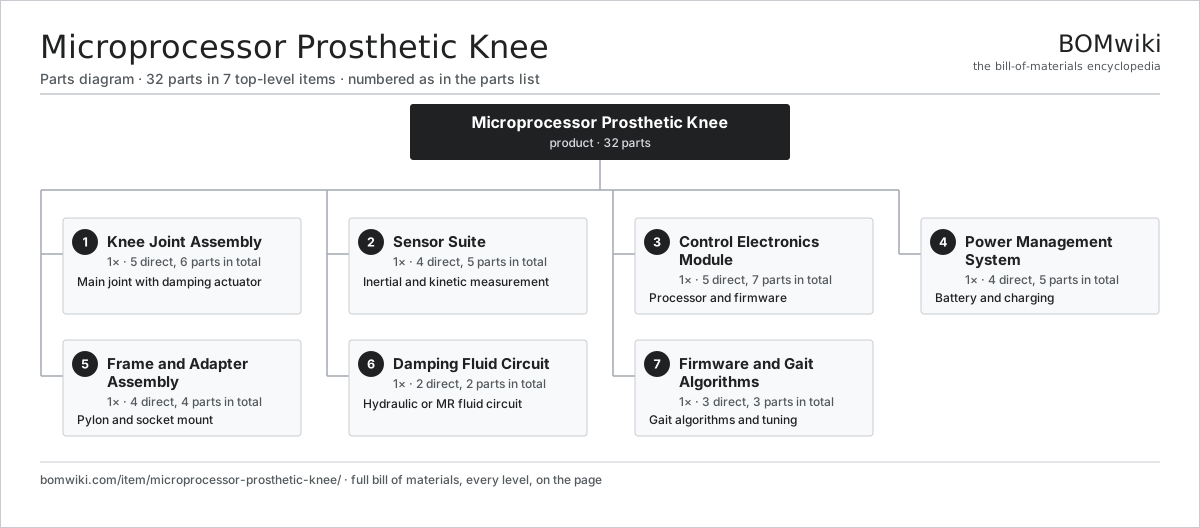
| # | Part | Qty | What it does |
|---|---|---|---|
| 1 | Knee Joint Assembly 5 parts | 1× | Main joint with damping actuator |
| 2 | Sensor Suite 4 parts | 1× | Inertial and kinetic measurement |
| 3 | Control Electronics Module 5 parts | 1× | Processor and firmware |
| 4 | Power Management System 4 parts | 1× | Battery and charging |
| 5 | Frame and Adapter Assembly 4 parts | 1× | Pylon and socket mount |
| 6 | Damping Fluid Circuit 2 parts | 1× | Hydraulic or MR fluid circuit |
| 7 | Firmware and Gait Algorithms 3 parts | 1× | Gait algorithms and tuning |
3D model
No 3D model yet. Have a CAD file of this? Add a 3D model. STL renders right on this page; STEP, FreeCAD, and OpenSCAD sources are welcome too (openly licensed, like all 3D models on BOMwiki).
Build & assembly graph
expand / collapse · shared sub-assemblies converge · links to related products · est. labourTap an assembly to expand/collapse · tap a part to open it · use “Open page” for any node · drag to pan, scroll to zoom.
Bill of materials for Microprocessor Prosthetic Knee
7 top-level lines · 34 rows shown · 32 parts total · indented to 3 levels| # | Item / sub-assembly | Part no. | Qty/assy | Ext. qty | Parts | Type |
|---|---|---|---|---|---|---|
| 1 | Knee Joint Assembly 5 parts | microprocessor-prosthetic-knee-knee-joint | 1× | 1 | 6 | assembly |
| 1.1 | Joint Housing | microprocessor-prosthetic-knee-joint-body | 1× | 1 | · | part |
| 1.2 | Electronically Modulated Damping Valve | microprocessor-prosthetic-knee-damping-valve | 1× | 1 | · | part |
| 1.3 | Hydraulic Piston | microprocessor-prosthetic-knee-piston-assembly | 1× | 1 | · | part |
| 1.4 | O-Ring Set | oring-set | 2× | 2 | · | part |
| 1.5 | Knee Pivot Bearings | microprocessor-prosthetic-knee-bearing-set | 1× | 1 | · | part |
| 2 | Sensor Suite 4 parts | microprocessor-prosthetic-knee-sensor-suite | 1× | 1 | 5 | assembly |
| 2.1 | Inertial Measurement Unit | microprocessor-prosthetic-knee-imu | 1× | 1 | · | part |
| 2.2 | Digital Inclinometer | microprocessor-prosthetic-knee-inclinometer | 1× | 1 | · | part |
| 2.3 | Sensor Interface PCB | microprocessor-prosthetic-knee-sensor-pcb | 1× | 1 | · | part |
| 2.4 | Connector | connector | 2× | 2 | · | part |
| 3 | Control Electronics Module 5 parts | microprocessor-prosthetic-knee-control-electronics | 1× | 1 | 7 | assembly |
| 3.1 | Main Control PCB | microprocessor-prosthetic-knee-main-pcb | 1× | 1 | · | part |
| 3.2 | Solenoid Driver Module | microprocessor-prosthetic-knee-solenoid-driver | 1× | 1 | · | part |
| 3.3 | Bluetooth Module | microprocessor-prosthetic-knee-wireless-module | 1× | 1 | · | part |
| 3.4 | Flash Memory | microprocessor-prosthetic-knee-flash-memory | 1× | 1 | · | part |
| 3.5 | SMD Passive (R/C/L) | smd-passives | 3× | 3 | · | part |
| 4 | Power Management System 4 parts | microprocessor-prosthetic-knee-power-system | 1× | 1 | 5 | assembly |
| 4.1 | Li-ion Cell, 18650 | li-cell-18650 | 2× | 2 | · | part |
| 4.2 | Battery Management System | microprocessor-prosthetic-knee-bms | 1× | 1 | · | part |
| 4.3 | Charging Interface | microprocessor-prosthetic-knee-charger-interface | 1× | 1 | · | part |
| 4.4 | DC-DC Converter Module | microprocessor-prosthetic-knee-dcdc-converter | 1× | 1 | · | part |
| 5 | Frame and Adapter Assembly 4 parts | microprocessor-prosthetic-knee-frame-adapter | 1× | 1 | 4 | assembly |
| 5.1 | Pylon Tube | microprocessor-prosthetic-knee-pylon-tube | 1× | 1 | · | part |
| 5.2 | Socket Block | microprocessor-prosthetic-knee-socket-block | 1× | 1 | · | part |
| 5.3 | Foot Module Adapter | microprocessor-prosthetic-knee-foot-adapter | 1× | 1 | · | part |
| 5.4 | Fastener Set | fastener-set | 1× | 1 | · | part |
| 6 | Damping Fluid Circuit 2 parts | microprocessor-prosthetic-knee-structural-damper | 1× | 1 | 2 | assembly |
| 6.1 | Damping Fluid | microprocessor-prosthetic-knee-damping-fluid | 1× | 1 | · | part |
| 6.2 | Fluid Accumulator | microprocessor-prosthetic-knee-accumulator | 1× | 1 | · | part |
| 7 | Firmware and Gait Algorithms 3 parts | microprocessor-prosthetic-knee-firmware-config | 1× | 1 | 3 | assembly |
| 7.1 | Gait Phase Detector | microprocessor-prosthetic-knee-phase-detector | 1× | 1 | · | part |
| 7.2 | Proportional Control Law | microprocessor-prosthetic-knee-control-law | 1× | 1 | · | part |
| 7.3 | Telemetry and Logging | microprocessor-prosthetic-knee-telemetry-stack | 1× | 1 | · | part |
Something wrong in this list? Report a problem with this BOM.
Related products
same domain, ranked by shared parts Blood Pressure Monitor
173 parts · shares 2 with this page
Blood Pressure Monitor
173 parts · shares 2 with this page
 Infusion Pump
341 parts · shares 2 with this page
Infusion Pump
341 parts · shares 2 with this page
 Medical Ventilator
612 parts · shares 2 with this page
Orthopedic Cast Saw
73 parts · shares 2 with this page
Medical Ventilator
612 parts · shares 2 with this page
Orthopedic Cast Saw
73 parts · shares 2 with this page
 Surgical Power Drill
144 parts · shares 2 with this page
Surgical Power Drill
144 parts · shares 2 with this page
Sourcing: possible vendors
Browse the supplier directory → Prices, MOQ, and lead times are algorithmic estimates, not quotes, and not claims about these companies. Company mappings are curated by keyword; est. price band $500–$3M. How estimates work| Vendor | HQ | Specialty | MOQ | Lead time |
|---|---|---|---|---|
| gehealthcare.com ↗ | Chicago, US | Medical imaging & devices | 100 units | 12–20 wks |
| siemens-healthineers.com ↗ | Erlangen, DE | Medical systems | 100 units | 12–20 wks |
|
🇳🇱Philips
philips.com ↗
|
Amsterdam, NL | Health technology | 100 units | 12–20 wks |
| medtronic.com ↗ | Minneapolis, US | Medical devices | 100 units | 12–20 wks |
|
🇨🇳Mindray
mindray.com ↗
|
Shenzhen, CN | Medical devices | 100 units | 12–20 wks |
825-word article